
Newcastle is Sydney’s closest capital-adjacent escape, close enough to feel like a half-day drive and far enough to feel like a proper trip. Two hours by car, under three by train, and a short hop by air if you’d rather skip the road altogether. Whichever way you go, you land somewhere with real beaches, a working harbour, and none of Sydney’s traffic once you get there. This guide covers every practical option for 2026, from the exact speed camera stretches to watch for on the M1, to which airline actually flies this route now that Rex has pulled out, to what the Greyhound coach is really like on a Friday night.
| Mode | Time | Typical Cost | Best For |
|---|---|---|---|
| Car (M1 direct) | 2h 5min (163km) | Fuel + tolls ~$35-45 | Flexibility, luggage, side trips |
| Car (scenic coastal route) | 2h 55min (167km) | Fuel, minimal tolls | A slower, prettier drive via the Central Coast |
| Train (CCN Line, Opal) | ~2h 40min-3h | ~$7-9 Opal fare | Budget travel, no booking needed |
| Train (Regional, booked) | ~2h 50min-4h30min | From ~$22 Economy, ~$28+ First Class | Guaranteed seat or First Class comfort |
| Bus (Greyhound) | ~2h 20min | From $41 | Cheapest door-to-door option |
| Plane (FlyPelican) | 40min flight | From $119 | Time-poor travellers connecting onward |
Who It Suits – Why Newcastle?
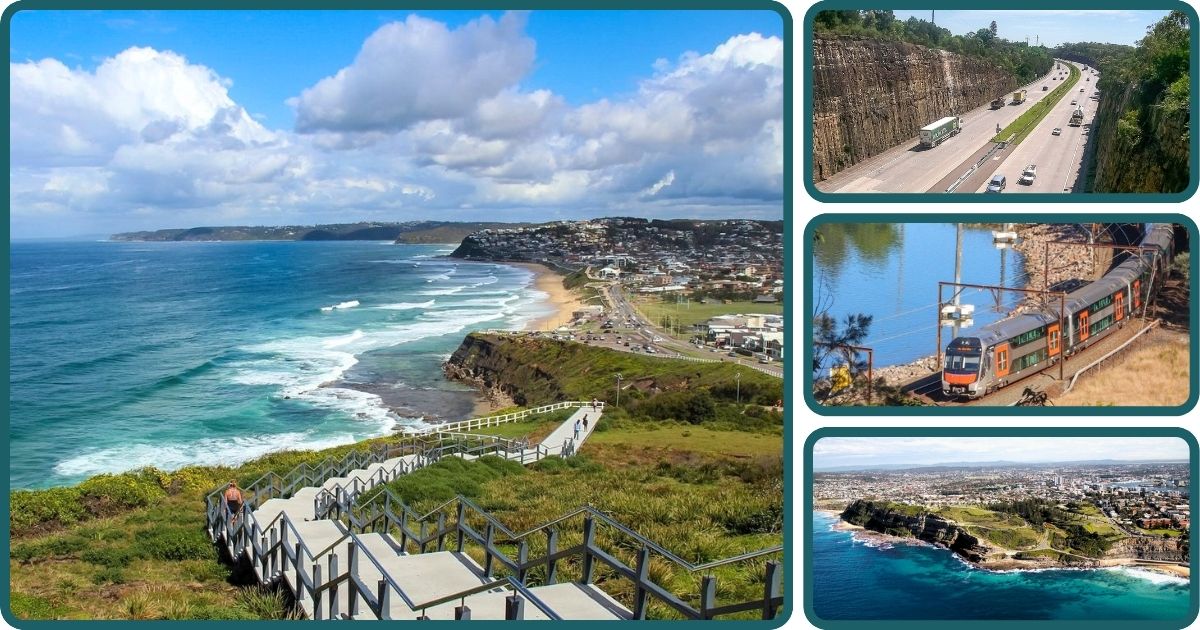
Newcastle works for almost anyone leaving Sydney: surfers chasing Merewether and Bar Beach, wine lovers detouring into the Hunter Valley on the way up, families wanting a beach weekend without the Sydney price tag, and anyone who just wants a real city with a working harbour instead of a purely touristy strip.
If you’re driving, the coastal route via Gosford and the Central Coast makes a good day of it rather than just a way to get somewhere. If you’re short on time or hate driving, the train is the easy default, and the plane only really earns its keep if you’re connecting onward or simply value your time more than the fare difference.
Sydney to Newcastle by Car
There are two different ways to drive this route, and which one you pick changes the trip completely.
The Direct Route (M1 Pacific Motorway)
The fast option: straight up the M1 Pacific Motorway, about 2 hours 5 minutes for 163km in normal traffic. This is the route to take if the destination matters more than the journey, or if you’re driving up on a Friday evening and just want to get there before dinner.
The Scenic Route (via Gosford, Norah Head and Swansea)
The slower, prettier option follows the old Pacific Highway alignment through the Central Coast: Gosford, then out towards Norah Head with its heritage lighthouse and coastal walking track, down through The Entrance for fish and chips by the lake, and along the coast past Swansea and Lake Macquarie before crossing into Newcastle. It’s around 2 hours 55 minutes for 167km, so barely any longer in distance but meaningfully slower given the number of towns you pass through. Norah Head Lighthouse and the surrounding heathland walk are worth the short detour if you’ve got an extra 30-40 minutes, and Swansea Channel is a good stretch-the-legs stop with cafes right on the water.
Road Rules, Speed Cameras and Enforcement
- The M1 Pacific Motorway is patrolled with mobile and fixed speed cameras along multiple stretches; NSW Police also run regular double-demerit enforcement periods around long weekends and school holidays.
- Speed limits along the M1 run mostly at 110km/h with sections dropping to 100km/h approaching interchanges, so watch signage closely as you come into the Central Coast and Hunter exits.
- The scenic route through Central Coast townships has a mix of 50-80km/h zones, several school zones (enforced 40km/h during term time on weekday mornings and afternoons), and pedestrian-heavy strips around Gosford, The Entrance and Swansea where police presence is common on weekends.
- If you’re continuing north past Newcastle towards Port Stephens or the Hunter, the new M1 extension to Raymond Terrace opened well ahead of its original 2028 schedule and has removed a major bottleneck through Heatherbrae and Raymond Terrace, cutting several minutes off peak-period trips in that stretch. It doesn’t affect the Sydney-to-Newcastle leg directly, but it’s worth knowing about if your trip continues north.
Known Hazards and What Locals Know
- Friday afternoon and Sunday evening are the worst times on the M1, with Sydney weekenders and Novocastrians commuting both directions creating stop-start traffic around the M1/Hunter Expressway merge.
- Fog is common on the Central Coast and Hunter sections in winter mornings, particularly around Ourimbah and the Mooney Mooney Bridge approach; slow down and use headlights rather than hazards.
- The scenic coastal route has narrower, slower sections through town centres where locals know to expect delays around school pick-up/drop-off times (roughly 3-3:30pm weekdays).
- If you want a proper stopover rather than a straight run, the Hunter Valley wine region is a short detour off the direct route near Cessnock, and Lake Macquarie on the scenic route has plenty of lakeside accommodation if you want to break the trip into two easier legs.
Breakdown Cover and Rental Vehicles
NRMA covers the whole route and most of the Hunter region; if you’re renting from an interstate club, check reciprocal roadside assistance arrangements before you leave, as coverage details and call-out limits vary. Major rental companies (Hertz, Avis, Budget, Europcar) all operate depots in both Sydney and Newcastle, so one-way rentals are straightforward, though expect a relocation or one-way fee on top of the standard rate. If you’re planning to continue further north into the Hunter or up towards Port Stephens, confirm your rental agreement covers unsealed or regional roads if you’re heading off the highway.
Driving With Kids
The direct M1 route is short enough that most kids handle it without a proper break, but if you’ve got younger children, the scenic route turns the drive itself into part of the holiday: Norah Head Lighthouse for a leg-stretch and a short easy walk, The Entrance for fish and chips and the pelican feeding (usually mid-morning, check current times locally), and several playgrounds right on the water around Swansea and Lake Macquarie. Either way, pack snacks and entertainment for the M1 option since there are limited service-centre stops between Sydney and the Newcastle exits.
Sydney to Newcastle by Train
There are actually two different train products on this route, and it’s worth knowing the difference before you book. The Central Coast & Newcastle Line (CCN) is the everyday Opal service: no booking required, just tap on with Opal or a contactless card, with fares generally landing around $7-9 for an adult single depending on time of day. It’s a turn-up-and-go service running regularly throughout the day, with journeys typically taking around 2 hours 40 minutes to just under 3 hours.
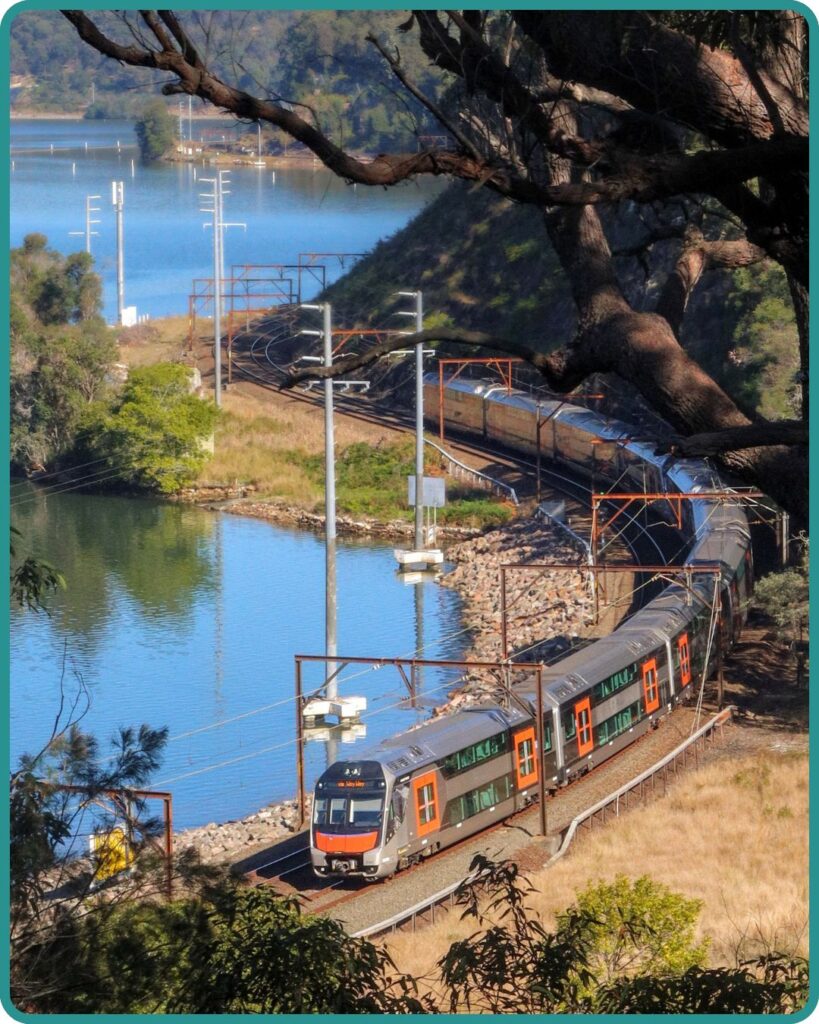
The CCN Opal service now runs on the newer Mariyung intercity fleet, and it’s a real step up from the older carriages it replaced: wheelchair-accessible spaces, power and USB sockets at seats, proper luggage racks, fully accessible toilets, fold-down tray tables, and digital displays showing your carriage number and what’s coming up. The one downside that many note is that the seats aren’t reversible, so you may end up facing backwards for part of the trip depending on where you sit.
Separately, NSW TrainLink also sells this route as a bookable Regional service, with reserved Economy and First Class fares (Economy typically from around $22, First Class from around $28-36 depending on the specific departure). These regional services run at set times through the day and vary more in duration than the CCN service, anywhere from around 2 hours 50 minutes on the fastest departures up to 4.5 hours if the service you pick makes more stops. If you want a guaranteed seat, First Class comforts, or you’re travelling at a specific time and want it locked in ahead, book the Regional service; if you’re happy to tap on and go with Opal and take whatever seat’s available, the CCN service is simpler and cheaper. Note that these regional services use the Xplorer trains designed for longer journeys, not the Mariyung trains, which are designed for intercity travel.
Check transportnsw.info for exact current fares and timetables for both before you travel, since prices and schedules are periodically adjusted.
The scenery is a real highlight and one of the most scenic train journeys out of Sydney: the line crosses the Hawkesbury River near Brooklyn, skirting Berowra Valley and Ku-ring-gai Chase National Park with houses visible along the water that have no road access at all. Keep an eye out for Wondabyne, a genuine hidden gem and possibly Australia’s most unusual station: it has no road, no car park, and no path in or out, just a wharf and a bushwalking trailhead, reachable only by train or boat. It’s request-stop only, but even spotting it from the window is a nice moment. After that the line heads into the Central Coast before the final run up to Newcastle. On-time running has historically hovered in the mid-to-high 80% range, so build in a little buffer if you have a tight connection at the other end, and if you’d rather skip the standing-room commuter crowd, aim for a mid-morning or early-afternoon service rather than peak hour or book the regional service and pay a little more.
One thing worth knowing before you arrive: Newcastle Interchange isn’t the old city-centre station some travellers remember. Since the line into central Newcastle was truncated in 2017, trains now terminate at the Interchange in Wickham, from where it’s an easy walk to the Honeysuckle harbourside precinct and the foreshore, or you can hop on the connecting light rail (a tram, not a train) which continues on through Civic and out towards the city beaches. It’s a small adjustment if you remember Newcastle’s old main station, but it works well in practice and puts you within walking distance of the harbour either way.
Train With Kids
This is one of the easier train trips for families: no booking required, kids travel free or heavily discounted under the Opal child fare structure, and the journey length is short enough that most children manage it without restlessness. The Mariyung fleet’s accessible toilets and generous luggage space make travelling with prams and gear noticeably easier than on the older trains, and the Hawkesbury River and Wondabyne stretch gives younger kids something to look out for the window for. Newcastle Interchange is an easy walk to the harbour foreshore, with the light rail on hand for the beaches further along, so onward travel with luggage and kids in tow is straightforward.
Sydney to Newcastle by Bus
Greyhound runs the Sydney-Newcastle route with fares starting from $41 one way, journey time around 2 hours 20 minutes, which makes it faster than the train on paper. Coaches depart from Central Station’s coach bays in Haymarket and arrive at Newcastle Interchange on Hunter Street in Newcastle West, an easy walk from the Honeysuckle harbourside precinct.
The service typically runs a couple of times a day rather than continuously, so check current departure times before planning around it, particularly for evening travel. Coaches have onboard toilets, air conditioning, and free WiFi on most services, and it’s the cheapest door-to-door option of the four. As with any coach service, expect the usual niggles reported by regular travellers: variable legroom depending on where you’re seated, occasional noisy groups on evening services, and less personal space than the train given the narrower seat pitch. Bring your own snacks and a jacket, since coach air conditioning tends to run cold.
Bus With Kids
At just over two hours with no scheduled break, this is manageable for most kids without needing a stop, but it’s worth packing headphones and entertainment since there’s no guaranteed break to let them stretch their legs. Honestly, younger children may do better on the train, which has more room to move around.
Sydney to Newcastle by Plane
One important update for 2026: Rex no longer flies this route (Rex exited capital-city jet services in 2024 after entering administration, and never operated this specific sector at scale). QantasLink’s current Newcastle network covers Perth, Adelaide, Brisbane and Melbourne, but not Sydney. The Sydney-Newcastle route is now flown by FlyPelican, a small regional turboprop carrier, with fares starting from around $119 one way and a flight time of just 40 minutes, departing from Sydney Airport’s Terminal 2. Given the short distance, flights aren’t as frequent as a major-carrier route, so check FlyPelican’s current schedule directly before building a trip around a specific departure time; on a route this short, it’s realistically only worth it if you’re time-poor, connecting onward internationally, or simply prefer not to drive or take public transport.
Airport Transfers
At the Sydney end, Terminal 2 connects easily to the Airport Link train line into the city (around 15 minutes to Central) or standard taxi/rideshare ranks. At the Newcastle end, there’s no train, metro or light rail connection at the airport itself; Newcastle Airport (Williamtown) is about 23km north of the Newcastle CBD, and your options are a pre-booked shuttle service (several local operators run door-to-door shuttles), taxi, rideshare, or a hire car from one of the airport’s on-site rental desks. There is no scheduled public bus service directly connecting the airport to the CBD, so don’t plan around one.
Flying With Kids
The regional turboprop aircraft used on this route are smaller than mainline jets, which some kids find exciting and others find noisier and bumpier in light turbulence. At 40 minutes flight time it’s short enough that it rarely matters either way, but factor in the lack of public transport at the Newcastle end when deciding whether flying actually saves you time once you add a pre-booked shuttle or taxi to the equation.
Car, Train, Bus or Plane: Which Should You Choose?
| Traveller Type | Best Option | Why |
|---|---|---|
| Weekend beach trip, no rush | Car (scenic route) | Turns the drive into part of the holiday |
| Quick weekday trip, no car | Train (CCN) | Frequent, no booking, easy at both ends |
| Want a guaranteed seat or First Class | Train (Regional) | Bookable ahead, reserved seating |
| Tightest budget | Bus | Cheapest fare, faster than the train |
| Connecting onward, time-poor | Plane | 40 minutes in the air, though add transfer time |
| Family with young kids | Car or Train | Flexibility to stop, or space to move around |
Is It Worth Flying Instead of Driving or the Train?
For most people, no. This is one of the few routes on this list where flying doesn’t save much once you account for airport arrival times, security, and the fact there’s no public transport waiting for you at the Newcastle end. Driving or the train each take roughly the same door-to-door time as flying once you add transfers, and both cost less and involve far less hassle. Flying only makes sense if you’re connecting onward internationally through Sydney Airport, travelling with minimal luggage and a pre-booked transfer already sorted, or you simply have more money than time. Everyone else is better off on the M1, the scenic coastal drive, the train, or the Greyhound.
Frequently Asked Questions
Does Rex still fly Sydney to Newcastle?
No. Rex exited capital-city jet routes after entering administration in 2024. The Sydney-Newcastle route is currently flown by FlyPelican, a smaller regional carrier.
Is there a train or metro at Newcastle Airport?
No. Newcastle (Williamtown) Airport has no train, metro or light rail connection. You’ll need a pre-booked shuttle, taxi, rideshare or hire car to reach the city, about 23km away.
Which drive is better, the direct M1 or the scenic coastal route?
The M1 is faster at about 2 hours 5 minutes. The scenic route via Gosford, Norah Head and Swansea takes closer to 2 hours 55 minutes but turns the trip into an actual day out with lighthouse walks and lakeside stops.
How much does the train cost from Sydney to Newcastle?
It depends which train product you book. The everyday CCN Opal service is around $7-9 for an adult, no booking required. The bookable NSW TrainLink Regional service is separate and costs more, from around $22 Economy or $28-36 First Class. Check transportnsw.info for exact current fares before you travel.
Is the Greyhound bus a good option?
Yes, it’s the cheapest option from $41 and actually faster than the train at around 2 hours 20 minutes, though it runs only a couple of times a day so check current timetables before planning around it.
Is Newcastle worth visiting with kids?
Yes. Beaches, harbourside walks, and an easy-to-navigate city centre make it a solid family weekend option, and the scenic drive up via the Central Coast gives younger kids plenty of stops along the way.
What is Wondabyne station and is it worth looking out for on the train?
Wondabyne is a small request-stop station on the CCN line near the Hawkesbury River, notable for having no road access at all, just a wharf and a bushwalking trail. It’s a genuine hidden gem for train spotters and a nice thing to point out to kids as the train passes through the scenic Hawkesbury and Berowra Valley stretch early in the journey.
Does the train still arrive at Newcastle’s old city-centre station?
No. Since 2017 the line has terminated at Newcastle Interchange in Wickham, a short walk from the Honeysuckle harbourside precinct, with a connecting light rail (tram) continuing on through Civic and out towards the city beaches.
Is there a difference between the CCN train and the NSW TrainLink Regional train?
Yes. The CCN service is the everyday Opal, tap-on-and-go option with no booking, running on the Mariyung fleet. NSW TrainLink also sells this same route as a bookable Regional service with reserved Economy and First Class fares, at a higher price but with a guaranteed seat. Pick whichever suits how you like to travel.