
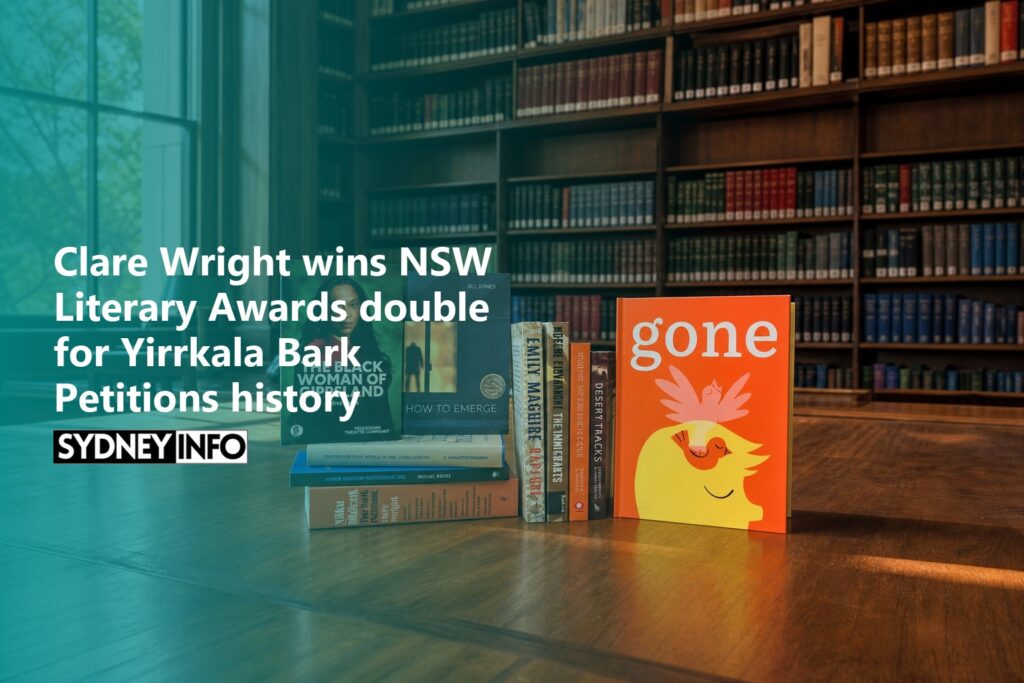
La Trobe University’s Professor Clare Wright OAM has claimed both Book of the Year and the Douglas Stewart Prize for Non-fiction at the 2026 NSW Literary Awards. Her win worth $50,000 came for Näku Dhäruk The Bark Petitions, a 640-page history that’s already in its fourth print run.
The winners were announced on 18 May at the State Library of NSW during the opening event of Sydney Writers’ Festival. Wright’s meticulously researched account of the 1963 Yirrkala Bark Petitions has now received 11 literary prize nominations and five wins, making it one of the most decorated books in Australian literary history.
Wright described the recognition as particularly meaningful for scholarly work. “For a work of evidence-based history, grounded in scholarship, to be recognised for its literary merit is particularly sweet,” she said.
The book chronicles how Yolŋu Elders from northeast Arnhem Land created four bark petitions in 1963, painted with traditional designs by senior artists using brushes made from children’s hair, ochre from sacred sites, and charcoal from ceremonial fires. The petitions were presented to federal Parliament to protest mining on ancestral lands, representing the first formal Aboriginal petition on land rights issues.
Wright moved to Arnhem Land in 2010 and was culturally adopted by the family of the late Dr Galarrwuy Yunupiŋu, a Yolŋu activist and Elder who recognised her as a historian capable of honouring their narrative. The adoption gave her access to family archives and community knowledge that shaped the book’s perspective.
Douglas Stewart Prize judges praised Wright’s achievement in making complex political history compelling. “This book offers the reader a powerful and historically important story replete with vivid human characters from a range of backgrounds,” the judging panel said. “The story builds very gradually, but every paragraph works in creating a drama of pivotal national importance.”
Wright’s approach challenges conventional Australian political history by centring First Nations perspectives rather than treating Aboriginal history as separate. The work presents the Bark Petitions alongside Australia’s more familiar foundational events, offering an important contribution to addressing ongoing colonial injustice and cultural amnesia.
Wright completed the book’s epilogue only after witnessing how First Nations communities responded to the failed 2023 Voice referendum. The timing makes Näku Dhäruk particularly resonant in contemporary Australia, offering historical context for ongoing debates about Indigenous recognition and land rights.
The 640-page academic history achieving four print runs represents exceptional commercial success for serious scholarship. Wright expressed gratitude for the broad recognition. “I’m gratified to have that breadth of recognition for a history book, a 640-page history book written by an academic historian that is in its fourth print, which means people are actually reading it,” she said.
The NSW Literary Awards represent Australia’s richest and longest-running state-based literary recognition, with $320,000 in total prize money distributed across all genres in 2026. Wright’s double win caps the final instalment in her Democracy Trilogy, which began with The Forgotten Rebels of Eureka and continued through Australia’s voting rights history.
Wright, who chairs the National Museum of Australia Council, has demonstrated that rigorous archival research can reach general audiences without compromising scholarly standards. Her trilogy offers a fundamentally different perspective on Australian democracy, one that positions previously marginalised voices at the centre of the national story.
Quick Facts
State Library of New South Wales
The State Library of NSW administers the NSW Literary Awards in association with Create NSW. The awards are the richest and longest-running state-based literary awards in Australia, first presented in 1979 and covering all genres of writing.
NSW Literary Awards
The 2026 NSW Literary Awards (previously known as the NSW Premier’s Literary Awards) honour distinguished achievement by Australian writers across 12 categories with a total prize pool of $320,000. The awards were announced at the opening event of the Sydney Writers’ Festival on May 18, 2026.
La Trobe University
La Trobe University is home to Professor Clare Wright OAM, who holds positions as Professor of History and Professor of Public Engagement. The university is proud of Wright’s groundbreaking work helping Australians understand the vital contribution Indigenous people have made to the political history of Australia.