
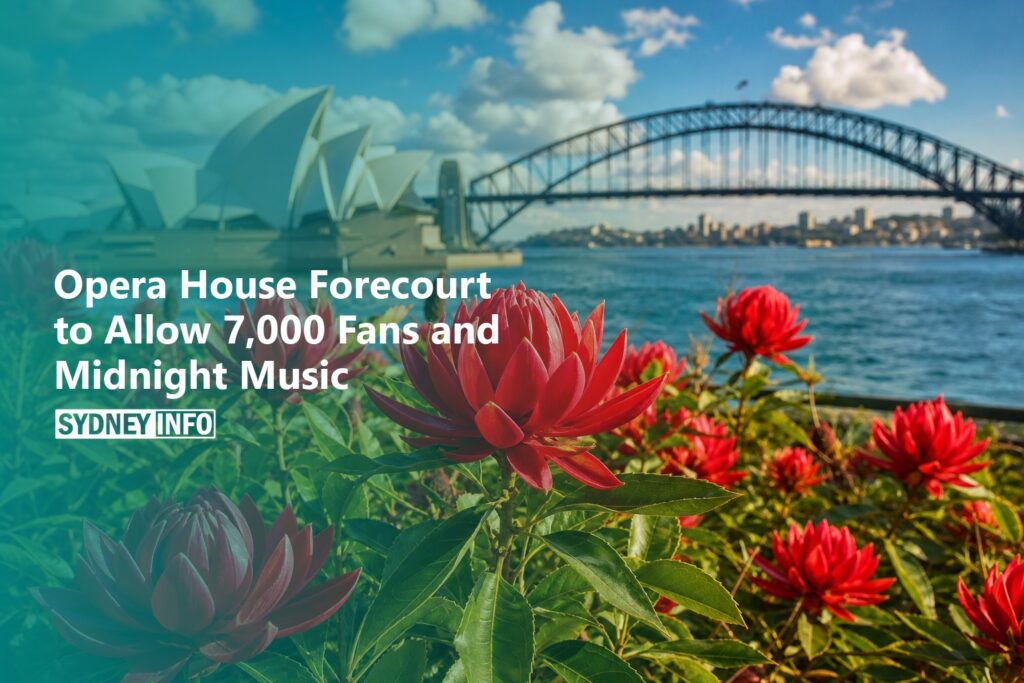
No longer will noise levels at the Sydney Opera House Forecourt be dictated by the bedtimes of the residents at the Toaster. The NSW Government announced on 7 June that it will allow amplified music until midnight, increase headline concert crowds to 7,000, and put an end to what Arts Minister John Graham calls “a Sydney sport” of moving next to a venue and then campaigning to shut it down.
The planning reforms, on public exhibition until 7 July, will lift major Forecourt events from 6,000 to 7,000 capacity and boost low and medium-scale outdoor events from 5,000 to 6,000. Late-night sound limits will align with daytime levels for the first time, meaning a midnight set can reach the same volume as a twilight show. The changes are part of a broader package that includes easier pop-up events in town halls, expanded rooftop dining, and the conversion of empty shops into small venues.
“Over the decades it became a Sydney sport to move in next door to a pub and then campaign to close it down. We are putting an end to that and the same approach should apply to the world’s greatest performance venue,” Graham said. “The Sydney Opera House is everyone’s house and these changes make sure the experience matches the epic setting.”
Opera House CEO Louise Herron framed the reforms as a programming leap forward. “These changes will enliven the Opera House experience for audiences and artists alike, expanding the possibilities of live performance on the world’s most recognisable stage,” she said. “By offering events with greater capacity and sound, the Opera House will deliver a more contemporary, diverse and dynamic outdoor event program, elevating the patron experience while maintaining appropriate heritage safeguards for this significant precinct.”
Australian singer-songwriter Dan Sultan described his headline Forecourt show as a career high point. “It’s difficult to put into words just what that concert meant to me. The best my band had ever sounded, my family in the wings, and the biggest crowd I’d played for at that point. The Sydney Opera House Forecourt is truly a bucket-list show for any artist anywhere in the world.”
The Forecourt has long been constrained by complaints from nearby apartment buildings, a tension that Graham’s “Toaster” remark squarely addresses. The extra 1,000 people and later finish times mean international acts can now be booked against the harbour backdrop with the sound levels they need.
Anyone keen to weigh in can do so during the public exhibition, which closes on 7 July. The reforms are not automatic — they require final approval — but the policy intent is clear: the Opera House Forecourt is being treated as a major performance space first and a quiet neighbour second. The Opera House already welcomes 10 million visitors a year and hosts around 1,800 performances; the new rules are designed to stretch those numbers even further without the ceiling that once muffled them.
For the artists who have already tasted that Forecourt magic, the change is personal. Sultan’s memory of his family watching from the wings will now be available to many more performers in front of thousands, with the Sydney Harbour night wrapped around them and a playlist that truly goes until midnight.
Quick Facts
Sydney Opera House
Iconic multi-venue performing arts centre on Sydney Harbour, designed by Jørn Utzon and opened in 1973. Welcomes 10 million visitors annually, hosts 1,800 performances and events for over 1.4 million attendees, and supports more than 8,000 jobs. A UNESCO World Heritage site and symbol of Sydney.
NSW Department of Creative Industries, Tourism, Hospitality and Sport
NSW government department responsible for arts, culture, tourism and related policy. Oversees initiatives like Special Entertainment Precincts and venue reforms to boost the night-time economy and cultural programming.