
The Ponds didn’t exist as a suburb name until January 2007. Before that the land was carved out of Kellyville and Kellyville Ridge, and before that it was paddock straddling Second Ponds Creek, a waterway that gave the area its name as far back as 1789, when Lieutenant Watkin Tench recorded “several ponds of water” near the emerging farms north of Rose Hill. Everything you see today, the streets, the schools, the lake, the shopping centre, was built after that: the first residential lots went to market on 31 March 2007, and the suburb’s population went from a rounding error to 16,315 people by the 2021 Census, a 39% jump on 2016.
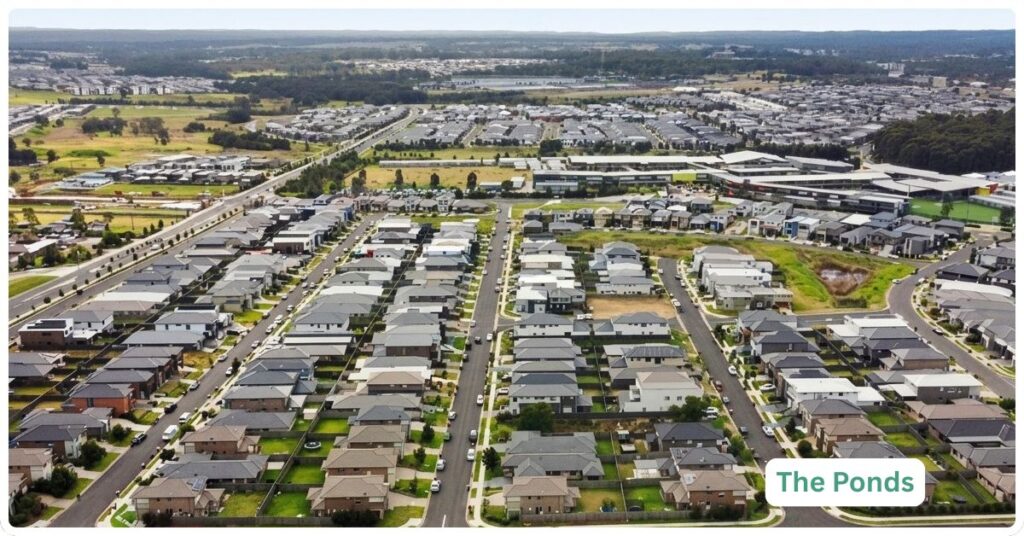
That speed shows in the built form. The Ponds was designed as a single masterplanned estate by Landcom, not stitched together lot by lot, and it has the water-sensitive urban design to prove it: rain gardens, engineered wetlands and stormwater ponds run through the estate as functional infrastructure, not decoration, feeding into Ironbark Lake and the suburb’s 88 hectares of parkland. In 2011 the Australian Bureau of Statistics ranked The Ponds the single most advantaged suburb in Sydney on its socio-economic index, and census data has repeatedly shown it has one of the highest rates of married couples of any suburb in the country. This is not a suburb with an identity crisis. It knows exactly what it is: a high-income, family-heavy, ethnically diverse estate for people who wanted new land, new schools and a commute they were willing to manage.
The trade-off is equally clear. A suburb built this fast, this recently, is still catching up with itself in places, particularly childcare, and it has no train station of its own, relying instead on a metro line that opened in 2019 and buses to get you there. Don’t come here expecting heritage character or a walk-to-everything town centre. Come here for the schools, the parkland and a level of build quality and infrastructure planning that older, more organically grown suburbs in western Sydney simply don’t have.
The Ponds Suburb Boundary and Location Map
The Ponds sits in the North West Growth Area, part of the Sydney Metro Northwest corridor, bounded roughly by Schofields Road, Hambledon Road, Riverbank Drive and Ridgeline Drive. It borders Kellyville and Kellyville Ridge to the south and east (the suburbs it was carved out of in 2007), Rouse Hill to the north, and Schofields further to the west. Stanhope Gardens sits a short distance south. The whole pocket, The Ponds, Rouse Hill, Kellyville, Stanhope Gardens, Beaumont Hills and North Kellyville, was developed as one continuous growth front from the mid-2000s onward, which is why the boundaries feel administrative rather than geographic. There is no natural feature separating one from the next; it is street names and land release stages.
Quick Facts
| LGA | Blacktown City Council |
| Postcode | 2769 |
| Population | 16,315 (2021 Census); local data aggregators put the estimate closer to 18,600 as of August 2025, though that figure is not an official ABS release |
| Distance from CBD | Around 38 to 40 km north-west of the Sydney CBD |
| Named After | Second Ponds Creek, a waterway name recorded as far back as 1789; gazetted as a separate suburb in January 2007 |
| Parks & Lake | Ironbark Lake and its lakefront walkway; estate-wide network of engineered wetlands and rain gardens |
| Shopping | The Ponds Shopping Centre; Rouse Hill Town Centre about a kilometre from the suburb’s edge |
| Health | Norwest Private Hospital and Blacktown Hospital nearby; a hospital has been flagged for Rouse Hill but remains undelivered |
| Median House Price | Around $1.5 to $1.6 million in 2025, depending on the data source |
| Median Unit Price | Near $1.3 million; unit stock is thin, around 5 sales in a 12-month period |
| Rail | No train station in the suburb itself; nearest are Tallawong and Rouse Hill metro stations, both opened on the Metro North West Line in May 2019 |
| Bus | Routes connect to Blacktown, Rouse Hill, Schofields and Riverstone |
| Road | Westlink M7 and M2 Hills Motorway give motorway access; Sunnyholt Road and Withers Road are the main arterial routes |
What Makes The Ponds Special
Built as one estate, not stitched together
Most Sydney suburbs grew in fits and starts over decades, which is why you get a Federation cottage next to a 1970s brick veneer next to a 2015 townhouse block. The Ponds was masterplanned by Landcom from a blank paddock, with water-sensitive urban design (rain gardens, wetlands, stormwater ponds feeding Ironbark Lake) built into the estate from the start rather than retrofitted. It won UDIA NSW awards for residential development and sustainability in 2012. The result is visual and infrastructural consistency that older suburbs can’t easily replicate, for better or worse depending on whether you want variety or uniformity in your street.
An unusually advantaged, unusually married suburb
In 2011 the ABS ranked The Ponds the most socio-economically advantaged suburb in Sydney using its SEIFA index (income, internet access, bedroom numbers, qualifications). Census data has separately shown The Ponds has one of the highest proportions of married residents of any suburb in Australia, over 71% of residents aged 15 and over as of the 2011 Census. Both figures are dated now, but they describe the kind of buyer this estate was built for and largely still attracts: dual-income couples and families settling in rather than passing through.
A genuinely diverse population, not a demographic monoculture
At the 2021 Census, 45.2% of residents were born in Australia, with India (22.6%), the Philippines (3.5%), China (2.6%), Pakistan (2.3%) and Sri Lanka (1.9%) the next most common birthplaces. Only 41.7% spoke only English at home; Hindi, Punjabi, Gujarati, Urdu and Mandarin were all common. Religiously, Hinduism (25.1%) was the single largest response, ahead of Catholic (19.1%), no religion (14.8%), Islam (9.9%) and Anglican (6.4%). This is one of the more culturally mixed growth suburbs in Sydney’s north west, and it shows up in the shopping centre, the places of worship nearby and the community events calendar.
What Is It Like Living Here?
Daily life in The Ponds revolves around the school run, the shopping centre car park and, for a lot of households, a commute that starts with a bus or shuttle before it even reaches a train. It’s a quiet, orderly, new-build suburb: wide streets, consistent architecture, a lot of double-storey houses on tight blocks, and very little of the mixed-use grit you’d find in an established inner suburb. Local anecdotal sentiment tends to praise the parks, the schools and the general upkeep of the estate, while flagging the same two frustrations repeatedly: traffic congestion on the internal roads at school drop-off and pickup times, and the lack of a train station forcing a bus-then-metro routine for anyone commuting into the city.
Hospitals
There is no hospital in The Ponds itself. Norwest Private is the closest private option. Public options include Blacktown Hospital and Westmead Hospital (which also houses The Children’s Hospital at Westmead), both a drive away, along with Westmead Private and Mount Druitt Hospital. A hospital has been flagged for Rouse Hill, less than a kilometre from parts of The Ponds, but as of this writing it remains a planned rather than delivered facility, so don’t buy here counting on it being open soon.
Education
The Ponds has two government primary schools: John Palmer Public School, which opened in 2008, and Riverbank Public School, which opened in 2015. The Ponds High School, also opened in 2015, covers Years 7 to 12 and has grown large enough that, due to rising enrolment numbers within its own catchment, it generally only accepts out-of-area students in exceptional circumstances.
The Ponds School, a specialist school for students with disability that also opened in 2015, was the first of its kind in north-western Sydney, with a hydrotherapy pool and purpose-built facilities. There is no Catholic or independent school within the suburb’s own boundaries; families wanting one typically look to schools in Kellyville, Riverstone or further into the Hills District. If school zoning matters to your purchase decision, check the current catchment maps directly with the NSW Department of Education, because boundaries here have shifted before as neighbouring high schools (Glenwood, Riverstone) absorbed overflow.
Industry & Work Life
The Ponds is overwhelmingly a residential dormitory suburb, not an employment centre. Most working residents commute out, whether to Norwest Business Park, Parramatta, Macquarie Park or the Sydney CBD via the metro line. The nearest significant local employment and retail hub is Rouse Hill Town Centre, with Norwest Business Park a further drive south offering white-collar office jobs. There is no meaningful industrial or logistics employment base within the suburb itself, unlike growth suburbs further west such as Marsden Park.
Parks and Natural Spaces
The Ponds is named after water, and it shows. Second Ponds Creek runs through the area, and the estate’s whole stormwater system was designed around it: rain gardens, constructed wetlands and detention ponds that manage runoff while doubling as public open space, restoring riparian corridor along the way rather than just piping water underground.
Ironbark Lake, offers a five-hectare park with a continuous lakefront walkway, open green space, and picnic and barbecue facilities, sitting within an estate-wide parkland network the developer put at roughly 88 hectares across the community. It’s engineered landscape, not bushland remnant, and it reads that way: clean lines, new plantings, purpose-built paths. If you want rugged native bush, this isn’t it. If you want a lake to walk around after work with a pram, it delivers.
Running north-south down the center of the suburb is a series of interconnected parks offering an excellent semi-native bushland following the small creek and joining Arrowroot Park, Peel Reserve, The Gathering Park and The Ponds Parklands.
Peel Reserve and Jonas Bradley Oval offer mixed-use sporting fields.
Shopping & Retail
Daily needs are easily handled by the Ponds Centre, featuring Woolworths as the main anchor. For retail shopping, most will head to Rouse Hill Town Centre. Marsden Park, about 10 mins to the west by car, has a Bunnings, Costco, and IKEA. A staple journey slash family shopping outing for locals is Parklea Markets, ten minutes or less to the southeast, offering over 100 stores with fresh produce, food stalls, and more.
Transport
The Ponds has no train station within its own boundaries. The nearest is Tallawong metro station, the north-western terminus of the Metro North West & Bankstown Line, which opened on 26 May 2019 and runs services every four minutes at peak toward Norwest, Castle Hill, Macquarie Park, Chatswood, Town Hall and Central. Rouse Hill metro station, on the same line, is also close by, roughly a kilometre from parts of the suburb. Kellyville station sits further south on the same line for residents in that direction.
If you need the T1 North Shore, Northern & Western Line rather than metro, the nearest stations are Schofields and Quakers Hill, with the former being a quick 8 min drive or 10-15min bus ride.
Busways operates the local network, with routes 734 and 752 connecting The Ponds to Blacktown, Rouse Hill, Schofields and Riverstone. A Cooee Busways on-demand service also connects the estate directly to Tallawong and Rouse Hill metro stations, which matters given how much of the suburb sits beyond comfortable walking distance of either station.
Internally, The Ponds runs on The Ponds Boulevard, Riverbank Drive, Ridgeline Drive, Hambledon Road, Stanhope Parkway and Schofields Road. Sunnyholt Road, which carries traffic west toward Blacktown, and Withers Road, in neighbouring Kellyville and Rouse Hill, are the wider corridor roads locals use to escape the estate’s internal loop. The Westlink M7 gives motorway access from the south and the M2 Hills Motorway from the east, both a short drive away, which matters more here than a train station does for most car-owning households.
The Ponds sits roughly 38 to 40 km north-west of the Sydney CBD. By metro and train, that’s a multi-leg trip: bus or on-demand shuttle to Tallawong or Rouse Hill, then metro into the city, typically 50 to 70 minutes door to door depending on connection timing. By car, expect the M7/M2 run to take anywhere from 45 minutes off-peak to well over an hour in peak traffic.
Realty Market
Median house prices in The Ponds sat around $1.5 to $1.6 million through 2025, with sources disagreeing on the exact figure and even on direction: one dataset puts the median at $1,615,000, up roughly 0.9% year on year, another puts recent sales at a $1.6 million median, up 7.7% annually, and a third puts the median closer to $1.5 million, down 3.6% over the year. That spread tells you the market here is thinner and choppier than the headline “median” figure suggests, so treat any single number as indicative rather than precise, and check a recent comparable sale before you anchor on it. This is overwhelmingly a house market. Roughly 200 houses sold in the suburb over a recent 12-month period against only around 5 units, so unit buyers have very little stock to choose from and very little price signal to rely on. Where units do sell, medians sit around $1.3 million, up roughly 3% year on year.
Rental stock mirrors the sales market: it’s a house-dominated suburb, and family-sized homes are what’s available. Where unit rentals do exist, weekly rents have been reported around $670, putting rental yields for units near 4.4%. House rental yields run lower given the high purchase prices, which is typical of a suburb bought predominantly by owner-occupiers rather than investors chasing yield.
Future Growth
Be honest about where The Ponds is in its lifecycle: it is close to built out. The major land releases happened between 2007 and the mid-2010s, the schools were built to serve that population and have already reached capacity in places (The Ponds High School restricting out-of-area enrolments is the clearest sign of this), and the shopping centre and core parkland network are complete.
The genuine growth story in this corridor now belongs to suburbs still releasing land nearby, such as Box Hill, Riverstone and Marsden Park, not to The Ponds itself.
What’s still incomplete locally is largely social infrastructure catching up to a population that arrived fast: childcare capacity is tight relative to the number of under-fives in the suburb, and a hospital flagged for nearby Rouse Hill has not yet been delivered. Anyone buying here on a growth thesis should be buying into the broader North West corridor’s maturity, not expecting The Ponds itself to keep transforming.
The Honest Verdict
Buy in The Ponds if you want a modern, well-planned family house on a small block, don’t need a train station on your doorstep, and can afford a median price north of $1.5 million. It suits dual-income families prioritising schools, parkland and build quality over commute time or heritage character, and it suits buyers who want a genuinely diverse, high-SEIFA-ranked community rather than a demographic monoculture.
It does not suit investors chasing unit yield (there’s barely a unit market to invest in), first home buyers on a tight budget (the entry price is high for what is, functionally, outer Sydney), or anyone who needs walk-to-station convenience for a CBD job. Weighed against Kellyville, Stanhope Gardens, Beaumont Hills and North Kellyville, the suburbs a buyer would genuinely cross-shop this against, The Ponds holds its own on parkland and school infrastructure but doesn’t have a meaningfully better transport story than any of them; all of that corridor relies on the same Tallawong and Rouse Hill metro stations.
The real trade-off buyers need to accept going in: you’re paying inner-suburb-adjacent prices for a suburb with no train station of its own, betting that the school zones, the lake and the build quality are worth more to your family than the commute.
Frequently Asked Questions
Does The Ponds have a train station?
No. The nearest metro stations are Tallawong and Rouse Hill, both on the Metro North West & Bankstown Line, which opened in May 2019. The nearest Sydney Trains heavy rail stations are Schofields and Quakers Hill. Getting to either metro station from most of The Ponds means a bus or on-demand shuttle first.
Is The Ponds a safe suburb?
Crime data in NSW is published by the Bureau of Crime Statistics and Research at local government area level, not suburb level, so there is no crime rate specific to The Ponds itself. Blacktown City Council, the LGA covering The Ponds, has recorded crime rates above the NSW average, and BOCSAR’s March 2025 report showed violent offences up 3.2% and property offences up 2.7% year on year across the state, with Blacktown among the LGAs recording the highest offence volumes. That said, LGA-wide figures blend very different pockets, from established higher-crime areas to newer estates like The Ponds, so don’t assume the LGA number describes this specific suburb.
What is the median house price in The Ponds?
Depending on the data source, the median house price through 2025 sits somewhere between roughly $1.5 million and $1.615 million, with disagreement even on whether prices rose or fell over the year. It is a house-dominated market with very little unit stock to compare against.
Is childcare hard to get in The Ponds?
It’s tighter than the raw centre count suggests. There are dozens of childcare listings across the 2769 postcode, but only a handful of centres physically within The Ponds itself offer long day care, against an estimated 1,000-plus children under five living in the suburb. Vacancies exist across the wider postcode, but if you need a place close to home rather than a drive away, expect to book early and have a backup plan.
Why is it called The Ponds?
The name comes from Second Ponds Creek, which runs through the area. Records of “The Ponds” as a place name date back to 1789, when Lieutenant Watkin Tench described “several ponds of water” near farms north of Rose Hill. The modern suburb wasn’t formally gazetted until January 2007, when it was split out of Kellyville and Kellyville Ridge.
References
Australian Bureau of Statistics, 2021 Census QuickStats, The Ponds (SAL13851) (accessed 2 August 2026).
htag.com.au, “The Ponds, NSW 2769 Property Market and House Prices 2025” (accessed 2 August 2026).
Your Investment Property Magazine, “The Ponds, NSW 2769: Suburb Profile & Property Report”, (accessed 2 August 2026).
NSW Bureau of Crime Statistics and Research, “NSW Recorded Crime Statistics, Quarterly Update to June 2025”, (accessed 2 August 2026).
aucrimetracker.com, “Blacktown Crime Rate, NSW: Latest Statistics & Analysis”, (accessed 2 August 2026, secondary aggregator citing BOCSAR data).
Toddle, “Compare Child Care in The Ponds, NSW 2769”, (accessed 2 August 2026).
CareForKids.com.au, “Childcare in The Ponds, NSW 2769”, (accessed 2 August 2026).
Landcom, “Sustainability & urban design at The Ponds”, (accessed 2 August 2026).
Clouston Associates, “The Ponds Parklands”, (accessed 2 August 2026).
The Ponds High School, “Enrol”, (accessed 2 August 2026).
NSW Geographical Names Board, Geographical Names Register entry for “The Ponds”, (accessed 2 August 2026).
See all suburbs in the Blacktown City Council. See the full Sydney Regions overview to explore more of greater Sydney.