
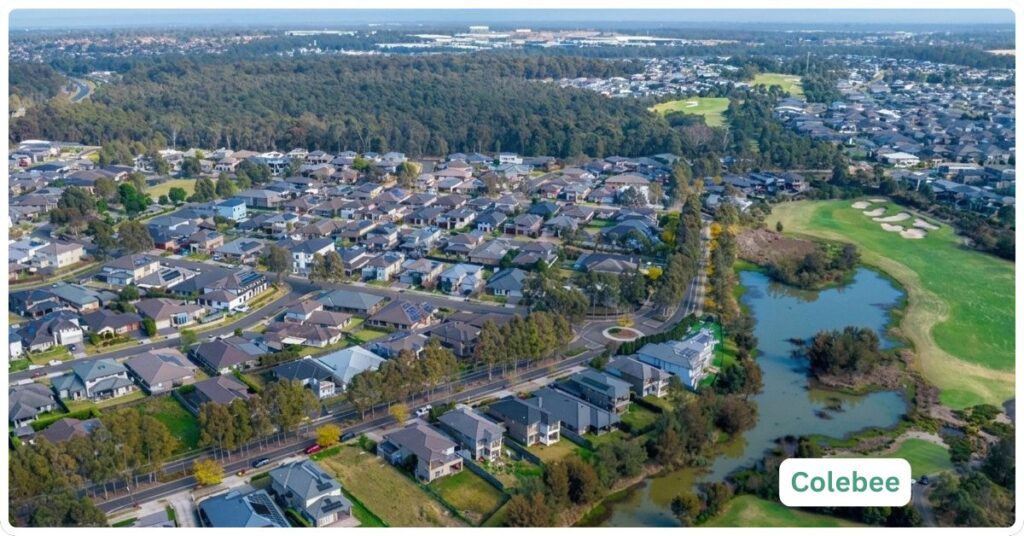
Colebee is the suburb that put a Greg Norman-designed golf course at the centre of a Sydney growth-area estate, and named the whole thing after a man who spent his life negotiating, not always willingly, the terms on which colonial Sydney and the Dharug people would coexist. It is a young, still-forming pocket of the Blacktown North West Growth Area, wedged between Glenwood and Hassall Grove to the east and Marsden Park to the north, and its population has grown by well over 150 per cent in five years as Stonecutters Ridge and the surrounding estates have filled in what was, until recently, largely paddock.
Don’t come here expecting a town centre or a train line. Colebee is a residential estate built around a golf club, with its retail, schools and rail access borrowed almost entirely from its neighbours. What it does offer is new housing on land that isn’t yet fully built out, a genuine 18-hole golf course as a resident amenity rather than a marketing render, and a name with more historical weight than most of the growth corridor’s estate-branding exercises.
Boundary and Location Map
Colebee sits within the Blacktown local government area, roughly 47 kilometres west of the Sydney CBD, in the North West Growth Area. It borders Marsden Park to the north, Glenwood and Hassall Grove to the east, and sits close to Dean Park and Plumpton to the south. Richmond Road forms much of the suburb’s eastern edge and is the main arterial connecting it to the rest of the growth corridor.
Quick Facts
| LGA | Blacktown City Council |
| Postcode | 2761 |
| Population | 4,914 at the 2021 Census, up 154.5% on 2016 (ABS) |
| Median age | 33 years (ABS 2021 Census) |
| Distance to CBD | approx. 47km west |
| Landmark | Stonecutters Ridge Golf Club (Greg Norman design, opened 2012) |
| Name origin | Colebee, Dharug land grant recipient, circa 1819 |
| Median house price | approx. $1.3m to $1.4m, sources vary (2025) |
| Median rent, house | approx. $820 to $850 per week (2025) |
| Nearest station | Schofields, T1 Western Line, approx. 10-15 min drive |
| Road corridor | Richmond Road, under active $720m upgrade (construction started Feb 2026) |
What Makes Colebee Special
The Man Behind the Name
Colebee (born around 1770, died around 1830) was a Boorooberongal man of the Dharug people and the son of Yarramundi, a senior Dharug figure from the Hawkesbury region. On 31 August 1819, Colebee and fellow Dharug man Nurragingy were granted 30 acres of land on Richmond Road, at what is today the intersection with Rooty Hill Road, making Colebee, by the Geographical Names Board of NSW’s own record, the first Aboriginal person to receive a colonial land grant in the Blacktown area. The grant sat near, and later became entangled with, the Black Town Native Institution, a government-run school for Aboriginal children that operated in the district until 1833, with many Aboriginal families camping close to the land grant to remain near children held at the Institution. The land grant site is heritage-listed on the NSW State Heritage Register. It is a genuinely significant piece of early contact history, not a decorative naming exercise, and it sits at the eastern edge of the modern suburb that carries his name.
A Golf Course as the Organising Idea
Where most North West Growth Area suburbs are organised around a town centre or a rail station, Colebee is organised around a golf course. The Stonecutters Ridge estate paired a Greg Norman-designed 18-hole championship course, built on roughly 93 hectares, with a residential release around it, and the club opened in 2012. It is a genuine amenity, not a marketing render: the club runs public and member play, and around 60 per cent of the broader development is set aside as open green space, including the golf course and several parks.
Is It Worth Visiting?
Unless you’re playing golf, there isn’t much reason to visit Colebee if you don’t live there. Stonecutters Ridge Golf Club is a legitimate reason to make the trip for a round, and it’s a genuinely good course for the price point. Beyond that, this is a residential estate still filling in its own amenities, not a destination suburb.
What Is It Like Living Here?
Colebee reads as a young family suburb still under construction, in every sense. The 2021 Census put the median age at 33 and average household size at a high 3.7 people, both consistent with a new estate filling up with families and multigenerational households rather than an established, ageing suburb. Median weekly household income of $3,223 at the 2021 Census sits well above the Sydney average, which tracks with the price point of new-build housing here. The trade-off is the one every growth-corridor buyer needs to accept going in: schools, shops and public transport are largely borrowed from Marsden Park, Glenwood and Schofields rather than provided locally, and Richmond Road’s current roadworks mean some daily friction before the upgrade delivers its promised relief.
Healthcare & Hospitals
RenewMed Health Hub and PGK Medical offer GP services in the suburb. Blacktown Hospital is the primary referral hospital for Colebee residents, roughly a 20 to 25 minute drive.
Education
There is no dedicated Colebee Public School. The nearest public primary option most commonly serving the suburb is William Dean Public School in neighbouring Dean Park, alongside newer schools in Marsden Park as that suburb’s own school stock has expanded. Secondary options are drawn from the wider Blacktown and Riverstone/Schofields catchments. As with most of the North West Growth Area, buyers should check current Department of Education zoning directly before assuming a specific school, since boundaries here have shifted as the corridor has grown.
Industry & Work Life
Colebee itself has essentially no local employment base beyond the golf club and a handful of estate-level services. Most working residents commute out, with Marsden Park’s Sydney Business Park precinct (IKEA, Costco, Bunnings and a logistics cluster) the nearest significant jobs hub, plus Blacktown and the wider Sydney labour market further afield.
Parks and Natural Spaces
Stonecutters Ridge Golf Club is the suburb’s dominant green space and its most visible drawcard, an 18-hole Greg Norman design that doubles as informal open space for residents even if they never play a round.
Colebee Nature Reserve sits to the west of the golf course, a smaller pocket of retained bushland rather than a developed park with facilities. The broader Stonecutters Ridge estate includes several local parks built into the residential release, though individual naming and amenities for each vary and are still being finished off as later stages of the estate complete. For larger-scale parkland, residents are within a short drive of Bungarribee Park and, further afield, the Blue Mountains foothills.
Shopping & Retail
Right next door to Colebee is the sprawling Sydney Business Park, offering IKEA, Bunnings, Costco, Anaconda, and much more. In the southwest corner of the suburb itself is Greenway Village, anchored by Woolworths, along with a cafe, pizza shop, and bakery.
Transport
Colebee has no train station within the suburb. Schofields, on the T1 Western Line, is the nearest operating station, roughly 10 to 15 minutes away by car. Riverstone station on the same line is a similar distance in the other direction. Neither is realistically walkable from most of Colebee, so a car or connecting bus is part of daily life here.
Local bus routes connect Colebee to Blacktown, Schofields and the wider Marsden Park and Glenwood area, but frequency and coverage are typical of a still-developing growth suburb rather than an established one. Most residents drive.
Richmond Road is the suburb’s main arterial and is currently the subject of a $720 million NSW Government upgrade. Major construction began in February 2026 on the M7 Motorway to Townson Road section, which will widen roughly 2.2 kilometres of Richmond Road between Colebee and Marsden Park from four lanes to six, add a new bridge over Bells Creek, and build a flyover connecting the M7’s Rooty Hill Road North off-ramp directly to Richmond Road northbound. A related upgrade between Elara Boulevard and Heritage Road is also under construction. Planning for further upgrades to Townson Road and Burdekin Road, linking Marsden Park toward Schofields, was under investigation through to mid-2026. This is a live, funded, under-construction project, not a proposal on a wish list, and it is the single biggest infrastructure story attached to Colebee right now.
Colebee is around 47 kilometres from the Sydney CBD. The Westlink M7 is accessible via Richmond Road, giving reasonably direct motorway access to the wider Sydney network once the current roadworks are complete.
Realty Market
Median house price estimates for Colebee vary noticeably by source as of 2025: figures range from around $1.32 million to $1.5 million, with reported 12-month movement anywhere from a small decline to an 8 per cent rise depending on which data provider and sample period is used. Take any single figure with some caution and treat the honest range as $1.3 million to $1.4 million. Housing stock is almost entirely new-build houses on estate-sized blocks, reflecting the suburb’s short development history; there is little established unit stock to speak of.
Median rent for houses sits around $820 to $850 per week as of 2025, with a rental yield reported around 3.45 per cent, a range consistent with other North West Growth Area new-build suburbs. Unit rental data is too thin to report a reliable figure, reflecting how few units exist locally.
The Honest Verdict
Colebee is a golf-estate suburb still filling in around its own edges, and it should be evaluated as exactly that. Against Glenwood and Hassall Grove, its established neighbours to the east, Colebee offers newer housing stock and the genuine amenity of Stonecutters Ridge, but loses on maturity: those suburbs have decades-established schools, shopping and a settled feel that Colebee simply doesn’t have yet. Against Marsden Park immediately north, Colebee is quieter and more purely residential, without Marsden Park’s retail firepower or its own emerging jobs base. If you want a new build near a genuine golf course and can live without a nearby train station until Richmond Road’s upgrade delivers its promised relief, Colebee is a reasonable buy. If proximity to established schools and shops matters more than novelty, Glenwood or Hassall Grove will serve you better today.
Frequently Asked Questions
Where does the name Colebee come from?
Colebee was a Boorooberongal man of the Dharug people, son of Yarramundi, who received a 30-acre land grant on Richmond Road with fellow Dharug man Nurragingy in 1819, the first such grant to an Aboriginal person recorded in the Blacktown area (Geographical Names Board of NSW).
Does Colebee have a train station?
No. Schofields station on the T1 Western Line is the nearest, roughly 10 to 15 minutes away by car.
What is Colebee’s median house price?
Estimates for 2025 vary by source, roughly $1.3 million to $1.5 million, with the more consistent figure sitting around $1.3 million to $1.4 million.
Is Colebee a good suburb for families?
The Census profile (median age 33, average household size 3.7) points to a young family-heavy population, but schools, shops and most services are borrowed from neighbouring suburbs rather than provided locally, so it suits families comfortable with a car-dependent routine.
What is there to do in Colebee?
Stonecutters Ridge Golf Club, an 18-hole Greg Norman-designed course, is the suburb’s main drawcard. Beyond that, amenities are limited and residents typically travel to Marsden Park or Glenwood for shopping and dining.
References
ABS 2021 Census QuickStats, Colebee
Dictionary of Sydney, Colebee and Nurragingy’s Land Grant
NSW Government, Major construction begins on $720 million Richmond Road upgrade
Blacktown City Council, City Profile
See all suburbs in the Blacktown City Council. See the full Sydney Regions overview to explore more of greater Sydney.