
Glenwood is what happens when a masterplanned suburb finishes building and just gets on with life. There are no cranes here, no display homes, no sales offices spruiking the “next release.” The estate was largely built out through the 1990s and 2000s on land once known as Norfolk Vale, then Sorrento, then Glenwood Park, and it was formally gazetted as its own suburb in 1996, the first site developed within the old Rouse Hill Development Area. Everything that made it a good buy then (big blocks, a proper high school, a real sporting precinct) still applies now, and the market has priced that in.
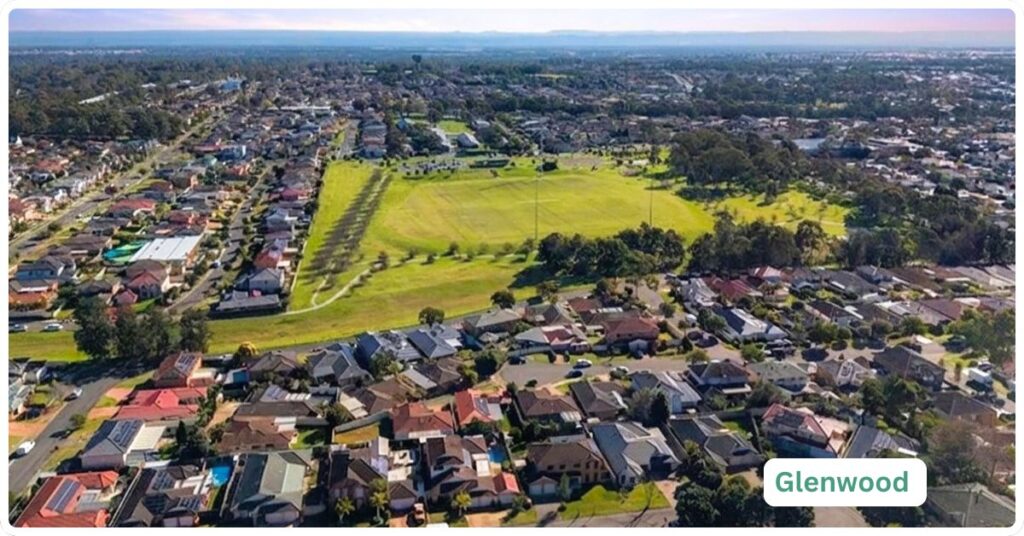
What sets Glenwood apart from the growth suburbs pushing out further north and west is that its main institutional asset, Glenwood High School, has a genuine track record rather than a marketing brochure. That single fact does a lot of work in this suburb’s price tag: buyers pay a premium here that comparable land in newer, unzoned estates simply doesn’t carry. Don’t come here expecting a train station on your doorstep either. Glenwood sits between the Sydney Metro Northwest line’s Bella Vista and Norwest stations without hosting either, so getting to rail means a bus or a drive first.
It’s a suburb for people who’ve decided the school zone and the established infrastructure are worth more than a shorter commute, not for people chasing the cheapest entry point into the North West.
Glenwood Boundary and Location Map
Glenwood sits within the City of Blacktown, roughly 31 kilometres north-west of the Sydney CBD. The Westlink M7 Motorway runs along its southern edge, feeding into the M2 Hills Motorway. Old Windsor Road forms the eastern boundary, and Sunnyholt Road wraps around the western and northern edges. The suburb borders Stanhope Gardens, Parklea and Kellyville Ridge, all currently in various stages of development or already established themselves, with Bella Vista and Norwest sitting just across the M7 to the south.
Quick Facts
| LGA | Blacktown City Council |
| Postcode | 2768 |
| Population | 15,829 (2021 Census, ABS) |
| Median age | 37 years (2021 Census) |
| Distance to CBD | approx. 31km north-west |
| Suburb established | Gazetted 1996 |
| Sporting hub | Valentine Sport Park, HQ of Football NSW |
| Main park | Glenwood Reserve (approx. 19.7ha) |
| Heritage site | Exeter Farm, Knightsbridge Avenue |
| Median house price | approx. $1.62M-$1.69M (2025, sources vary) |
| Median unit price | approx. $1.15M (2025) |
| 12-month change (houses) | approx. +2.7% (2025) |
| Nearest Metro stations | Bella Vista and Norwest (bus/T-way link required) |
| Motorway | Westlink M7 forms the southern border |
| Key roads | Sunnyholt Road (west/north), Old Windsor Road (east) |
What Makes Glenwood Special
A school with an actual track record
Glenwood High School opened in 2005 and now runs Years 7 to 12 as a fully comprehensive, coeducational public school with well over 1,500 students. It isn’t selective, and it doesn’t market itself as one, but it has built a genuine academic reputation over two decades rather than through developer copy. Based on Higher School Certificate results, Better Education ranked it 177th among NSW secondary schools in 2022, a solid outcome for a non-selective, fully comprehensive intake school competing against a state list stacked with selective and partially selective schools. For a suburb built almost entirely on volume land releases in the 1990s and 2000s, that’s a genuinely unusual result, and it’s the single biggest reason established Glenwood addresses hold their price against newer, cheaper land further out.
One thing worth clearing up for anyone searching: there is a primary school called “Glenwood Public School,” but it’s in Glenfield, near Campbelltown, not in this Glenwood at all. It’s a naming coincidence that trips up plenty of online suburb searches. The actual government primary schools zoned to serve this suburb are Caddies Creek Public School and Parklea Public School, with Holy Cross Primary School covering the Catholic option.
A finished masterplanned community, not a work in progress
Glenwood was the first site developed within the old Rouse Hill Development Area, and by the standards of Sydney’s North West Growth Area, it’s ancient history. The roads, parks, schools, shopping strips and sporting facilities were built out decades ago rather than being staged in behind population growth, which is the single biggest structural difference between Glenwood and its newer neighbours to the north. There’s no infrastructure catch-up happening here. What you see is what’s been there for twenty-plus years, for better (nothing half-finished) and worse (an aging housing stock that will need money spent on it).
Valentine Sport Park
Valentine Sport Park is a genuinely significant piece of sporting infrastructure for a suburb this size: it’s the headquarters of Football NSW, and the multipurpose complex hosts a wide spread of local clubs, from the Northwest Hurricanes Junior Rugby League Club and Glenwood Netball Club to Blacktown Warriors Rugby Union and Glenwood Redbacks Soccer Club. For families with sporty kids, that concentration of clubs and facilities in one place is a real, tangible drawcard that most suburbs its size don’t have.
What Is It Like Living Here?
Living in Glenwood means living in a suburb that finished growing up a long time ago. The streets are wide, the blocks are generous by current Sydney standards, and the housing stock (mostly brick veneer, double-storey, four-bedroom homes from the 1990s and early 2000s) reflects an era when land was cheaper and buyers wanted size over density. That’s now also the suburb’s biggest honest trade-off: many of those homes are due for kitchens, bathrooms and roofs to be redone, and buyers are paying a premium for the school zone and established feel on top of renovation costs that a newer home elsewhere wouldn’t carry.
Glenwood is genuinely multicultural, with just under half of residents born overseas as of the 2021 Census, largest cohorts from India (18.7%) and the Philippines (4.0%), and just under half the suburb speaking a language other than English at home, Punjabi and Hindi the most common. It’s a settled, family-heavy suburb rather than a transient rental market, and that shows in the local shopping strips, places built around school runs and weekend sport rather than nightlife.
Healthcare & Hospitals
For GP services, Glenwood Medical Practice, Parklea Medical Centre, Malvern Road GP & Paediatric Centre, and Glenwood Medical Centre are located in the suburb. Blacktown Hospital and Norwest Private Hospital both serve Glenwood, a reasonable drive in either direction, though there’s no hospital within the suburb itself.
Education
Glenwood High School is the suburb’s standout institution: a fully comprehensive, coeducational public school (not selective) that has nonetheless built a genuinely solid HSC track record, ranked 177th in NSW by Better Education in 2022 off a non-selective intake. That’s a real, defensible differentiator for buyers who want strong public schooling without an entrance exam.
On the primary side, Caddies Creek Public School and Parklea Public School are the zoned government options, with Holy Cross Primary School the local Catholic alternative.
Childcare is a mixed picture. There are around 40 childcare services listed across the suburb, with vacancies at most centres, but the more established, better-regarded long day care operators report families joining waitlists six to twelve months ahead of a planned start, particularly for the mid-week days parents want most. It’s tighter than “wide open” but nowhere near as strained as the newer growth suburbs further north where supply is still catching up to population.
Industry & Work Life
Most Glenwood residents commute out for work rather than working locally, with the Norwest Business Park a short drive or bus ride south offering one of Sydney’s larger suburban employment precincts, and Parramatta and the Sydney CBD both reachable via the Bella Vista or Norwest Metro stations once you’ve made the connecting trip. Local employment within Glenwood itself is limited to retail, education and the sporting and community facilities clustered around Valentine Sport Park.
Parks and Natural Spaces
Apart from Valentine Sports Park that we mentioned earlier, there are numerous sports fields and smaller reserves across the suburb, making keep fit and active pretty easy for kids and adults alike.
Glenwood Reserve, on Forman Avenue, is the suburb’s main open space: a large park with soccer and cricket fields, basketball and tennis courts, outdoor exercise equipment and shaded walking paths, well used by both organised sport and casual dog walkers.
Cornucopia Reserve and Exeter Farm Reserve provide a mixed-use sports fields. Alwyn Lindfield Reserve provides a mixed-use sports field, a playground, basketball courts, cricket nets, and a skate park.
Beyond the named reserves, Glenwood’s residential streets were laid out with generous verge planting and connecting pathways typical of 1990s masterplanned design, giving the suburb a settled, tree-canopied feel that newer greenfield estates further north are still years away from reaching.
Transport
Glenwood has no train station within its own boundaries. The nearest Sydney Metro Northwest stations are Bella Vista and Norwest, both just south of the M7 and both requiring a bus, T-way service or a drive to reach. From either station, Metro trains run at high frequency through Macquarie Park and Chatswood to the Sydney CBD, and out to the line’s north-western terminus at Tallawong.
The North-West T-way runs services through the suburb via Burns and Sorrento stops on its Blacktown-Parklea branch, and Burns, Balmoral, Celebration, Meurants and Norbrik stops on its Rouse Hill-Parramatta section, giving residents dedicated busway access without needing to reach Bella Vista or Norwest directly. CDC NSW operates routes 663, 664 and 665 to Rouse Hill and Parramatta, plus 607X and 616X express services into the Sydney CBD. Busways runs route 730 to Blacktown and Castle Hill, 734 and 735 to Riverstone and Rouse Hill, and 745 to Bella Vista.
The Westlink M7 forms the suburb’s southern edge and connects directly to the M2 Hills Motorway, giving reasonable access to Sydney’s motorway network without needing to touch local arterials for long trips. Sunnyholt Road runs along the western and northern boundary and Old Windsor Road along the east, both of which carry heavy peak-hour traffic as they funnel Hills District and North West traffic south. Internally, Glenwood Park Drive is the suburb’s main collector road.
Glenwood sits roughly 31 kilometres north-west of the Sydney CBD, around 20 kilometres from Parramatta, and a short drive from both the Norwest Business Park and Rouse Hill Town Centre.
Realty Market
Median house prices in Glenwood are reported anywhere from around $1.62 million (NSW Government Rent and Sales Report, November 2025) to around $1.69 million to $1.76 million depending on the data provider and month (auguide.com.au and htag.com.au, 2025-2026), with most sources agreeing on modest annual growth of roughly 2.5% to 5% over the past year. Median unit prices sit around $1.15 million (2025). That makes Glenwood one of the pricier established suburbs in this part of Blacktown LGA, and the school zone is doing real work in that price. Buyers should budget for renovation on top of the purchase price given the age of most housing stock; this isn’t a suburb where you buy and move straight in without touching anything.
Unit rental yields in Glenwood sit around 3.29%, with median unit rents around $785 per week (2025 data). As with the sale market, rental stock skews toward larger, older family homes rather than compact new-build apartments, reflecting the suburb’s original masterplanned character.
The Honest Verdict
Glenwood suits buyers who’ve already decided that an established, tree-settled suburb with a genuinely solid comprehensive high school is worth paying more for than raw land size or proximity to a train line. It doesn’t suit anyone chasing the cheapest entry point into the North West, or anyone who wants a station within walking distance; both of those buyers are better served elsewhere in the corridor. Weighed against its closest cross-shop, Stanhope Gardens (median house price around $1.525 million in 2025, down 2.9% over the year) and Quakers Hill (around $1.365 million, up a strong 9.2%), Glenwood is consistently the most expensive of the three, and the gap is almost entirely explained by that school zone rather than by land size, transport or newer housing stock, since Glenwood’s homes are, if anything, older than Stanhope Gardens’ equivalent stock. If the Glenwood High School zone matters to your family, that premium is defensible. If it doesn’t, Quakers Hill’s stronger recent growth and lower entry price make a harder case on pure numbers.
Frequently Asked Questions
Does Glenwood have a train station?
No. Glenwood sits between the Sydney Metro Northwest line’s Bella Vista and Norwest stations, both just south of the M7, and reaching either requires a bus, T-way service or a drive.
Is Glenwood High School actually a good school, or is that just local hype?
It has a genuine track record. Glenwood High School is fully comprehensive and non-selective, but Better Education ranked it 177th among NSW secondary schools on 2022 HSC results, a strong outcome for a school that doesn’t screen its intake. It’s a real reason buyers pay a premium for this suburb.
Is “Glenwood Public School” in this suburb?
No, and this trips people up regularly online. The school called Glenwood Public School is actually located in Glenfield, near Campbelltown, roughly 40 kilometres away. The government primary schools actually zoned for Glenwood, NSW 2768 are Caddies Creek Public School and Parklea Public School.
How much does a house cost in Glenwood in 2025?
Estimates vary by source, from around $1.62 million (NSW Government Rent and Sales Report, November 2025) to around $1.69 million to $1.76 million (auguide.com.au, htag.com.au), with modest growth of roughly 2.5% to 5% over the past year depending on the dataset.
Is Glenwood safe?
NSW crime data is published at the local government area level, not suburb by suburb, so there’s no crime figure specific to Glenwood itself. Blacktown City Council’s overall recorded crime rate runs above the NSW average, though it has fallen by roughly 15% over the past five years according to aggregated BOCSAR data.
References
ABS 2021 Census QuickStats, Glenwood (NSW)
Better Education, NSW Secondary School HSC Comparisons
NSW BOCSAR, Crime Statistics by LGA
AU Crime Tracker, Blacktown LGA Crime Statistics
Blacktown City Council, Glenwood Reserve
AU Guide, Glenwood Suburb Data
HTAG, Glenwood NSW 2768 Property Market
See all suburbs in the Blacktown City Council. See the full Sydney Regions overview to explore more of greater Sydney.