
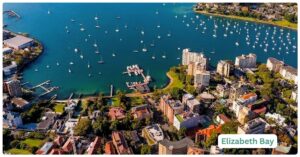
Elizabeth Bay has spent nearly two centuries being small, expensive and slightly apart from the rest of Sydney, and that hasn’t changed. It’s a peninsula of Art Deco apartment blocks and one extraordinary colonial mansion, wedged onto a finger of land between Potts Point and Rushcutters Bay with harbour frontage on three sides. The trade-off is blunt: you get water views, heritage streetscapes and one of the tightest, wealthiest small markets in the city, but you get almost no shops, no train station of your own, and a housing stock that is, for practical purposes, entirely units. If you need a backyard, a Woolworths on your corner or a five-minute walk to a platform, this is not your suburb.
Elizabeth Bay Boundary and Location Map
Elizabeth Bay occupies a small peninsula about 2.5 kilometres east of the Sydney CBD, bounded by the harbour (Elizabeth Bay itself, part of Sydney Harbour) to the north and east. It shares its western boundary with Potts Point along roughly Ithaca Road and Billyard Avenue, and its southern edge runs toward Rushcutters Bay, with Kings Cross sitting just to the southwest. The whole suburb can be walked end to end in about fifteen minutes, which tells you most of what you need to know about its scale.
Quick Facts
| LGA | City of Sydney |
| Postcode | 2011 |
| Population | 4,878 (2021 Census, ABS). Down from 5,215 in 2016, a 6.5% fall attributed largely to smaller household sizes and unit conversions; no updated ABS estimate has been released as of August 2026, with the next Census due in 2027 |
| Growth Rate | Declining slightly, roughly -6.5% between the 2016 and 2021 Census counts (ABS) |
| Distance from CBD | Approximately 2.5km east of the Sydney CBD |
| Character | Dense Art Deco and harbourside apartment peninsula, heritage-heavy, almost no houses |
| Median House Price | Not meaningfully available. Only around one standalone house sale was recorded in the past 12 months to May 2026 (Your Investment Property Mag), too thin a sample to report a reliable median |
| Median Unit Price | $955,000, up 12.35% over the year to May 2026 (Your Investment Property Mag); a separate April/May 2026 Domain snapshot shows one-bedroom units around $897,500 and two-bedroom units around $1,965,000, illustrating how much the median swings by bedroom count |
| Transport | No station within the suburb. Kings Cross station (T4 Eastern Suburbs & Illawarra Line) is roughly a 7-10 minute walk from most of Elizabeth Bay. Bus route 311 runs along the suburb’s edge toward the CBD and eastern suburbs |
| Crime Rate (LGA) | City of Sydney LGA non-domestic-violence assault rate of 1,217.6 per 100,000 residents (2025, BOCSAR), well above the NSW average given the LGA’s dense nightlife precincts; suburb-level data isn’t published separately |
| Childcare Availability | Tight. Only a handful of long day care and family day care services are registered within the Elizabeth Bay postcode itself (CareforKids.com.au, 2025), with most families drawing on the wider Potts Point/Kings Cross/Darlinghurst pool |
| School Zone Quality | No school sits inside Elizabeth Bay itself. It falls within the Plunkett Street Public School catchment (Woolloomooloo), a well-regarded inner-city government primary, with independent options including SCEGGS Darlinghurst nearby |
| Parks & Recreation | Beare Park, the suburb’s harbourside green space on Ithaca Road, with a playground, harbour views and foreshore access; Elizabeth Bay Marina for boat berths and moorings |
| Shopping | Essentially none within the suburb. Macleay Street in Potts Point and the Kings Cross strip, both a short walk away, cover day-to-day needs |
| Health | St Vincent’s Hospital and St Vincent’s Private Hospital, both in nearby Darlinghurst, are the closest major hospitals; GPs are concentrated in Potts Point and Kings Cross rather than in Elizabeth Bay itself |
| Best For | Established professionals, downsizers and older owner-occupiers who want harbour proximity and heritage character and are happy to walk for groceries and transport |
Elizabeth Bay – History & Heritage
Elizabeth Bay was originally known by the Aboriginal names Jerrewon, at what is now Mackey Point, and Yarrandabby (Francis Pollon, “The Book of Sydney Suburbs,” 1988). Its current name honours Elizabeth, wife of Governor Lachlan Macquarie, and the suburb sits on the eastern side of Potts Point with views across Sydney Harbour that were, from the outset, the whole point of the address.
In 1828 a 54-acre grant here was made to Alexander Macleay (1767-1848), who had come to New South Wales to take up the post of colonial secretary. In 1833 Macleay commissioned architect John Verge, whose other work included Camden Park, to design a Regency-style residence on the site. The house, Elizabeth Bay House, took four years to complete, finished in 1837.
Macleay had seventeen children, and the house was built to match: several large cellars supported what was, in practice, a busy and crowded family home rather than a quiet showpiece. It also drew a cross-section of colonial society through its doors. In 1834 Captain Charles Sturt, a close friend of Macleay’s son George, rowed across the harbour from his moored ship to the house with his new bride, to stay with the Macleay family. Sturt and George Macleay had a working history by then: George had accompanied Sturt on his 1829 expedition down the Murray and Murrumbidgee Rivers, for which he was granted 2,630 acres between Goulburn and Yass.
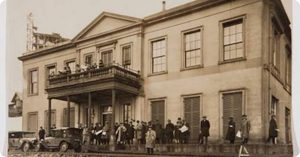
Alexander Macleay was a serious student of natural history, and the gardens around Elizabeth Bay House were planted with a wide range of plants brought in from overseas, a private collection that doubled as a working botanical showcase. His specimens, displays and scientific papers, later added to by his son William, his son George and his nephew William, became the founding collection of the Macleay Museum of Natural History at the University of Sydney, a resource still valuable to scholars today. After William’s death the estate was subdivided by his brother George Macleay, who had inherited it from him.
The Elizabeth Bay of today bears almost no resemblance to that estate. Where the grounds once sloped in unbroken gardens down to the water’s edge, dense residential development, houses and home units alike, has since filled in the winding streets around the house. Elizabeth Bay House itself survives, but what’s left of Macleay’s once-famous gardens is a single small patch of lawn: the last physical trace of a 54-acre botanical estate that used to be one of the colony’s more talked-about addresses.
Elizabeth Bay House is widely regarded as one of the finest Regency-era houses in Australia and is now run as a museum by Museums of History NSW at 7 Onslow Avenue, open to the public with regular general entry sessions and events. It’s the single most significant heritage asset in the suburb and the reason Elizabeth Bay carries more historical weight than its tiny footprint would suggest.
What Is It Like Living Here?
Living in Elizabeth Bay means accepting a very specific bargain: you are buying or renting into a beautiful, quiet, harbourside pocket of the inner city, and in exchange you give up almost every convenience that “inner city” usually implies. There is no supermarket, no real high street, no primary school and no train station inside the suburb’s own boundaries. Everything practical happens a short walk away in Potts Point or Kings Cross. Locals describe it less as a suburb you live “in” and more as a quiet residential enclave you retreat to, with the noise and amenity of Kings Cross kept at arm’s length.
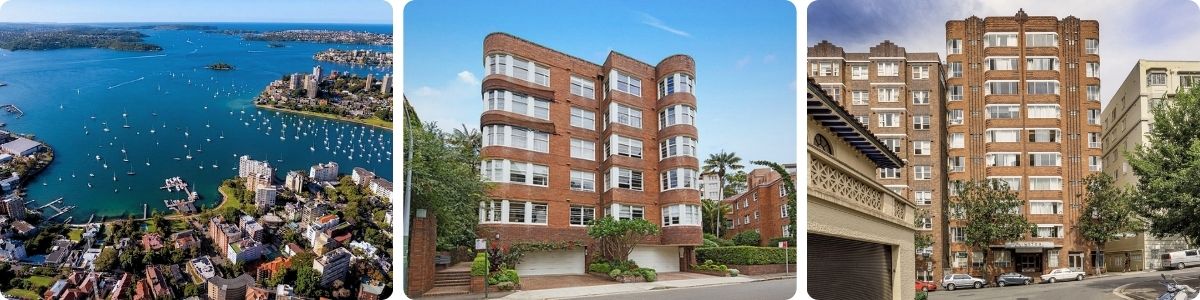
What Elizabeth Bay is actually made of, block by block, is 1920s and 1930s Art Deco apartment buildings, a concentration that rivals neighbouring Potts Point and gives the suburb a distinctive streetscape of curved balconies, wrought-iron detailing and lobby tiling that has aged into something closer to a design landmark than a relic. Layer harbour frontage on top of that, and you get a suburb where a modest one-bedroom flat can carry a water view that would cost several times as much attached to a house anywhere else in Sydney. That combination, heritage architecture plus harbour proximity in a suburb you can walk across in fifteen minutes, is the actual point of difference.
Elizabeth Bay’s median household income of $2,116 a week (2021 Census, ABS) sits well above both the NSW ($1,829) and national ($1,746) medians, and 57.9% of residents hold a bachelor degree or higher, more than double the state rate. That points squarely to professional and executive work, most of it commuted out to the CBD, North Sydney or the wider eastern suburbs corporate corridor rather than found locally. There is essentially no commercial or industrial employment base within the suburb itself; work happens elsewhere, and Elizabeth Bay functions purely as a residential address for people who can afford the commute-free luxury of walking to the CBD if they choose to.
For commuters, Elizabeth Bay has no station of its own. The closest is Kings Cross station, serviced by the T4 Eastern Suburbs & Illawarra Line (confirmed current as of August 2026), around a 7-10 minute walk from most of the suburb depending on which street you’re on, with trains to the CBD in well under 10 minutes. Bus route 311 skirts the suburb’s edge, connecting through to Central and out toward the eastern suburbs and Watsons Bay, and is useful if the walk to Kings Cross station doesn’t suit. For most residents, walking is the default mode for anything local, and a car is largely optional unless you’re commuting outside the inner city; on-street parking is tight and permit-controlled, which is a drawback for anyone who does need one.
There is no hospital in Elizabeth Bay itself, and GP clinics are thin on the ground within the suburb, with most residents using practices in neighbouring Potts Point and Kings Cross. St Vincent’s Hospital and the adjoining St Vincent’s Private Hospital in Darlinghurst are the nearest major public and private facilities, both within a few kilometres and a short drive or bus trip away, and cover the full range of emergency and specialist services an inner-city population needs. Aged care in the immediate area is limited, reflecting the suburb’s dense apartment stock rather than any purpose-built retirement housing, so ageing residents wanting to stay local tend to rely on home-care support rather than dedicated aged care facilities.
On the education front, Elizabeth Bay is too small to have its own school, government or otherwise. It sits within the catchment for Plunkett Street Public School in nearby Woolloomooloo, a well-regarded inner-city government primary that also serves Potts Point. Families wanting an independent option typically look to SCEGGS Darlinghurst or one of the other Eastern Suburbs/inner-city independent schools, none of which are walkable from Elizabeth Bay in the way a suburban school would be. Secondary schooling means a bus or train trip regardless of sector. Childcare is the tighter squeeze: CareforKids.com.au lists only a small handful of long day care and family day care services registered directly in the Elizabeth Bay postcode as of 2025, so most families end up on the books of centres in Potts Point, Kings Cross or Darlinghurst, and given the suburb’s older median age (43 years, 2021 Census) and low proportion of young families, that thin supply hasn’t historically been under the pressure it would face in a growth suburb.
Don’t come to Elizabeth Bay expecting a shopping strip, because there isn’t one. What locals actually use is Macleay Street in neighbouring Potts Point, a village high street of grocers, delis, cafes and restaurants, plus the broader Kings Cross retail and dining strip a short walk in the other direction, both offering everyday shopping options far beyond anything within Elizabeth Bay’s own boundaries. It’s an odd position for a suburb this prestigious to be in: you’re paying harbour-view prices without a single cafe of your own, and the trade you’re making is quiet residential streets in exchange for a five to ten minute walk whenever you want a coffee, a loaf of bread or dinner out.
Beare Park, on Ithaca Road, is the suburb’s green lung: a harbourside park with a playground, shaded seating and direct water views, and it’s the closest thing Elizabeth Bay has to a community gathering point. Elizabeth Bay House, run by Museums of History NSW, is the standout heritage attraction and a drawcard beyond the suburb’s own residents, with regular general entry and event openings. The Elizabeth Bay Marina serves the suburb’s substantial boat-owning contingent with berths and moorings right on the water. Beyond that, the appeal is really the harbour itself: foreshore walking access around the peninsula and water views from a large share of apartments, rather than any large-scale sporting or recreational infrastructure, which this suburb simply doesn’t have room for.
Anecdotally, residents describe Elizabeth Bay’s own streets as quiet and low-crime, a reputation that fits its older, wealthier, owner-occupier-heavy population, but this is anecdotal signal, not a substitute for suburb-specific data that simply doesn’t exist. It isn’t a suburb where residential burglary or street crime is a defining feature, but its proximity to Kings Cross’s nightlife strip is worth being clear-eyed about, especially late at night.
Realty Market
Elizabeth Bay is, for practical purposes, a unit-only market. Only around one standalone house sale was recorded in the 12 months to May 2026 (Your Investment Property Mag), which is too thin a sample to report a reliable median house price, and any figure claiming otherwise should be treated with suspicion. The unit market is where the action is: the median unit price sat at $955,000 in the year to May 2026, up a striking 12.35% over that period (Your Investment Property Mag), with a rental yield around 3.62%. A separate Domain snapshot from the same window breaks the median down by bedroom count: one-bedroom units around $897,500 (74 sold in the prior 12 months), two-bedroom units around $1,965,000 (43 sold), and three-bedroom units averaging $5,237,500 across a much thinner pool of just 12 sales, a spread that shows how dramatically the “median” moves depending on what you’re actually buying. Days on market ran 50-59 days across bedroom types, with auction clearance rates between 40% and 57%, both signs of a market that moves deliberately rather than in a frenzy.
Rental demand is strong and structural: 58.6% of occupied dwellings in Elizabeth Bay are rented (2021 Census, ABS), well above the Sydney-wide average, reflecting the suburb’s older Art Deco apartment stock and its appeal to professionals wanting a harbourside address without buying in. Domain listings in mid-2026 show weekly rents ranging broadly from roughly $1,175 to $4,750 depending on aspect, size and water frontage, while Your Investment Property Mag records an average median weekly rent around $700 across the broader stock. Investors should note this is a low-yield, capital-growth-oriented market rather than a cash-flow play.
Our Honest Thoughts on Elizabeth Bay
Elizabeth Bay is likely to appeal most to established professionals, downsizers and older owner-occupiers who want unimpeachable harbour proximity and heritage character, and who are entirely comfortable walking for groceries, coffee and the train rather than having any of it on their own doorstep. If your priority is a water view and a quiet, low-density residential street a stone’s throw from the city, few Sydney suburbs deliver it as directly. It doesn’t suit families chasing a local primary school, first-home buyers hunting for entry-level stock, or anyone who wants a local high street to call their own, because none of that exists inside Elizabeth Bay’s own boundaries. It is less compelling for investors focused on rental yield, given the roughly 3.6% return on offer and a high entry price; this is a capital-growth suburb, not a cash-flow one.
The obvious cross-shop is Potts Point next door: similar Art Deco apartment stock, similarly high owner-occupier wealth, but with its own Macleay Street shopping and dining strip that Elizabeth Bay simply doesn’t have. If you want the same architectural character and inner-city prestige but with a five-minute walk to a decent coffee rather than a fifteen-minute one, Potts Point is the more liveable everyday choice. Elizabeth Bay’s edge over it is purely the water: more direct harbour frontage, quieter streets, and a stronger sense of separation from the noise of Kings Cross. Choose Elizabeth Bay for the view and the peace, and go in accepting you’re buying a beautiful address, not a convenient one.
Frequently Asked Questions
Is there a train station in Elizabeth Bay?
No. The nearest station is Kings Cross, on the T4 Eastern Suburbs & Illawarra Line, roughly a 7-10 minute walk from most of the suburb depending on which street you live on.
Can you buy a house in Elizabeth Bay?
Technically, occasionally, but not in any meaningful volume. Only around one standalone house sale was recorded in the 12 months to May 2026 (Your Investment Property Mag). The suburb’s housing stock is 98.6% flats and apartments (2021 Census, ABS), so a freestanding house here is close to a curiosity, not a realistic option for most buyers.
Where do Elizabeth Bay residents shop and go to school?
Shopping is almost entirely done on Macleay Street in neighbouring Potts Point or in Kings Cross, since Elizabeth Bay has no retail strip of its own. School-age children fall within the Plunkett Street Public School catchment in Woolloomooloo, with independent options such as SCEGGS Darlinghurst nearby.
Is Elizabeth Bay House open to the public?
Yes. Elizabeth Bay House at 7 Onslow Avenue is operated by Museums of History NSW and runs regular general entry sessions and special events, making it one of the few visitor attractions inside the suburb itself.
Is Elizabeth Bay safe?
Crime is only tracked at the City of Sydney LGA level, which is pushed up by the nightlife precincts of Kings Cross and the CBD rather than Elizabeth Bay’s own residential streets. Anecdotal and demographic signals (an older, wealthier, owner-occupier-heavy population) point to a quiet suburb, but suburb-specific crime figures simply aren’t published, so treat that as informed inference rather than hard data.
References
- Australian Bureau of Statistics, 2021 Census Community Profiles and QuickStats, Elizabeth Bay (SAL11398), accessed August 2026
- NSW Bureau of Crime Statistics and Research (BOCSAR), LGA-level crime data, City of Sydney, 2025
- Museums of History NSW, Elizabeth Bay House visitor information, accessed August 2026
- City of Sydney Council, Beare Park Playground page, accessed August 2026
- Elizabeth Bay Marina, official berthing and moorings information, accessed August 2026
- NSW Spatial Services, NSW Administrative Boundaries Theme (suburb boundary query), accessed August 2026
For a fuller sense of how Elizabeth Bay compares to its neighbours, browse the rest of Sydney’s suburb profiles, or explore the wider Sydney regions overview to see how the inner city fits into the bigger picture.