
Waterloo is a suburb in the middle of being rebuilt, literally, while people are still living in it. You get a metro station under your feet, a demolition site over the fence, and a rental market priced for the professionals filling the new towers, not the residents being moved out of the old ones. If you want a settled, finished suburb where nothing changes for a decade, this is not it. If you want to buy or rent into the single biggest urban renewal story in inner Sydney at the point where the cranes are arriving rather than departing, keep reading.
Waterloo Boundary and Location Map
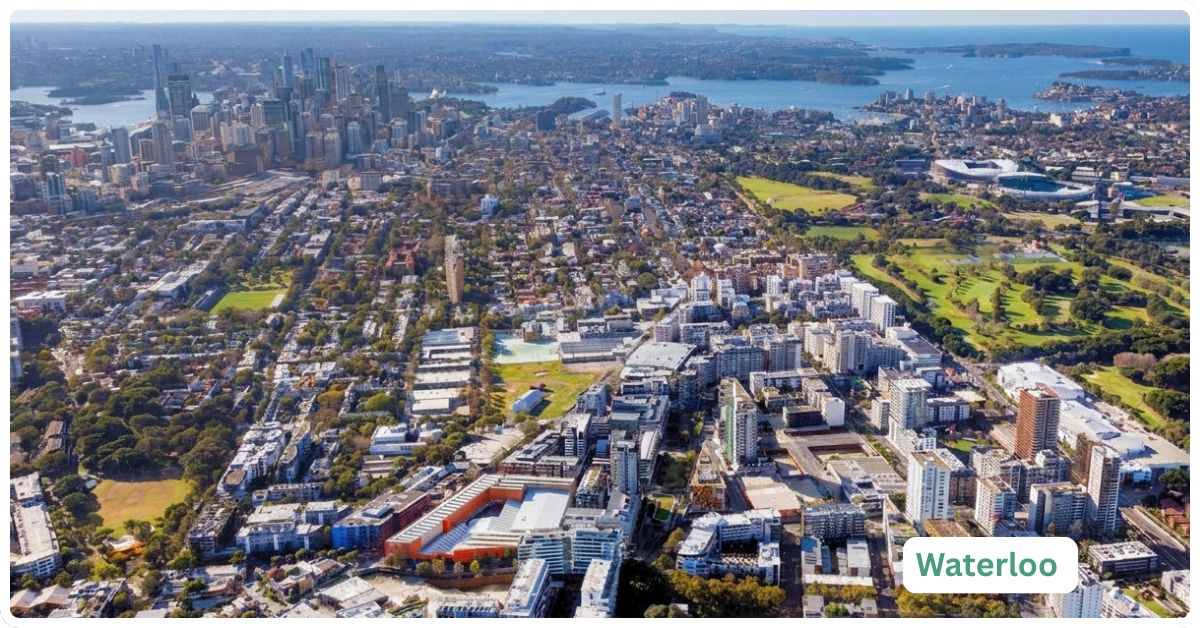
Waterloo sits about 3 kilometres south of the Sydney CBD, inside the City of Sydney local government area. It’s a small, tightly bounded suburb, roughly a square kilometre, wedged between Redfern to the north and west, Alexandria to the south, Zetland and Green Square to the east, and Surry Hills and Darlington nearby to the north. Botany Road and Bourke Street form the spine most residents navigate by; the old Waterloo public housing estate occupies a large chunk of the suburb’s centre, directly around the metro station.
Quick Facts
| LGA | City of Sydney |
| Postcode | 2017 |
| Population | 16,379 at the 2021 Census, up 12.1% on 2016. No official update since; a 2026 estimate is not yet published, though the pace of apartment completions and the Waterloo South relocation program mean the actual current figure is moving in both directions at once (Australian Bureau of Statistics, 2021 Census, released June 2022; htag.com.au market data, referencing 2021 Census, accessed August 2026) |
| Growth Rate | 12.1% population growth 2016 to 2021 (ABS Census). New supply from Waterloo Metro Quarter and, later, Waterloo South will drive further growth over the next decade, offset in the near term by the demolition and relocation of roughly 150 existing public housing units from mid-2026 |
| Distance from CBD | Approximately 3 kilometres south of the Sydney CBD |
| Character | Dense, apartment-dominated inner-city suburb, half established high-rise public and private housing, half active construction site, built around a brand-new metro station |
| Median House Price | Around $1.7 million, but treat this figure with real caution. Separate houses are just 0.5% of Waterloo’s dwelling stock (2021 Census), so the “house” sample is dominated by terraces and townhouses on a handful of annual sales, not a reliable market indicator (PropertyValue.com.au, 12 months to August 2026) |
| Median Unit Price | $929,000, down 1.2% over the past 12 months, on a much deeper sample (96 unit sales in the most recent quarter alone). This is the figure that actually describes the Waterloo market (OpenAgent, sourced from CoreLogic-derived data, accessed August 2026) |
| Transport | Waterloo Metro station (Sydney Metro City & Southwest, opened August 2024) sits inside the suburb; Green Square station (T8 Airport & South Line) is a short walk over the Zetland border. Extensive local bus network along Botany Road, Bourke Street and Wyndham Street |
| Crime Rate (LGA) | City of Sydney LGA runs above the NSW average on most recorded offence categories, consistent with an inner-city LGA carrying heavy licensed venue, retail and transient foot traffic. BOCSAR’s year-to-March-2026 LGA data was released mid-2026 as a raw dataset rather than a single published rate; we were not able to source one clean, citable incidents-per-100,000 headline figure for the LGA as a whole, and we’d rather say that than invent one. This is LGA-wide, not Waterloo-specific (NSW Bureau of Crime Statistics and Research, LGA data release, June 2026) |
| Childcare Availability | Tight. A handful of long day care centres and family day care options sit within Waterloo itself, with more across the border in Alexandria, Zetland and Redfern, but Green Square’s population boom has pushed demand hard against supply across the whole precinct (StartingBlocks.gov.au / ACECQA national register, accessed August 2026) |
| School Zone Quality | Solid rather than outstanding. Bourke Street Public School and Alexandria Park Community School (K-12) are the local government options; both have absorbed rapid enrolment growth as Green Square and Waterloo have densified |
| Parks & Recreation | Waterloo Park (playground, skate park, sports oval, fitness equipment) and Turruwul Park nearby; Sydney Park and Alexandria’s Alexandria Park are both a short walk or ride away for anyone wanting real green space |
| Shopping | Danks Street precinct for boutique retail, galleries and cafes; broader everyday shopping via Woolworths, Coles and the Meriton retail strip on Bourke Street, with Green Square Town Centre’s larger amenity just over the Zetland boundary |
| Health | Multiple GP clinics within the suburb (including on Bourke Street); nearest major public hospitals are St Vincent’s Hospital (Darlinghurst) and Royal Prince Alfred Hospital (Camperdown), both a short drive or bus ride away |
| Best For | Renters and owner-occupiers who want a metro-linked apartment lifestyle close to the CBD and are comfortable living alongside an active urban renewal project for the next decade or more |
What Makes Waterloo Special
History
Waterloo’s land was originally part of Smith’s Grant, a colonial-era land grant in the Parish of Petersham, and by the mid-nineteenth century the area was being progressively subdivided around Shea’s Creek (later canalised into the Alexandra Canal). What followed was industry, not gentility. Waterloo Mills, a woolwashing establishment photographed in 1877, and the Waterloo Tanning School (a Sydney Technical College satellite training leatherworkers) set the tone for a suburb that grew up around trades, manufacturing and workers’ cottages rather than harbour views (Dictionary of Sydney, State Library of NSW image archive, accessed August 2026).
The defining chapter, though, is public housing. The first four small apartment blocks went up in 1948 as part of the post-war housing push, followed by low-rise complexes through the 1960s. The Endeavour Project of the 1970s delivered the estate’s most recognisable architecture: four 17-storey slabs and two 30-storey towers, built as high-density social housing at a scale rarely attempted in Sydney before or since. More low- and mid-rise blocks followed into the early 1980s. By the time construction wound down, Waterloo held one of the largest concentrations of public housing anywhere in the country (The Conversation, “Sydney’s largest public housing estate is being redeveloped”, October 2024; NSW Government, Waterloo renewal project page, accessed August 2026).
Waterloo South: the redevelopment that defines the suburb right now
Waterloo is in the middle of what the NSW Government describes as Australia’s largest social housing renewal project. Waterloo South, the first and southernmost of three planning stages covering the estate (Waterloo South, Central and North), will replace 750 existing public homes with roughly 3,300 mixed-tenure dwellings: around 50% private, 30% social and 20% affordable housing under the government’s own figures, delivered progressively over an estimated 10 to 15 years.
As of August 2026, this is not a future plan on paper, it is happening. Homes NSW lodged a Concept State Significant Development Application and rezoning proposal for Waterloo South in April 2026, which went to public exhibition from 6 May to 2 June 2026 and remains under departmental review, with a final determination expected late in 2026. Separately, and further along, a Stage 1 Review of Environmental Factors for early demolition was approved, and the first block of roughly 150 units was fenced off in late May 2026 ahead of demolition, which was scheduled to begin by the end of June 2026 and run in stages over 6 to 9 months. Most existing tenants had been relocated by this point, including at least 70 households moved into new social housing built directly above Waterloo Metro station, though activists and some remaining residents disputed how complete and how voluntary that relocation process actually was. A protest encampment occupied the site from late May, was cleared by police on 19 June 2026 (one arrest, for trespass), and demolition proceeded from there (NSW Government, Waterloo renewal project page, updated 6 May 2026; NSW Department of Planning, Waterloo South priority precinct page, accessed August 2026; ABC News, 25 May 2026 and 19 June 2026).
We’re not going to relitigate the social policy argument here (whether mixed-tenure renewal genuinely improves outcomes for existing public housing tenants, or whether it’s a net loss of public housing stock dressed up as renewal, is a real and contested debate, and it isn’t ours to settle). What matters for anyone considering Waterloo as a place to live is the practical reality: demolition, construction noise, site fencing, hoarding and staged building works will be a feature of parts of this suburb, on and off, for well over a decade. Buy or rent expecting a long-running construction backdrop, not a finished neighbourhood.
What Is It Like Living Here?
Day to day, Waterloo reads as a young, transient, apartment-dwelling suburb that happens to sit on top of one of Sydney’s biggest infrastructure and housing stories. Most residents rent (72.7% at the last Census), most live alone or as a couple without kids, and most are within walking distance of a metro station that didn’t exist two years ago. It’s convenient and current, but it isn’t settled, and it isn’t cheap to rent given the location.
Transport
Waterloo Metro station opened in August 2024 on the Sydney Metro City & Southwest line, and it’s the single biggest change to the suburb in decades. It puts the CBD (Barangaroo, Martin Place, Central) around 6 to 10 minutes away by turn-up-and-go metro service, no timetable required. Green Square station, on the T8 Airport & South Line, sits just over the Zetland boundary and is walkable from eastern parts of Waterloo, giving a second option toward Central and the airport.
Locally, bus services run along Botany Road, Bourke Street and Wyndham Street connecting Waterloo to Redfern, Surry Hills and the CBD, though the metro has taken pressure off buses as the default commute. Don’t buy here expecting easy car access into the CBD at peak hour; Waterloo isn’t built for driving in, it’s built for walking to the platform.
Healthcare
Several GP clinics operate within Waterloo itself, including general practices along Bourke Street offering standard family medicine, women’s and men’s health, chronic disease management and vaccinations. For anything beyond a GP, the nearest major public hospitals are St Vincent’s Hospital in Darlinghurst and Royal Prince Alfred Hospital in Camperdown, both reachable by bus or a short drive. Neither is walkable, which is a genuine consideration for anyone without a car and reliant on public transport for hospital visits.
Schools and Childcare
Waterloo’s demographic skews so heavily toward young, childless renters (children aged 0-14 are just 7.8% of the population, versus 18.2% across NSW) that schools and childcare have never been the primary drawcard here, though that’s shifting as families increasingly move into the newer apartment stock. Locally zoned government schools are Bourke Street Public School and Alexandria Park Community School, the latter a K-12 school covering both primary and secondary years. Neither carries the premium reputation of the eastern suburbs’ selective or heavily zoned schools, but both have coped with genuinely fast enrolment growth as Green Square and Waterloo have densified around them, and that growth pressure is worth knowing about before you commit.
Childcare is tight. A small number of long day care centres operate within Waterloo (including services registered on the national ACECQA register), and more are available across the border in Alexandria, Zetland and Redfern, but Green Square’s rapid population growth over the past decade has pushed demand against supply hard across the whole precinct. If childcare is a non-negotiable for your household, get on waitlists early and don’t assume a place will be waiting when you need it.
Industry & Work Life
Waterloo’s old industrial base (woolwashing, tanning, light manufacturing) is long gone, replaced by commercial office and creative-industry space, much of it converted from former warehouses. Today’s typical resident is a young professional commuting into the CBD, Surry Hills or the broader inner-city tech and creative economy, helped enormously by the metro connection. It’s a suburb built for people who work in the city and want a short, easy commute, not one with a substantial local employment base of its own.
Shopping & Eating Out
Danks Street is Waterloo’s genuine point of difference: a compact strip of galleries (including the long-running 2 Danks Street art complex), specialty cafes and small restaurants that gives Waterloo a genuine local identity distinct from the surrounding new-build towers. For everyday shopping, there’s a Woolworths and Coles plus the Meriton retail strip on Bourke Street, and for bigger-format shopping, Green Square Town Centre’s larger amenity (more supermarkets, chain retail, a library and community facilities) is a short walk or ride across the Zetland border.
Attractions, Parks and Natural Spaces
Waterloo Park, on Elizabeth Street at McEvoy Street, is the suburb’s main green space: a playground, sports oval, skate park (920 square metres, catering to skaters, scooters and BMX riders), outdoor fitness equipment and off-leash dog areas. Turruwul Park nearby adds more playground and open space. For anyone wanting more than a neighbourhood park, Sydney Park in adjoining St Peters and Alexandria Park in Alexandria are both a short walk or bike ride away, and offer the kind of larger, open green space that Waterloo’s own dense, built-up footprint doesn’t have room for.
Crime and Safety
Crime data is only available at the City of Sydney LGA level, not suburb by suburb, so treat anything here as a description of the LGA, not of Waterloo specifically. City of Sydney’s recorded crime, per BOCSAR’s 2026 LGA data releases, runs above the NSW average across most offence categories, which is typical of a dense inner-city LGA carrying heavy licensed-venue, retail and transient foot traffic well beyond its resident population. We were unable to source a single, clean, citable incidents-per-100,000 headline figure for the LGA as a whole from BOCSAR’s most recent release, and rather than invent one, we’re saying so directly: check BOCSAR’s Crime Mapping tool (crimetool.bocsar.nsw.gov.au) directly for the latest LGA-level breakdown if this is a deciding factor for you. Anecdotally, the Waterloo South construction and relocation site has drawn a heavier-than-usual police and security presence through mid-2026 due to the demolition protests, which is a temporary, project-specific factor rather than a reflection of everyday safety in the suburb.
Realty Market
Waterloo is, functionally, a unit market. Flats and apartments make up 91.1% of dwellings, semi-detached and townhouses another 8.1%, and separate houses just 0.5% (2021 Census). That last figure matters: any “median house price” quoted for Waterloo is describing a tiny handful of annual sales, mostly older terraces, and should be treated as indicative at best, not a reliable market signal. The figure most agents and data providers cite is around $1.7 million, but with genuinely thin volume behind it.
The unit market is the real story: a median of $929,000, down 1.2% over the 12 months to August 2026, on a much deeper sample (96 unit sales in the most recent quarter alone, versus single digits for houses). That modest softening sits against a backdrop of significant new supply arriving through the Waterloo Metro Quarter development and, eventually, Waterloo South’s roughly 1,500 private dwellings, which will add meaningfully to competing stock over the next decade (OpenAgent / CoreLogic-derived data; PropertyValue.com.au, both accessed August 2026).
Rental demand is strong and rents are high for the dwelling size on offer: median weekly rent sits around $530 to $1,150 per week depending on dwelling type and data source (the $530 Census figure covers the full mix of household types including share housing; more recent listings-based data for standalone units skews notably higher), with vacancy sitting tight at around 1.4%. Gross rental yields for houses run around 3.2 to 3.5%, again on a thin sample; unit yields are the more meaningful figure for most investors given the dwelling mix, and sit in a broadly comparable range. With 72.7% of Waterloo households renting rather than owning, this is fundamentally a landlord’s market in terms of demand, even as price growth has flattened (Australian Bureau of Statistics, 2021 Census; PropertyValue.com.au and htag.com.au, accessed August 2026).
Our Honest Verdict
Waterloo suits renters and owner-occupiers who want the shortest possible commute to the CBD, don’t need much living space, and are comfortable living next to an active, decade-plus construction and social housing renewal project. It’s likely to appeal most to young professionals and couples without children who value the metro connection and Danks Street’s genuine local character over a settled, finished streetscape. It’s less compelling for anyone chasing a family-sized home, a quiet, unchanging neighbourhood, or a large green backyard; the suburb simply doesn’t have the dwelling stock or the open space for that, and won’t for years.
It’s also worth being clear-eyed about the Waterloo South story specifically. This is not a suburb where you can assume a stable status quo. Whichever side of the public housing renewal debate you land on, the practical reality for a resident is staged demolition, construction traffic and site disruption around the metro precinct through at least the mid-2030s. If that’s a dealbreaker, this isn’t the suburb for you right now, regardless of how good the transport link is.
For a genuine cross-shop, look at Zetland. It sits immediately next door, shares almost identical apartment-dominated housing stock and a similarly young, renter-heavy demographic, and carries a comparable median unit price (around $995,000 as of 2026). The difference is that Zetland’s major redevelopment phase (the old Elizabeth Street industrial precinct turned into Green Square) is largely finished and settled, while Waterloo’s biggest transformation is only just getting underway. If you want the same lifestyle without the active construction site, Zetland is the more finished version of the same bet. If you want to get in before Waterloo South is complete and the suburb’s character has fully turned over, Waterloo is where that opportunity sits, for better or worse.
Frequently Asked Questions
Is Waterloo a good suburb to buy an investment property in?
It depends heavily on your goal. Rental demand is strong (vacancy around 1.4%, 72.7% of residents rent) and the metro link is a real, permanent amenity uplift. But unit prices have been flat to slightly down over the past 12 months, and a wave of new supply from Waterloo Metro Quarter and eventually Waterloo South’s private apartments will add competing stock over the next decade, which is a genuine headwind for capital growth. This isn’t investment advice; it’s a description of the supply and demand picture as it currently stands, and it’s worth weighing against your own goals and a financial adviser’s input.
What is happening with the Waterloo public housing estate right now?
As of August 2026, the first stage (Waterloo South) is in early demolition. Around 150 units were fenced off in late May 2026, a protest encampment on the site was cleared by police in mid-June 2026, and demolition of that first block began shortly after, scheduled to run in stages over 6 to 9 months. Most existing tenants had been relocated ahead of this, including at least 70 households moved into new social housing built above Waterloo Metro station. A wider rezoning proposal for the full Waterloo South site remains under NSW Government review after public exhibition closed in June 2026, with a determination expected later in 2026. The plan is to replace 750 existing public homes with around 3,300 new mixed-tenure dwellings over an estimated 10 to 15 years.
Is Waterloo well connected by public transport?
Yes, this is Waterloo’s strongest single feature. Waterloo Metro station opened within the suburb in August 2024, putting the CBD around 6 to 10 minutes away with a turn-up-and-go service. Green Square station on the T8 line is walkable from parts of the suburb, and local buses run along Botany Road and Bourke Street. It’s a suburb built around not needing a car for the daily commute.
Are schools and childcare a strong point in Waterloo?
Not particularly, and that’s consistent with the demographic; only 7.8% of residents are aged 0-14, well below the NSW average. Zoned government schooling is available (Bourke Street Public School, Alexandria Park Community School) and both have absorbed significant enrolment growth as the wider precinct has densified. Childcare is genuinely tight across the whole Green Square and Waterloo area, so families should get onto waitlists well ahead of need rather than assuming availability.
How does Waterloo compare to Zetland?
They’re close cousins: similar apartment-dominated stock, similar median unit prices, similar renter-heavy, young-professional demographic. The practical difference is timing and disruption. Zetland’s major redevelopment cycle is largely behind it; Waterloo’s is only just beginning. Choose Zetland for a more settled version of the same lifestyle, or Waterloo if you’re comfortable living alongside an active, long-running construction and renewal project in exchange for being early to however the suburb ultimately turns out.
References
- Australian Bureau of Statistics, 2021 Census Community Profiles and QuickStats, Waterloo (NSW), released June 2022, accessed August 2026
- NSW Spatial Services, NSW Administrative Boundaries Theme (suburb and LGA boundary data), accessed August 2026
- NSW Government, “Waterloo renewal project”, nsw.gov.au, last updated 6 May 2026
- NSW Department of Planning, Housing and Infrastructure, “Waterloo South” priority precinct page, planning.nsw.gov.au, accessed August 2026
- NSW Bureau of Crime Statistics and Research (BOCSAR), LGA-level recorded crime data releases and Crime Mapping tool, updated June 2026, accessed August 2026
- StartingBlocks.gov.au / Australian Children’s Education and Care Quality Authority (ACECQA) national register, accessed August 2026
- City of Sydney Council, Waterloo Park and Turruwul Park pages, cityofsydney.nsw.gov.au, accessed August 2026
For more Sydney suburb profiles, browse the full Sydney suburbs directory, or explore the broader Sydney regions overview.