
On a sandstone platform at Marks Park, just south of Bondi, the first people of this coast carved a shark into the rock. It’s about six metres long, with a fish inside it and another swimming at its side.
Most of the thousands of people who walk past it each week don’t notice it. They’re looking at the water, or their phones, or the person in front of them on the stairs.
That’s the thing about the Bondi to Coogee walk. It’s six kilometres long and you can do it in two hours, but it packs in more stories per step than almost any coastline in Australia: Aboriginal engravings, a cliff-top cemetery full of poets, a vanished amusement park, five ocean pools and the strangest murder case in Sydney’s history.
Here’s how to walk it well, what’s changed in the past year, and what’s worth stopping for.
Bondi to Coogee Walk Map (& KML)
Here’s the KML file for the route with markers for the highlights along the route (zoom in for info), which you can load into your favourite map app.
Before you go: what’s happening on the walk right now
Sculpture by the Sea runs from Friday 16 October to Monday 2 November 2026. It’s the 30th year that around 100 sculptures have lined the Bondi to Tamarama stretch, centred on Marks Park. It’s free, and it’s spectacular. Transport for NSW expects about 450,000 visitors.
That means crowds. On a sunny weekend afternoon, the cliff path is shoulder to shoulder. Clearways apply on Bondi Road and Campbell Parade on the weekends, and local streets close during the day. The Transport for NSW event page says to leave the car at home, and it’s right.
The path at Bronte has a detour. Two things are going on there. Bronte Surf Life Saving Club is being rebuilt, a $24 million project due to finish around April 2027, and the coastal walk is on a temporary diversion around the site.
Then, at noon on 1 August 2025, a section of cliff at North Bronte collapsed onto the sand below a stairway. Nobody was hurt. “It was fully in the spot where I was walking, so I would have died,” one surfer told reporters. Parts of the beach, the park and the walk near the surf club remain closed while Waverley Council arranges cliff remediation, and no reopening date has been set. Follow the signs.
The good news is at Marks Park. A cliff collapse in April 2024 took out part of the walkway at Tamarama. After stabilisation works, a rebuilt path and a delay over the steel balustrade, it reopened on 12 December 2025.
The walk at a glance
| Distance | About 6km one way |
| Time | 2–3 hours walking, a half day with swims and coffee |
| Difficulty | Grade 2, with steep stair sections |
| Prams and wheelchairs | Not suitable end to end. Randwick’s Clovelly to Coogee section is accessible except at Gordons Bay. |
| Dogs | On a lead on the path, but not on beaches or at Gordons Bay |
| Cost | Free, plus pool entry if you swim at Icebergs, Wylie’s or McIver’s |
Which way to walk
Start at Bondi and walk south. It’s easier to get to Bondi, you’ll be walking with the crowd rather than into it, and you’ll finish in Coogee, where the pools and pubs are and the buses to the city leave often.
The exception is Sculpture by the Sea. If you go in the next few weeks, start at the Tamarama end, so you’re walking against the flow, or go on a weekday morning in the first hour after sunrise.
At any time of year, start early. There is little shade on the clifftops, and one TripAdvisor reviewer this month said they “wouldn’t want to do it in 40′ heat.” Joggers own the path at dawn and dusk, so keep left.
Bondi to Tamarama: sharks in stone
The name Bondi comes from the Dharawal language. The Gujaga Foundation, working with Waverley Council, says it describes a loud thud: the sound of waves breaking over rocks. Surveyor James Meehan wrote it down as “Bundi Bay” in 1809.
Walk past Bondi Icebergs and along Notts Avenue, then climb up to Marks Park on Mackenzies Point. This is where to find the shark engraving. Council asks that you never walk on or touch the engravings. The grooves are fragile, and well-meaning people have done enough damage already: in 1951 and 1964, the carvings at nearby North Bondi were recut by a stonemason, and some images weren’t traced exactly.
From May to November, look out to sea from here. This is humpback territory, and the whales are on their southern migration in spring, often mothers with calves. The Dharawal word for humpback whale is buriburi, and at North Bondi there’s an engraving of one.
Tamarama and the vanished Wonderland
Tamarama is small, steep and deep. The 1839 land grant called it “Gamma Gamma”, which is believed to mean storm. It has earned that name. Its rip currents give it one of the higher rescue rates for its size in Sydney, so swim between the flags or not at all.
It’s hard to picture now, but this narrow gully was once a theme park. Wonderland City opened on 1 December 1906, and 20,000 people turned up on the first night. Among its attractions was an airship called the “Airem Scarem” that ran on a cable from cliff to cliff, over the water at high tide.
The owner, William Anderson, also fenced off the public path to the beach. Local swimmers kept cutting it down. In March 1907 the Lands Minister resumed the strip “to give free access for all time to the beach at Tamarama Bay,” according to the Dictionary of Sydney, and many of those fence-cutters went on to found Tamarama Surf Life Saving Club. Wonderland City closed in 1911.
Every Sydneysider who has walked onto a beach for free owes those swimmers a small debt.
Bronte: baths, barbecues and a detour
Bronte probably isn’t named after the sisters. The more likely story is Lord Nelson, who was made Duke of Bronte in 1799, which is why the bay was officially called Nelson Bay for a long time.
Bronte Baths date from 1887, when the old bogey hole was enlarged and a sea wall built. It’s believed the Australian crawl was first seen there, in 1899. The baths are free, and are closed on Wednesdays for cleaning, starting about four hours before low tide. The little rock pool at the southern end, the Bogey Hole, is free too, and best at low tide.
Bronte Park is the best place on the walk to stop for an hour. There are barbecues, grass, toilets, and a strip of cafes across the road. Bronte beach has a strong permanent rip on its southern side, and lifeguards patrol year-round.
Waverley Cemetery: the most beautiful view in Sydney belongs to the dead
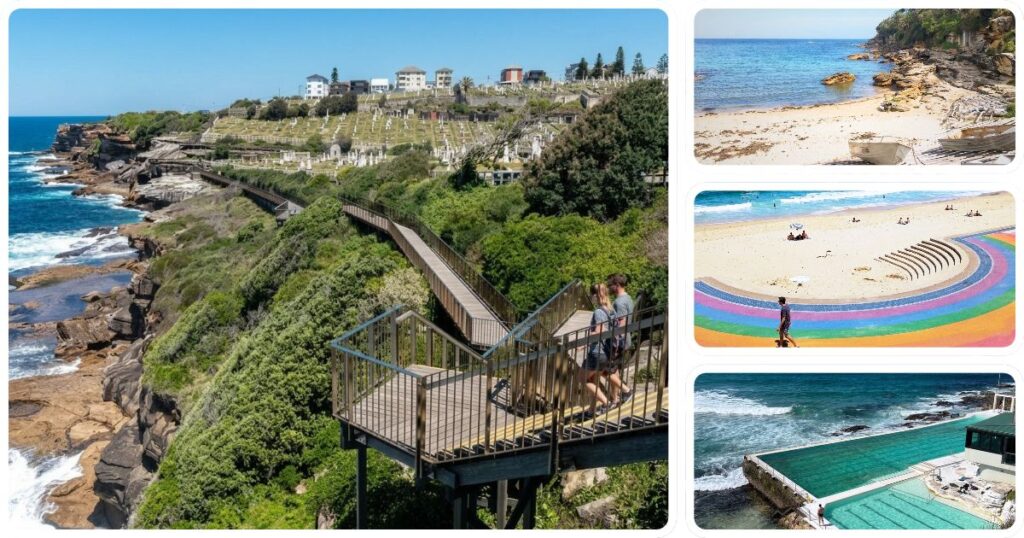
South of Bronte, the path climbs up onto the 515-metre boardwalk that runs along the cliff below Waverley Cemetery. It opened in 1877 and covers about 16 hectares, its white headstones running right to the edge of the sandstone.
Henry Lawson is buried here. So is Dorothea Mackellar, who wrote “My Country”. So are poet Henry Kendall, J F Archibald (co-founder of The Bulletin and the man behind the Archibald Prize), cricketer Victor Trumper, aviation pioneer Lawrence Hargrave and Olympic champion Fanny Durack. There are more than 200 war graves.
The largest monument is the 1798 Memorial to the Irish rebellion, built between 1898 and 1901. A space is still left on it for Robert Emmet’s name, which was never carved.
The cliff here is fragile. A storm in June 2016 caused the collapse of some 77,000 square metres of fill in the cemetery’s central gully, according to the State Heritage Register. The walk was closed for more than two years until $4.26 million of sea wall and landslip works were completed, and it reopened in October 2018.
Walk slowly here. It’s the quietest part of the route, and it’s a reminder that everyone who has ever looked out at this view has been passing through.
Clovelly and Gordons Bay: the snorkelling stretch
Clovelly is a long, narrow inlet more like a natural swimming pool than a beach, and it’s the calmest water on the walk. The concrete platforms that line it were built during the Depression, between 1929 and 1933, as part of a plan to dam the mouth of the bay with a causeway. A storm in 1938 destroyed the works, and the plan was abandoned.
Clovelly Ocean Pool had new accessible stairs and resurfacing in 2025. Lifeguards patrol the beach from sunrise to sunset every day of the year. There’s a cafe, toilets and showers.
Gordons Bay is just around the corner, and you can only reach it from the coastal walk. The beach is lined with the fishing club’s boat racks. Under the water is a 600-metre underwater nature trail: concrete-filled drums about 20 metres apart, linked by a chain and marked with plaques. Snorkellers can follow it on a clear day. Bring your own snorkel.
There are no toilets at Gordons Bay, no dogs, and no alcohol. This is also the one section of Randwick’s walk that isn’t accessible, because of the steep steps up the north side.
Coogee: three pools and a shark story
Coogee comes from “koojah”, usually translated as bad smell or stinking place, after the seaweed that washes up and rots on the sand.
As you come down onto the northern headland, you reach Dolphin Point in Dunningham Reserve. It’s a memorial to the people killed in the Bali bombings of 12 October 2002, including six members of the Coogee Dolphins rugby league club. It lists 20 residents of Sydney’s eastern suburbs, and was dedicated on the first anniversary. The 24th anniversary passed just this week. Stop here for a moment.
The pools
Coogee has more ocean pools than any other beach on the walk.
- Giles Baths is on the northern headland, reached from Dunningham Reserve. It’s free, but it can be rough in big surf. Oscar Giles leased it in 1924 and built a Mediterranean-style bathhouse whose sign read “Ladies Mens Hot Sea Baths”.
- McIver’s Ladies Baths is for women and children only, and has been officially since 1876. It’s run by the Randwick and Coogee Ladies Amateur Swimming Club, which has managed it for more than a century. It’s open 7am to 7pm in summer, 7am to 4pm in winter, and closed on Tuesdays for cleaning. Pay a small entry fee at the gate.
- Wylie’s Baths is the most beautiful pool on the walk. Champion swimmer Henry Wylie opened it in 1907, and it was one of the first places in Australia to allow men and women to swim together. His daughter Mina won silver at the 1912 Stockholm Olympics, behind Fanny Durack, who you passed in Waverley Cemetery. Entry is $6.50 for adults, and the kiosk sells coffee and toasties (Wylie’s).
The Shark Arm case
In April 1935, a tiger shark caught off Coogee was put on display at the Coogee Aquarium. On Anzac Day, it vomited up a human arm, still with a tattoo of two boxers on it. Fingerprints identified the arm as belonging to James Smith.
What followed became one of Sydney’s most famous unsolved cases. A man was charged with murder. A key witness was found shot dead in his car at Dawes Point hours before the inquest. The case fell apart, and the accused was acquitted. The Dictionary of Sydney has the full story.
It’s a strange tale to remember as you look down at the water. Coogee had a more serious reminder in June 2026, when a swimmer was badly hurt by a shark close to shore. Shark sightings also closed Bondi for several days later that month. The NSW Government has since expanded drone surveillance across Sydney beaches. Swim where lifeguards are on duty, and get out if they tell you to.
Swimming the walk: the ocean pools compared
| Pool | Cost | Watch out for |
|---|---|---|
| Bondi Icebergs | $10 adult, $7 child, $30 family | Closed Thursdays for cleaning (may open in summer when tides allow) |
| Bronte Baths | Free | Closed Wednesdays for cleaning |
| Clovelly Ocean Pool | Free | Usually cleaned on Fridays |
| Giles Baths | Free | Rough in big surf |
| McIver’s Ladies Baths | Small entry fee | Women and children only; closed Tuesdays |
| Wylie’s Baths | $6.50 adult | 7am–7pm October to April |
Getting there and back
By bus: the 333 runs from Circular Quay and Bondi Junction to Bondi Beach. To get back from Coogee, the 373 goes to the city and the 313 goes to Bondi Junction station. During Sculpture by the Sea, there’s an extra 381 loop between Bondi Junction and Tamarama, and a weekend-only 362 between Coogee and Tamarama. Expect queues.
By car: don’t, if you can help it. Beachside parking at Bondi cost $11.60 an hour under Waverley Council’s 2025–26 rates, and it fills up early, even at 8am. Coogee’s beach parking is still unmetered, after Randwick Council voted down paid visitor parking in mid-2026, but has time limits. A car also leaves you at the wrong end of a one-way walk.
Staying safe on the cliffs
This is a beautiful walk, and the cliffs that make it beautiful are dangerous.
People have fallen to their deaths along this coast in recent years, including at Dunningham Reserve in Coogee in 2022 and 2024, and at North Bondi in 2022. Some had climbed over fences to get a better photo. The fences are there for a reason.
After heavy rain or a big swell, sections of the walk sometimes close because of rockfalls or waves washing over the path. Check Waverley and Randwick council updates before you go. If you’re rock fishing, wear a lifejacket and never fish alone. In the warmer months, bluebottles often wash up, so watch where you step.
Keep going: longer versions of the walk
- Coogee to Maroubra: about 5km further south, past Wedding Cake Island. There’s still a gap at Lurline Bay, where you’ll detour inland via Malabar Road. Randwick has bought land to close it, but calls the link a longer-term priority. Finish with a swim at Mahon Pool, which turned 90 this year.
- North to Watsons Bay: the Federation Cliff Walk from Dover Heights to Watsons Bay is about 5km, and easy.
- Bondi to Manly: an 80km waymarked trail that you can walk over two to seven days.
What we couldn’t confirm
There’s no official count of steps or total climb for the walk, so we haven’t given one. Randwick’s website hadn’t confirmed the end of the 2025 works at Clovelly pool when we checked. McIver’s doesn’t publish its entry fee online. Waverley’s parking rates are from the 2025–26 schedule, and the 2026–27 rates may be slightly higher.
Waverley also has no single live page showing closures on the coastal walk. We found no other closures as of 15 October 2026, but the coast changes quickly.
The last word
You can walk from Bondi to Coogee in two hours, take a selfie at Icebergs, and call it done. Plenty of people do.
But if you slow down, you’ll find a carved shark older than the colony, a beach that swimmers won back by cutting down a fence, poets buried on a cliff, and a pool built by the father of an Olympic medallist. It’s six kilometres of Sydney’s history, laid out along the edge of the Pacific.
Take your time. The water will still be there when you get to Coogee.