
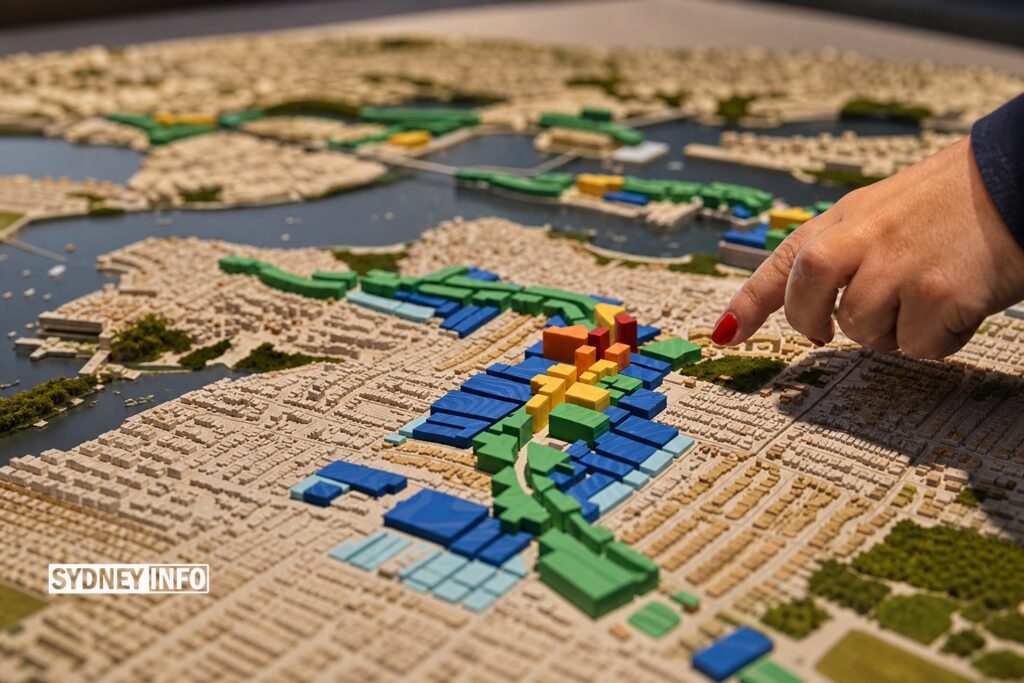
The vote was unanimous. Mosman Council endorsed its draft Masterplan and draft Affordable Housing Contributions Scheme on 26 August 2026, sending both proposals to the NSW Department of Planning, Housing and Infrastructure after 25 community members addressed the meeting.
The decision advances a long-term plan for approximately 4,700 additional homes while directing growth towards Mosman’s town centres and major corridors. It does not rezone individual properties or approve apartment projects, with detailed planning controls still requiring state assessment and formal public exhibition.
About 4,000 interactions were recorded during the early engagement program, including 2,680 online survey responses, 257 written submissions, 309 drop-in participants and more than 250 pop-up participants. Council said the engagement involved about 11 per cent of Mosman’s adult population, making the next consultation stage important for residents trying to understand how the preferred approach may affect particular streets.
Ann Marie Kimber, Mayor of Mosman, said the level of participation showed how closely residents were watching the municipality’s future. “The extraordinary level of community engagement in the Mosman Masterplan demonstrates how deeply residents care about the future of our community,” she said.
Kimber urged residents to remain involved as the proposal moves through the state process. She said residents should continue sharing their views while Council plans for future housing needs and works to protect Mosman’s character and amenity.
The masterplan follows years of disagreement over the NSW Government’s Low and Mid-Rise Housing Policy, which Council opposed in February 2024 because of concerns about its effect on built form, infrastructure and local character. Earlier consultation tested a “Low and Wide” option with buildings between three and 20 storeys across 13 per cent of Mosman, and a “High and Narrow” option with buildings between three and 28 storeys across 9 per cent, concentrated around Military Road, Spit Road and Spit Junction.
The final endorsed package may refine those earlier models. Residents will need to read the eventual maps, height controls, floor-space ratios, setbacks, heritage provisions and design standards to see what can actually be built in each area.
Growth is expected to be felt most strongly around centres and movement corridors rather than evenly across every residential street. Council has identified these locations as suitable for additional housing because they are close to shops, services, bus routes and existing infrastructure, although greater intensity could bring construction disruption, parking pressure and a more demanding urban form.
Transport will be a central test. Military Road and Spit Road carry much of Mosman’s regional traffic, while the Spit Bridge remains a critical connection between the Northern Beaches, the Lower North Shore and Sydney CBD, so the value of new housing will depend partly on bus capacity, safer crossings, footpath upgrades, cycling links and reliable infrastructure funding.
The package is supported by 18 specialist studies covering urban design, transport, heritage, infrastructure, environmental sustainability, biodiversity, flooding, stormwater, affordable housing and economic feasibility. Council is also progressing an Infrastructure Contributions Plan, an Affordable Housing Framework and a proposed Voluntary Planning Agreement Policy, although the available announcement does not set out project costs or guaranteed construction dates.
The affordable housing scheme is intended to create a statutory way to collect contributions from eligible development and direct them towards housing that remains affordable in perpetuity. Its final contribution rate, qualifying developments, management arrangements and eligibility rules have not been provided, so residents should avoid treating all future housing as affordable housing.
The Mosman Historical Society has raised a different concern, warning that the NSW policy in its present form could cause significant losses to the municipality’s heritage. That view sets up the central question for the next stage: whether density can be concentrated around Spit Junction and the Military Road-Spit Road corridor while protecting heritage streetscapes and delivering usable transport, open space and community facilities.
The next step is state assessment. If the Department allows the planning proposal to proceed, Council will place the detailed planning controls on formal public exhibition, while the Affordable Housing Contributions Scheme will follow its own statutory assessment and exhibition process.
Residents who want to understand whether their street may be affected should wait for the formal exhibition maps rather than relying on broad consultation diagrams or property websites. Registering for updates through the Your Voice Mosman masterplan page and responding to specific maps, clauses and technical evidence will provide a clearer way to comment on height, traffic, heritage, flooding, design and infrastructure.
Related to This Story
Mosman Council
Mosman Council is the local government authority for Sydney’s Lower North Shore municipality. It oversees local planning, public spaces, community facilities and strategic planning, including the locally tailored Mosman Masterplan.
Mosman Masterplan
The Mosman Masterplan is a long-term project guiding housing growth, urban design, transport connections, public spaces, sustainability and infrastructure across the municipality. It must pass state assessment before formal public exhibition.
Spit Junction
Spit Junction is a major commercial and transport centre where Military Road and Spit Road meet. It is one of the locations identified for additional housing and public-space investment under the masterplan work.
The August endorsement closes the first major consultation chapter, but the street-level detail is still to come. For Mosman residents, the most consequential documents will be the maps and controls released for the next exhibition.