
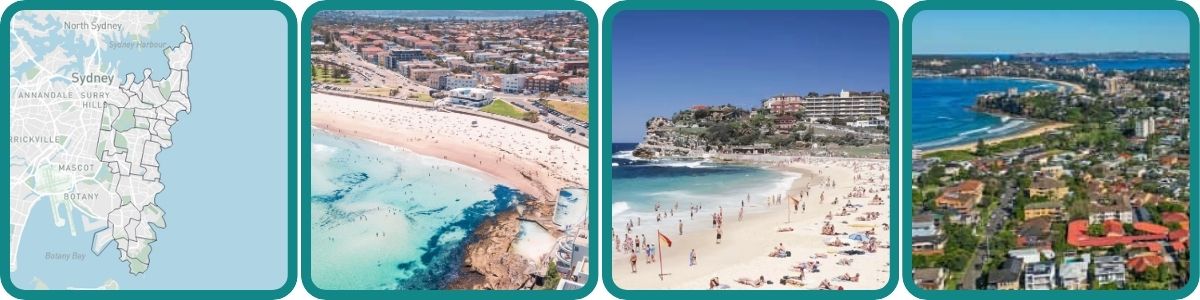
The Eastern Suburbs is Sydney’s most recognisable coastal corridor: a stretch of ocean beaches, harbour bays, terrace-lined streets and cliffside walks that runs south and east from the CBD. It is the part of Sydney that most visitors picture before they arrive, and it largely delivers on that picture.
What makes the region genuinely interesting is its duality. You have the ocean-facing beach suburbs (Bondi, Coogee, Bronte, Tamarama) that are energetic, international and built around surf culture. And then, tucked behind South Head, you have the sheltered harbour suburbs: Rose Bay, Double Bay, Vaucluse, Point Piper and Watsons Bay. Quieter, wealthier, and almost entirely off the tourist map.
City access is real here. Bondi Junction sits at the end of the T4 train line, 12 minutes from the CBD. From there, buses and footpaths reach most of the coast. You can have a swim at Bronte, walk the coastal track to Coogee, eat lunch, and be back in the city by early afternoon. That combination of genuine beach access and genuine city convenience is rare in any major city.
The Eastern Suburbs also contains Australia’s most expensive real estate. Point Piper’s median house price sits around $17.3 million. The region holds nine of Sydney’s ten most expensive suburb addresses. That wealth is visible in the harbour suburbs, less so on the beaches themselves, where the crowd is democratic and the sand is free.
Bondi Beach, coastal walks, harbour prestige suburbs, terrace architecture
Bondi Beach
Beach visits, coastal walking, café culture, Sydney’s harbour at its quietest
Active and coastal; mix of international visitors, professionals and long-term locals
Excellent to Bondi Junction and beach strip; limited in Vaucluse, Dover Heights and harbour fringe
High to very high; among Sydney’s most expensive residential areas
Confident, outdoorsy, international; café-first mornings, ocean before everything
The Eastern Suburbs covers the land east of the CBD and south of the harbour, bordered by the Pacific Ocean to the east and south. The local government areas are Waverley, Woollahra, Randwick, and parts of Bayside. The region begins roughly at Darlinghurst and Paddington to the west, extends to South Head at the harbour entrance, and runs south to Maroubra and La Perouse.
For orientation: Sydney’s suburb boundaries by municipality shows the full picture. The Eastern Suburbs does not have a single border everyone agrees on, but the core is clear enough. Bondi, Coogee, Double Bay, Paddington and the suburbs between them are what most people mean.
Suburbs in the Eastern Suburbs region: Bondi, Bondi Beach, Bondi Junction, North Bondi, Tamarama, Bronte, Clovelly, Coogee, South Coogee, Randwick, Kensington, Kingsford, Maroubra, Matraville, Malabar, La Perouse, Little Bay, Paddington, Woollahra, Edgecliff, Double Bay, Rose Bay, Bellevue Hill, Vaucluse, Watsons Bay, Dover Heights, Darling Point, Point Piper, Rushcutters Bay, Elizabeth Bay.
The Eastern Suburbs beaches are not remote or quiet by nature. They sit at the end of bus routes, within walking distance of cafés and residential streets, and Bondi in particular draws people from every part of the world year-round. This is a different experience to the Northern Beaches, where the surf culture is more local and the drive to get there filters the crowd.
Here, the beach is woven into daily life. You will see people in work clothes carrying a swim bag, construction workers eating lunch on the grass at Bronte, grandmothers doing laps at the Coogee ocean pool. The accessibility shapes the culture more than any other single factor.
Most Sydney beach suburbs face one direction. The Eastern Suburbs has both. The ocean strip runs from Maroubra north to Bondi. Behind South Head, the harbour suburbs face sheltered water: Nielsen Park at Vaucluse for calm harbour swimming, Watsons Bay for ferry arrivals, Rose Bay for seaplanes and water access.
You can swim in the Pacific at Bondi in the morning and in the harbour at Nielsen Park in the afternoon. That combination exists nowhere else in Sydney quite so easily.
The Bondi to Coogee coastal walk is the headline: 6 kilometres of cliff paths, ocean views and beach access that most visitors complete in under two hours. But walkability runs deeper than that single route. Paddington’s Oxford Street is one of Sydney’s most walkable urban strips. Bondi Junction connects to Bondi Beach on foot in around 20 minutes.
The inner eastern strip (Paddington, Woollahra, Bondi Junction, Bondi Beach) rewards people who prefer exploring on foot. It is one of the few parts of Sydney where a car feels genuinely optional for a week’s worth of activity.
Bondi is one of the most internationally recognised place names in Australia. The combination of a photogenic beach, a strong backpacker and working-holiday market, and decades of cultural export means it draws visitors who have specifically come to Sydney for it.
That international dimension shapes the suburb’s food scene, retail mix and atmosphere in ways that are immediately noticeable. Double Bay and Rose Bay also have a high concentration of international residents, though the character there is different: established wealth rather than transient energy.
Point Piper carries a median house price of approximately $17.3 million, making it the most expensive suburb in the country. The Eastern Suburbs holds nine of Sydney’s top addresses by median price. This is not incidental to the region’s character. It is reflected in the quality of local retail, the calibre of restaurants, and the preservation of heritage streetscapes in Woollahra and Paddington.
Not all of the Eastern Suburbs is at that price point. Kingsford, Kensington and Malabar offer relative affordability within the region, though they remain well above Sydney’s median.
Bondi Junction is the region’s transport centre. The T4 line terminates here, and a large Westfield makes it the main shopping destination east of the CBD. It is functional rather than charming, but everything you need is here.
Bondi Beach itself is 20 minutes on foot or a short bus ride north. The beach suburb is a genuine mix: international visitors, local families, year-round residents who have been here for decades, and a hospitality scene that runs from breakfast through late evening. Campbell Parade facing the beach is lively and commercial; the streets running back from it are quieter and residential.
South of Bondi, the coastal suburbs (Tamarama, Bronte, Clovelly, Coogee, South Coogee and Maroubra) draw far fewer visitors and a much higher proportion of locals. This is where the Eastern Suburbs feels most like a neighbourhood rather than a destination.
Coogee has a legitimate beach town feel: a main strip, an ocean pool, good cafés, and families. Bronte is favoured by locals who find Bondi too busy. Maroubra is the surfers’ beach at the southern end, relatively uncrowded by Eastern Suburbs standards. The coastal walk connects most of these beaches, and you can walk the full strip from Bondi to Coogee in under two hours.
Rose Bay, Double Bay, Vaucluse, Point Piper, Darling Point and Watsons Bay occupy the harbour-facing side of the peninsula. Watsons Bay is the most visited, primarily because of the ferry from Circular Quay and the restaurant scene there. The others are largely residential.
Double Bay has a strong café and boutique retail strip. Rose Bay offers harbour walking paths and seaplane connections to the regions. Vaucluse and Point Piper are primarily residential enclaves. You drive through rather than to them, unless you are visiting Nielsen Park or heading to South Head.
These inner suburbs sit at the western edge of the Eastern Suburbs, bordering Darlinghurst and the CBD fringe. Paddington is defined by its Victorian terrace houses, some of the best-preserved in Sydney, and Oxford Street, which runs east from the city as the main spine of café culture, independent retail and galleries.
Paddington Markets, held every Saturday at St John’s Church on Oxford Street, have run since 1973 and remain one of the better markets in the city: local designers, food, art and clothing. Woollahra adds quiet residential streets and a cluster of antique dealers around Queen Street.
Randwick anchors the southern inner section of the Eastern Suburbs. The University of New South Wales campus sits here, along with Prince of Wales Hospital, making it one of Sydney’s main medical and education precincts. The suburb itself is family-oriented, with good transport links and a less expensive profile than the beach suburbs immediately to the north.
Kensington and Kingsford extend further south and west, offering more affordable entry points into the Eastern Suburbs while remaining well-connected to the beach strip by bus.
Best for: First-time visitors, iconic Sydney experience, people-watching.
Bondi is the beach most visitors to Sydney put on the list. It earns that reputation. The arc of the bay is genuinely good-looking, the surf is real, and the lifeguard presence makes it one of the safest patrolled beaches in the city. It is also busy, especially on summer weekends, and parking is effectively impossible. Come by train and bus or on foot from Bondi Junction.
Best for: Families, calmer water, ocean pool swimming.
Coogee is a solid second to Bondi: less crowded, slightly calmer water, and a good main street for lunch or coffee after a swim. The Coogee Women’s Baths (McIver’s Baths) and Wylie’s Baths ocean pool add a swimming option that suits those who prefer lanes to surf. Good bus access from the city.
Best for: Locals, families, ocean pool, Sunday mornings.
Locals who find Bondi too crowded tend to land at Bronte. It is smaller, the grassy park above the beach fills up with picnics on weekends, and the rockpool at the southern end is well-used by families. The surf can be punchy: the beach sits in a narrow gully and the waves reflect off the rocks. Worth knowing before you paddle in.
Best for: Scenery, dramatic setting, experienced swimmers only.
Tamarama is striking: a narrow beach set between high sandstone cliffs, with some of the most powerful surf in the Eastern Suburbs. It has a strong rip and is patrolled only on weekends and public holidays. Do not underestimate it. The coastal walk passes directly above, and the views from the headland are among the best on the track.
Best for: Surfing, locals’ retreat, avoiding tourist crowds.
At the southern end of the Eastern Suburbs coastal strip, Maroubra is where locals go when everywhere else is too busy. It is a proper surfing beach: long, exposed, with good banks at the right swell, and it draws a more local crowd than the northern beaches. Less infrastructure, more beach. A 20-minute bus ride from the city.
Best for: Snorkelling, calm water, off the tourist track.
Gordons Bay sits between Coogee and Clovelly and is easy to miss. There is no surf beach here, just a calm protected cove and an underwater nature trail marked with a chain along the bottom. It is Sydney’s only dedicated shore-dive trail and most Sydneysiders have never done it. Bring a snorkel. The visibility is consistently good and the marine life is genuine.
Best for: Harbour swimming, picnics, a quieter Eastern Suburbs experience.
Nielsen Park is a harbour beach within Shark Bay, netted for swimming, calm enough for children, and set in a heritage park with historic buildings and good lawn space. It is on the harbour-facing side of the peninsula, completely different in feel to the ocean beaches. The ferry to Watsons Bay stops nearby. Pack a lunch and make an afternoon of it.
Parking at Bondi and Coogee on summer weekends is not a realistic option. The streets around both beaches fill before 9am on a hot Saturday and council rangers are active. The practical answer is the T4 train to Bondi Junction, then the 380 or 333 bus, or a 20-minute walk down to the beach. For Coogee, the 370 and X74 buses run directly from the CBD. On Sydney’s transport network, both beaches are genuinely well-served.
The Bondi to Coogee coastal walk is 6 kilometres and mostly flat. There are a few short climbs around the headlands but nothing demanding. Most people complete it in 90 minutes to two hours walking at a relaxed pace. You can start at either end, and the full route passes Tamarama, Bronte and Clovelly. Water and cafés are available at each beach along the way.
Tamarama has some of the strongest rips on the coast and is a beach where conditions should be read carefully before swimming. Always swim between the flags at patrolled beaches. Gordons Bay and Nielsen Park are calm enough that rips are not a concern, but the ocean beaches (particularly Tamarama and Maroubra) require respect at larger swells.
The main road running out to Watsons Bay through Vaucluse and Rose Bay backs up considerably on weekend afternoons, particularly on sunny days when everyone has the same idea. If you are taking the ferry to Watsons Bay, do that. It is faster, more pleasant, and the arrival by water is worth experiencing in its own right.
Icebergs Dining Room at the southern end of Bondi Beach books out weeks ahead, particularly for weekend dinners. If you want a table there at a specific time, plan ahead. The pool club below it is less difficult to access and the view from either level is the same.
The Eastern Suburbs accommodates several quite different ways of living, often within a few kilometres of each other.
Families tend to land in Randwick, Woollahra and the quieter parts of Coogee and Bronte. School zoning is a significant factor in the property market here. Certain streets in Woollahra and Randwick command premiums purely for proximity to particular public schools.
Professionals who want walkable access to cafés, restaurants and the city favour Bondi Junction, Paddington and the Oxford Street corridor. These suburbs function well without a car for daily life, which is unusual in Sydney.
International residents have a longstanding presence in Double Bay and Rose Bay, where a high proportion of residents were born overseas. The café culture and retail in Double Bay reflects this, with a European café tradition that feels different to the beach suburbs a few kilometres away.
Students and younger renters cluster around the UNSW corridor in Randwick and Kensington, which offer relative affordability by Eastern Suburbs standards and good bus access to both the university and the CBD.
Bondi is smaller than most people expect from its reputation. The beach itself is about one kilometre long and the main commercial strip is a single street. First-timers who have imagined something more expansive occasionally feel surprised by how contained it is. That is not a criticism. The scale is part of why it works.
Double Bay feels nothing like Bondi, despite being 10 minutes apart. The harbour-facing suburbs have an entirely different character: quieter, older in feel, less transient. Most visitors who spend all their time on the ocean side never see this half of the region. Gordons Bay and its snorkel trail are genuinely unknown to most Sydneysiders, not just tourists. Maroubra offers a noticeably quieter beach experience. Locals use it as an escape from the more crowded northern strip.
South Coogee is the suburb worth watching within this region. The median house price sits around $4.45 million, which is a significant number in most contexts but represents relative value within the Eastern Suburbs when viewed against the fully-priced harbour suburbs. Over five years, it has risen around 66%, and apartment rents have increased approximately 43% over a decade.
It is the kind of suburb that has been overlooked for years by people focused on the more visible beach strips, and that is beginning to correct.
Beach access in summer comes with real crowds at the northern end of the strip. Bondi and Coogee are busy. The people who live here accept this and develop routines around it: early swims before the crowds arrive, preference for Bronte or Maroubra on weekends when the main beaches are at capacity.
The harbour suburbs carry different trade-offs. The prestige and the views come with limited public transport in parts of Vaucluse and Dover Heights. These are car-dependent suburbs in a city that otherwise rewards public transport users. And the outer harbour fringe suburbs are not within comfortable walking distance of much, despite their postcode prestige.
Six kilometres of cliff paths connecting Sydney’s most famous beaches, with access to Tamarama, Bronte and Clovelly along the way. Free, mostly flat, and achievable by anyone at a comfortable pace. One of Sydney’s genuinely great walks, and easy to underestimate on a map. Do it early on a weekday if you want the headlands to yourself.
At the tip of the South Head peninsula, this trail runs through the heritage military precinct at Camp Cove and Hornby Lighthouse, with views back across the harbour entrance to North Head. Far fewer visitors make it here than to the coastal walk, and the combination of history and open water views is hard to match anywhere close to the city.
The ferry from Circular Quay arrives at Watsons Bay after a run through the upper harbour. Arriving by water is the way to do this suburb. You see the harbour as it opens toward the heads, and the village-scale of Watsons Bay makes sense when you arrive from the water rather than by road. Doyles fish and chips on the wharf is the obvious lunch.
Every Saturday at St John’s Church on Oxford Street, Paddington Markets has run since 1973. Local designers, vintage clothing, jewellery, food stalls and art across the church grounds. Better than most Sydney markets of its kind, and the Paddington terrace streets around it are worth exploring on the same trip.
Icebergs Dining Room sits at the southern end of Bondi Beach, above the historic swimming club. The view at sunset is the reason to be here. Book ahead. This is not a walk-in situation on a Friday evening. Italian-influenced menu, serious wine list, and a view that earns the price.
A chain runs along the bottom of Gordons Bay marking the route of Sydney’s only dedicated shore-dive trail. Snorkellers and divers follow it through kelp beds and over rocky outcrops with solid marine life visibility. Most people who live in the Eastern Suburbs have never done it. You will need your own snorkel gear; no hire is available on-site. Come on a calm day when the swell is down.
The Eastern Suburbs covers a broad area east and south-east of the CBD. The core suburbs are Bondi, Bondi Beach, Bondi Junction, Coogee, Bronte, Tamarama, Clovelly, Maroubra, Paddington, Woollahra, Double Bay, Rose Bay, Vaucluse, Watsons Bay and Randwick. The full list also includes South Coogee, North Bondi, Dover Heights, Bellevue Hill, Point Piper, Darling Point, Edgecliff, Kensington, Kingsford, Malabar, Matraville, Little Bay and La Perouse.
Yes. Bondi, Bondi Beach and Bondi Junction all fall within the Eastern Suburbs, in the Waverley local government area. Bondi is the region’s most internationally recognised suburb and its most visited beach.
Point Piper holds the highest median house price in the Eastern Suburbs and in Australia as a whole. The median sits around $17.3 million. The Eastern Suburbs as a region holds nine of Sydney’s ten most expensive suburb addresses, concentrated in the harbour-facing suburbs of Point Piper, Darling Point, Bellevue Hill and Vaucluse.
That depends on what you want. Bondi has more energy, more infrastructure and a stronger international atmosphere. Coogee is calmer, less crowded, has a better ocean pool, and feels more like a neighbourhood and less like a destination. Locals who find Bondi too busy on summer weekends usually prefer Coogee or Bronte. For a first visit to Sydney, Bondi makes sense. For a longer stay, you will probably find Coogee easier to enjoy at a relaxed pace.
Yes, broadly. The Eastern Suburbs is one of Sydney’s most expensive residential areas. The harbour suburbs and beach-adjacent streets command premium prices, and rental costs across the region are well above Sydney’s median. Relative affordability within the region is found in Randwick, Kensington, Kingsford and Malabar. Still expensive by most Australian standards, but more accessible entry points than Bondi, Double Bay or Woollahra.
There is no single answer. It depends on what you are after. Bondi is the most iconic and best-serviced. Coogee suits families. Bronte is a local favourite with a good ocean pool. Tamarama is dramatic but has strong rips. Maroubra is the surfers’ beach at the quieter southern end. For harbour swimming, Nielsen Park in Vaucluse is the pick. If you want something genuinely off the track, Gordons Bay with a snorkel is worth a morning.
Bondi Beach, Bondi, North Bondi, Tamarama, Bronte, Clovelly, Coogee, South Coogee, Maroubra, Malabar, Matraville, Little Bay, La Perouse
Watsons Bay, Vaucluse, Point Piper, Rose Bay, Double Bay, Darling Point, Rushcutters Bay, Elizabeth Bay, Bellevue Hill, Dover Heights
Paddington, Woollahra, Edgecliff, Bondi Junction
Randwick, Kensington, Kingsford
The Eastern Suburbs is the part of Sydney that most people picture before they arrive. It earns the reputation, and it rewards the visitors who go further than Bondi: south along the coast to the quieter beaches, or across the peninsula to the harbour suburbs that most tourists never see. The Sydney Regions guide covers the full picture of how the Eastern Suburbs fits within the city.
Sydney suburb rankings: Most Expensive Suburbs in Sydney | Best Suburbs to Live in Sydney