
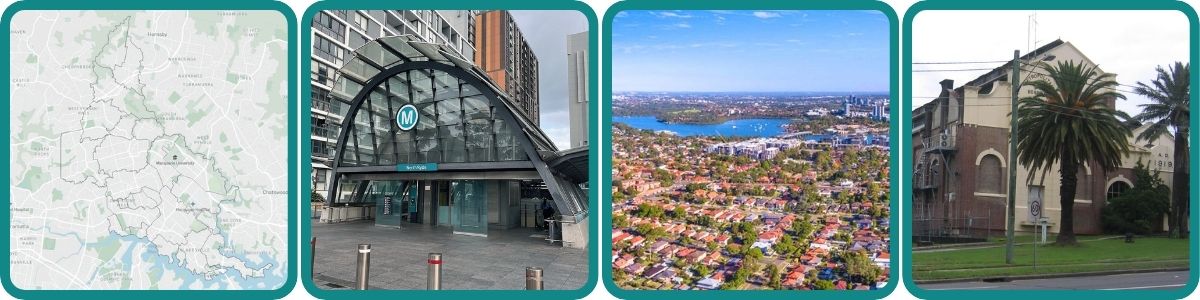
The Northern Suburbs is the connector region that most Sydney visitors never consciously plan to visit, but end up in anyway. It sits in the wedge of Sydney north of the Parramatta River, west of the Lane Cove River, and south of the M2 Motorway, occupying the space between the established North Shore to the east and the Hills District to the north.
This is a region defined less by a single identity than by function. You’ll find one of Australia’s most significant technology and biomedical employment precincts at Macquarie Park, some of Sydney’s most compelling Asian dining in Eastwood, a major open-access university campus, and a Metro line that transformed car-dependent suburbs into one of Greater Sydney’s best-connected regions when it opened in 2019.
The City of Ryde LGA forms the backbone of the Northern Suburbs. It records 55.3% of residents speaking two or more languages at home, compared to a national average of 24.8%. The top overseas birthplace countries are China, India, South Korea, Hong Kong, and the Philippines. This linguistic and cultural diversity is genuinely distinct from the Anglo-heritage prestige character of the adjacent North Shore, and it shapes everything from the local food scene to the composition of the professional workforce.
The Sydney Metro M1 changed the region’s trajectory. Suburbs like Macquarie Park and North Ryde, which were car-dependent despite being major employment hubs, now connect to Chatswood and the CBD with driverless trains every four minutes at peak. The Meadowbank and Shepherd’s Bay waterfront corridor is in the middle of one of Greater Sydney’s largest residential transformation projects. And Carlingford gained a direct light rail connection to Parramatta CBD in December 2024. The Northern Suburbs is moving fast.
Macquarie Park tech and biomedical precinct, Eastwood Asian dining, Macquarie University, Sydney Metro M1
Epping (T1/Metro junction), Eastwood (food scene), Macquarie Park (employment)
Tech and biomedical professionals, university students, Asian-Australian families, buyers priced out of the North Shore
Diverse, knowledge-economy, family-oriented, community-embedded; less prestige-signalling than the North Shore, more density than the Hills
Excellent: Metro M1, T1/T9 trains, Parramatta Light Rail (Carlingford), F3 ferry (Meadowbank), extensive bus network
Above Greater Sydney median; meaningfully below equivalent North Shore suburbs; Carlingford is the most affordable entry point
International-facing, food-obsessed, commuter-oriented, rapidly densifying along the Metro and river corridors
The Northern Suburbs occupy a clearly defined geographic wedge: north of the Parramatta River, west of the Lane Cove River and Lane Cove National Park, and south of the M2 Motorway. The LGA backbone is the City of Ryde, with portions of Eastwood and Carlingford in the City of Parramatta.
Key suburbs include Ryde, Meadowbank, West Ryde, Eastwood, Epping, Carlingford, North Ryde, Macquarie Park, Marsfield, Putney, Shepherd’s Bay, and Ermington. The region is not the North Shore, which follows the harbour-facing corridor east of the Lane Cove River. And it is not the Hills District, which sits north of the M2 Motorway. The Northern Suburbs is the wedge between them.
Locals navigate this distinction regularly. Epping sits at the junction of all three regions in people’s mental maps, which is why the transport system meets there too: the Metro M1, the T1 North Shore and Western Line, and the T9 Northern Line all call at Epping Station.
Most Sydneysiders underestimate Macquarie Park. With approximately 47,540 workers, it ranks as the fourth-largest employment cluster in Greater Sydney and holds the title of Australia’s largest non-CBD office market. The precinct’s industry mix concentrates in technology, telecommunications, and pharmaceuticals: Optus HQ (re-signed a 12-year lease), Microsoft, Cochlear and the Australian Hearing Hub, Johnson and Johnson, AstraZeneca, Sanofi, Novartis, Nanosonics, and Saluda Medical all operate here.
In December 2025, the Aegros plasma fractionation facility completed at 5 Eden Park Drive, adding a significant biomedical manufacturing capability to the precinct. Stockland’s MPark development adds 38,000-plus square metres of commercial space. The Connect Macquarie Park Innovation District (MPID) body restructured in August 2025 with new leadership and a sharpened focus on translational research. This is not a business park people have heard of casually, but it is one of the most consequential in the country.
Eastwood’s railway line does more than divide the suburb geographically. East of the tracks along Rowe Street is the officially designated Koreatown, funded by the NSW Government ($198,200), marked with Korean street banners, and dense with Korean BBQ restaurants, fried chicken shops, karaoke venues, bubble tea, and Korean bakeries. West of the tracks is the Chinese dining precinct: Shanghainese, Cantonese, Sichuan, Chongqing, and Hong Kong-style cuisine, plus fresh seafood markets and Asian grocers.
In 2025, Eastwood received Special Entertainment Precinct designation, unlocking later trading hours, live music viability, and an 80% reduction in liquor licensing fees. Locals and those in the know consider it a serious rival to Chatswood for Asian dining quality, with a more authentic, street-level energy and considerably fewer crowds.
The Sydney Metro M1 transformed the Northern Suburbs from a car-dependent region into one of the best-connected non-CBD areas in Greater Sydney. Macquarie Park and North Ryde now have driverless trains every four minutes at peak, connecting to Chatswood in four minutes and the CBD in under 20. Epping is the sole junction where Metro meets the T1 and T9 train lines, making it a genuine multi-line interchange.
Along the river corridor, the Metro has unlocked a development surge. Meadowbank and Shepherd’s Bay have concept approval for 2,033 new dwellings on the Parramatta River foreshore. A March 2026 height-uplift application at Church Street Ryde sought to increase a tower from 10 to 14 storeys. The Metro did not just improve commutes; it reshaped what the region is becoming.
The City of Ryde LGA records 55.3% of residents speaking two or more languages at home, more than double the national average of 24.8%. The top overseas birthplace countries are China, India, South Korea, Hong Kong, and the Philippines. Around 47% of residents were born in Australia; 49% were born overseas.
This is not peripheral demographic data. It explains the food scene, the retail mix, the school catchment competition, the property demand patterns, and the cultural texture of the region. Locals know that the Northern Suburbs feels nothing like the North Shore, despite the two regions being directly adjacent. The character difference is real, not just a matter of geography.
Macquarie University enrolls 45,000-plus students on an open campus that includes a central lake, parklands, a public aquatic centre, cafes, and the adjacent Macquarie Centre shopping complex. The campus is publicly accessible, and the grounds are worth visiting in their own right as a peaceful open space with water views and walking paths.
The university anchors the demographic character of the entire Macquarie Park and North Ryde precinct, generating consistent rental demand from domestic and international students and feeding graduates into the surrounding tech and biomedical employers. The Metro station bearing the university’s name sits at the campus edge.
The Ryde railway line divides the suburb into two distinct dining cultures. East of the tracks along Rowe Street East is the officially designated Koreatown, backed by NSW Government funding and visible in Korean-language street signage. You’ll find Korean BBQ restaurants with tabletop grills, Korean fried chicken shops, karaoke venues, boba tea cafes, and Korean-style bakeries. The community dining here is real, not themed.
West of the tracks is the Chinese precinct: Shanghainese soup dumplings and hand-pulled noodles, Cantonese BBQ and yum cha, Sichuan hotpot, Chongqing stir-fries, and Hong Kong-style cha chaan teng snacks. Fresh seafood markets and Asian grocery stores fill out the streetscape. Weekend mornings are when dim sum feels most alive here.
The 2025 Special Entertainment Precinct designation changed the economics for venues. Later trading hours (up to two additional hours for live music venues), an 80% reduction in liquor licensing fees, and protection from unreasonable noise complaints mean the Rowe Street precinct is now investable for a new generation of hospitality operators.
Compare it with Chatswood: Eastwood is more neighbourhood-scaled, less mall-dependent, and more authentic at street level. Chatswood has the higher total dining density and more polished fitouts. Eastwood is stronger in Korean cuisine specifically, and considerably less crowded. Parking is easier during weekdays; weekend evenings are genuinely busy, particularly on the Korean side of the tracks.
The Metro M1 is the most useful service for the core of the region. From Macquarie Park station, you’ll reach Chatswood in four minutes and the CBD in under 20. From North Ryde, times are comparable. Epping is the key interchange if you need to connect Metro with the T1 or T9 train lines. For Carlingford, the Parramatta Light Rail Stage 1 (opened December 2024) connects directly to Parramatta CBD with 16 stops. Meadowbank provides F3 ferry access to Circular Quay for a more scenic, 50-minute commute option.
Eastwood parking is easier on weekdays. Weekend dining, especially on the Koreatown side, fills up from early evening. If you’re coming for dinner on a Friday or Saturday, plan to arrive before 6:30pm or after 8pm.
The Macquarie University campus is open to visitors. The lake and grounds are a genuine amenity for the region and worth a walk even if you have no university connection. The campus aquatic centre is available to the public, and there are cafes and retail close to the Metro station.
The Meadowbank waterfront remains under-discovered by most of Sydney. The Shepherd’s Bay foreshore, river walk, and kayak jetty are accessible and largely uncrowded on weekdays. This will not remain the case as more dwellings complete along the corridor over the next few years.
For a full picture of how the region connects with the rest of Sydney’s transport network, the Sydney transport overview covers train lines, ferry routes, and Metro connections. The T1 North Shore and Western Line and T9 Northern Line both serve key Northern Suburbs stations.
Asian-Australian families, particularly Chinese-Australian and Korean-Australian communities with generational roots in the area, are embedded throughout Eastwood and Carlingford. These are not recent arrivals chasing affordability; many families have lived in the region for decades and built the food and community institutions that define it.
Young families priced out of the North Shore find genuine value in Ryde, West Ryde, and Ermington: good primary school catchments, riverfront parkland access, and a 20-minute Metro ride to the CBD. Established professional families in Epping value the dual-line transport access, the school options, and the leafy residential character. Putney attracts a more affluent cohort seeking a village feel and river access at prices that are still (barely) below the Mosman tier.
The dominant demographic shift of the past decade is the Metro-driven influx of renters and first-home buyers into the Meadowbank and Macquarie Park corridor, attracted by new apartment stock, strong transit access, and proximity to university or tech employment.
The scale of Macquarie Park is the consistent revelation. Most Sydneysiders outside the region assume it’s a suburb adjacent to the university, not the fourth-largest employment cluster in Greater Sydney and the largest non-CBD office market in the country. The Optus and Cochlear campuses alone employ tens of thousands of people in a precinct most inner-city residents have never visited.
Eastwood’s food scene surprises people in a different way: they arrive expecting a quiet suburban strip and find a dense, energetic dining quarter with a legitimately distinct Korean precinct on one side of the tracks and a Chinese precinct on the other. The official Koreatown designation is newer and less publicised than Sydney’s Chinatowns, which adds to the sense of discovery. The comparison with Chatswood cuts both ways: Eastwood is less well-known, but that is changing.
The Meadowbank and Shepherd’s Bay corridor is the most significant residential transformation project in the Northern Suburbs right now. Over 2,000 dwellings are approved for the Parramatta River foreshore, with height-uplift applications active in early 2026. The foreshore amenity is improving in parallel: parks, paths, jetties, and ferry infrastructure.
Eastwood’s nightlife expansion is accelerating after the 2025 Special Entertainment Precinct designation. The licensing fee reductions and extended trading hours are attracting new venue investment through 2025-27. Carlingford is the quiet gentrification story: the light rail connection to Parramatta opened in December 2024, and buyer interest is beginning to follow, with the suburb priced approximately 24% below Eastwood. The Macquarie Park Innovation District’s August 2025 restructure signals a new phase of employer-university collaboration that is likely to deepen the precinct’s research credentials over the next decade.
The Northern Suburbs offers affordability relative to the North Shore, but not absolute affordability: median houses run from $2.2 million in Carlingford to $3.5 million in Putney, above the Greater Sydney median of approximately $1.5-1.7 million. The region’s lower profile compared to the North Shore or Inner West is a genuine trade-off for some buyers, though it is mitigating as Metro connectivity improves the region’s standing.
Nightlife remains limited outside Eastwood, though the Special Entertainment Precinct designation is improving this. The density along the Metro corridor is increasing faster than community infrastructure in some areas. And the region’s geographic identity, sitting between the North Shore and the Hills, can make it harder to describe in shorthand, which matters for some buyers navigating social expectations.
What suburbs are in the Northern Suburbs of Sydney?
The core suburbs of Sydney’s Northern Suburbs, defined by the City of Ryde LGA and the geographic wedge north of the Parramatta River, west of Lane Cove National Park, and south of the M2 Motorway, include: Ryde, Meadowbank, Shepherd’s Bay, West Ryde, Eastwood, Epping, Carlingford, North Ryde, Macquarie Park, Marsfield, Putney, and Ermington. Parts of Eastwood and Carlingford fall within the City of Parramatta LGA boundary. For a full list of Sydney suburbs by municipality, see our suburbs by municipality guide.
Is Epping part of the North Shore?
No. Epping sits at the edge of the Northern Suburbs, not the North Shore. The North Shore follows the harbour-adjacent corridor from Mosman and Cremorne through Chatswood and St Leonards, east of the Lane Cove River. Epping is further west and inland, and shares the Metro M1, T1, and T9 train lines. It is sometimes described as North Shore-adjacent due to its school catchments and socio-economic profile, but it belongs to the Northern Suburbs geographically.
What is Macquarie Park known for?
Macquarie Park is Australia’s largest non-CBD office market and one of its most significant technology and biomedical research precincts. Around 47,540 workers are employed in the precinct, at organisations including Optus HQ, Microsoft, Cochlear and the Australian Hearing Hub, Johnson and Johnson, AstraZeneca, Sanofi, and Novartis. Macquarie University, with 45,000-plus students, is located on the precinct’s western edge. The Metro M1’s Macquarie Park station connects the precinct to Chatswood and the CBD.
Is Eastwood good for food in Sydney?
Yes, genuinely. Eastwood is one of Sydney’s best Asian dining precincts. The suburb is divided by its railway line: east of the tracks is the officially designated Koreatown (Rowe Street East), with Korean BBQ, fried chicken, karaoke, and boba; west of the tracks is a Chinese dining hub covering Shanghainese, Cantonese, Sichuan, and Hong Kong-style cuisine. The 2025 Special Entertainment Precinct designation has extended trading hours and reduced licensing costs for venues. Locals consider it a genuine rival to Chatswood for Asian dining quality, with a less crowded, more neighbourhood feel.
Is the Northern Suburbs affordable compared to the North Shore?
Relatively, yes. Median house prices in the Northern Suburbs range from approximately $2.2 million in Carlingford to $3.5 million in Putney, compared to $3 million-plus in Chatswood and above $5 million in Mosman. Units around the Metro corridor in Macquarie Park and North Ryde run at approximately $820,000-$890,000, with rental yields of around 5-5.3% driven by university students and tech workers. The Northern Suburbs offers a meaningful price advantage over equivalent North Shore suburbs, though it sits above the broader Greater Sydney median.
How do you get to Macquarie Park from the CBD?
The Sydney Metro M1 is the most direct option: trains run every four minutes at peak from Central and Chatswood, reaching Macquarie Park station in under 20 minutes from the CBD. The M1 is driverless and frequent, making it a practical daily commute. Bus services also connect the precinct to surrounding suburbs. The Sydney transport guide covers route options in detail.
The Northern Suburbs is one of the most consequential and under-narrated parts of Greater Sydney. Its employment scale, cultural density, and transport transformation make it a region that shapes a significant portion of the city’s economy and community life, largely without the media profile of the North Shore or Inner West. For those exploring Sydney’s regions, it rewards attention.
Sydney suburb rankings: Most Expensive Suburbs in Sydney | Best Suburbs to Live in Sydney