
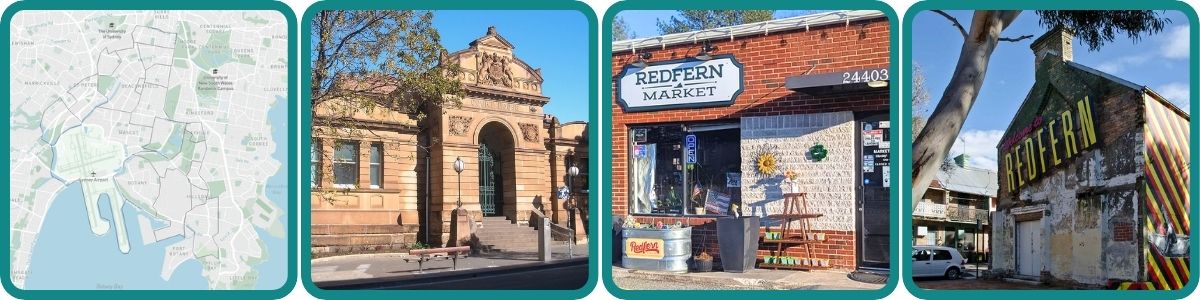
South Sydney: Redfern, Alexandria, Green Square & Local Guide

South Sydney sits directly south of Central Station, in the corridor between the Eastern Suburbs and the Inner West. It is the part of Sydney with the most compressed history: convict-era infrastructure, 20th-century industry, and 21st-century urban renewal happening within a few kilometres of each other.

Redfern holds a unique and irreplaceable place in Aboriginal Australia. Alexandria went from meat works to design studios in under two decades. Green Square is now a functioning urban neighbourhood with award-winning public buildings and tens of thousands of residents. This is a region where Sydney’s layers are most visible.

The defining quality of South Sydney is velocity. No other Sydney region has physically transformed as dramatically, or as recently. And yet the layers do not disappear: the loading docks become café entrances, the factory floor becomes a restaurant, the housing commission tower casts its shadow over a 40-storey private tower still under construction.

If you want to understand what Sydney is becoming, this is where to look. It rewards those who take the time to look past the construction cranes.

South Sydney
Known ForIndustrial transformation, Aboriginal cultural significance, urban renewal at scale
Most Recognisable SuburbRedfern (history), Alexandria (lifestyle), Green Square (new city quarter)
Best ForYoung professionals, creatives, design and tech industry workers, airport-adjacent living
LifestyleDense, urban, warehouse aesthetic, strong cafe culture, rapidly evolving
Public TransportExcellent: Redfern is a major rail interchange (T1, T2, T3, T8); Green Square and Mascot on T8 Airport line
Relative CostBelow Eastern Suburbs; competitive with Inner West. Units $840K (Mascot) to $1.03M (Redfern)
Local CharacterIndustrial heritage, creative industries, Aboriginal community, rapid gentrification, multicultural

South Sydney is bounded to the north by Central Station and the CBD edge, to the east by Anzac Parade (where the Eastern Suburbs begin), to the west by the main railway corridor (the Inner West sits west of the tracks through Newtown and Erskineville), and to the south by the northern bank of the Cooks River.

The region spans two local government areas: City of Sydney (covering Redfern, Waterloo, Zetland, Alexandria, and Beaconsfield) and Bayside Council (covering Mascot and Botany). The full suburb list includes Redfern, Alexandria, Waterloo, Zetland, Green Square, Beaconsfield, Mascot, Botany, Rosebery, and Erskineville on the western fringe.

A note on fuzzy edges: Erskineville straddles the South Sydney and Inner West character zones depending on who you ask. Kensington is sometimes grouped here but sits closer to the Eastern Suburbs and Randwick LGA boundary. Surry Hills belongs to the CBD and Inner City, not South Sydney.

For a full list of suburbs by municipality, see our Sydney suburbs by council area guide. For the broader picture, the Sydney regions overview shows how South Sydney fits into the city’s geography.

The Transformation Story
Alexandria’s transition from abattoirs and industrial warehouses to design studios, tech offices, and warehouse apartments is one of Sydney’s most dramatic urban shifts. It happened in under two decades. The bones of the old city are still visible: brick facades that once housed tanneries now frame architecture studios; loading docks serve as cafe entrances; factory floors hold restaurant kitchens. The Grounds of Alexandria, a converted pie factory, became one of Sydney’s most photographed hospitality venues. Median house prices have crossed $2.1 million. The suburb did not erase its past; it built on top of it.
Redfern’s Dual Identity
Redfern holds two simultaneous identities in constant tension. It has been the centre of Koori culture and activism since the 1970s, when Aboriginal people from across NSW migrated here seeking work and community. The Block, bounded by Eveleigh, Louis, Caroline, and Vine Streets, was Australia’s first urban Indigenous land rights claim. Paul Keating delivered his landmark 1992 Redfern Park speech here: the first time an Australian Prime Minister acknowledged dispossession on the land where it happened. At the same time, the Central to Eveleigh Tech Central precinct is rising along the rail corridor immediately to Redfern’s north: Atlassian’s world’s-tallest hybrid timber tower is targeting 25,000 or more tech workers in the precinct. These two Redferns coexist, unresolved, in the same streets.
Green Square: A New City Within the City
Australia’s most significant urban renewal project spans 278 hectares and is projected to reach 70,000 residents by 2030. This is not a future plan: the Green Square Library won World’s Best Library in 2018. The Gunyama Park Aquatic Centre is Sydney’s largest pool since the 2000 Olympics. Three new apartment buildings added 311 homes in 2025-26 alone. It is no longer a construction site; it is a functioning neighbourhood with cafes, a town square, parks, and award-winning public infrastructure.
Airport Adjacency
Mascot and Botany sit directly adjacent to Sydney Airport. This shapes the housing profile, the noise environment, and the demographics. It also means strong transport links via the T8 Airport and South line, and the area functions as a practical base for frequent travellers and airport industry workers. Median units in Mascot at around $840K sit among the more affordable in the inner-south corridor. The trade-off is real: aircraft noise is a daily factor in Mascot and Botany, and worth checking before committing.
Proximity to Everything
Redfern is 2 kilometres from Town Hall. Alexandria is 4 kilometres from the CBD. We often say this in conversation and people are surprised: South Sydney is genuinely inner-city, not merely inner-suburban. This is inner-city living at a price point materially below the Eastern Suburbs immediately to the east, with train and bus connections that reach every major Sydney corridor. “You walk out of Redfern Station and you’re basically in the CBD,” is something locals say. The numbers back it up.
Redfern
Aboriginal heritage, tech corridor, rail interchange
Redfern is the most complex suburb in Sydney. It has been the spiritual centre of Aboriginal Sydney for over 50 years, and it is simultaneously the southern anchor of the Central to Eveleigh tech precinct targeting 25,000 or more workers. The Block, the Pemulwuy Project, and Redfern Park sit within walking distance of Atlassian’s new headquarters. Redfern Station is one of the busiest interchanges in the inner city. The suburb has galleries, street art of real cultural weight, strong cafe culture, and a degree of tension that most Sydney suburbs do not carry.
Alexandria and Beaconsfield
Design industries, warehouse conversions, Sydney Park
The design and creative heartland of the inner south. Alexandria’s industrial bones, abattoirs, tanneries, and factories, have been converted into warehouse apartments, architecture studios, furniture showrooms, and hospitality venues. The Grounds of Alexandria anchors the suburb’s identity as a lifestyle destination. Sydney Park, a 40-plus hectare former brick quarry and landfill on the suburb’s western edge, is one of inner Sydney’s best urban parks and almost entirely unknown to visitors. Median houses in Alexandria are around $2.1 to $2.2 million; units around $905,000, up 9.5 per cent year-on-year.
Waterloo and Zetland
High-density living, major urban renewal underway
High-density apartment living at the heart of the region’s transformation. The Waterloo Estate, historically one of Sydney’s largest public housing concentrations, is undergoing a 20-year renewal: the preferred masterplan proposes 6,800 new dwellings including towers up to 40 storeys, with 30 per cent social housing. Zetland is almost entirely post-2000 apartment stock, popular with young professionals and renters priced out of the Eastern Suburbs. Median units are around $935,000 in Waterloo and $973,000 in Zetland.
Green Square
Urban renewal, award-winning public buildings, T8 train
Green Square is a precinct spanning Alexandria, Zetland, Waterloo, and Beaconsfield, with its own town centre, train station, library, aquatic centre, and cycleways. Projected to reach 70,000 residents by 2030. The landmark public infrastructure is open and functioning: the library is World’s Best Library 2018, the pool is the largest built in Sydney since the Olympics. If your mental image of Green Square is cranes and dust, that image is now years out of date.
Mascot and Botany
Airport-adjacent, T8 access, Botany Bay foreshore
Practical and underrated. Mascot is home to Qantas headquarters, a genuine village strip along Botany Road, and direct T8 access to the CBD and the airport. Botany borders the bay where Cook first landed in 1770: the foreshore walking and cycling track runs for 10 kilometres. Median units in Mascot are around $840,000. Aircraft noise is real; so is the value and the connectivity.
Rosebery and Erskineville
Mid-corridor, residential character, established cafes
The quieter mid-corridor of South Sydney. Rosebery was laid out as a model industrial suburb in the early 20th century; that streetscape is still visible alongside its cafes and small bars. Median houses around $2.5 million and unit yields around 5.54 per cent make it one of the better-performing inner-south suburbs for investors. Erskineville, on the western fringe, carries more Inner West character and is often debated as belonging to either region.

In the 1980s, Alexandria was the kind of suburb that appeared on maps but not in conversations. Its identity was industrial: abattoirs, tanneries, wool stores, chemical plants, and the smell that went with them. The suburb existed to make things and process things, and it did so without attracting much attention from anyone who did not work there.

By the early 2000s, industrial zoning began giving way to mixed-use and residential. Warehouse conversions became studios, then showrooms, then restaurants. The Grounds of Alexandria, a converted pie factory, grew from a weekend farmers market into one of Sydney’s most photographed hospitality destinations: a multi-venue complex with a cafe, restaurant, bar, bakery, mini-farm, and seasonal garden installations. It has since become a point of genuine confusion: many Sydneysiders assume The Grounds is in the Inner West. It is firmly in Alexandria, east of the railway corridor, in South Sydney.

Today, Alexandria’s median house price exceeds $2.1 million and unit values are up 9.5 per cent year-on-year to around $905,000. The design, architecture, and tech industries have followed the warehouse conversions. The suburb’s bones are still visible in the brick facades and loading docks. That visible history is part of the appeal.

Waterloo and Zetland followed a different path. For decades these suburbs were dominated by Housing Commission high-rise towers. Now those towers are slated for demolition. The Waterloo Estate renewal, with its Concept Application on public exhibition until June 2026, proposes 6,800 new dwellings over 20 years, with towers rising to 40 storeys and a requirement that 30 per cent of dwellings be social housing. The Matavai and Turanga towers will come down. The community that occupied them has been central to a significant planning dispute about what is gained and what is lost in the process.

Green Square is the grandest chapter. A 278-hectare precinct of former industrial land is being rebuilt as one of Australia’s most ambitious planned urban communities. The target is 70,000 residents by 2030. Three new apartment buildings, The Frederick, Portman on the Park, and Portman House, added 311 homes in 2025-26 alone, with a combined construction value exceeding $210 million. The precinct now has its own town centre, train station, library, aquatic centre, cycleways, raingardens, and stormwater recycling system. It is not a future plan. It is a neighbourhood.

Note on the Waterloo Estate

The Concept Application for Waterloo South was on public exhibition until 2 June 2026. The preferred masterplan proposes towers up to 40 storeys and the demolition of the Matavai and Turanga towers. The renewal is one of the most significant public housing redevelopments in Australian history and remains actively contested.

The Grounds of Alexandria is in South Sydney
This is the most common geographical confusion in the inner south. The Grounds is in Alexandria, which is in South Sydney, east of the railway corridor. It is not in the Inner West. Not in Newtown. Not in Marrickville. It sits within the City of Sydney LGA. When someone says “The Grounds is kind of Inner West,” they are wrong, and this matters for navigation.
Green Square is a Real Neighbourhood Now
The library and aquatic centre are open. The town square is functioning. Cafes, parks, and services are established. If your mental image of Green Square dates to 2018 or earlier, it is worth updating: the place has materially changed. “Green Square blew my mind. I drove past it for years thinking it was still cranes and dust. Now there’s a library that looks like a spaceship and a pool bigger than anything I’ve seen in inner Sydney,” is a common reaction from people who make it there for the first time in a while.
Redfern Station is a Major Interchange
Redfern Station is served by the T1, T2, T3, T4, T8, and T9 lines, connecting to effectively every major Sydney rail corridor. It is a genuine interchange, not a local stop. The T8 Airport and South line also serves Green Square and Mascot stations directly. For transport planning, see the T8 Airport and South line guide.
Sydney Park is Significantly Underused by Non-Locals
Sydney Park in Alexandria is 40-plus hectares of former brick quarry and landfill, now wetlands, cycling paths, a large playground, BBQ facilities, and abundant birdlife. Free entry. Always busy with locals. Almost entirely unknown to visitors and new residents, despite being as large as many suburban parks and sitting within 5 kilometres of the CBD. The closest trains are St Peters and Erskineville.
Airport Noise in Mascot and Botany is Genuine
Mascot and Botany are directly adjacent to Sydney Airport. The T8 access and the value are real. So is the aircraft noise. Check flight paths and noise contour maps before committing to either suburb. North-facing apartments in Mascot under flight paths are notably affected. This is not a minor consideration.

South Sydney has one of the most varied demographic profiles in the inner city. The common thread is density: almost everyone is renting or living in an apartment, and the suburb you are in shapes the experience considerably.

Alexandria and Zetland draw young professionals, designers, architects, and tech workers. The warehouse conversion aesthetic and proximity to the tech corridor along the Central to Eveleigh precinct are real pulls. Redfern has a longtime Aboriginal community alongside newer arrivals: young professionals, hospitality workers, students, and creatives attracted by character, cafes, and a price point below neighbouring Eastern Suburbs suburbs.

Mascot and Botany draw airport industry workers, fly-in-fly-out professionals, and multicultural families. The Vietnamese and Chinese dining scenes along Botany Road have developed over decades and are not performative: they reflect the communities that built them. Waterloo and Zetland are dominated by high-density renters, young couples, sharers, and first-home buyers working with the newer apartment towers. Rosebery attracts a mix of established families and investors.

The region overall skews young, predominantly renting, and professional. It is not a suburban family area in the conventional sense. The presence of the Aboriginal community in Redfern adds a layer of history and complexity that is not visible in comparable inner-city suburbs.

What Surprises First-Time Visitors
The Grounds of Alexandria is in South Sydney, not the Inner West. Green Square is a real neighbourhood, not a construction zone. Redfern is 2 kilometres from Town Hall, far closer to the CBD than most people imagine. Sydney Park is one of Sydney’s best large parks and almost nobody outside the local area knows it. The depth of Aboriginal history in Redfern: many visitors are unaware that Keating’s 1992 speech was delivered here, that The Block represents Australia’s most significant urban Indigenous land claim, or that the Pemulwuy Project took decades of community organising to deliver.
Trending in 2025-26
The Waterloo Estate renewal is the most significant planning story in South Sydney: the Concept Application for Waterloo South closed exhibition in June 2026, with the fate of the Matavai and Turanga towers and thousands of social housing tenants actively contested. Alexandria unit prices are up 9.5 per cent year-on-year to around $905,000 median. Green Square apartment delivery continues at pace. Redfern gentrification is accelerating as Tech Central fills: high-income workers entering the suburb are increasing pressure on rents and intensifying the tension with the Aboriginal community. Mascot is consolidating as a practical inner-south lifestyle suburb with a growing dining scene.
The Trade-offs to Know
Affordability relative to the Eastern Suburbs, set against aircraft noise in Mascot and Botany. Creative and diverse character set against ongoing gentrification pressure on established communities. Strong rail connections set against limited greenery in the densest parts: Sydney Park in Alexandria is the main relief valve for the inner south, and it is worth knowing it is there. Warehouse conversion character set against the reality that much of the housing stock is dense and without private outdoor space.
Sydney Park, Alexandria
Forty-plus hectares of former brick quarry and landfill transformed into one of inner Sydney’s best urban parks. Wetlands, walking and cycling paths, a large playground, BBQ facilities, and birdlife including cockatoos, lorikeets, and kookaburras. Free entry. Cycling connections link to the wider inner-city network. The park is almost entirely unknown to visitors despite sitting within 5 kilometres of the CBD. Go on a weekday morning and you will share it with dog walkers and cyclists. Go on a Sunday afternoon and locals will have already claimed every BBQ spot.
The Grounds of Alexandria
A converted pie factory turned into one of Sydney’s most popular dining and lifestyle destinations: cafe, restaurant, bar, bakery, mini-farm, and florist in a complex of elaborately themed seasonal installations. It is perpetually photographed and perpetually busy on weekends. Go mid-week if you can. Note that it is in Alexandria, South Sydney, not the Inner West: worth knowing before you navigate.
Green Square Library
Worth visiting as architecture even if you have no interest in borrowing books. Voted World’s Best Library in 2018 at the Architectural Review Awards, and winner of the Sir Zelman Cowen Award for Public Architecture in 2019. The 2,300 square metre space has 40 skylights and a sunken town plaza. One of Sydney’s best recent public buildings by any measure.
Gunyama Park Aquatic Centre
The biggest public pool built in Sydney since the 2000 Olympics, designed to evoke the city’s iconic ocean pools. The first recreation centre in Australia with a 5 Green Star design rating. Won the Australian Institute of Architects public architecture award. Open to the public and popular across the inner south. A serious facility, not a local lap pool.
Redfern Street Art Walk
Redfern’s walls and laneways carry a significant collection of street art, including Aboriginal-themed murals of real cultural weight. The area around Eveleigh Street, The Block, and Redfern Street is walkable and merits attention beyond the photography opportunity. Independent galleries are growing in number, particularly around Redfern Street. A more complex experience than Newtown’s better-known art scene, and worth approaching as such.
Botany Bay Foreshore
The northern shore of the bay where Cook first landed in 1770. A 10-kilometre walking and cycling track runs along the foreshore. Sir Joseph Banks Park has wetlands, waterbird habitat, children’s play areas, and a boat ramp. Historical, calm, and within 20 minutes of the CBD. One of Sydney’s less-visited foreshore areas and better for it.
What suburbs are in South Sydney?
The core suburbs are Redfern, Alexandria, Waterloo, Zetland, Green Square (a precinct rather than a standalone suburb, spanning Alexandria, Zetland, Waterloo, and Beaconsfield), Beaconsfield, Rosebery, Mascot, Botany, and Erskineville on the western fringe. Darlington and Eveleigh are often included. Kensington sits closer to the Eastern Suburbs and Randwick LGA boundary. Surry Hills belongs to the Inner City, not South Sydney.
Is Redfern safe to visit?
Redfern is safe to visit during the day and is heavily gentrified. Crime data shows 3,366 incidents in 2025, or around 25,750 per 100,000 people, which is above the NSW average. However, overall crime has decreased significantly since 2015. The station area warrants the usual urban awareness late at night. Most residents and visitors experience no issues. Redfern’s crime statistics partly reflect the presence of crisis services and population density rather than a universally dangerous environment.
What is Green Square like to live in?
Green Square in 2025-26 is a functioning urban neighbourhood. The library, aquatic centre, town square, cafes, and parks are open and established. Apartment delivery continues, and the precinct is projected to reach 70,000 residents by 2030. It is dense, modern, and still growing. If you have not visited since 2018, expect to find a different place.
Is Alexandria part of the Inner West?
No. Alexandria is in South Sydney, within the City of Sydney LGA. It sits east of the railway corridor that defines the Inner West boundary. The suburb is sometimes loosely referred to as Inner West in casual conversation, but this is geographically incorrect. The Grounds of Alexandria is in Alexandria, South Sydney, not in Newtown or Marrickville.
What is The Grounds of Alexandria?
The Grounds is a large converted pie factory in Alexandria that operates as a multi-venue hospitality and lifestyle complex: cafe, restaurant, bar, bakery, mini-farm, and florist, set among elaborately themed seasonal garden installations. It is one of Sydney’s most popular weekend destinations and is located in Alexandria, South Sydney, not in the Inner West. Weekends are busy. Mid-week is considerably easier.
Is Mascot a good place to live?
Mascot suits people who prioritise connectivity and value. The T8 line gives direct access to the CBD, the airport, and Green Square. Median units at around $840,000 are among the more affordable in the inner south. The Botany Road strip has a genuine village feel with strong multicultural dining. The main consideration is aircraft noise: check flight paths and noise contour maps before committing. For frequent travellers and airport industry workers, Mascot is genuinely practical. “The rent is real,” as locals put it.
Inner South CoreRedfern, Waterloo, Darlington
Warehouse and Creative PrecinctAlexandria, Beaconsfield, Erskineville
New Urban RenewalZetland, Green Square precinct
Airport CorridorMascot, Botany
Mid-South ResidentialRosebery, Kensington (eastern fringe)
South Sydney is not a region that asks you to like it. It asks you to pay attention. The history is compressed, the change is fast, and the contrasts are real. For transport options across the region, see our Sydney transport guide.

Sydney suburb rankings: Most Expensive Suburbs in Sydney | Best Suburbs to Live in Sydney