
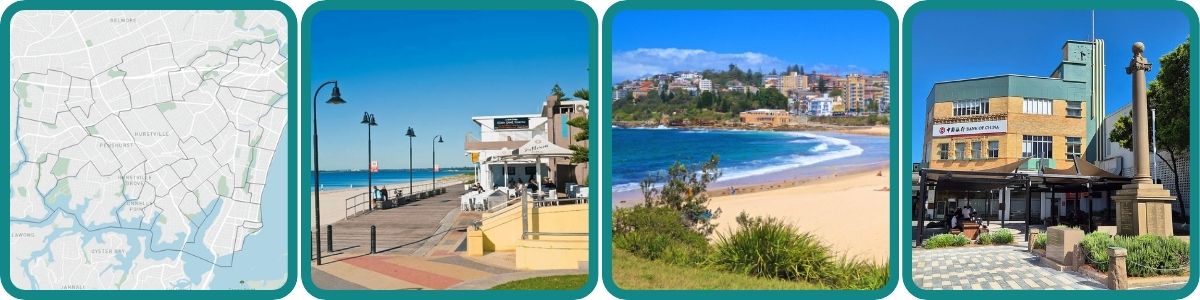
St George sits in one of Sydney’s most quietly underrated corridors, strung along the Georges River about 15 kilometres south of the CBD. It has a bayside beach strip on sheltered Botany Bay, a food scene that genuinely rivals the city centre, and train connections that put you at Central Station in under 30 minutes. For most visitors, it simply doesn’t register on the map.
The region has two distinct anchors. Hurstville is the commercial and cultural heart, a thriving Chinese-Australian hub where more than 55% of residents report Chinese ancestry and the dining strip around Forest Road is widely regarded by Sydney food writers as the city’s most authentic Asian food precinct. Brighton-Le-Sands, on the western shore of Botany Bay, carries a Mediterranean character earned over decades of Greek and Italian settlement, now concentrated in a waterfront dining strip and calm bay swimming.
Between those two poles lies a mosaic of leafy river suburbs, a major hospital and health precinct in Kogarah, 514 hectares of national park along the Georges River, and suburban pockets ranging from the tightly-held family enclaves of Oatley and Connells Point to the more affordable apartment corridors of Rockdale and Wolli Creek.
The Georges River is the region’s defining natural feature. Kayakers, anglers, families at riverside swimming baths, waterfront homes with private jetties: the river lifestyle is a genuine part of daily life here that most outsiders never discover. Georges River National Park alone covers 15 sectors of protected bushland within 20 kilometres of the CBD. If you come looking for that, and for food that is genuinely good rather than performatively trendy, St George rewards the detour.
Hurstville Asian food scene, Georges River lifestyle, Brighton-Le-Sands bay beach, multicultural community
Hurstville (commercial and administrative centre), Brighton-Le-Sands (visitor destination)
Families, food lovers, river and bay lifestyle, first-home buyers, airport-adjacent living
Established, multicultural, riverside and bayside, community-oriented
Excellent: T4 line through Kogarah, Hurstville, Mortdale, Oatley; T8 airport interchange at Wolli Creek
Region median house ~$1.91M (Q1 2026); units from $620k in Rockdale and Banksia; affordable relative to Eastern Suburbs and Inner West
Genuinely diverse, culturally rich, settled and community-focused; less self-conscious than the inner city
The St George region covers the Georges River Council LGA, formed on 12 May 2016 from the merger of Hurstville City Council and Kogarah City Council. It extends across approximately 38 square kilometres, sitting 13 to 17 kilometres south of the Sydney CBD. The broader St George identity also encompasses adjacent Bayside Council suburbs, particularly Rockdale, Brighton-Le-Sands, Arncliffe and Bexley, which share transport links, community ties and postcode identity with the Georges River area.
The region is bounded by Canterbury-Bankstown LGA to the north and north-west, the Bayside Council to the east (Botany Bay foreshore), the Georges River and Salt Pan Creek to the south and west, and the Sutherland Shire LGA to the south-east. The Georges River itself forms both a physical boundary and a lifestyle corridor, with national park stretching along much of its length. The 2021 Census recorded a population of 152,274 for Georges River Council, with 46% born overseas.
For a broader look at how St George fits within Sydney’s district structure, the Sydney Suburbs by Municipality guide covers all LGA groupings across the city. The Sydney Regions overview places St George in context alongside the Inner West, Eastern Suburbs and other major corridors.
The Georges River is not just scenery here, it is an active part of daily life. Georges River National Park covers 514 hectares across 15 sectors of protected riverbank bushland, with walking tracks, kayak and canoe launch points, fishing spots (bream, flathead, whiting and mulloway are regularly caught), picnic grounds and birdwatching routes recording over 100 species including pink robins and grey fantails. Multiple boat ramps serve the boating community that has grown up along both banks.
Oatley Park is the region’s most beloved riverside green space: 45 hectares of bushland with the Jewfish Bay Baths, one of NSW’s largest swimming enclosures at 320 metres, a historic castle (1937), an inclusive adventure playground with a 12-metre play tower, and Aboriginal rock carvings. Carss Park offers a quieter alternative, with a sheltered swimming enclosure, kayak access and foreshore picnic areas on the river. For residents, the refrain is consistent: the river is what sold us on this area.
Brighton-Le-Sands sits on the western shore of Botany Bay, 13 kilometres south of the CBD. This is not a surf beach. The water is sheltered and calm, which makes it ideal for families and confident swimmers who find the ocean beaches too rough, but it offers a completely different experience from Bondi or Coogee. The setting is more comparable to a Mediterranean waterfront: flat water, an esplanade walk along The Grand Parade, plane-spotting directly beneath Sydney Airport’s approach paths, and a dining strip with strong Greek, Italian and modern Australian restaurants.
The suburb’s character comes from its Greek-Australian community, established through post-WWII migration. Greece remains the second most common country of birth at 5%, and 12.1% of residents speak Greek at home. It has long been called “Little Greece by the Bay”. The 2025/26 launch of The Brighton Hotel Sydney, a MGallery property with multiple restaurants including hatted Mediterranean chef Peter Conistis’s Ammos Brighton, has given the strip a new anchor. Note that water quality can be affected after heavy rainfall, so check before swimming.
Hurstville is often described as Sydney’s real Chinatown, and the data supports the claim. More than 55% of Hurstville’s population reports Chinese ancestry, with 37% born in mainland China. The dining precinct around Forest Road and the streets surrounding Westfield Hurstville covers yum cha, Shanghainese dumplings, Taiwanese street food, Vietnamese pho, BBQ meats, bubble tea and modern fusion. The range and authenticity of the regional Chinese cuisine in particular is something most Sydney diners who stick to the CBD have not experienced.
There is also a growing Korean and Japanese presence, and the evening dining culture on weekdays is genuinely lively without the tourist crowds that shape comparable precincts in the city centre. We’ve been going to Chinatown for years and the food here is so much better is a comment heard regularly from first-time visitors to the strip. Weekday evenings are the best time to visit, when tables are more available and the kitchen pace is focused.
The T4 Eastern Suburbs and Illawarra Line runs through the heart of St George, with stations at Wolli Creek, Rockdale, Banksia, Arncliffe, Carlton, Kogarah, Allawah, Hurstville, Penshurst, Mortdale and Oatley. At peak times, trains run every 5 to 15 minutes. Hurstville to Central Station takes approximately 25 to 30 minutes; Kogarah is roughly 22 to 27 minutes.
Wolli Creek, in the northern part of the region, is a key interchange where the T4 meets the T8 Airport and South Line. From Wolli Creek, Sydney Domestic Airport is approximately 11 minutes by train. Even from Hurstville, the airport is reachable in under 20 minutes without changing lines. For anyone who travels regularly for work, this is a genuinely significant convenience. An extensive bus network connects suburbs not on the rail line, including Beverly Hills, Bexley, Sans Souci and Brighton-Le-Sands, to the nearest stations. For more on getting around, see the Sydney Transport guide.
With 46% of Georges River residents born overseas, St George is among NSW’s most multicultural local government areas. The diversity is not just statistical, it shapes the commercial strips, community events, food options and social fabric of the region in ways that are immediately visible on the ground. The Chinese-Australian community dominates Hurstville and surrounds. Greek and Italian communities give Brighton-Le-Sands and Sans Souci their Mediterranean flavour. South Asian, Lebanese, Vietnamese and Korean communities are distributed across the mid-corridor suburbs.
This is not a region that has become multicultural through recent gentrification; it has been this way for decades, across successive waves of migration. For newcomers from overseas, the comment we heard consistently was: coming from overseas, I felt at home immediately. The cultural infrastructure, the familiar foods and the community ties are already here.
Brighton-Le-Sands deserves its own section because it is genuinely unlike the rest of the St George region, and genuinely unlike Sydney’s famous ocean beaches. The suburb runs along The Grand Parade on the western shore of Botany Bay, 13 kilometres south of the CBD. The beach faces east across the bay, with flat calm water, no surf, and a consistent shallowness that makes it ideal for young children and casual swimmers.
The setting has a Mediterranean quality that is no accident. Post-WWII Greek migration shaped the suburb’s character in a way that is still visible: Greece remains the second most common country of birth (5%), Greek is spoken at home by 12.1% of residents, and the dining strip along The Grand Parade and Bay Street carries that influence in its restaurants, cafes and community events. The suburb is commonly called “Little Greece by the Bay”.
The 2025/26 launch of The Brighton Hotel Sydney, a MGallery luxury hotel on the former Bayside Plaza site, has added a new dining anchor. Ammos Brighton, from hatted Mediterranean chef Peter Conistis, Coco’s on the Beach and the Sands Bar are part of the new complex, bringing a level of hospitality investment the strip had not previously seen. The esplanade walk along The Grand Parade is flat, wide and pleasant year-round, with views across the bay toward the eastern shore.
The difference between this and an Eastern Suburbs beach is pronounced. Brighton-Le-Sands is a local beach, used primarily by residents of the immediate area and families who know it. On summer weekdays it is relaxed and uncrowded. Summer weekends bring more traffic and parking becomes competitive, so an early arrival is recommended. Water quality can be affected after heavy rain, particularly given the bay’s catchment characteristics, so checking before swimming after storms is worthwhile.
One idiosyncratic feature: the beach sits almost directly beneath the approach paths to Sydney Airport’s main runway. Planes pass overhead at low altitude every few minutes during peak periods, which is either a fascination or a distraction depending on your point of view. It has become a draw in its own right for aviation enthusiasts.
The T4 line from Hurstville or Kogarah gives you a straightforward run to the CBD, with trains every 5 to 15 minutes at peak times. Rockdale station connects to the airport line at Wolli Creek one stop north: Sydney Domestic Airport is about 11 minutes from Wolli Creek by T8. If you are travelling to or from the airport regularly, the northern St George suburbs offer a genuine advantage. Bus services reach suburbs not on the rail line, including Brighton-Le-Sands, Beverly Hills, Sans Souci and Bexley.
Weekday evenings are the best time to explore the Hurstville food strip. Weekend queues at the most popular yum cha and dumpling venues can stretch considerably, and the dining experience is more relaxed on a Tuesday or Wednesday night. The precinct around Forest Road and the Westfield perimeter covers multiple cuisines, so allow time to explore rather than committing to the first place you pass.
Busiest on summer weekends. Arrive before 10am if you want a parking spot along The Grand Parade. The esplanade walk and waterfront dining are enjoyable year-round. The beach itself is best in the warmer months from November to March. Avoid swimming for 24 to 48 hours after heavy rainfall due to bay water quality.
Oatley Park is one of Sydney’s best family parks and is largely unknown to anyone outside the immediate suburbs. The 45-hectare site with its 320-metre swimming enclosure, historic castle, adventure playground and wildlife walks is free to enter and rarely crowded. Midweek visits in particular feel like you have discovered something most of the city has overlooked, because functionally you have.
St George accommodates a notably wide demographic range without any single group dominating the region’s character. Established families concentrate in the leafy riverside suburbs: Oatley, Mortdale, Lugarno, Connells Point and Peakhurst are drawn by large blocks, strong school catchments, water access and a low-key pace that suits long-term living. These suburbs have low turnover and most residents have been there for years or decades.
Multicultural communities give the region much of its commercial and cultural energy. The Chinese-Australian community in Hurstville and surrounds has created one of Sydney’s most distinctive retail and dining precincts. The Greek and Italian communities in Brighton-Le-Sands and Sans Souci contribute a Mediterranean character to the bayside corridor that is quite different from the rest of the city.
Young professionals and first-home buyers are increasingly drawn to Kogarah, Rockdale, Hurstville apartments and the Bexley/Beverly Hills corridor, where train access and relative affordability combine in a way that has become harder to find closer to the CBD. Health workers cluster around Kogarah given the hospital precinct. Airport workers and frequent travellers are well-served by the northern suburbs’ T8 interchange access. Retirees favour the quieter river suburbs, where the pace is deliberate and the lifestyle is built around parks, gardens and the water.
The most common first reaction to Hurstville’s food scene is that it outperforms expectations significantly. Many Sydney food writers consider the Forest Road precinct superior to the CBD’s official Chinatown for regional Chinese cuisine: fresher, more diverse, more regionally specific, and less shaped by tourist demand. People who discover it tend to return regularly.
Brighton-Le-Sands surprises visitors expecting an ocean beach. What they find instead is a calm bay beach with a Greek-flavoured dining strip and a completely different atmosphere from the Eastern Suburbs beaches they may know. Oatley Park surprises almost everyone who visits for the first time: the scale, the quality of the facilities and the wildlife encounters are not what people expect from a suburban park. And the Georges River itself, with its national park and kayaking corridors, is a revelation for anyone who pictured St George as purely a commuter suburb.
Hurstville is in its most significant development phase in decades, with $298.5 million in construction projects underway or commencing 2025 to 2027. The 529 new apartments coming to market, led by the 19-storey Horizon Hurstville tower above a full-line Woolworths (due Q4 2026), represent a new generation of mixed-use urban living for the region.
Kogarah’s health precinct is expanding with St George Private Hospital’s $177.9 million development adding 155 inpatient beds and a new clinical tower. Brighton-Le-Sands has seen new hospitality investment through The Brighton Hotel Sydney, bringing the first luxury hotel accommodation and hatted dining to the bayside strip. Across the region, property is recording 10% annual growth (the highest in Sydney’s inner southwest corridor) with auction clearance rates of 89% in April 2026, well above the Sydney average of 72%.
The “south of the airport” perception is real for some buyers, who associate the area with flight paths and perceive it as less prestigious than northern or eastern suburbs at similar price points. The T4 line is not the fastest rail connection in Sydney, and the CBD is genuinely 25 to 30 minutes away rather than 10. This is a middle-ring commute, not an inner-city one.
Nightlife is limited compared to Newtown or the inner city. The region is culturally rich and food-strong, but it is not a late-night precinct. And while the multicultural food diversity is a significant asset, the retail offer outside Westfield Hurstville is fairly conventional suburban shopping. The trade-off is clear: you get more space, more community, lower prices and better food for the money, but you trade some proximity and urban energy to get it.
Hurstville, South Hurstville, Allawah, Beverley Park, Hurstville Grove
Kogarah, Carlton, Kogarah Bay
Brighton-Le-Sands, Rockdale, Arncliffe, Banksia, Wolli Creek, Monterey
Oatley, Mortdale, Peakhurst, Peakhurst Heights, Lugarno, Kyle Bay, Connells Point
Sans Souci, Ramsgate, Ramsgate Beach, Blakehurst, Carss Park, Beverley Park
Bexley, Bexley North, Beverly Hills, Narwee, Kingsgrove, Riverwood, Penshurst
St George is one of Sydney’s most complete middle-ring regions: it has good food, river and bay access, solid train connections and genuine cultural depth. It rewards people who look beyond the obvious postcode choices. Explore all Sydney regions to see how St George compares with the rest of the city.
Sydney suburb rankings: Most Expensive Suburbs in Sydney | Best Suburbs to Live in Sydney