
Beaconsfield is what happens when a suburb gets carved out of Alexandria for administrative tidiness in 1977 and never quite grows a personality of its own. It is one of the smallest suburbs in Sydney by both area and population (1,172 people at the 2021 Census), a pocket of terraces and low-rise flats bounded by Botany Road, squeezed between Alexandria, Erskineville and the Green Square renewal zone. There is no high street, no suburb-defining park, no Beaconsfield shops to speak of. The trade-off is blunt: you get a central postcode (5km south of the CBD) and a quiet, low-traffic residential pocket, in exchange for walking next door for literally everything else, from a coffee to a Medicare-bulk-billing GP.
Beaconsfield Boundary and Location Map
Beaconsfield sits roughly 5 kilometres south of the Sydney CBD in the City of Sydney local government area, tucked into the corner where Alexandria, Erskineville and the Green Square renewal precinct meet. Botany Road forms its eastern edge, Alexandria wraps around to the west and south, and Erskineville sits immediately to the north. It shares postcode 2015 with the much larger Alexandria, and the two are so tightly interleaved that most residents describe their address by street rather than suburb.
Quick Facts
| LGA | City of Sydney |
| Postcode | 2015 (shared with Alexandria) |
| Population | 1,172 at the 2021 Census (ABS, SAL10239), up from 987 in 2016. No newer official count exists; the next Census is due in 2027, so treat this as a 2021 baseline, not a current figure. |
| Growth Rate | +18.8% between the 2016 and 2021 Censuses (987 to 1,172), but off a base small enough that a single new apartment building can move the percentage. No reliable annual read exists between Census years. |
| Distance from CBD | About 5km south of the Sydney CBD |
| Character | Small, tightly bounded pocket of semi-detached terraces and low-rise flats between industrial-turned-residential Alexandria, Erskineville and the Green Square renewal precinct. No commercial strip of its own. |
| Median House Price | $2,000,000 (PropertyValue.com.au, 12 months to August 2026). Domain’s own breakdown shows 2-bedroom houses at $1.544m and 3-bedroom houses at $2.08m over the same period. Only 19 house sales were recorded in the past 12 months, so any single median here should be read as indicative, not precise. |
| Median Unit Price | Not reliably available. Unit sales in Beaconsfield in the past 12 months run to single digits per bedroom count, too thin for Domain or PropertyValue to publish a stable median. |
| Transport | Green Square station (T8 Airport & South Line) is the suburb’s default station; Erskineville station (also T8) sits just across the northern boundary. No light rail or metro stop sits inside Beaconsfield itself. |
| Crime Rate (LGA) | City of Sydney LGA recorded 19,852 incidents per 100,000 people in the year to March 2026, above the NSW average and dominated by theft, though the LGA’s 10-year trend (2016 to 2026) is down. |
| Childcare Availability | Adequate, not abundant. No long day care centre sits inside Beaconsfield’s own boundary; families draw on the surrounding Alexandria, Erskineville and Green Square catchment. |
| School Zone Quality | No public school inside the suburb. Zoning defaults to Alexandria Park Community School and/or Erskineville Public School depending on the street, both well regarded but small and shared with several neighbouring suburbs. |
| Parks & Recreation | Beaconsfield Park and Janet Beirne Reserve, two compact local parks with playgrounds inside the suburb boundary. Sydney Park, a much larger regional park, is a walk away via Alexandria and St Peters. |
| Shopping | Essentially none inside Beaconsfield itself. Nearest everyday shopping is Alexandria’s Botany Road/Bourke Road strip or the Green Square Town Centre, both a short walk or drive. |
| Health | No hospital or major medical centre inside the suburb. Nearest major public hospitals are St Vincent’s Hospital (Darlinghurst) and Royal Prince Alfred Hospital (Camperdown), both a short drive away. |
| Best For | Renters and owner-occupiers who want a central, low-traffic address and are happy to walk to Alexandria or Erskineville for everyday errands. |
What Makes Beaconsfield Special
History & Heritage
Beaconsfield was originally part of Alexandria before becoming its own small area, lying between Bourke Street and Botany Road and adjacent to the large industrial precinct that adjoins Rosebery (Francis Pollon, “The Book of Sydney Suburbs,” 1988). The suburb takes its name from Benjamin Disraeli, Lord Beaconsfield, the British prime minister during Queen Victoria’s reign best remembered for arranging Great Britain’s purchase of shares in the Suez Canal. The name was officially gazetted on 10 June 1977, well over a century after Disraeli’s premiership, and the suburb’s streets carry a matching royal theme, including Queen Street, Victoria Street and William Street.
Like its neighbours, Beaconsfield was built as a manufacturing suburb. Its earliest factories made soap and candles, alongside brickworks, before mechanical and engineering works came to dominate the local industry (Pollon, 1988). Some of the office blocks that have since gone up alongside the older works are modern, and, in keeping with the trend of the time, were fitted out with attractive garden settings rather than left purely functional.
Rosebery Park Racecourse operated nearby through the 1920s, but the sport died out in Sydney and the site was eventually overrun by the suburb’s ongoing industrial growth (Pollon, 1988). Today Beaconsfield’s residential footprint is limited, with two small parks and the larger McConville Reserve sitting like islands in what is still, overwhelmingly, a working industrial suburb.
Terrace Housing on the Doorstep of a Renewal Zone
Beaconsfield’s housing stock is dominated by semi-detached terraces (44.6% of dwellings at the 2021 Census) and flats (36.6%), a legacy of its industrial-worker-housing past rather than any deliberate planning vision. What makes it worth a second look now is its position inside the 278-hectare Green Square urban renewal precinct, which also spans Zetland, Rosebery, Alexandria and Waterloo. Beaconsfield itself hasn’t seen the large-scale apartment towers that have reshaped Zetland and Waterloo, its low-rise character has largely held, but it sits close enough to the precinct’s new parks, pools and retail to benefit from the spillover without absorbing the construction dust.
What Is It Like Living in Beaconsfield?
Day to day, living in Beaconsfield means treating your own suburb as a bedroom and treating Alexandria, Erskineville and Green Square as your actual neighbourhood. Nobody who lives here pretends otherwise: it’s a five-minute walk to a proper coffee, a supermarket or a GP, but that walk crosses a suburb boundary every time. The upside is a quiet, low-through-traffic pocket of narrow streets that feels calmer than its wildly convenient location would suggest.
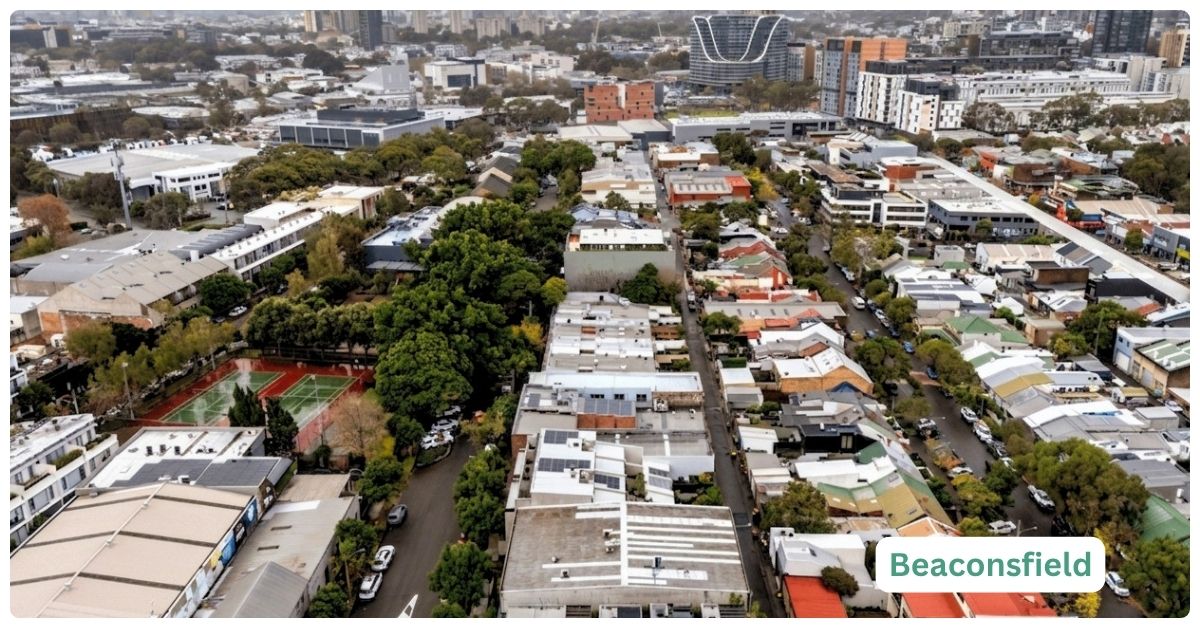
Beaconsfield was built as worker housing for the light-industrial belt that once ran through this whole corridor, and while much of that industry has been redeveloped into residential and commercial space across the wider Green Square area, the legacy is still visible in the mix of small warehouses, trade businesses and converted industrial buildings that sit alongside the terraces. Most residents commute out rather than working locally: the CBD’s 5km proximity and the direct T8 line into Central make this a commuter pocket for city-based professional and service jobs, while the median weekly household income of $3,061 (2021 Census, well above both the NSW figure of $1,829 and the national figure of $1,746) correctly points to a resident base skewed toward higher-income, likely white-collar, employment.
Transport
Green Square station, on the T8 Airport & South Line, is Beaconsfield’s default station, with Central roughly 10 to 12 minutes away by train. Erskineville station, also on the T8 line, sits just across the suburb’s northern boundary and is a alternative depending on which street you’re on. Neither station sits inside Beaconsfield itself, so factor in a 5 to 15 minute walk regardless of which one you use.
Bus coverage runs along Botany Road on the suburb’s eastern edge (see Sydney’s public bus network for full route detail), useful for a direct run into the city without changing at a station. There is no light rail or Sydney Metro stop within Beaconsfield; the closest Sydney Metro access is via the City & Southwest line stations further north, a bus or train transfer away, not a walk.
Healthcare
There’s no hospital, and no real cluster of GP clinics, inside Beaconsfield’s own boundary. Residents rely on general practices in neighbouring Alexandria and Erskineville for day-to-day care, and on St Vincent’s Hospital in Darlinghurst or Royal Prince Alfred Hospital in Camperdown for anything more serious, both a short drive or a couple of train stops away. Aged care is similarly a neighbouring-suburb affair rather than a local one; nothing purpose-built for aged care sits within Beaconsfield itself, so expect to look toward Alexandria, Erskineville or Zetland for that kind of facility.
Schools and Childcare
No school sits inside Beaconsfield, government or otherwise. Zoning depends on your exact street, but most of the suburb draws on Alexandria Park Community School (a combined K-12 public school) and/or Erskineville Public School, both well regarded locally but small, and both shared with several surrounding suburbs, which keeps enrolment pressure real rather than hypothetical. There is no independent or systemic Catholic school within Beaconsfield’s borders; families looking at those options are looking at Erskineville, Alexandria or further into the inner west. Childcare follows the same pattern: there is no long day care centre physically inside Beaconsfield, but the surrounding Alexandria/Erskineville/Green Square catchment carries a reasonable spread of centres, enough to call supply adequate rather than tight, though not abundant given the population growth the wider Green Square precinct has absorbed over the past decade.
Shopping & Eating Out
Be honest with yourself here: Beaconsfield has no shopping strip and no notable dining street of its own. Everything happens next door. Alexandria’s Botany Road and Bourke Road corridor carries cafes, homewares showrooms and destination eateries (the suburb has built a reputation well beyond its size for brunch spots and specialty coffee), and the Green Square Town Centre a short walk south delivers a full-line Coles supermarket plus a pharmacy and everyday retail. Erskineville to the north adds a proper pub-and-cafe main street along Erskineville Road. None of this is inside Beaconsfield, but none of it is far either, typically a five to ten minute walk from most Beaconsfield addresses.
Attractions & Greenspace
Beaconsfield’s own green space is modest but local: Beaconsfield Park and the Janet Beirne Reserve, both compact City of Sydney reserves with playgrounds, sit inside the suburb boundary and serve as the neighbourhood’s everyday green space rather than a destination park. For anything larger, residents walk to Sydney Park via Alexandria or St Peters, a large regional park with wetlands, cycling paths and sporting fields, or to the newer parks and public pool built as part of the Green Square town centre renewal. There’s no beach, harbour frontage or major cultural attraction inside Beaconsfield itself; this is a suburb for locals who want quiet streets, not a suburb that pulls in visitors.
Realty Market
Be upfront about the limits here: Beaconsfield is too small to generate a statistically solid market read, and any source quoting a precise median should be treated with some caution. PropertyValue.com.au puts the median house price at $2,000,000 for the 12 months to August 2026, down 13.25% year on year, but that figure rests on just 19 recorded house sales across the entire period, a thin sample for a suburb-wide median. Domain’s own breakdown, drawn from the same period, shows 2-bedroom houses transacting at a median of $1.544m (12 sales) and 3-bedroom houses at $2.08m (10 sales), which is a more useful read than a single blended figure precisely because it doesn’t average away the difference between a 2-bedroom terrace and a 4-bedroom house.
There is no reliable median unit price to report. Unit sales volume across all bedroom counts sits in the single digits over the past 12 months, too thin for either Domain or PropertyValue to publish a stable figure, and we won’t invent one. Given that flats make up 36.6% of the suburb’s dwelling stock (2021 Census), this is a gap in the available data, not a sign that units don’t trade here.
The rental market skews toward the higher end for an inner-city terrace pocket: median asking rent sits around $1,093 per week (PropertyValue.com.au, 12 months to August 2026), with a median gross rental yield of around 2.8%, above the national average despite the recent price softness, which points to rents holding up better than sale prices over the past year. Sample listings from Domain show a similar spread, from around $875 per week for a 2-bedroom unit up to $1,250 per week for larger options. Renters make up the largest tenure group in the suburb (48.8% of occupied dwellings at the 2021 Census), well ahead of owners with a mortgage (35.6%) and outright owners (14.9%), which tells you this has historically been an investor-heavy, renter-heavy pocket rather than an owner-occupier stronghold, though that mix can shift as the surrounding Green Square precinct matures.
Our Honest Thoughts on Beaconsfield
Beaconsfield works for a specific kind of buyer or renter: someone who wants a central, quiet, low-traffic residential address and is completely comfortable treating the suburb next door as their actual neighbourhood. If you want to walk out your front door to a cafe, a supermarket or a GP, this isn’t your suburb, Alexandria is, and Alexandria is the honest cross-shop here. Alexandria carries the same 2015 postcode, sits directly alongside Beaconsfield, shares the same Green Square renewal upside, and offers what Beaconsfield doesn’t: an actual shopping and dining strip, a larger and more liquid property market, and a bigger population base to draw services from. What Beaconsfield offers in return is a quieter, smaller, arguably more villagey pocket of streets, at a price point that, on the thin data available, looks broadly comparable to its larger neighbour rather than meaningfully cheaper.
This suburb is likely to appeal most to renters and owner-occupiers who prioritise a central location and quiet streets over having amenity on their own doorstep, and to investors comfortable with a thin resale market and a renter-heavy tenant pool. It is less compelling for anyone chasing an easy resale (a 19-sale annual pool makes timing an exit harder to control), for families wanting a school inside their own suburb, or for buyers who want to be able to point at “their” high street. If any of those matter more to you than the extra few minutes of walking, Alexandria, Erskineville or somewhere with its own commercial centre will serve you better.
Frequently Asked Questions
Is Beaconsfield the same as Alexandria?
No, though the confusion is understandable. Beaconsfield was gazetted as its own suburb in 1977, carved out of the former Municipality of Alexandria, and it still shares postcode 2015 with Alexandria today. They are administratively separate suburbs but functionally one neighbourhood; most everyday amenity a Beaconsfield resident uses is technically in Alexandria.
What train station serves Beaconsfield?
Green Square station, on the T8 Airport & South Line, is generally the closer and default option, with Erskineville station (also T8) an alternative for the suburb’s northern streets. Neither station sits inside Beaconsfield’s own boundary, so expect a walk of roughly 5 to 15 minutes depending on your address.
Does Beaconsfield have its own shops or supermarket?
No. There is no commercial strip inside Beaconsfield. The nearest supermarket and everyday shopping is a short walk south at the Green Square Town Centre, or west along Alexandria’s Botany Road/Bourke Road strip.
How big is Beaconsfield’s population?
1,172 people at the 2021 Census, making it one of the smallest suburbs in Sydney. That’s up from 987 in 2016, but the base is small enough that percentage growth figures should be read with caution. There’s no more recent official count; the next Census is due in 2027.
Is Beaconsfield a good suburb for a family with school-age children?
It can work, but go in with eyes open. There’s no school inside Beaconsfield itself, zoning depends on your street and generally points to Alexandria Park Community School or Erskineville Public School, and the suburb’s own dwelling stock (mostly terraces and flats) skews toward couples rather than families with children, at 51.3% couple-without-children households versus 37.1% couple-with-children at the 2021 Census.
References
- Australian Bureau of Statistics, 2021 Census QuickStats, Beaconsfield (NSW), SAL10239, accessed 23 August 2026
- NSW Bureau of Crime Statistics and Research (BOCSAR), data as reported via aucrimetracker.com, City of Sydney LGA, year ending March 2026, accessed 23 August 2026
- City of Sydney Council, Beaconsfield Park Playground and Janet Beirne Reserve Playground pages, accessed 23 August 2026
- Redfern News, “From Factories to Families: Green Square Transforms Five Suburbs” (Green Square precinct area and suburb list), accessed 23 August 2026
- NSW Department of Education, School Infrastructure NSW and school websites for Alexandria Park Community School and Erskineville Public School, accessed 23 August 2026
- City of Sydney Council, Areas of Service and Local Government Area boundary map, accessed 23 August 2026
For a wider view of how Beaconsfield fits alongside its neighbours, browse the complete list of Sydney suburbs or explore the Sydney regions overview to see how the South Sydney district it sits within compares to the rest of the city.