
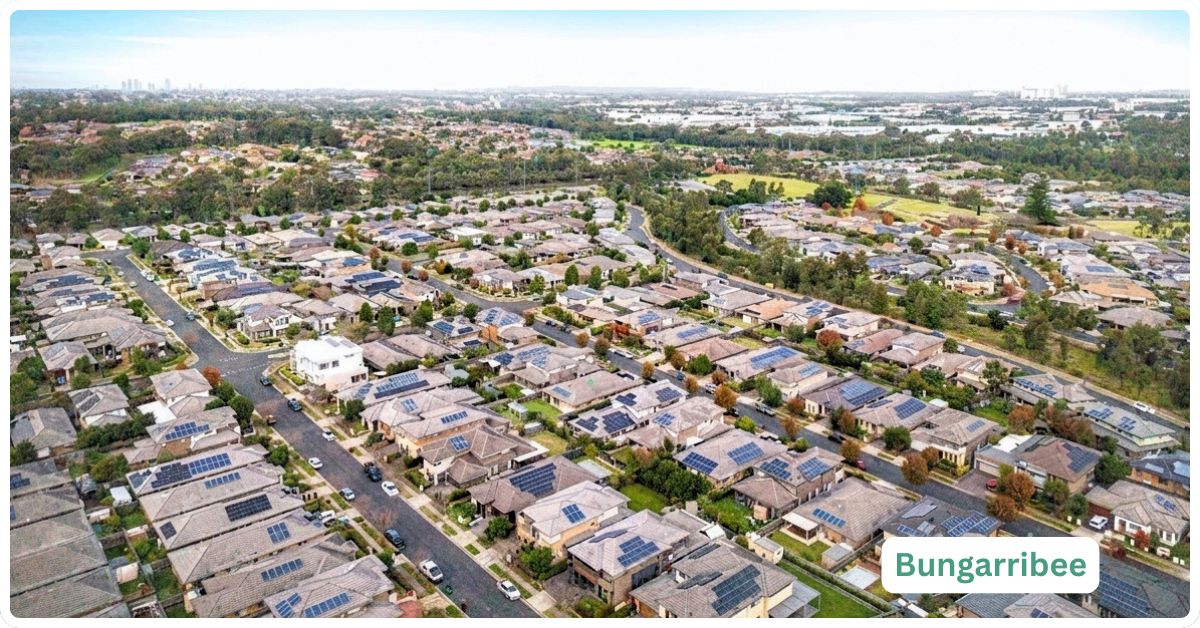
Bungarribee is one of a small handful of Sydney suburbs with a zoo inside its own boundary. Sydney Zoo, a 16.5-hectare facility with more than 30 exhibits, opened here in December 2019, sitting inside the 300-hectare Bungarribee Precinct of the Western Sydney Parklands. The housing around it is just as deliberate: an 800-home, 55-hectare Landcom masterplanned estate, completed in stages between 2011 and 2014, built on water-sensitive design principles with mandatory solar and water tanks on every home. This isn’t an organic suburb that grew up around infrastructure. It’s a planned community that got its infrastructure first, and it shows in both the price tag and the population it has attracted.
Bungarribee Boundary and Location Map
Bungarribee sits roughly 38-40 kilometres west of the Sydney CBD in Blacktown City Council, bounded by the M4 Motorway, Doonside Road, Eastern Road and the M7 Motorway. It borders Doonside to the west, Rooty Hill to the south, Eastern Creek to the north, and sits immediately alongside the Western Sydney Parklands, which separate it from Prospect and Huntingwood further east.
Quick Facts
| LGA | Blacktown City Council |
| Postcode | 2767 |
| Population | 3,177 (2021 Census, ABS QuickStats SAL10679), up 20.4% since 2016. Median age 33, well below the NSW median of 39 |
| Growth Rate | 20.4% population growth 2016-2021 (ABS Census), reflecting the estate’s staged build-out through that period rather than ongoing sprawl; the estate itself is now largely complete |
| Distance from CBD | Approximately 38-40km west of the Sydney CBD |
| Character | Purpose-built Landcom masterplanned housing estate (completed) directly adjoining Sydney Zoo and the Western Sydney Parklands |
| Median House Price | $1.5M (PropertyValue.com.au, 12 months to 2026), up 8.06% year on year on 21 recorded sales, ranking 470th of NSW suburbs by median value |
| Median Unit Price | Not applicable. 98% of dwellings are separate houses; there is no meaningful unit market (ABS Census 2021) |
| Transport | No train station within the suburb. Nearest is Rooty Hill Station (T1 North Shore & Western Line), roughly 2km away. Bus routes 723, 728, 729, 738 and 739V connect Bungarribee to Mount Druitt, Rooty Hill and Blacktown |
| Crime Rate (LGA) | Blacktown LGA: violent crime 1,294.8 per 100,000 (rank 57 of 128 NSW LGAs, Apr 2025-Mar 2026, BOCSAR), up from rank 59 the year before. Property crime 1,401.6 per 100,000 (rank 71 of 128), up from rank 74 |
| Childcare Availability | Moderate. Around 26 childcare services and 14 after-school-care options across the postcode (2026), reasonable for a family-heavy suburb of this size |
| School Zone Quality | No school within Bungarribee itself; families are zoned to schools in neighbouring Doonside and Rooty Hill, a short drive or walk depending on address |
| Parks & Recreation | Genuinely exceptional. Bungarribee Superpark, part of the 300-hectare Western Sydney Parklands precinct, offers grasslands, over 6,000 planted trees across two linear forests, large-scale play equipment and an events lawn, all within or adjoining the suburb |
| Shopping | No major shopping centre within the suburb itself. Westpoint Blacktown and Rooty Hill’s local shops are the nearest realistic options, both a short drive away |
| Health | No hospital in the suburb. Blacktown and Mount Druitt Hospital is the nearest major facility, a short drive away |
| Best For | Established families and buyers wanting a purpose-built, higher-budget estate with genuine parkland and attraction access, rather than a fixer-upper or entry-level buy |
What Makes Bungarribee Special
A Suburb Built Around a Zoo and a Superpark, Not the Other Way Around
Most Sydney suburbs get their parks and attractions retrofitted, years after the houses go up. Bungarribee is the reverse: Sydney Zoo (16.5 hectares, more than 30 exhibits across Primate Boulevard, Asia, Africa, Australia and an Aquarium precinct) and Bungarribee Park, with its restored native grasslands and more than 6,000 newly planted trees across two linear forests tracing the site’s history as a World War II airfield, were built as part of the same 300-hectare parklands precinct the housing estate sits beside. That’s not a nearby amenity you drive to occasionally, it’s genuinely walkable from parts of the suburb.
Built Green From the Ground Up
Landcom’s masterplan for the 800-home estate mandated solar power and water tanks on every home, alongside vegetated eco-medians and water treatment rain gardens designed to manage stormwater and cool the streetscape. That’s a genuinely unusual level of environmental design discipline for a project that broke ground back in 2010, well ahead of when sustainability features became standard in new estates.
What Is It Like Living Here?
Bungarribee is an established, higher-budget family estate rather than a growth-corridor suburb still finding its feet. Nearly all housing (98%) is separate houses, and a striking 80.7% have four or more bedrooms, well above what’s typical even in family-oriented Western Sydney. It’s also overwhelmingly a mortgage-belt suburb: 72.5% of dwellings are owned with a mortgage, against just 16.7% renting, a tenure mix that skews heavily toward stable, long-term owner-occupiers rather than a rental or investor-churn market.
The cultural makeup is distinctly South Asian and Pacific: Indian ancestry leads at 31.2%, followed by Filipino at 11.4%, with Hinduism the largest religious affiliation (34.4%) and Gujarati and Hindi both common home languages alongside English.
Transport
There’s no station inside Bungarribee. The nearest is Rooty Hill Station on the T1 North Shore & Western Line, about 2km away, from which it’s roughly 50 minutes to an hour into the Sydney CBD.
Locally, bus routes 723, 728, 729, 738 and 739V connect Bungarribee through to Mount Druitt, Rooty Hill and Blacktown, useful for local trips more than a city commute.
By car, the estate’s edges run directly along the M4 and M7 Motorways, genuinely convenient for anyone driving to work rather than training in, which given the lack of an in-suburb station is the more realistic daily pattern for most residents here.
Healthcare
No hospital or major clinic sits within Bungarribee itself. Blacktown and Mount Druitt Hospital is the nearest major facility, a short drive away, with general GP services concentrated in neighbouring Rooty Hill and Mount Druitt.
Schools and Childcare
Bungarribee has no school within its own boundary, families are zoned to schools in neighbouring Doonside and Rooty Hill, which is a genuine trade-off given how family-heavy this suburb otherwise is (95.7% of occupied dwellings are family households). On childcare, around 26 childcare services and 14 after-school-care options across the postcode (2026), a moderate supply that roughly matches demand from a suburb with a median age of 33 and a heavy skew toward young families.
Industry & Work Life
Bungarribee itself has no commercial or industrial employment base, it’s purely residential. Sydney Zoo is a genuine local employer, but most residents commute out: to the Eastern Creek, Arndell Park and Minchinbury industrial precincts for trade and logistics work, to Blacktown and Parramatta for retail and professional roles, or further into the Sydney CBD, aided by the direct M4/M7 access at the estate’s edge.
Shopping & Eating Out
There’s no major shopping centre within Bungarribee. Westpoint Blacktown is the nearest full-scale shopping destination, along with smaller local shops in Rooty Hill, both a short drive away. It’s a genuine gap for a suburb this well-resourced on parkland and recreation, worth factoring in if daily walkable shopping matters to you.
Attractions, Parks and Natural Spaces
Sydney Zoo and Bungarribee Park are the standout features of living here, both within or immediately adjoining the suburb. The Superpark’s design deliberately references the site’s past as a World War II airfield, with two linear forests retracing former runways, alongside large-scale play structures, an events lawn, small amphitheatre and picnic shelters. It’s genuinely rare for a Sydney suburb this size to have amenity of this calibre on its doorstep rather than a half-hour drive away.
Crime and Safety
At the LGA level, Blacktown recorded a violent crime rate of 1,294.8 per 100,000 people for the year to March 2026 (rank 57 of 128 NSW LGAs, BOCSAR), a slight worsening from rank 59 the year before, and a property crime rate of 1,401.6 per 100,000 (rank 71 of 128), also up slightly from rank 74. No suburb-specific figures are published for Bungarribee by BOCSAR, and there’s no distinct anecdotal signal available either; as a purpose-built, high owner-occupier estate it doesn’t carry the same public discussion around safety that some of its older neighbours do, but that’s an absence of data, not a claim about actual risk.
Realty Market
Bungarribee’s median house price sat at $1.5 million over the 12 months to 2026 (PropertyValue.com.au), up 8.06% year on year across 21 recorded sales, a modest but workable sample. That price ranks Bungarribee around 470th of NSW suburbs by median house value, meaningfully above most of its Mount Druitt-corridor neighbours, reflecting its larger, newer housing stock (80.7% of homes have four or more bedrooms) and parkland-adjacent positioning. There is no meaningful unit market, with 98% of dwellings being separate houses.
The rental market here is thin but not negligible: PropertyValue.com.au records a median asking rent of $900 a week (3.2% median gross yield), well above most of the surrounding suburbs, consistent with the estate’s larger homes and higher entry price. With only 16.7% of dwellings rented, Bungarribee functions primarily as an owner-occupier market rather than an investor-heavy one.
Our Honest Verdict
Bungarribee is likely to appeal most to established families with a larger budget who want a genuinely well-designed, parkland and attraction-rich estate, and who are comfortable driving rather than training to work. It is a considerably weaker fit for first-home buyers chasing an entry-level price point, or for investors focused on rental yield, given the modest 3.2% gross return relative to the $1.5 million entry price. Marsden Park, a comparable Blacktown growth-corridor suburb with a similarly master-planned, family-oriented character, is a genuine suburb to cross-shop against Bungarribee.
Frequently Asked Questions
Is Sydney Zoo actually in Bungarribee?
Yes. Sydney Zoo, which opened in December 2019, sits within the Bungarribee Precinct of the Western Sydney Parklands, immediately adjoining the residential estate.
Is there still new housing being built in Bungarribee?
No. Landcom lists the 800-home, 55-hectare estate as a completed project, with infrastructure works beginning in 2010 and the Community Hub opening in 2014. The 20.4% population growth recorded between the 2016 and 2021 Census reflects that staged build-out completing, not ongoing expansion.
Does Bungarribee have its own train station?
No. The nearest is Rooty Hill Station on the T1 North Shore & Western Line, about 2km away.
Why is Bungarribee more expensive than its Mount Druitt-corridor neighbours?
Newer, larger housing stock (most homes have four or more bedrooms), a purpose-built environmentally designed estate, and direct adjacency to Sydney Zoo and the Western Sydney Parklands all support a higher median price than the older, smaller housing stock in nearby suburbs like Bidwill or Blackett.
References
- Population, age, tenure, cultural makeup and dwelling data: Australian Bureau of Statistics, 2021 Census QuickStats, Bungarribee (SAL10679), accessed 2026
- Median house price, sales volume and NSW ranking: PropertyValue.com.au, Bungarribee NSW 2767, accessed 2026
- Open-market median rent and rental yield: PropertyValue.com.au, Bungarribee NSW 2767, accessed 2026
- Landcom masterplan, estate scale, timeline and sustainability features: Landcom, Bungarribee project page, accessed 2026
- Sydney Zoo location, size, opening date and exhibits: Sydney Zoo official site and Wikipedia summary, accessed 2026
- Bungarribee Superpark design and heritage features: Landscape Australia, “A grassland splendour: Bungarribee Superpark,” accessed 2026
- Bus routes 723, 728, 729, 738 and 739V: Transport for NSW / Busways area timetable, Eastern Creek-Minchinbury-Mount Druitt-Rooty Hill
- Nearest rail station and line status: Transport for NSW, T1 North Shore & Western Line
- Blacktown LGA violent and property crime rates and ranks, April 2025 to March 2026: NSW Bureau of Crime Statistics and Research (BOCSAR), LGA ranking of recorded crime offences
- Childcare and after-school-care service counts: CareforKids.com.au, Bungarribee NSW 2767, accessed 2026
- Suburb boundary and postcode: NSW Spatial Services, NSW Administrative Boundaries Theme, accessed 2026
For more suburbs across Blacktown City Council, see the complete list of Sydney suburbs, or browse the broader Sydney Regions overview.