
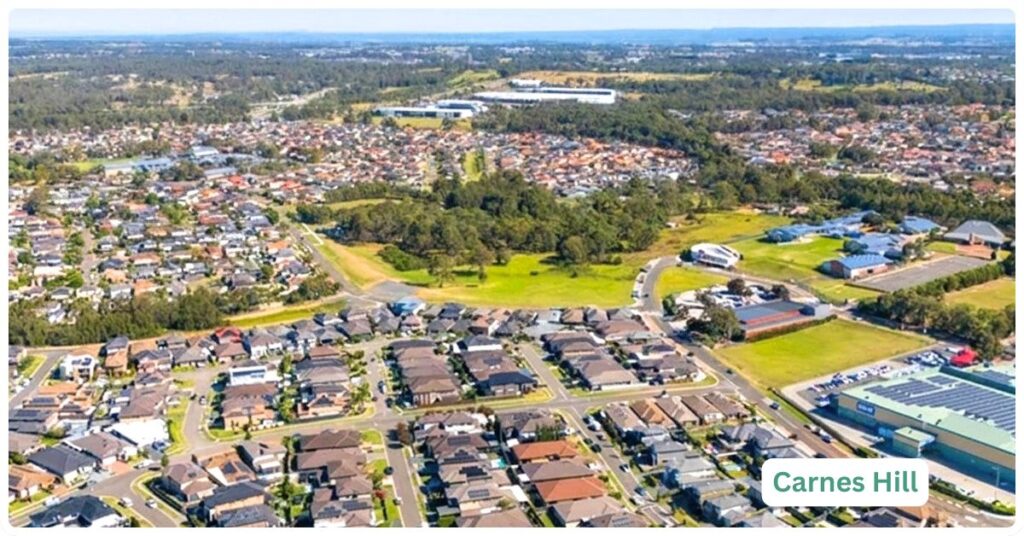
Carnes Hill is what happens when a council builds the community centre first and lets the suburb catch up around it. Most of South West Sydney’s growth suburbs get rooftops for years before they get any real gathering place. Carnes Hill got its library, community centre, skate park, cafe and shopping precinct clustered on the corner of Cowpasture and Kurrajong Roads back in 2016, and the housing has kept filling in around that anchor ever since.
The name itself predates all of it by two centuries. It comes from Thomas Carne, a lieutenant in the 46th Regiment and former Liverpool coroner, who was granted 285 hectares here in 1819 and named his own property Bellevue. It was a nearby watering hole, Carnes Inn, that stuck in local memory and eventually gave the hill, then the suburb, its name. The Carnes Hill tollgate later sat at the junction of Cowpasture and Bringelly Roads in 1849, which means the intersection anchoring today’s community precinct has been a local reference point for well over 170 years.
Don’t come here expecting a train station or a walkable village strip. Carnes Hill is car-dependent, postcode 2171, sitting inside Liverpool City Council roughly 38 kilometres southwest of the Sydney CBD, and its identity is built almost entirely around one genuinely good piece of civic infrastructure rather than heritage streetscapes or transport links.
Carnes Hill Boundary and Location Map
Carnes Hill sits in the Liverpool local government area, bordered by Hoxton Park and Cecil Hills, with West Hoxton and Horningsea Park nearby to the south and Middleton Grange to the west, all part of the same broad South West Growth Area pocket of Liverpool. The suburb is built around the Cowpasture Road and Kurrajong Road corridor, the two arterial roads that carry almost all of the local traffic and define its shopping and community hub.
Quick Facts
| LGA | Liverpool City Council |
| Postcode | 2171 |
| Population | 3,332 (2021 Census, ABS) |
| Median age | 32 years (2021 Census) |
| Distance to CBD | approx. 38km southwest |
| Region | South West Growth Area |
| Landmark | Carnes Hill Community and Recreation Precinct |
| Shopping | Carnes Hill Marketplace (Woolworths, Big W, Dan Murphy’s) |
| Name origin | Thomas Carne, 1819 land grant |
| Median house | approx. $1.03m-$1.4m (2025, sources vary) |
| Median unit | approx. $885,500 (2025) |
| Nearest train | Liverpool station, approx. 8km / 18min bus |
| Reality check | Car-dependent, no station in the suburb |
What Makes Carnes Hill Special
The Community and Recreation Precinct
The Carnes Hill Community and Recreation Precinct, opened in August 2016, is the genuine reason this suburb has an identity at all. It combines a public library, a community centre with function rooms for hire (the largest catering for up to 170 people, complete with commercial kitchen and projection screens), the Michael Clarke Recreation Centre with an indoor fitness and basketball facility, tennis courts, a skate park, a cafe and a public plaza, all on one site at the corner of Cowpasture and Kurrajong Roads. It is the kind of concentrated civic infrastructure that most South West Growth Area suburbs wait a decade or more to see, and Carnes Hill had it within a few years of the estates filling in.
The Aquatic Centre, Still Coming
Liverpool City Council has an aquatic and recreational centre planned as a further addition to the precinct, expanding on the existing library, community centre and Michael Clarke Recreation Centre. As of the council’s most recent published update, the project remains in its design and planning phase, working through budget constraints, so anyone weighing up Carnes Hill on the promise of a new pool should treat it as a genuine but not yet delivered addition rather than a current amenity.
Carnes Hill Marketplace
Carnes Hill Marketplace anchors the retail side of the same precinct, with a Woolworths, Big W and Dan Murphy’s as its major tenants alongside Bakers Delight, Priceline, Flight Centre and a run of smaller specialty stores. It is a suburban shopping centre rather than a destination in its own right, but combined with the library and recreation centre next door, it gives Carnes Hill a genuine everyday-errands hub that plenty of comparable growth suburbs still lack.
What Is It Like Living Here?
Carnes Hill records one of the largest average household sizes in Sydney at 3.8 people per household across 845 families (2021 Census), a figure that says as much about the suburb’s character as any postcard description could. This is a suburb of large, often multigenerational and culturally diverse households rather than young singles or downsizing retirees. Just over half of residents, 51.8 per cent, were born in Australia, with Iraq (10.3 per cent) and Fiji (4.9 per cent) the next most common countries of birth, and only 37.3 per cent of households speaking only English at home. Catholic (37.3 per cent), Islam (12.7 per cent) and Hinduism (7.7 per cent) are all significant religious affiliations locally, reflecting a genuinely mixed cultural mix rather than any single dominant community.
Day to day, life here revolves around the car, the Community and Recreation Precinct, Carnes Hill Marketplace and school runs. There’s no walkable village strip in the traditional sense and no train station, so anyone who values that kind of urban texture will find Carnes Hill flat in that respect. What it offers instead is new-ish housing stock, a functioning local shopping and recreation hub, and proximity to a cluster of similar South West Growth Area suburbs, Hoxton Park, Cecil Hills, West Hoxton and Horningsea Park among them, that together form one contiguous, fairly homogeneous outer-suburban belt.
Hospitals
Liverpool Hospital, one of south-western Sydney’s major tertiary referral hospitals, is the primary hospital for Carnes Hill residents, roughly a 15 to 20 minute drive depending on traffic on Cowpasture Road and Hoxton Park Road.
Education
There is no Carnes Hill Public School. The local primary school most commonly serving the suburb is Greenway Park Public School, with several other Liverpool LGA primary schools within a short drive. For secondary schooling, families typically look toward Hoxton Park High School and Cecil Hills High School, both nearby in the same pocket of Liverpool LGA, though exact enrolment zoning should always be confirmed directly with the NSW Department of Education’s school finder rather than assumed, since growth-area boundaries shift as new schools come online.
Industry & Work Life
Carnes Hill is overwhelmingly a residential, commuter suburb. Most working residents travel out to Liverpool, greater South West Sydney, or further into the city for employment, with the Carnes Hill Marketplace precinct itself providing a modest amount of local retail and hospitality employment. Longer term, the Western Sydney Aerotropolis and Western Sydney International Airport, both a reasonable drive south, are expected to expand local job options across the wider South West Growth Area over the coming decade, though Carnes Hill itself will likely remain a bedroom suburb rather than an employment centre.
Parks and Natural Spaces
Carnes Hill’s green space is mostly built into the recreation precinct itself: the skate park, tennis courts and outdoor plaza around the library and community centre double as the suburb’s most-used public open space. The suburb has two AFL fields and is home to the South West Tigers Australian Football Club, giving local families organised weekend sport within the suburb rather than a drive elsewhere.
The larger Western Sydney Parklands network is accessible a short drive north for anyone wanting proper bushland or cycling trails.
Transport
Carnes Hill has no train station of its own. The nearest railway station is Liverpool, roughly 8 kilometres away, reachable by local bus in about 18 minutes. Leppington station, on the T2 Leppington Line, is further out at around 16 kilometres by road, with a direct bus service running every 20 minutes taking about 37 minutes. Anyone who needs a genuinely short commute to a station should be honest with themselves about this before buying: Carnes Hill is a suburb you drive to a train from, not one you walk to a train from.
Transit Systems operates local bus services connecting Carnes Hill to Liverpool station roughly every 30 minutes, with fares around $2 to $3, and alternate routes running via Hoxton Park and neighbouring estates. Coverage is reasonable for a growth suburb of this size, but frequency and directness both trail what residents in rail-connected suburbs like Edmondson Park get as a matter of course.
Cowpasture Road and Kurrajong Road are the suburb’s two defining arterial corridors, carrying almost all through traffic and linking Carnes Hill to Hoxton Park, Cecil Hills and the broader Liverpool road network. The M7 motorway is accessible via these arterials, giving reasonable connections toward the M5 and the wider South West Growth Area, though like most of this corridor, peak-hour congestion on Cowpasture Road is a known local frustration rather than a rare event.
Carnes Hill sits approximately 38 kilometres southwest of the Sydney CBD, around 8 kilometres from Liverpool, and within a short drive of Cecil Hills, Hoxton Park, West Hoxton and Middleton Grange.
Realty Market
Pin down a single median house price for Carnes Hill and you’ll get a different answer depending on where you look, and that spread is itself worth noting for a lower-volume suburb like this. Recent sold-price data puts the median house at around $1.4 million over the 12 months to mid-2025, up roughly 4.5 per cent annually, while other sources report medians closer to $1.03 million to $1.3 million depending on whether the figure reflects sales or asking prices. Units are more consistent, sitting around $885,500 as of 2025. Whatever the precise figure, Carnes Hill sits solidly in the upper-middle band for the South West Growth Area, priced above several newer, less-established release suburbs but below fully rail-connected neighbours like Edmondson Park.
Reliable, dated rental figures specific to Carnes Hill were not readily available at the time of writing, and this profile won’t invent a number to fill the gap. Prospective renters should treat this as a suburb where demand is driven by its family-sized housing stock and community amenity rather than transport access, and should check current listings directly for an accurate read on asking rents.
The Honest Verdict
Carnes Hill is the South West Growth Area suburb for buyers who want their community infrastructure delivered early rather than promised for later. Weighed against its immediate neighbours, Hoxton Park, West Hoxton and Horningsea Park among them, Carnes Hill’s genuine point of difference is the Community and Recreation Precinct and Marketplace, a real, functioning civic and retail hub rather than a rendering on a developer’s website. What it doesn’t have, and won’t get any time soon, is a train station, so buyers who need rail access for a daily commute should look toward Edmondson Park or Leppington instead. For families who value large homes, a solid community facility, and a genuinely mixed cultural community over transport convenience, Carnes Hill delivers on what it promises, even if the aquatic centre everyone’s still waiting for hasn’t arrived yet.
Frequently Asked Questions
Does Carnes Hill have a train station?
No. Carnes Hill has no railway station of its own. Liverpool station is the nearest, about 8 kilometres away and roughly an 18-minute bus ride, and Leppington station on the T2 line is a further, less direct option.
Is there a Carnes Hill Public School?
No, there is no school by that name. Greenway Park Public School is the local primary school most commonly associated with the suburb, and Hoxton Park High School and Cecil Hills High School are the nearest secondary options.
What is the Carnes Hill Community and Recreation Precinct?
It’s a combined civic facility opened in August 2016 on the corner of Cowpasture and Kurrajong Roads, including a public library, community centre with function rooms, the Michael Clarke Recreation Centre, tennis courts, a skate park, a cafe and a public plaza, alongside the adjoining Carnes Hill Marketplace shopping centre.
Is Carnes Hill safe?
NSW crime data is published at the Liverpool City Council LGA level, not suburb by suburb, so there’s no official Carnes Hill-specific figure. Liverpool LGA recorded around 110 offences per 1,000 residents in 2025 (BOCSAR-sourced data via RedSuburbs), with crime up 7.3 per cent on 2024, and a violent crime victimisation rate of roughly 1 in 77 versus 1 in 83 for NSW overall, meaning the LGA sits slightly above the state average on violent offences. Independent suburb-level aggregation from the same source ranks Carnes Hill itself as one of the lower-crime suburbs within Liverpool LGA, though this is a private analytical ranking rather than an official BOCSAR statistic.
Where does the name Carnes Hill come from?
It’s named for Thomas Carne, a lieutenant in the 46th Regiment and former Liverpool coroner, who received a 285-hectare land grant in the area in 1819. A well-known local watering hole, Carnes Inn, put the name on the map, and the hill was formally gazetted on 21 March 1975.
References
ABS 2021 Census QuickStats, Carnes Hill
Liverpool City Library, Carnes Hill (suburb history and name origin)
Liverpool City Council, Carnes Hill Aquatic and Recreation Centre (project status)
Liverpool City Council, Carnes Hill Community Precinct
NSW BOCSAR, Crime Statistics by LGA (Liverpool)
RedSuburbs, Liverpool LGA crime profile (BOCSAR-derived, 2025)
See all suburbs in the Liverpool City Council. See the full Sydney Regions overview to explore more of greater Sydney.