
Centennial Park is the only Sydney suburb where the front yard is a national heritage landscape. Its residential footprint is a slim wedge of streets pressed against the western and southern edges of the 189-hectare Centennial Parklands, and almost everything about the place, the price, the quiet, the near-total absence of anything resembling a shop, flows directly from that one fact. Buy here and you are buying proximity to a park, not a neighbourhood in the conventional sense: there is no high street, no supermarket, and barely a café to your name. That is not an oversight in the marketing. It is the trade-off the suburb was built on, and it has never really changed.
Centennial Park Boundary and Location Map
Centennial Park sits roughly 4 kilometres east of the Sydney CBD, sharing postcode 2021 with neighbouring Paddington. The suburb itself is a narrow residential band running along the parklands’ western and southern boundary, bordered by Paddington to the north, Woollahra and Queens Park to the east, Kensington and Randwick to the south, and Moore Park to the west. The park it is named for makes up the overwhelming majority of the suburb’s land area and sits within Randwick City Council. Older references sometimes describe a City of Sydney overlap here, and it is true that the parklands themselves are jointly governed and that the suburb’s northern fringe runs hard up against the City of Sydney line at Paddington. For rating, planning and everyday council-service purposes, the residential precinct is confirmed as falling within Randwick City Council.
Quick Facts
| LGA | Randwick City Council |
| Postcode | 2021 (shared with Paddington) |
| Population | 2,225 (2021 Census, ABS). Down slightly from 2,376 in 2016. The 2026 Census was conducted in August 2026; small-area results are not due until 2027, so this is the most recent verified figure available. |
| Growth Rate | Broadly flat to marginally declining over 2016-2021, consistent with a fully built-out, heritage-protected precinct with almost no scope for new dwellings. |
| Distance from CBD | Approximately 4 km east of the Sydney CBD. |
| Character | A small, quiet, heritage residential enclave defined almost entirely by its border with Centennial Parklands, with virtually no commercial strip of its own. |
| Median House Price | $5,350,000 (12 months to May 2026, CoreLogic via Your Investment Property, up 15.98% year on year). Based on just 5 recorded sales, so treat the figure as indicative only, not a reliable trend line. |
| Median Unit Price | $870,000 (12 months to May 2026, CoreLogic via Your Investment Property, up 1.61% year on year, 55 sales). Domain’s separate 12-month sales read shows 1-bedroom units around $757,500 and 2-bedroom units around $1.11 million. |
| Transport | No train station. Bondi Junction (T4 Eastern Suburbs and Illawarra Line) is a 10-minute walk from the park’s northern edge. L2 Randwick light rail stops at Moore Park and Royal Randwick border the suburb’s west and south. Bus routes 333, 340, 352, 355, 389 and 440 run along Oxford Street at the Paddington gates. |
| Crime Rate (LGA) | Randwick LGA recorded roughly 5,027 incidents per 100,000 people in the year to March 2026 (BOCSAR), below the NSW average and down over the past decade, though up modestly on five years ago. |
| Childcare Availability | Tight within the suburb itself; the realistic catchment leans on Paddington and Woollahra centres nearby. |
| School Zone Quality | Centennial Park Public School services the local streets, with Sydney’s private and selective school market (Paddington, Woollahra, Moore Park) within easy reach for those not zoned or not chasing a public option. |
| Parks & Recreation | Exceptional. Centennial Parklands (189 hectares) plus Queens Park directly adjacent; this is the suburb’s entire reason for being. |
| Shopping | Almost none in-suburb. Nearest options are Oxford Street, Paddington and the Woollahra shopping strip. |
| Health | Prince of Wales Hospital and Prince of Wales Private Hospital, Randwick, a short drive or bus ride away. |
| Best For | High-income professionals and established families who want daily access to green space and heritage housing stock, and who are comfortable driving or bussing for groceries. |
What Makes Centennial Park Special
There is exactly one reason people pay a premium to live in Centennial Park, and it is the park. Everything else about the suburb, the housing stock, the quiet streets, the lack of a corner shop, follows from a decision made more than a century ago to protect the land and control what got built beside it.
A park opened for the people, 26 January 1888
Centennial Park was officially opened on 26 January 1888, the centenary of European settlement, as part of a week of celebrations. Sir Henry Parkes dedicated it as, in his words, “emphatically the people’s park”, and Lady Carrington, wife of the Governor of the day, planted the first of thirteen ceremonial trees on a site so rocky it had to be blasted and topped up with imported soil before anything would grow. It has been a public reserve ever since, and at 189 hectares it remains one of the largest urban parks in the world still managed as open parkland rather than progressively built over. Ponds covering almost 26 hectares, cycling and equestrian tracks, and open grounds used for everything from picnics to major public events sit inside a five-minute walk of every house in the suburb.
The 1904 subdivision that still shapes the streetscape
In 1904, roughly 41 hectares of land along the park’s western border was released for housing, and the subdivision came with conditions that were strict even by the standards of the day: no wooden buildings, no terrace housing, brick or stone only, with tile or slate roofs. Development ran through to the mid-1920s, leaving a streetscape of Federation, Arts and Crafts and Old English-style freestanding houses that has changed remarkably little since. It is a big part of why the suburb reads as distinctive rather than just expensive: the housing stock is unusually consistent, low-density and heritage-flavoured, and there was never room for the terrace rows or corner shops that give most inner-Sydney suburbs their commercial spine.
What Is It Like Living Here?
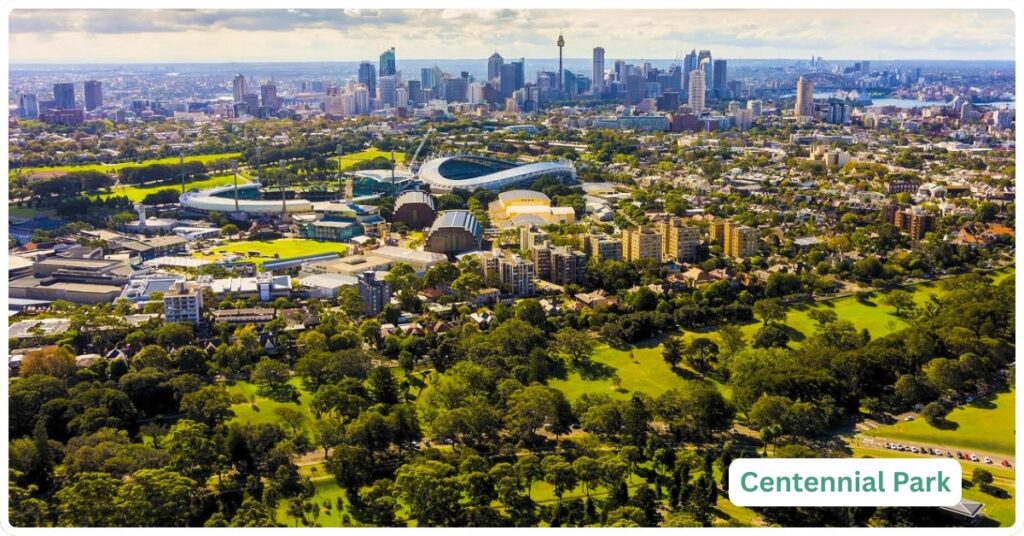
Living in Centennial Park means accepting a trade-off up front: you get one of Sydney’s best outdoor spaces on your doorstep and almost nothing else within walking distance. Locals describe it less as a suburb with a park attached and more as a small residential fringe of the park itself. It suits people who have already made peace with driving or bussing to do their groceries, and who value quiet, heritage streets and green space over the convenience of a local strip.
This is not a suburb built around local industry or employment. With a median resident age around 36 and a population skewed toward working professionals, most people here commute into the CBD, the health and education precinct around Randwick and the University of New South Wales, or the media and creative businesses clustered through Paddington and Moore Park. The light rail and bus network do the heavy lifting for that commute; very few people are working from a home office overlooking the park, however tempting the view.
Attractions, Parks and Natural Spaces
This is the section that actually explains the suburb. Centennial Park itself covers 189 hectares, with cycling and equestrian tracks, ponds spanning almost 26 hectares that draw birdlife minutes from the CBD, and open grounds used for everything from weekend picnics to major public gatherings. It connects into the broader Centennial Parklands estate alongside Moore Park (home to the Sydney Cricket Ground and Allianz Stadium) and Queens Park immediately to the east, giving residents an unbroken stretch of green space that few Sydney suburbs can match at any price. Whatever Centennial Park lacks in shops, it makes up for many times over here.
Shopping & Eating Out
Here is the honest part: Centennial Park has essentially no shopping or dining of its own. There is no supermarket, no café strip, no local pub to speak of. Residents walk or drive to Oxford Street, Paddington, for cafés, restaurants and the Saturday Paddington Markets, or to the Woollahra shopping strip for boutiques and grocers. It is a major trade-off, not a minor inconvenience: if a five-minute walk to milk and bread matters to you, this suburb will frustrate you regularly. If you are happy treating the park as your amenity and driving for everything else, it barely registers.
Transport
The nearest heavy rail is Bondi Junction, served by the T4 Eastern Suburbs and Illawarra Line, about a 10-minute walk from the park’s northern edge via Grafton Street and Oxford Street. The more useful option for most residents is the L2 Randwick light rail line, which runs from Circular Quay through Central Station and stops at Moore Park and Royal Randwick, both bordering the suburb, with services roughly 5am to 1am daily. Buses 333, 340, 352, 355, 389 and 440 run along Oxford Street at the Paddington gates and connect through to the CBD and Bondi Junction; details and timetables are on the Sydney bus network page. Don’t buy here expecting a train station any time soon: nothing in current infrastructure planning changes that.
Healthcare
Prince of Wales Hospital and the adjoining Prince of Wales Private Hospital in Randwick are the nearest major facilities, a short drive or a bus and light rail combination away. GP clinics are not a strength inside the suburb itself; residents typically use practices in neighbouring Paddington, Woollahra or Randwick. For a suburb this small and this residential, that is a realistic and workable arrangement.
Schools and Childcare
Centennial Park Public School serves the local streets, and given the suburb’s tiny footprint, most families here are within its zone or very close to its boundary. Beyond that, the eastern suburbs’ deep private and selective school market, including options across Paddington, Woollahra and Moore Park, sits within a short drive, which is one reason the area appeals to established professional families who are not fussed about walking their kids to school. Childcare is the honest weak point: long day care options inside Centennial Park are limited, and most families realistically draw on centres in Paddington and Woollahra rather than expecting supply on their own street. Anyone planning around a childcare place should treat the immediate suburb as tight and budget time to secure a spot nearby rather than locally.
Crime and Safety
Crime statistics are only reliably available at the Randwick City Council LGA level, not suburb by suburb, so treat the following as an area-wide signal rather than a Centennial Park-specific figure. BOCSAR data for the year to March 2026 puts Randwick LGA’s overall crime rate at roughly 5,027 incidents per 100,000 people, below the NSW average, and down over the past decade, though up modestly compared to five years earlier. Theft is the most commonly recorded offence category. Anecdotally, given the suburb’s tiny population and low-traffic streets, residents and local forums describe Centennial Park itself as quiet, with the parklands at night the more commonly flagged safety consideration than the residential streets. That is anecdotal, not a substitute for the LGA data above.
Realty Market
Centennial Park is a low-volume market by nature. With only a few hundred dwellings in the entire suburb, annual sales numbers are small enough that any median price should be read as a rough signal, not a precise valuation tool.
Buying: Over the 12 months to May 2026, CoreLogic data reported a median house price of $5,350,000, up 15.98% year on year, but from just 5 recorded sales, a sample size too thin to treat as a reliable trend. Units are a more useful read given far higher turnover: the median sat around $870,000 (up 1.61% year on year, 55 sales), with a separate Domain read of recent sales showing 1-bedroom units around $757,500 and 2-bedroom units around $1.11 million, the latter typically taking around a month to sell. Housing stock is almost entirely heritage freestanding houses from the 1905-1925 subdivision period, with a smaller mix of apartments filling out the unit market. Given the tiny house sample, anyone benchmarking against Centennial Park house prices should treat the headline figure with real caution rather than as a settled market value.
Renting: Rental supply is similarly thin. Recent Domain listings showed 1-bedroom units renting around $675 a week and 2-bedroom units around $850 a week, with houses rarely available to rent at all given how few exist. Over 55% of dwellings in the 2021 Census were rented rather than owned, a notably high renter share for a suburb this expensive, reflecting both the unit stock and a transient professional tenant base drawn by the park rather than by any local amenity.
Our Honest Verdict
Centennial Park suits a narrow but certain buyer: established, high-income professionals or downsizers who want daily, unrestricted access to an exceptional piece of open space, who already have a car or are comfortable relying on light rail and buses for everything else, and who are not looking for a local café culture or a walkable high street. It also suits investors chasing tenants who want the same thing on a rental budget, given the unit market’s much healthier transaction volume than the house market.
It does not suit families who want a supermarket, a chemist and a school gate all within a five-minute walk, or first-home buyers chasing value, given the entry price and the wafer-thin house sales sample working against anyone trying to time the market here. It is less compelling for investors primarily focused on rental yield off the house stock, given how rarely houses here actually change hands. For a comparison, look at Randwick: bigger, better served by shops, cafés and its own commercial spine, with more housing variety and considerably more liquidity in its property market, but without Centennial Park’s direct, everyday border onto 189 hectares of parkland. If the park is the point, Centennial Park wins outright. If day-to-day convenience matters more than a park view, Randwick is the more sensible choice.
Frequently Asked Questions
Is Centennial Park in the City of Sydney or Randwick City Council?
The confirmed governing council for the suburb is Randwick City Council. The parklands themselves are managed jointly under a separate trust arrangement, and the suburb’s northern edge sits close to the City of Sydney boundary at Paddington, which is likely the source of older references to a dual-council split.
Is there a train station in Centennial Park?
No. The nearest heavy rail station is Bondi Junction, roughly a 10-minute walk from the park’s northern edge. Most residents rely on the L2 Randwick light rail (Moore Park and Royal Randwick stops) or buses along Oxford Street instead.
Is Centennial Park a good suburb for families with young children?
It works well for families who already have a car and value green space over convenience. Childcare places inside the suburb itself are limited, and most families use centres in Paddington or Woollahra. Centennial Park Public School services the local streets for those who want a zoned public option.
Why doesn’t Centennial Park have any shops?
The 1904 subdivision that created the suburb’s residential streets banned terrace housing and wooden construction in favour of freestanding brick and stone homes, which left no room for the shopfront terraces that typically anchor inner-Sydney shopping strips. The pattern has simply persisted for over a century.
How reliable is the median house price for Centennial Park?
Treat it with caution. The most recent 12-month read was based on just 5 house sales, which is too small a sample to be a dependable market indicator. The unit market, with around 55 sales over the same period, gives a far more useful read on where prices actually sit.
References
- Australian Bureau of Statistics, 2021 Census QuickStats, Centennial Park (SAL10872), accessed September 2026
- Australian Bureau of Statistics, 2026 Census topics and data release plan, accessed September 2026
- NSW Bureau of Crime Statistics and Research (BOCSAR), LGA crime data tables and Recorded Crime Report, Randwick LGA, year to March 2026, accessed September 2026
- Centennial Parklands (Greater Sydney Parklands), history of the opening of Centennial Park, accessed September 2026
- Centennial Parklands (Greater Sydney Parklands), Centennial Park overview page (area, ponds, cycling facilities), accessed September 2026
- Greater Sydney Parklands, Getting to Centennial Parklands (transport information), accessed September 2026
- NSW Spatial Services, NSW Administrative Boundaries Theme, point-in-polygon LGA and postcode verification, accessed September 2026
- Dictionary of Sydney, entry for Centennial Park, accessed September 2026
- Paddington Markets, transport and location information, accessed September 2026
See the full list of Sydney suburbs or explore the broader Sydney Regions overview to understand where Centennial Park fits within Greater Sydney.