
Darlinghurst is the suburb where Sydney worked out, in public, over about fifty years, what an inner city is for. It gave Australia its first openly gay high street, it houses one of the country’s busiest teaching hospitals two minutes from a heroin-history park bench, and it still can’t decide whether Oxford Street is a heritage precinct or a construction site.
Buy or rent here and you are not choosing a leafy retreat. You are choosing 2.4 square kilometres of terraces, walk-up flats and high-rise towers with almost no backyard, a hospital siren every hour or so, and a claim to LGBTQIA+ history that no amount of vacant shopfronts has managed to erase. The trade-off is real: space and quiet for culture, density and a five-minute walk to everything that matters in inner Sydney.
Darlinghurst Boundary and Location Map
Darlinghurst sits roughly 1.5 to 2 kilometres east of the Sydney CBD, wedged between the city centre and the harbour-side peninsula of Potts Point and Elizabeth Bay. William Street forms its rough northern edge, separating it from Woolloomooloo and the Kings Cross entertainment strip; South Dowling Street and Moore Park mark its eastern boundary with Paddington; Oxford Street runs along its southern flank, the shared spine with Surry Hills; and College Street and Riley Street form the western edge against East Sydney and Hyde Park. It is small enough to walk end to end in fifteen minutes, which is precisely the point: everything in Darlinghurst is designed around not needing a car.
Quick Facts
| LGA | City of Sydney |
| Postcode | 2010 |
| Population | 10,615 at the 2021 Census (ABS QuickStats, SA2 Darlinghurst). No suburb-level update has been published since; the next Census is due 2027. |
| Growth Rate | Essentially built out. Dwelling stock is fixed by heritage controls and lot size, so population change tracks household turnover (more singles vs. couples) rather than new supply, unlike Sydney’s growth-corridor suburbs. |
| Distance from CBD | Approximately 1.5-2km east of the Sydney CBD; a 10-15 minute walk to Hyde Park and Museum Station. |
| Character | Dense inner-city terraces, walk-up flats and apartment towers; historic heart of Sydney’s LGBTQIA+ community; hospital precinct; nightlife strip mid-transition. |
| Median House Price | $2,925,000, up 15.6% in the 12 months to May 2026 (CoreLogic data via Your Investment Property, accessed August 2026). Standalone houses are rare; most “house” sales are narrow terraces. |
| Median Unit Price | $1,022,500, up 13.8% in the 12 months to May 2026 (CoreLogic data via Your Investment Property, accessed August 2026). |
| Transport | Kings Cross Station (T4 Eastern Suburbs & Illawarra Line) and Museum Station (City Circle) both within walking distance; dense bus network on Oxford, William and Riley Streets; no light rail or metro station sits inside the suburb itself. |
| Crime Rate (LGA) | City of Sydney LGA (BOCSAR). A nightlife-and-CBD-adjacent LGA that historically runs above the NSW average on non-domestic assault and theft categories tied to licensed venues; suburb-specific figures are not published, only LGA-level data. |
| Childcare Availability | Tight. Space-constrained sites limit long day care capacity relative to demand; several centres in Darlinghurst itself plus more in adjoining East Sydney and Surry Hills. |
| School Zone Quality | No comprehensive local high school sits inside the suburb; primary schooling covered by Darlinghurst Public School and nearby Plunkett Street Public School. SCEGGS Darlinghurst (independent, girls) is the one major school actually headquartered here. |
| Parks & Recreation | Green Park and Fitzroy Gardens are the local greenspace; Hyde Park and Moore Park are both a short walk away for anything larger. |
| Shopping | Oxford Street (in the middle of a rocky revitalisation), Stanley Street’s Italian dining strip, Victoria Street cafes. |
| Health | St Vincent’s Public Hospital and St Vincent’s Private Hospital, both headquartered in the suburb, plus the St Vincent’s Clinic and long-standing sexual health services. |
| Best For | Singles, couples and professionals who want inner-city walkability and are comfortable with density and noise; particularly relevant for LGBTQIA+ residents wanting proximity to the community’s historic and cultural centre. Not built for families needing space or a local comprehensive high school. |
What Makes Darlinghurst Special
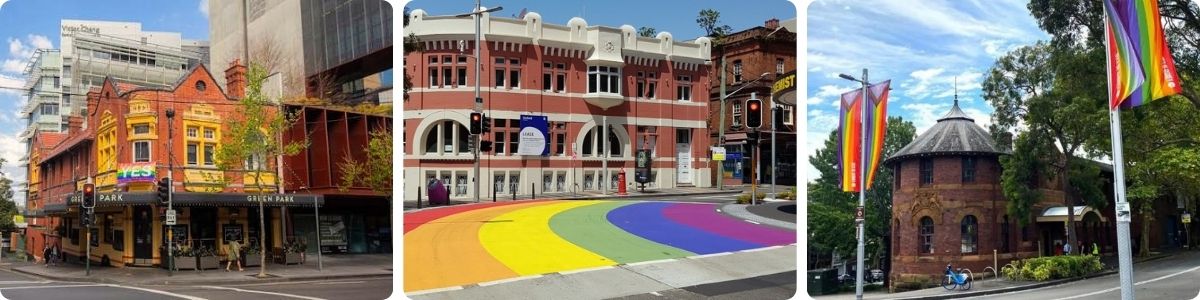
The Historic Heart of LGBTQIA+ Sydney
Oxford Street through Darlinghurst is not a marketing label, it’s the actual, physical origin point of Sydney’s Gay and Lesbian Mardi Gras, first held here in 1978, and the street remains the official parade route today, a status recognised on the Commonwealth Heritage List (Department of Climate Change, Energy, the Environment and Water, accessed August 2026). The City of Sydney has separately assessed and heritage-listed individual LGBTIQA+ sites along the strip, which is a level of formal recognition few other Australian suburbs can claim (City of Sydney Oxford Street LGBTIQA+ Heritage Study, accessed August 2026). This history is genuinely lived, not curated for tourists: it shows up in who owns the terraces, which venues survived the lockout-law years, and who turns out every February for the parade. Whatever happens to the strip’s retail fortunes, that layer of identity is not going anywhere.
A Genuine Hospital Suburb
Most inner-city suburbs have a hospital nearby. Darlinghurst has one inside it. St Vincent’s Public Hospital and St Vincent’s Private Hospital both sit on Victoria Street, and between them they cover major trauma, cardiac care, cancer treatment and a long-running HIV and sexual health service that dates back to the epidemic’s earliest and hardest years in Australia. That’s a genuine amenity advantage that most buyers underweight: proximity to a major teaching hospital matters more than a park view if you or a family member ever need one, and it also means the suburb carries a permanent, unglamorous soundtrack of ambulance sirens that a listing photo will never show you.
What Is It Like Living Here?
Living in Darlinghurst means small rooms, thin walls, and being able to walk to a genuinely wide range of hospitals, bars, gyms and parks within ten minutes. It suits people who want their life organised around footpaths, not driveways. It does not suit anyone chasing a quiet night’s sleep with the window open, or a family that needs a spare bedroom and a backyard for less than eight figures.
Transport
Kings Cross Station sits just over the William Street boundary and runs on the T4 Eastern Suburbs & Illawarra Line, putting the CBD (Martin Place/Town Hall) roughly 4-6 minutes away by rail. Museum Station, on the City Circle at the suburb’s western edge near Hyde Park, adds another direct link into the CBD’s core. Neither station is inside Darlinghurst proper, both are a genuine 8-12 minute walk depending on where in the suburb you live, which matters more than it sounds for anyone carrying groceries or a pram.
There is no Sydney Metro or light rail station within Darlinghurst itself; the CBD and South East Light Rail runs through the city centre and out via Moore Park, brushing the suburb’s southern edge without stopping in it.
Bus coverage is dense and genuinely useful, with routes running along Oxford Street, William Street and Riley Street connecting to the CBD, Bondi Junction and the eastern suburbs beach corridor (see the Sydney public bus guide for full route detail).
Most residents walk or bus rather than drive; on-street parking is scarce and permit-restricted, and anyone keeping a car here should budget for a paid space.
Healthcare
This is the suburb’s standout practical advantage. St Vincent’s Public Hospital on Victoria Street is a major teaching and referral hospital covering emergency, trauma, cardiology and oncology, and St Vincent’s Private Hospital sits alongside it, with St Vincent’s Clinic providing specialist consulting rooms. The area also carries a long institutional history in sexual health and HIV care, built during the epidemic and still operating today through dedicated clinics associated with the St Vincent’s campus. GP clinics are plentiful in Darlinghurst and neighbouring East Sydney given the density of residents and the hospital workforce itself. For anyone weighing up “what happens if something goes wrong at 2am,” few Sydney suburbs answer that question better.
Schools and Childcare
Darlinghurst is not a school-zone suburb in the way outer-ring Sydney is, and buyers chasing a specific comprehensive high school catchment should look elsewhere. Darlinghurst Public School and the nearby Plunkett Street Public School (technically East Sydney) cover local government primary schooling. SCEGGS Darlinghurst, an independent Anglican girls’ school, is the one major institution actually based in the suburb and draws enrolments from across the eastern suburbs and inner city rather than purely local zoning.
Childcare is the tighter constraint: long day care centres exist within Darlinghurst and just over the border in East Sydney and Surry Hills (CareforKids and Toddle both list around a dozen-plus options within a short pram-push radius as of 2025-2026), but sites are small by necessity and demand from the area’s dense apartment stock keeps waitlists real. Anyone planning a family here should treat childcare enrolment as a task for the day you sign the lease, not the week before you need it.
Industry & Work Life
Darlinghurst’s working population skews toward health (unsurprising given St Vincent’s is one of the area’s largest employers), creative and media roles, hospitality, and professional services commuting the short hop into the CBD. The City of Sydney LGA overall runs one of Australia’s highest concentrations of office floor space and knowledge-economy jobs (City of Sydney Floor Space and Employment Survey, accessed August 2026), and Darlinghurst residents are typically working inside that same footprint rather than reverse-commuting out. It is a suburb built for people whose commute is a walk or a five-minute train ride, not a suburb built around any single local industry of its own.
Shopping & Eating Out
Oxford Street remains the suburb’s main strip and its most complicated one right now (more on that below). Stanley Street, sometimes called Sydney’s “Little Italy,” has run as a dedicated cluster of Italian restaurants since the 1950s and remains a genuine dining destination, not a nostalgia act. Victoria Street carries a run of cafes serving the hospital workforce and residents alike. For anything beyond boutique retail and hospitality, most residents head into the CBD (Pitt Street Mall, Westfield Sydney) or across to Surry Hills’ Crown Street strip, both a short walk or bus ride away.
Attractions, Parks and Natural Spaces
Green Park, on Victoria Street opposite St Vincent’s, is the suburb’s principal park: modest in size but genuinely well used, with mature fig trees and a war memorial. Fitzroy Gardens, tucked behind Oxford Street near the old fire station, is smaller again but adds another pocket of green. Neither is a substitute for a real backyard, and residents wanting to kick a ball or spread a picnic blanket properly walk the ten minutes to Hyde Park to the west or Moore Park to the east, both genuinely large city parks.
The National Art School, housed in the former Darlinghurst Gaol on Forbes Street, is a working art school and gallery open to the public and one of the suburb’s more distinctive cultural assets.
Crime and Safety
Suburb-specific crime figures for Darlinghurst are not published; BOCSAR reports at the City of Sydney LGA level, which covers everything from the CBD core to Darlinghurst, Surry Hills, Kings Cross and Pyrmont. That LGA has historically recorded higher rates of non-domestic assault and licensed-venue-related incidents than the NSW average, a pattern well documented through the 2014-2016 lockout law period and its aftermath (BOCSAR, “The effect of lockout laws on assault,” accessed August 2026), though NSW’s most recent quarterly update (BOCSAR, December 2025 quarterly report) describes crime rates as broadly stable statewide, with retail theft and domestic violence categories trending up rather than street assault. Anecdotally, Darlinghurst’s own residents and local media describe the Oxford Street strip as far quieter late at night than its reputation suggests, a function of venue closures rather than improved safety outcomes as such. Treat this as a nightlife-adjacent inner-city suburb where normal city precautions apply, not as a suburb carrying a distinct crime problem of its own.
Realty Market
Darlinghurst’s housing stock is almost entirely units, walk-up flats and narrow terraces; freestanding houses barely exist in any meaningful supply. CoreLogic data (via Your Investment Property, accessed August 2026) puts the median house price at $2,925,000, up 15.6% over the 12 months to May 2026, and the median unit price at $1,022,500, up 13.8% over the same period, though the “house” figure should be read as terraces rather than the standalone family homes that term implies elsewhere in Sydney. A separate CoreLogic-based read via HtAG (accessed August 2026) put the median house figure closer to $2,901,000 with 5.87% annual growth and flagged the market as structurally tight, with stock on market around 0.20% and roughly 1.47 months of inventory, both signs of a genuine supply-demand imbalance rather than a soft patch. Local agency reporting for the year to date (Murray Property, EOFY 2026 wrap, accessed August 2026) put roughly 56-67 houses selling annually in the suburb against around 10 new listings a month, a thin market where a handful of sales can move the median noticeably. Gross rental yields on houses sit low, around 2.4%, typical of a capital-growth-driven inner-city market rather than a yield play.
The rental market is deep and active given the suburb’s overwhelmingly renter-occupied base (61.9% of dwellings were rented at the 2021 Census, versus 32.6% across NSW; ABS QuickStats, accessed August 2026). Murray Property’s EOFY 2026 data put median house rents around $905-938 a week and median unit rents around $700 a week, with unit yields sitting healthier than house yields at roughly 4.3%. That renter-dominant, unit-heavy profile is less compelling for investors focused purely on rental yield relative to Sydney’s outer growth corridors, given the high entry price per dollar of weekly rent, and is likely to appeal most to owner-occupiers and capital-growth-focused investors comfortable with a tight, competitive, low-volume market.
Our Honest Verdict
Darlinghurst suits singles, couples, and professionals who want to live somewhere with genuine history and genuine walkability, and who are honestly fine trading space and quiet for that. It suits LGBTQIA+ residents who want proximity to the community’s actual cultural and historic centre, not a suburb that merely markets itself as inclusive. It does not suit families needing more than one bedroom’s worth of breathing room, anyone who wants a quiet street, or an investor chasing yield over capital growth, given rental returns here run well below Sydney’s outer-ring averages.
The honest trade-off right now is Oxford Street itself. Vacancy on the strip has been reported as high as 31% in early 2026, well above the Sydney CBD average of around 4.3%, following the closure of long-standing venues including the Stonewall Hotel and The Bookshop Darlinghurst after more than 43 years (Star Observer, April 2026, accessed August 2026).
The $200 million Oxford and Foley redevelopment and City of Sydney planning changes are genuinely funded and under way, not just promised, but construction disruption is a real, current cost to anyone buying or renting on or near the strip today, not a historical footnote. Worth watching over the next 18-24 months: whether the new cultural and creative precinct controls (City of Sydney, announced 2021, still being implemented) translate into filled shopfronts, or whether the strip settles into a longer, harder rebuild.
For a genuine cross-shop, look at Surry Hills. It sits immediately south across Oxford Street, shares the same terrace-and-apartment housing stock and inner-city walkability, but carries a more settled, less transitional retail strip on Crown Street and a slightly less renter-dominant, more established-professional resident base. Anyone deciding between the two is really deciding how much they value Darlinghurst’s LGBTQIA+ history and hospital proximity against Surry Hills’ comparatively calmer high street.
Frequently Asked Questions
Is Darlinghurst a good place to raise a family?
Not typically. Dwelling stock is overwhelmingly units and narrow terraces, there is no comprehensive local high school inside the suburb, and childcare places are tight relative to demand. It works better for families with older, independent teenagers who value walkability over space than for young families needing a backyard.
Is Oxford Street still Sydney’s LGBTQIA+ hub?
Culturally and historically, yes: it remains the official Mardi Gras parade route and carries heritage-listed queer venues and sites. Commercially, the strip is going through a genuinely difficult period, with vacancy rates reported around 31% in early 2026 amid redevelopment construction and business closures. Its identity as the community’s spiritual home hasn’t gone anywhere; its retail vibrancy is a work in progress.
How do I get from Darlinghurst to the Sydney CBD?
On foot, it’s a 15-20 minute walk depending on which part of the suburb you’re in. By rail, Kings Cross Station (T4 line) or Museum Station (City Circle) both put you in the CBD core within about 5 minutes, though both stations require an 8-12 minute walk to reach from most Darlinghurst addresses. Bus routes along Oxford, William and Riley Streets offer a more direct door-to-door option for many residents.
Is Darlinghurst safe?
No suburb-specific crime data exists; BOCSAR reports at the City of Sydney LGA level, which historically runs above the NSW average on non-domestic assault and licensed-venue-related incidents, a legacy of its nightlife density rather than evidence of a distinct Darlinghurst-only problem. Standard inner-city precautions apply, particularly late at night around the Oxford Street and Kings Cross fringe.
What’s the difference between Darlinghurst and Surry Hills?
Both are dense, terrace-heavy inner-city suburbs sharing Oxford Street as a border. Darlinghurst carries deeper LGBTQIA+ history and the St Vincent’s hospital precinct; Surry Hills has a more settled, currently stronger retail and dining strip on Crown Street and a marginally less renter-dominated population. Price and rental levels between the two are broadly comparable rather than one being a clear discount on the other.
References
- Australian Bureau of Statistics, 2021 Census QuickStats, Darlinghurst (SA2 117031329), accessed August 2026
- Your Investment Property Mag / CoreLogic, Darlinghurst NSW 2010 suburb profile, median house and unit prices to May 2026, accessed August 2026
- HtAG Analytics, Darlinghurst NSW 2010 property market data, accessed August 2026
- Murray Property, “Darlinghurst & Surry Hills Mid-Year Market Wrap EOFY 2026,” accessed August 2026
- NSW Bureau of Crime Statistics and Research (BOCSAR), NSW Recorded Crime Statistics Quarterly Update, December 2025, accessed August 2026
- NSW Bureau of Crime Statistics and Research (BOCSAR), “The effect of lockout and last drinks laws on non-domestic assaults in Sydney,” accessed August 2026
- Star Observer, “Concerns For Oxford Street As More Shopfronts Remain Empty,” April 2026, accessed August 2026
- City of Sydney, “New planning controls to help Oxford Street shine,” media release, May 2021, accessed August 2026
- City of Sydney, Oxford Street LGBTIQA+ Heritage Study, heritage assessment report, accessed August 2026
- Department of Climate Change, Energy, the Environment and Water, Sydney Gay and Lesbian Mardi Gras Parade Route, Commonwealth Heritage List entry, accessed August 2026
- City of Sydney, Green Park park information page, accessed August 2026
- City of Sydney, Floor Space and Employment Survey 2022 summary report, accessed August 2026
- CareforKids.com.au and Toddle, Darlinghurst NSW 2010 childcare service listings, accessed August 2026
- St Vincent’s Hospital Sydney (svhs.org.au) and St Vincent’s Private Hospital Sydney (svph.org.au), service and location information, accessed August 2026
For a wider view of what’s happening across the inner city, browse the full directory of Sydney suburbs, or step back to the Sydney regions overview to see how Darlinghurst fits alongside the rest of the city.