
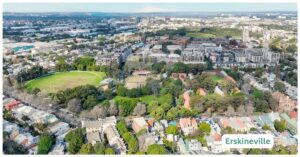
Erskineville is what happens when a suburb never had room to sprawl: half a square kilometre of Victorian workers’ cottages and terraces, laid out on a tight grid for the men who once worked the nearby brickworks and the Eveleigh railway workshops, that has since become one of the most fought-over small pockets of the inner west. The trade-off is blunt. You get a proper village, a heritage streetscape almost nobody has managed to knock down, and a five-minute walk to a train that gets you into the city faster than most of Sydney’s actual inner-ring suburbs. What you don’t get is choice. Stock is scarce, blocks are small, and because so little land is left to develop outside the Ashmore renewal precinct, waiting for “the right place to come up” in Erskineville can mean waiting years.
Erskineville Boundary and Location Map
Erskineville sits roughly 4 kilometres south of the Sydney CBD, within the City of Sydney local government area (confirmed via NSW Spatial Services boundary data, postcode 2043). It’s a small suburb, hemmed in tightly by its neighbours: Newtown lies immediately to the west across the rail corridor, St Peters sits to the south, Alexandria borders it to the east, and Redfern and Eveleigh are just across the tracks to the north. Nearly all of Erskineville is walkable end to end in under fifteen minutes, which is precisely the point for most people who choose to live here.
Quick Facts
| LGA | City of Sydney |
| Postcode | 2043 |
| Population | 9,657 at the 2021 Census (ABS QuickStats SAL11442), up 20.5% from 8,014 in 2016; a fresh figure is due when 2026 Census data is released |
| Growth Rate | +20.5% between the 2016 and 2021 Censuses, driven almost entirely by apartment completions rather than land release, given how little vacant land remains |
| Distance from CBD | Approximately 4km south of the Sydney CBD |
| Character | Dense Victorian terrace and workers’-cottage grid, village high street, strong LGBTQ-friendly and creative-professional community overlapping with Newtown |
| Median House Price | $1.85 million, past 3 months, up 3.3% year on year (Openagent.com.au, accessed August 2026) |
| Median Unit Price | $1.06 million, past 3 months, down 4.1% year on year (Openagent.com.au, accessed August 2026) |
| Transport | Erskineville station, currently on the T8 Airport & South Line since October 2024 (with occasional T4 Eastern Suburbs & Illawarra Line services); multiple bus routes to the CBD |
| Crime Rate (LGA) | City of Sydney LGA: overall crime rate 187.90 per 1,000 residents in 2025, down 2.38% on 2024 (BOCSAR-sourced data via RedSuburbs, 2025 annual figures); LGA-wide rate is skewed upward by CBD and nightlife-precinct incidents, not suburb-specific |
| Childcare Availability | Adequate for the suburb’s size: several long day care centres (SDN, Gowrie NSW, Mini Masterminds) plus family day care operate within Erskineville itself, though inner-city demand keeps places tight |
| School Zone Quality | Erskineville Public School (in-suburb, government) carries a strong ICSEA profile; secondary students generally zone to Alexandria Park Community School |
| Parks & Recreation | Erskineville Oval (heritage-listed); Harry Noble Reserve; Sydney Park (44 hectares) a short walk south |
| Shopping | Compact village strip on Erskineville Road and Swanson Street: cafes, pubs, boutique retail; larger grocery shopping done in Newtown or Alexandria |
| Health | Local GP clinics (including Erskineville Doctors); Royal Prince Alfred Hospital, Camperdown, is the nearest major public hospital |
| Best For | Professional couples and single buyers who want heritage character and walkability over living space, and renters happy to pay a premium for a village feel close to the CBD |
History & Heritage
Burren Farm and a Contested Inheritance
Some of the earliest land grants in the area were made in 1794 and 1799 to Nicholas Devine, superintendent of convicts, who built a house called Burren Farm near what is now the corner of George Street and Erskineville Road (Francis Pollon, “The Book of Sydney Suburbs,” 1988). Devine died in 1830 at the age of 104, and the property passed to Bernard Rochford and his wife, who had cared for Devine in his old age, a fitting conclusion Pollon notes did not, in fact, end there. In 1852 a John Devine arrived in the colony and made a claim on the whole area, which was dismissed. He appealed, and the resulting litigation dragged on until 1857, when he lost again. Undeterred, he attempted a third claim, but by then the owners of the Erskineville land had established a fund to compensate him for his loss rather than keep fighting it out in court (Pollon, 1988).
Erskine Villa and the Minister Who Named the Suburb
Rochford subdivided and sold the Burren Farm estate, and one parcel was bought by a Wesleyan minister, the Reverend George Erskine, who built a house there in 1830 that he called Erskine Villa (Pollon, 1988). Erskine did not get long to enjoy it: he died there in 1834 and was buried in the grounds. The villa then passed through a run of owners with their own small footnotes in the suburb’s story: naturalist Robert Henderson, then Sydney inn-keeper William Toogood, who on his death left the property to the Church of England. It became the rectory for Holy Trinity Church, Macdonaldtown, a connection that would outlast the house’s original owner by decades.
From Macdonaldtown to a Working Suburb
In 1893 parliament passed the Borough of Erskineville Naming Act, carving a brand new suburb out of what had until then been part of Macdonaldtown, including the very block on which the Methodist minister had built his home (Pollon, 1988). The church link resurfaced in an unexpected place sixteen years later: when electric trams began running to Erskineville in 1909, the destination sign on the front of the tram displayed a green diamond on a white background, a design chosen specifically because it was the symbol of the Trinity, honouring the parish church for which Erskine Villa had once served as rectory. By 1920 the suburb had become home to a substantial working population, with locals employed in brickmaking, bootmaking and hut manufacturing. Today’s Erskineville is a busy inner-city suburb, but Burren Street and Rochford Street still carry the names of the convict superintendent and the family who once cared for him, quiet reminders of the suburb’s early, occasionally litigious history.
What Makes Erskineville Special
Erskineville’s identity was set well before anyone thought to market it as a “lifestyle suburb”. It grew up as a working suburb, built to house labourers for the brickworks, tanneries and the sprawling Eveleigh railway workshops just over the tracks, and that industrial-era DNA is still legible in almost every street. What’s changed is who’s doing the living.
Victorian Terrace Heritage and Village Character
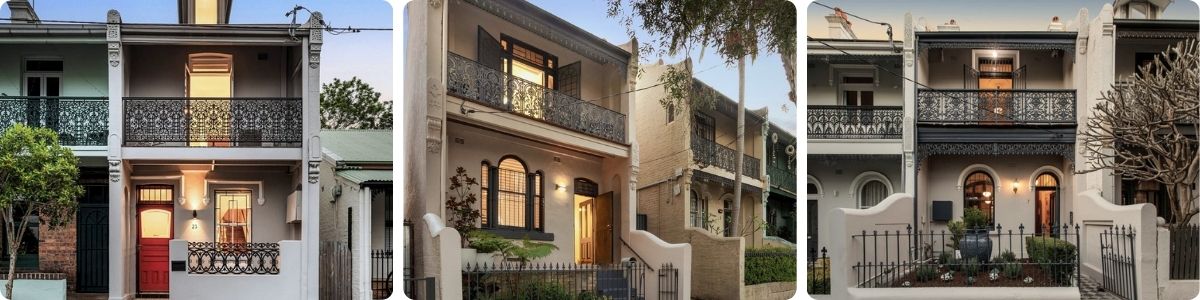
Walk any street off Erskineville Road and you’re looking at a near-continuous run of narrow Victorian terraces and workers’ cottages, most on tiny blocks, many heritage-listed as part of conservation areas that cover a large share of the suburb. That density of intact 19th-century housing stock is rare this close to a capital city CBD, and it’s the reason Erskineville commands prices well above what its floor area alone would suggest. The village strip around Erskineville Road and Swanson Street does the rest of the work: the Rose of Australia and the Imperial Hotel (permanently associated with The Adventures of Priscilla, Queen of the Desert, filmed there) anchor a compact stretch of pubs and cafes that give the suburb a main-street feel rather than a strip-mall one. The overlap with Newtown’s creative and LGBTQ-friendly community is real and mutually reinforcing: Erskineville doesn’t have its own nightlife scene to speak of, but it borrows heavily from Newtown’s, a five-minute walk away.
The Ashmore Precinct and a Suburb in Transition
The other defining story here is the Ashmore precinct, a 17-hectare urban renewal project spanning Erskineville’s eastern edge and into Alexandria, redeveloping former public housing land into a mixed public and private housing estate expected to house around 6,000 residents once complete. Early buildings (B and C) are finished and occupied; the most recent stage lodged with the City of Sydney in June 2025 comprises 1,082 apartments across four buildings, including 177 affordable homes managed by Evolve Housing, and developer Coronation has described it as the project’s final stage. What this means in practice: Erskineville isn’t a frozen heritage museum. It’s absorbing thousands of new residents on land that used to be public housing towers, and the character of its eastern fringe (new apartment stock, a new central park, new retail) will look meaningfully different from its terrace-lined western half within the next few years.
What Is It Like Living in Erskineville?
Day to day, Erskineville reads as compact and convenient rather than sprawling. Most errands happen on foot, most social life happens either on the village strip or a short walk into Newtown, and most residents have made peace with living in less space than they’d get further out in exchange for not needing a car most weeks.
For commuters, Erskineville station sits right in the middle of the suburb, an easy walk from almost anywhere within its borders. Since October 2024 the station has been served primarily by T8 Airport & South Line services, following the Bankstown Line’s conversion to Sydney Metro, with occasional T4 Eastern Suburbs & Illawarra Line services also stopping here; Transport for NSW has flagged the station eventually moving fully onto the T4 line, though no date has been set (NSW Trains Wiki, accessed August 2026). Trains to Central take under 10 minutes. The station itself went through a Transport Access Program upgrade (four new lifts, a new pedestrian footbridge, a new southern entrance and tactile platform indicators, roughly $40 million) largely delivered by 2024, with a further round of community consultation on kiss-and-ride and bike parking on Swanson Street run in mid-2024. For residents who don’t want to rely on rail, bus routes 308 and 309 run through the suburb toward the city in around 10 to 15 minutes, and King Street in Newtown (a short walk away) carries several more.
On the healthcare front, Erskineville has a handful of local GP clinics, including Erskineville Doctors on the village strip, which covers most everyday medical needs without a trip out of the suburb. For anything more serious, Royal Prince Alfred Hospital in Camperdown is the nearest major public hospital, a short drive or bus ride away, with St Vincent’s Hospital in Darlinghurst also within easy reach for residents on the eastern side of the suburb. Dedicated aged care facilities within Erskineville itself are limited given the suburb’s small footprint; most residents needing higher-level aged care look to facilities in neighbouring Newtown, Alexandria or further into the inner west.
Erskineville Public School sits inside the suburb itself and carries a strong ICSEA profile, making it a drawcard for young families willing to trade space for zone. St Mary’s Erskineville offers a Catholic primary alternative in the same few streets. There’s no comprehensive high school physically inside Erskineville; secondary-aged children generally zone to Alexandria Park Community School in neighbouring Alexandria, with selective and private options across the inner west also realistically in range given the suburb’s central location. On childcare, Erskineville punches above its size: SDN Erskineville, Gowrie NSW Erskineville, and Mini Masterminds all operate long day care centres within the suburb, supplemented by family day care operators such as Fae’s Family Day Care (ACECQA National Registers and CareForKids.com.au, accessed August 2026). That’s a reasonable spread for a suburb this small, though inner-city demand means places, especially for under-twos, still fill quickly.
There’s no supermarket-anchored shopping centre in Erskineville, and there won’t be much room for one; the suburb relies on its village strip along Erskineville Road and Swanson Street for cafes, small boutiques and everyday essentials, and on neighbouring Newtown (King Street) or Alexandria for full grocery shopping. What the strip lacks in scale it makes up for in character: the Imperial Hotel and the Rose of Australia are the two anchor pubs, both well known beyond the suburb itself, alongside a run of well-regarded cafes that do a brisk weekend trade. The Ashmore precinct’s build-out is adding new retail floor space on the suburb’s eastern edge, which over time should ease the current reliance on next-door suburbs for bigger shopping trips.
Erskineville Oval is the suburb’s standout piece of open space and its most historically loaded: heritage-listed as part of the Erskineville Estate Heritage Conservation Area, it hosted the Newtown Jets’ first-grade rugby league side from 1913 to 1954 before the club moved to Henson Park (heritage listing records, accessed August 2026). It remains a well-used local sporting ground rather than a museum piece. Harry Noble Reserve offers a smaller pocket of green space within the same conservation area. For anything larger, Sydney Park, one of the inner south’s biggest parks at 44 hectares, with wetlands, cycling paths and open lawns, sits just south of the suburb and functions as Erskineville’s de facto backyard given how little private green space most terraces have.
Anecdotally, residents describe Erskineville itself as a quiet, low-crime residential suburb, but that’s a local perception, not a verified suburb-level statistic, and should be read as such.
Realty Market
Erskineville’s housing stock is small in every sense: a tight geographic footprint, mostly narrow-block terraces on the western side, and a growing but still limited apartment stock concentrated around the Ashmore precinct on the east. Over the past three months the median house price sat at $1.85 million, up 3.3% year on year, while the median unit price was $1.06 million, down 4.1% year on year (Openagent.com.au, accessed August 2026). Twenty-five houses and 41 units sold in that same three-month window, with houses moving in a median of 29 days on market and units taking closer to 44 days. Read together, that’s a market where houses (scarcer, heritage-protected, effectively un-buildable in volume) are holding firm on price even as broader Sydney conditions soften, while units, whose supply is expanding via the Ashmore build-out, are absorbing more of the price pressure.
The rental market tells a similar story from the other direction. Average asking rent over the past 12 months was $985 a week for houses (down 1.3% year on year) and $875 a week for units (up 5.4% year on year), with both house and unit yields sitting well above the Sydney average, 8.1% and 11.9% respectively, on the same data set (Openagent.com.au, accessed August 2026). Given the median 53.3% of Erskineville households rented rather than owned at the 2021 Census (ABS QuickStats SAL11442), this is fundamentally a renter’s suburb by numbers, even though the aspirational buyer market for its terraces gets most of the attention.
Our Honest Verdict
Erskineville is likely to appeal most to professional couples, single buyers and renters who value heritage character, walkability and a five-minute train ride to the city over floor space, storage, or off-street parking, none of which the suburb has much of. It’s a suburb where you buy the location and the streetscape, not the square metreage. Families who need a backyard and a driveway will find better value a few suburbs further out; Erskineville’s terraces are narrow, its blocks are small, and Sydney Park is doing a lot of the heavy lifting as “the backyard” for people who live here.
It is less compelling for investors focused purely on rental yield growth or capital-value upside over the next couple of years; the unit market has already softened (down 4.1% in the past year), and with the Ashmore precinct still delivering new apartment stock, unit supply is not as tight as the suburb’s reputation would suggest. Houses are a different proposition entirely: scarce, heritage-protected, and unlikely to see meaningful new supply, which is exactly why they’ve kept appreciating while units haven’t.
The natural comparison is Newtown, immediately next door and sharing much of Erskineville’s creative, LGBTQ-friendly character. Newtown offers a deeper retail and dining strip along King Street and a broader range of housing stock, but it’s a bigger, busier, noisier suburb with less of Erskineville’s tucked-away village calm. If you want the character without the crowds, Erskineville is the pick. If you want the crowds, the nightlife and more choice on what to buy or rent, Newtown wins that trade-off.
Frequently Asked Questions
Is Erskineville a good suburb for families?
It works for families who prioritise a strong local public primary school and inner-city convenience over space. Erskineville Public School is well regarded and sits inside the suburb, and childcare options are reasonable for the suburb’s size. The trade-off is small terrace blocks, no backyard to speak of in most cases, and no comprehensive high school physically inside the suburb.
Which train line serves Erskineville station?
Erskineville station has been served primarily by the T8 Airport & South Line since October 2024, when Bankstown Line services were withdrawn ahead of that corridor’s conversion to Sydney Metro. Occasional T4 Eastern Suburbs & Illawarra Line services also stop at the station, and Transport for NSW has indicated the station will eventually move fully onto the T4 line, though no confirmed date exists yet.
Is Erskineville expensive compared to other inner-west suburbs?
Yes, particularly for houses. A $1.85 million median house price (as of August 2026 data) reflects the suburb’s tiny footprint, heritage terrace stock and very limited turnover. Units, at a $1.06 million median, are comparatively more attainable, and that gap has widened over the past year as unit prices have softened while house prices kept rising.
What is happening with the Ashmore precinct?
The Ashmore precinct is a 17-hectare City of Sydney urban renewal project replacing former public housing on Erskineville’s eastern edge with a mix of public, affordable and private housing, expected to house around 6,000 residents once complete. Early buildings are finished and occupied; the latest and reportedly final stage, comprising 1,082 apartments including 177 affordable homes, was lodged with the council in June 2025 and is progressing through planning.
Is Erskineville safe?
Crime is only tracked at the City of Sydney LGA level, which includes the CBD and nightlife precincts and therefore skews above what residential Erskineville itself likely experiences. The LGA’s overall crime rate fell 2.38% between 2024 and 2025. There is no verified suburb-specific figure for Erskineville, and locals describe it anecdotally as a quiet residential pocket, but that is not a substitute for the actual LGA-level data.
References
- Australian Bureau of Statistics, 2021 Census QuickStats, Erskineville (SAL11442), accessed August 2026
- NSW Spatial Services, NSW Administrative Boundaries Theme FeatureServer boundary query, Erskineville, postcode 2043, accessed August 2026
- NSW Bureau of Crime Statistics and Research (BOCSAR) data, City of Sydney LGA 2025 annual figures, via RedSuburbs.com.au, accessed August 2026
- ACECQA National Registers, childcare service listings for Erskineville NSW 2043, accessed August 2026
- Transport for NSW, Erskineville Station Upgrade project documentation and community notifications, 2021-2024
- City of Sydney Council, Planning for the Ashmore Precinct, accessed August 2026
- The Urban Developer, “Coronation Shapes Plans for 1000-Home Erskineville Stage”, June 2025
- NSW Government heritage listing records, Erskineville Estate Heritage Conservation Area and Erskineville Oval, accessed August 2026
For more suburbs across Sydney, browse the full list of Sydney suburbs, or step back and explore the Sydney regions overview to see how Erskineville fits into the wider inner west and City of Sydney area.