
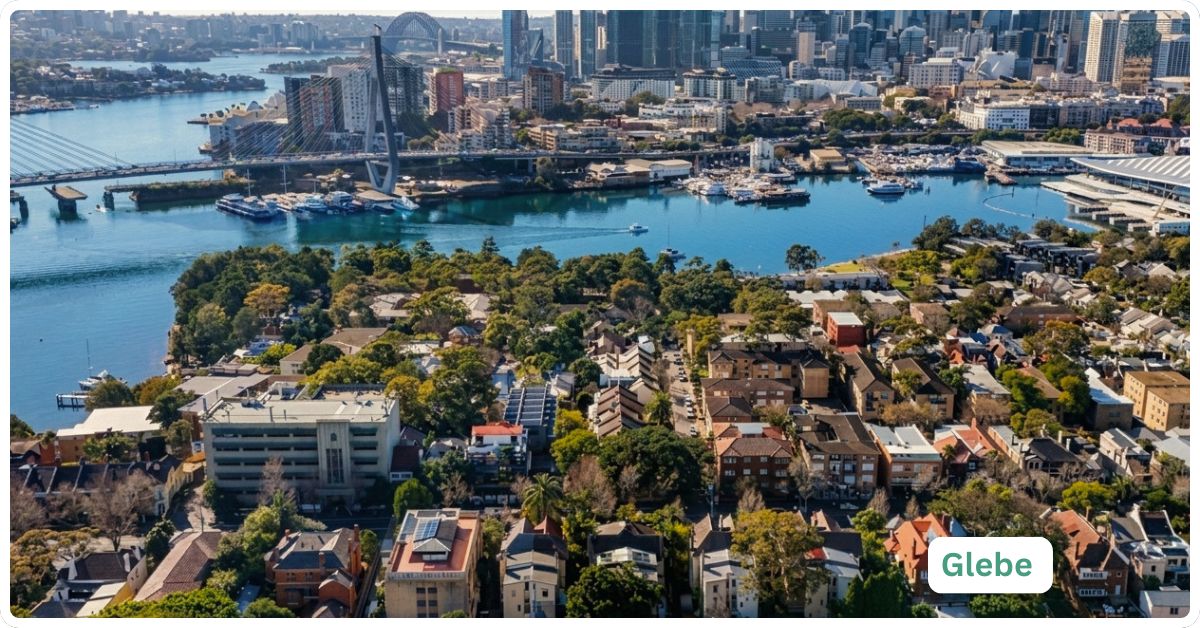
Glebe Point Road is the reason people put up with everything else. It is one of the last village high streets left in inner Sydney: secondhand bookshops with actual staff opinions, cafes that have outlasted three generations of renters, a Saturday market that still smells like someone’s actual attic.
Glebe pairs that strip with a harbour edge at Blackwattle Bay, a big stock of Victorian terraces, and a student and academic population large enough to change the character of the place (over a third of residents are studying at tertiary level, a direct consequence of sitting against the University of Sydney’s western flank).
The trade-off is real: Glebe Point Road and Parramatta Road carry traffic and foot-traffic noise, on-street parking is a blood sport, and the terrace stock ranges from beautifully restored to public and community housing that has sat here since well before gentrification arrived. It is louder, busier and more commercially developed than its tiny terrace-only neighbour Forest Lodge, and that is the whole point of choosing it.
Glebe Boundary and Location Map
Glebe sits roughly three kilometres southwest of the Sydney CBD, on the peninsula between Parramatta Road and Blackwattle Bay. It is bordered by Forest Lodge to the south (its much smaller, purely residential neighbour, sharing the 2037 postcode), Annandale to the west, Ultimo and Pyrmont across the water to the east, and Camperdown (home to the University of Sydney and Royal Prince Alfred Hospital) to the south-west. The suburb’s shape is defined by that harbour edge on one side and the Parramatta Road/City West Link corridor on the other.
Quick Facts
| LGA | City of Sydney |
| Postcode | 2037 (shared with Forest Lodge) |
| Population | 16,641 (2021 Census, ABS SAL11645, postcode 2037); no more recent official count published, next Census due 2027 |
| Growth Rate | Largely flat. Glebe’s heritage-conservation-area terrace stock leaves little room for new supply; the last major population bump came from the Harold Park redevelopment, completed in stages through the 2010s |
| Distance from CBD | Approximately 3km south-west of the Sydney CBD |
| Character | Inner-west village high street, Victorian terraces, harbourside parkland, large student and renter population |
| Median House Price | $2.35 million, up 4.8% year-on-year to June 2026 (Collings Real Estate, Glebe Property Market Report, June 2026) |
| Median Unit Price | $1.28 million as of June 2026 (Collings Real Estate, June 2026) |
| Transport | Inner West Light Rail (L1): Glebe, Jubilee Park and Wentworth Park stops; frequent buses on Glebe Point Road and Parramatta Road |
| Crime Rate (LGA) | City of Sydney LGA; BOCSAR does not publish a standalone per-capita rate for this LGA because its huge non-resident daytime and nightlife population distorts any resident-based denominator (BOCSAR, Crime Statistics by LGA, accessed August 2026) |
| Childcare Availability | Good by inner-Sydney standards. Multiple long day care centres within the suburb and immediate surrounds (ACECQA National Registers, accessed August 2026) |
| School Zone Quality | Glebe Public School (in-suburb primary); Sydney Secondary College Blackwattle Bay Campus is the local government high school, plus nearby Catholic and independent options |
| Parks & Recreation | Jubilee Park, Bicentennial Park, Blackwattle Bay foreshore, Harold Park, Bay Run access |
| Shopping | Glebe Point Road strip (bookshops, cafes, boutiques), Saturday Glebe Markets, Broadway Shopping Centre nearby |
| Health | Royal Prince Alfred Hospital, Camperdown (walking/light rail distance); multiple local GP clinics |
| Best For | Students, academics and young renters wanting walkable village life; owners who want a Victorian terrace and don’t mind traffic noise |
The Glebe Backstory – History & Heritage
Glebe takes its name from the church land, or “glebe,” set aside by Governor Phillip in 1789 as part of his instructions to reserve land for the support of the colony’s clergy. The Reverend Richard Johnson, the colony’s first chaplain, was granted the 400 acres but found it rough, heavily timbered and unsuited to cultivation, and with little convict labour available for clearing, he largely gave up on it. Aside from a handful of small grants near what’s now Parramatta Road, the land remained largely undeveloped until the Church and School Corporation subdivided and sold most of it in 1828, retaining only the area bounded by Parramatta Road, St John’s Road, Mount Vernon Street and Cowper Street. Substantial homes with pleasant gardens soon followed.
Several of Glebe’s grand estates survive from this era, at least in name or in part. Toxteth House, on what’s now Toxteth Street, was designed by the noted colonial architect John Verge for George Allen and completed in 1834, named after the English home of a family friend, Sir Robert Wigram. Allen’s son George Wigram Allen later lived there until 1885, and the house went on to serve as a boarding house before becoming part of the school run by the Sisters of the Good Samaritan, known today as St Scholastica’s. Wigram and Allen Streets still recall its first owners.
Nearby, Verge also designed Lyndhurst House for Dr James Bowman, principal colonial surgeon and a driving force behind the establishment of Sydney’s Rum Hospital, built on the 32-acre Lyndhurst Estate between 1833 and 1837. The mansion later housed an Anglican theological college and then a Catholic school before falling into a long decline, used variously as a laundry, a factory and flats. It came close to demolition in the early 1970s to make way for a north-western freeway before a green ban saved it, and it was carefully restored, becoming the Historic Houses Trust of NSW’s headquarters. It was sold into private hands in 2005 and today opens to the public only occasionally.
Hereford House, on the corner of Glebe Point Road and Pyrmont Bridge Road, was completed in 1829 and later served as a teacher training college from 1910 to 1924. It was eventually demolished, and only a plaque now marks the site, with part of the land given over to a baby health centre and public recreation space. Like most of Glebe’s large estates, it didn’t survive the 1880s intact, when the great subdivisions gave way to the workmen’s cottages and terraces that still define much of the suburb today.
Glebe’s church connection is also written into its architecture. St John’s Bishopthorpe, on the corner of St John’s and Glebe Point Roads, was designed by Edmund Blacket, the architect behind the nearby Bishopthorpe Estate (Derwent, Westmoreland and Mount Vernon Streets), originally set aside as a home site for the Bishop of Sydney, with all revenue from the estate earmarked as his personal income. Blacket, who lived in Glebe for nineteen years and served on its first council, laid the church’s foundation stone in 1868, and it opened in December 1870, built from stone quarried locally at Pyrmont.
Geographically, Glebe is bounded by Blackwattle Bay and Rozelle Bay to the north and Wentworth Park, once a swampy area filled and grassed for greyhound and trotting racing, to the east. Glebe Island, just offshore and long since joined to the mainland by a causeway, was first connected by a swing-span bridge, later replaced by a steel truss bridge with an electrically operated central span.
Proclaimed a borough in 1859, Glebe moved from fashionable beginnings into a working-class suburb through the early twentieth century as wealthier residents moved further out, and its housing stock, from grand mansions to modest workers’ cottages, still reflects that swing in fortunes. From the 1960s onward the suburb gentrified again, and today it’s home to a genuine mix of both.
Glebe Point Road: a real village strip, not a shopping centre substitute
Most Sydney suburbs that call themselves villages mean a strip of six cafes and a chemist. Glebe Point Road runs the length, from Broadway down toward the water, and it has kept the things that die first in gentrifying suburbs: independent bookshops. Gleebooks is the anchor, a Sydney literary institution that still runs author events most weeks, and Sappho Books, Cafe & Bar at 51 Glebe Point Road pairs a secondhand bookshop with a courtyard bar that locals treat as a living room. Badde Manors, the long-running vegetarian cafe on the corner of Glebe Point Road and Francis Street, has been feeding students and academics since well before “brunch culture” was a phrase anyone used. Layer in the Saturday Glebe Markets at Glebe Public School (bric-a-brac, vintage clothing, local makers, a different crowd to a farmers’ market) and you have a strip that does double duty as both daily amenity and weekend destination.
A Harbour Edge and a Redevelopment that Actually Delivered
Glebe’s other point of difference is water access most inner-west suburbs don’t get: Blackwattle Bay foreshore, Jubilee Park and Bicentennial Park sit right along the light rail corridor, and Jubilee Park connects into the Bay Run, the roughly 7km loop around Iron Cove that is one of Sydney’s most-used informal running and cycling circuits. The former Harold Park Paceway site, once a trotting track wedged between Glebe, Forest Lodge and Annandale, is now a completed residential and parkland precinct: the main apartment buildings and the heritage-listed Tramsheds (the old Rozelle Tram Depot, adaptively reused as a food and retail hall) were finished through the mid-2010s, and the public open space and heritage water tower artwork (“Immerge,” by Chris Fox) were completed by late 2021. It is a rare example in Sydney of a large brownfield redevelopment that actually delivered usable public parkland alongside the housing, rather than promising it and stalling.
What Is It Like Living Here?
Day to day, Glebe reads as two overlapping suburbs. There’s the student and academic Glebe: share-house terraces, a five to fifteen minute walk into the University of Sydney, cheap-ish eats, and a social life built around Glebe Point Road. And there’s the established-owner Glebe: renovated terraces on the quieter back streets toward Forest Lodge and the water, families who’ve been here two or three decades, and an attachment to the suburb’s activist, left-leaning community history (the Glebe Society has been fighting development and transport battles here since the 1960s). Both groups share the same complaint: Parramatta Road and the post-Rozelle-Interchange traffic changes have made the northern edge of the suburb noisier and harder to navigate by car than it used to be.
Transport
Glebe is well served by transport for an inner-west suburb without its own heavy rail station. The Inner West Light Rail (L1) runs through the suburb with three stops: Glebe, Jubilee Park and Wentworth Park, all operating and step-free, connecting through to Central Station and on to Dulwich Hill. It’s a light rail line, not a train line, so factor in a change if you’re headed further afield.
On top of that, bus routes run frequently along Glebe Point Road and Parramatta Road into the CBD and out toward Leichhardt and the inner west, making Glebe one of the few Sydney suburbs where giving up a car is a realistic option rather than an aspiration.
The catch is the Rozelle Interchange, opened in stages through late 2023 and into 2024: locals report southbound traffic being pushed onto residential streets like The Crescent/Ross Street and Johnston Street that were never built as arterial roads, along with confusing signage and increased rat-running along Wigram Road and Bridge Road. If you drive, expect the northern half of the suburb to feel busier than it did before the interchange opened.
Healthcare
Royal Prince Alfred Hospital in neighbouring Camperdown is the nearest major public hospital, a major tertiary teaching hospital with a full emergency department, and it’s close enough that many Glebe residents can walk or take a short bus ride there rather than drive. Glebe itself has a reasonable spread of local GP clinics and allied health practices along and just off Glebe Point Road, plus community health services run through the Sydney Local Health District. Aged care options sit mostly in the surrounding suburbs rather than within Glebe’s own tight terrace footprint, which is worth factoring in if you’re planning to age in place here.
Schools and Childcare
Glebe Public School sits inside the suburb itself and is the local zoned primary, with the Saturday markets held on its grounds doubling as the school’s main fundraiser. For high school, the zoned comprehensive government option is Sydney Secondary College Blackwattle Bay Campus, also within Glebe. Families who want a selective or independent alternative look further afield (Sydney’s inner west has several well-regarded options within a short drive or bus ride), and it’s worth noting Glebe’s own school-age population is thin by suburban standards. The 2021 Census shows a notably low share of school-age children relative to the 20-39 demographic bulge here, a direct consequence of the student and young-renter population outnumbering families (Glebe Society, “What the 2021 Census says about Glebe and Forest Lodge”).
Childcare supply is better than tiny neighbouring Forest Lodge: ACECQA’s national register lists several long day care services within or immediately around Glebe, including SDN Glebe Children’s Education and Care Centre, Goodstart Early Learning Glebe, WeKidz Early Learning and Oasis Early Learning Glebe (Montessori), giving families a real choice of philosophy and provider rather than a single waitlist.
Industry & Work Life
Given the University of Sydney sits directly on Glebe’s doorstep and RPA Hospital is a short walk away in Camperdown, education and healthcare are the two industries that dominate the working lives of people here, whether as university staff and postgraduate researchers, hospital clinicians and allied health workers, or the broader professional services and creative-industry crowd that fills the CBD a light rail ride away. It is not a suburb built around local industry or manufacturing; it’s a residential base for people who work in institutions nearby or commute the short distance into the city centre.
Shopping & Eating Out
Glebe Point Road does most of the heavy lifting: Gleebooks for new titles and events, Sappho Books, Cafe & Bar for secondhand stock and a courtyard drink, Badde Manors for long-running vegetarian brunch, plus a strip of restaurants covering Thai, Italian, Middle Eastern and modern Australian that turns over regularly but rarely goes quiet.
The Glebe Markets run every Saturday at Glebe Public School for vintage clothing, bric-a-brac and local makers. For bigger-format shopping, Broadway Shopping Centre sits right on the suburb’s northern edge with a full-line supermarket and chain retail, and the Tramsheds at Harold Park adds a food hall and specialty grocers within easy walking distance.
Attractions, Parks and Natural Spaces
Jubilee Park and Bicentennial Park run along the Blackwattle Bay foreshore and connect straight into the Bay Run, the roughly 7km loop around Iron Cove used constantly by runners, cyclists and dog walkers from across the inner west. Harold Park’s completed open space adds further green space and a heritage water tower artwork, while the harbour edge itself gives Glebe a natural amenity that landlocked inner-west suburbs simply don’t have. It is not beach-suburb scenery, but for an inner-city terrace suburb, it’s a real point of difference.
Crime and Safety
Anecdotally, opportunistic theft and bike theft are the more commonly reported local issues in Glebe itself, consistent with a dense, student-heavy, high-foot-traffic suburb, rather than any pattern of serious violent crime.
Realty Market
Glebe’s median house price sat at $2.35 million as of June 2026, up 4.8% over the previous 12 months, with median days on market of 22-28 and a clearance rate around 66% (a balanced-to-soft market rather than a frenzied one) (Collings Real Estate, Glebe Property Market 2026 report). Units carry a $1.28 million median as of the same date. Houses here are almost entirely Victorian and Federation terraces (only around 4.5% of Glebe dwellings are freestanding houses per the 2021 Census, versus roughly two-thirds across NSW), so “house” in Glebe generally means a two-to-three-bedroom terrace, not a freestanding block. Older listing sources put the median house figure closer to $2.7 million, a reminder that Glebe’s small transaction volume can swing reported medians noticeably between periods; treat any single figure as indicative rather than exact.
The rental market is the more revealing number for anyone assessing Glebe as an investment. Median advertised rents sit around $495 a week for houses and $435 a week for units as of mid-2026, translating to gross rental yields of roughly 1.1% for houses and 1.76% for units (Collings Real Estate, June 2026), both well below typical Sydney averages, a direct function of high entry prices against a rental pool. That renter pool is unusually deep: 61.2% of Glebe households rent, against 32.6% across NSW (ABS 2021 Census), driven heavily by the university-adjacent student and young-professional population. Glebe is likely to appeal most to buyers and investors comfortable trading yield for near-guaranteed tenant demand and low vacancy risk, given how reliably the university and hospital precincts refill the rental pool each year. It is less compelling for investors primarily focused on rental yield, given how far current gross yields sit below broader Sydney benchmarks.
Our Honest Verdict
Glebe suits people who want a walkable, amenity-rich inner-city life and are willing to pay a premium, in both price and noise, for it. Students, academics, young professionals happy in a share house or a small terrace, and owners who specifically want the bookshop-and-bay village character will get real value here that a generic real-estate portal page won’t tell them about: a working high street that hasn’t been hollowed out, a harbour edge most terrace suburbs lack, and light rail plus buses that make car-free living realistic. It doesn’t suit families chasing a quiet, low-traffic street and a big backyard, or anyone who wants certainty about parking.
If you specifically want Glebe’s terrace character and inner-west feel without Glebe’s own commercial strip, traffic and Saturday-market crowds, Forest Lodge (the small, purely residential suburb immediately south, sharing the same 2037 postcode) is the comparison: quieter, smaller, entirely without Glebe Point Road’s shops and cafes, and correspondingly more insulated from the post-Rozelle-Interchange traffic changes. Glebe is the louder, busier, better-resourced sibling; Forest Lodge is the quiet one next door.
Frequently Asked Questions
Is Glebe a good suburb for students?
Yes, and the data backs it up: 38.1% of Glebe residents were enrolled in higher education at the 2021 Census, against 15.3% across NSW, a direct result of sitting against the University of Sydney’s western boundary (ABS 2021 Census, via Glebe Society). Share-house terraces, cheap eats and a five to fifteen minute walk to campus make it one of the most popular student suburbs in inner Sydney.
Does Glebe have a train station?
No heavy rail station. Glebe is served by the Inner West Light Rail (L1), with Glebe, Jubilee Park and Wentworth Park stops, connecting through to Central Station, plus frequent buses along Glebe Point Road and Parramatta Road.
Has the Rozelle Interchange made traffic in Glebe worse?
Locals say yes, particularly on the suburb’s northern edge. Since the interchange opened in stages through late 2023 and 2024, residents report southbound traffic being pushed onto residential streets never designed as arterial roads, along with confusing signage near Victoria Road and increased rat-running on side streets (Glebe Society Bulletin, July 2024). It’s a trade-off to weigh if you drive regularly.
What is happening with the old Harold Park Paceway site?
It’s a finished project, not an ongoing one. The residential buildings and the adaptively reused Tramsheds were completed through the mid-2010s, and the public open space and heritage water tower artwork were finished by late 2021. Harold Park now functions as established parkland and residential precinct straddling Glebe, Forest Lodge and Annandale.
Is Glebe family-friendly?
It can be, but it isn’t the suburb’s core demographic. The 2021 Census shows a comparatively low share of school-age children against a large 20-39 age bulge, and most dwellings are terraces and medium-density housing rather than freestanding houses with yards. Families here are usually trading backyard space for walkability, harbourside parks and proximity to the city.
References
- Australian Bureau of Statistics, 2021 Census Community Profiles, Glebe (NSW), SAL11645, accessed August 2026
- Glebe Society, “What the 2021 Census says about Glebe and Forest Lodge,” accessed August 2026
- Glebe Society Bulletin, “Recent transport and traffic issues in Glebe-Forest Lodge,” July 2024
- Glebe Society, “Harold Park Redevelopment” issue page, accessed August 2026
- Collings Real Estate, “Glebe Property Market 2026: Inner-City Creative Precinct,” accessed August 2026
- NSW Bureau of Crime Statistics and Research (BOCSAR), Crime Statistics by LGA, accessed August 2026
- ACECQA National Registers, service listings for SDN Glebe Children’s Education and Care Centre, Goodstart Early Learning Glebe, WeKidz Early Learning and Oasis Early Learning Glebe, accessed August 2026
- NSW Department of Education, Glebe Public School, accessed August 2026
- NSW Department of Education, Sydney Secondary College Blackwattle Bay Campus, accessed August 2026
- Transport for NSW, Inner West Light Rail stop guides, accessed August 2026
- City of Sydney, “Markets at Glebe Public School,” accessed August 2026
- NSW Spatial Services, NSW Administrative Boundaries Theme, suburb boundary query, accessed August 2026
For more inner-west and Sydney options to compare against Glebe, browse the full list of Sydney suburbs, or explore the broader Sydney regions overview.