
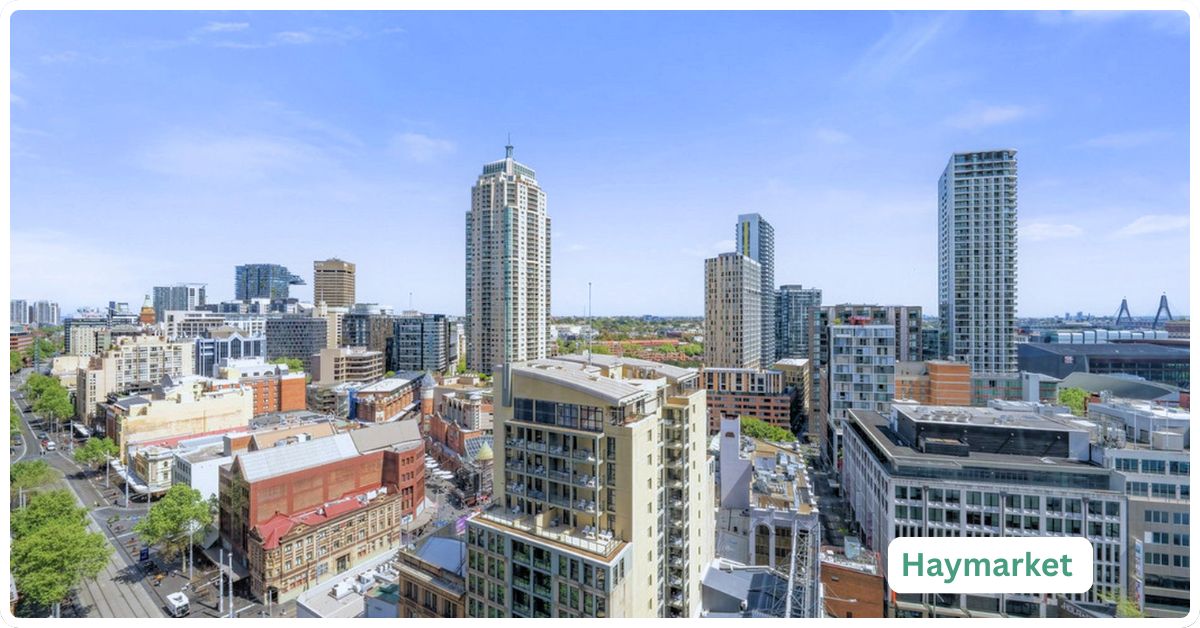
Haymarket doesn’t do quiet. This is the pocket of Sydney where Chinatown’s neon and yum cha steam meet the glass bulk of ICC Sydney’s convention halls, where Paddy’s Markets has been trading since before Federation and where Central Station’s platforms sit close enough to hear the announcements. You buy or rent here for density, not for a backyard: there is barely a house left standing, green space is rationed to one park and a strip of harbour foreshore, and daily life happens vertically, in towers stacked above restaurants, markets and exhibition halls. The trade-off is real and worth saying plainly: incredible food, culture and transport on your doorstep, in exchange for almost no residential quiet and a housing stock that is, for practical purposes, apartments only.
Haymarket Boundary and Location Map
Haymarket sits at the southern edge of the Sydney CBD, within the City of Sydney LGA and sharing postcode 2000 with the CBD itself. It’s a short walk (under a kilometre) from the Town Hall/QVB core, bordered by the CBD proper to the north, Ultimo and Darling Harbour to the west, Surry Hills to the east, and the Central Station precinct to the south. It’s a compact, walkable grid, not a sprawling suburb: you can cross it end to end in about fifteen minutes on foot.
Quick Facts
| LGA | City of Sydney |
| Postcode | 2000 |
| Population | 8,305 (2021 Census, ABS SAL11884) |
| Growth Rate | Up 12.95% from 7,353 in the 2016 Census; no updated ABS figure until the 2026 Census results are released (expected 2027) |
| Distance from CBD | Sits within the CBD’s southern edge, roughly 1km from Town Hall/QVB |
| Character | Dense, mixed-use inner-city precinct built around Chinatown, Paddy’s Markets and the ICC Sydney convention and exhibition precinct |
| Median House Price | Not applicable. Only 2 house sales recorded in Haymarket in the past 12 months (YourInvestmentPropertyMag/CoreLogic data, 2026), a sample too thin to report a meaningful median |
| Median Unit Price | $933,000, down 6.23% over the past 12 months (YourInvestmentPropertyMag/CoreLogic data, 2026) |
| Transport | Sydney Metro (Gadigal station, City & Southwest line, opened 4 August 2024), Central Station (Sydney Trains, multiple T-lines), L1 Inner West Light Rail (Capitol Square, Chinatown, Paddy’s Markets, Exhibition Centre stops), walking distance to Town Hall Station |
| Crime Rate (LGA) | BOCSAR does not calculate a per-capita rate for the City of Sydney LGA (transient daytime and visitor population distorts the denominator). Recorded incidents: 5,644 violent crime and 10,253 property crime across the LGA, Apr 2025-Mar 2026, both up on the prior 12 months |
| Childcare Availability | Thin. A small handful of centres serve the area (Darling Nest Child Care Centre is the main long day care option inside Haymarket); supply reflects a population skewed to students and young singles, not families |
| School Zone Quality | No zoned government primary school sits within Haymarket itself. Ultimo Public School, just west of the precinct, is the nearest option most families end up looking at; check the NSW Department of Education school finder for your exact address |
| Parks & Recreation | Belmore Park (within Haymarket, on Hay Street) is the only real green space on the ground; Prince Alfred Park and the Darling Harbour foreshore are both a short walk away |
| Shopping | Dixon Street Chinatown, Paddy’s Markets, Market City |
| Health | Multiple GP clinics locally (Chinatown Medical Centre, Worldciti Medical, Sydney Central Medical Centre); nearest major public hospital is Sydney Hospital & Sydney Eye Hospital on Macquarie Street (about 1.5km) |
| Best For | International students, young professionals wanting car-free CBD-adjacent living, and investors chasing rental yield rather than capital growth |
What Makes Haymarket Special
Chinatown and Dixon Street
Dixon Street is the spine of Sydney’s Chinatown and one of the densest concentrations of Asian dining in the country: yum cha, Cantonese roast meats, Thai, Vietnamese, Malaysian and Japanese all within a few blocks. The City of Sydney is mid-way through the first major upgrade of Dixon Street since 1980, with new paving, street furniture and lighting rolling out in phases through to December 2026. The Friday night Chinatown Markets relocated temporarily on 5 September 2025 to the Hay Street/Harbour Street pedestrian zone near the Paddy’s Markets light rail stop while the works proceed, with a return to Dixon Street pencilled in for May 2026.
ICC Sydney and the Darling Harbour Events Precinct
ICC Sydney anchors Haymarket’s western edge and, with it, a steady flow of conferences, trade shows and exhibitions that keeps the precinct’s cafes, hotels and short-stay apartments busy through the working week, not just on weekends. It’s a point of difference from almost any other inner-city Sydney suburb: you’re living inside an events and hospitality economy as much as a residential one, and that shapes everything from footpath traffic to the mix of short-term rentals in the local apartment stock.
What Is It Like Living Here?
Life in Haymarket is loud, walkable and almost entirely apartment-based. Forum chatter from residents in the towers around Quay Street and Hay Street describes constant street noise (markets, restaurant extraction fans, light rail bells), excellent access to food and transport, and a near-total absence of the things families usually look for: backyards, quiet streets, local primary schools. It suits people who want to walk to everything and are happy to trade a lawn for a lift lobby.
Transport
This is one of the best-connected patches of Sydney, full stop. Gadigal metro station, on the Sydney Metro City & Southwest line, opened 4 August 2024 at the southern end of the CBD and puts the Sydenham/Bankstown corridor and Chatswood/Macquarie Park within a single fast ride.
Sydney Metro also connects through to the wider network. Central Station, Sydney’s largest interchange, sits on Haymarket’s southern doorstep with Sydney Trains services across multiple T-lines plus regional and intercity trains. On the surface, the L1 Inner West Light Rail runs directly through the precinct with stops at Capitol Square, Chinatown, Paddy’s Markets and Exhibition Centre, linking Haymarket to Central, Darling Harbour, Pyrmont, Glebe and on to Dulwich Hill. Town Hall Station is an easy walk north.
Buses along George Street and through the CBD fill in the gaps; see the public bus network for routes. Most residents here don’t need a car.
Healthcare
GP access is good and unglamorous: a cluster of general practices sit within Chinatown and the broader Haymarket grid, including Chinatown Medical Centre and Worldciti Medical, many offering multilingual service given the local demographic. For anything more serious, Sydney Hospital & Sydney Eye Hospital on Macquarie Street is the closest major public hospital, about 1.5km away, with St Vincent’s Hospital in Darlinghurst and Royal Prince Alfred Hospital in Camperdown both a short trip further out.
Schools and Childcare
Be honest with yourself here if you’re planning around school-age kids: there is no zoned government primary school sitting inside Haymarket itself. Ultimo Public School, just across Darling Harbour’s eastern edge, is the realistic local option for most addresses, but confirm your own catchment via the NSW Department of Education’s school finder rather than assuming. Childcare supply is thin for the same reason the school picture is thin: this is a precinct built for students, workers and short-stay visitors, not families with pre-schoolers. Darling Nest Child Care Centre is the main long day care option within Haymarket; beyond that, families are largely looking into neighbouring Ultimo, Surry Hills or the CBD proper.
Industry & Work Life
Hospitality, retail, events and tourism dominate local employment, unsurprising given Paddy’s Markets, ICC Sydney and Chinatown’s restaurant density all sit within a few blocks of each other. UTS and TAFE NSW’s Ultimo campuses next door mean a large share of residents are international students rather than full-time workers, and the precinct’s rhythm (busy through the working week thanks to conventions, busy again on weekends thanks to the markets) reflects that mixed economy. For CBD office workers, it’s a walk to work, not a commute.
Shopping & Eating Out
Dixon Street is the headline act: yum cha houses, roast duck and barbecue shops, hotpot, and a deep bench of Cantonese, Thai, Malaysian and Vietnamese dining. Paddy’s Markets at Haymarket has traded on this site since the 1800s and remains the go-to for fresh produce, flowers and bargain goods, open Wednesday to Sunday. Market City, built above Paddy’s, adds a food court, fashion outlets and a cinema. Beyond Dixon Street, Sussex Street and the Darling Square precinct add further dining density, from casual noodle bars to higher-end contemporary Asian.
Attractions, Parks and Natural Spaces
Green space is the honest weak point. Belmore Park, on Hay Street opposite Central Station, is the only park sitting inside Haymarket, and the City of Sydney has completed community consultation on a renewal that would add better lighting, pathways and gathering and play spaces there. For anything bigger, residents walk to Prince Alfred Park (with its pool and running track, just south near Central) or the Darling Harbour foreshore to the west, home to the Australian National Maritime Museum, SEA LIFE Sydney Aquarium and Cockle Bay’s restaurant strip. The Capitol Theatre, a heritage-listed performing arts venue on Campbell Street, is the precinct’s other drawcard.
Crime and Safety
BOCSAR reports crime at the City of Sydney LGA level, and it explicitly does not calculate a per-capita rate for this LGA because the resident population figure doesn’t account for the huge daytime, visitor and nightlife population moving through it, Haymarket’s convention centre and markets very much included. Take any suburb-specific crime claim you see elsewhere with real scepticism. What BOCSAR does record: 5,644 violent crime incidents and 10,253 property crime incidents across the whole LGA in the 12 months to March 2026, both up on the prior year (5,505 and 9,605 respectively). Read that as an LGA-wide, activity-driven figure, not a Haymarket-specific one.
Realty Market
Haymarket is a unit market, full stop. There is essentially no house stock left to transact: YourInvestmentPropertyMag/CoreLogic data recorded just 2 house sales in the past 12 months against 177 unit sales, a gap too wide to call it a dual market. The median unit price sits at $933,000 (2026 data), down 6.23% over the past 12 months and down 3.32% over the most recent quarter, though average annual growth over a longer run sits at a modest +1.18%.
Units are moving reasonably quickly (an average 68 days on market) but stock on market is tight at 0.19% of total dwellings, with inventory sitting around 2.6 months. Gross rental yield for units is a strong 5.88%, with median weekly rent around $1,200-$1,250 (sources vary slightly) and rents up roughly 1.4% over the past year. This is a market built for yield-focused investors and owner-occupiers who want to live centrally, not for anyone hunting capital growth in the current cycle.
Our Honest Verdict
Haymarket is likely to appeal most to international students, young professionals who want to walk to work and eat well without owning a car, and investors primarily focused on rental yield rather than capital growth, given unit prices have actually softened over the past year. It is less compelling for families: there’s no zoned local primary school, childcare supply is thin, and green space is limited to one park undergoing renewal works. It doesn’t suit anyone chasing quiet, either. Markets, restaurant extraction fans and light rail bells are part of the deal, not an exception to it.
The comparable suburb here is Ultimo, immediately to the west. Ultimo carries the same inner-city apartment stock, the same proximity to UTS and TAFE NSW, and a broadly similar renter-heavy demographic, but trades some of Haymarket’s Chinatown intensity for a slightly calmer, more campus-adjacent feel and closer proximity to Darling Harbour’s quieter western edge. If Haymarket feels like one degree too much market and neon, Ultimo is worth a look before you commit.
Frequently Asked Questions
Is Haymarket the same as Sydney’s CBD?
No, though they share postcode 2000. Haymarket is a distinct, named precinct at the CBD’s southern edge, built around Chinatown, Paddy’s Markets and ICC Sydney, with its own identity separate from the office towers and retail core further north.
Can I buy a house in Haymarket?
Realistically, no. Only 2 house sales were recorded in the precinct in the past 12 months (2026 data), against 177 unit sales. This is an apartment market, not a house-and-land one.
Is Haymarket good for families with school-age children?
Generally, no. There’s no zoned government primary school inside Haymarket, childcare supply is thin, and green space is limited to Belmore Park. Families more often look to Ultimo, Surry Hills or further out for that mix of schooling and open space.
How do I get around without a car?
Very easily. Gadigal metro station (opened August 2024), Central Station’s Sydney Trains network, and the L1 Inner West Light Rail’s Capitol Square, Chinatown, Paddy’s Markets and Exhibition Centre stops all sit within the precinct, with Town Hall Station a short walk further north.
Is Haymarket safe?
BOCSAR doesn’t calculate a reliable per-capita crime rate for the City of Sydney LGA because of the huge non-resident population moving through it. Recorded incident counts across the LGA are trending up (5,644 violent and 10,253 property crime incidents in the year to March 2026), but that figure covers the entire LGA’s daytime, tourist and nightlife population, not a Haymarket-specific rate.
References
- NSW Spatial Services, NSW Administrative Boundaries Theme, boundary query for Haymarket, postcode 2000, accessed August 2026
- Australian Bureau of Statistics, 2021 Census QuickStats, Haymarket (SAL11884), accessed August 2026
- YourInvestmentPropertyMag/CoreLogic, Haymarket NSW 2000 Suburb Profile and Property Report, 2026
- HTAG, Haymarket, NSW 2000 Property Market and House Prices, 2026
- Sydney Metro, “New CBD metro station named Gadigal Railway Station,” accessed August 2026
- Global Railway Review, “Sydney Metro City project to launch on 4 August 2024,” accessed August 2026
- Transport for NSW, Sydney Light Rail Network Map, accessed August 2026
- Transport for NSW, Central Precinct Renewal Program project page, accessed August 2026
- Haymarket Chamber of Commerce, “Dixon Street Upgrade and Relocation of the Chinatown Friday Night Markets,” accessed August 2026
- City of Sydney, Belmore Park park page and Belmore Park renewal consultation page, accessed August 2026
- NSW Bureau of Crime Statistics and Research (BOCSAR), LGA ranking for violent and property offences, April 2016 to March 2026
- Paddy’s Markets, official site, accessed August 2026
- Market City Sydney, official site, accessed August 2026
- healthdirect, GP and hospital listings for Haymarket NSW 2000, accessed August 2026
For more inner-city options, browse the full Sydney suburbs list or explore the Sydney regions overview.