
Kellyville spent the better part of two centuries as farmland and horse paddocks on the road to Windsor, then spent the 2000s and 2010s turning into one of the largest slabs of new housing Sydney has built anywhere. The name goes back to convict-turned-innkeeper Hugh Kelly, who ran “The Bird in the Hand” at the corner of Wrights and Windsor Roads in the early 1800s; after his death in 1884 the land was subdivided as the “Kellyville Estate,” and the name stuck (before that it had been known, less flatteringly, as “There and Nowhere” and later “Irish Town,” for the Irish settlers who farmed it). The Bidjigal clan of the Dharug people were the original inhabitants of the land.
What you get today is a suburb split in character by its own history. The older, established pocket south of Wrights Road has big blocks, mature trees and 1990s-2000s brick homes; the newer estates north toward North Kellyville are still finishing, with display-home sheen, narrower lots and construction dust in places. Both halves now sit inside the catchment of a Sydney Metro station that didn’t exist before 2019, which changed the suburb’s commuter maths overnight and pushed prices well above the Sydney median. At the 2021 Census, Kellyville (SAL) had a population of 27,011, with a median age of 38 and an average of 3.3 people per household, well above the Sydney average and a strong signal of just how family-heavy this suburb is (Australian Bureau of Statistics, 2021 Census QuickStats, SAL12096).
Kellyville Suburb Map
Kellyville sits in the middle of The Hills Shire’s growth corridor, bounded roughly by Rouse Hill and North Kellyville to the north, Box Hill to the north east, Beaumont Hills and Kellyville Ridge to the west, and Bella Vista and Baulkham Hills to the south. Castle Hill sits a few kilometres to the south east along the same Old Northern Road corridor. Because Kellyville was developed in stages over three decades, the boundary lines with its immediate neighbours (particularly North Kellyville, carved out as its own growth precinct, and Kellyville Ridge, technically part of Blacktown LGA) are more administrative than they are visible on the ground; drive from one to the next and you likely won’t notice the change.
Quick Facts
Kellyville: At a Glance
| LGA | The Hills Shire Council |
| Postcode | 2155 |
| Population | 27,011 (2021 Census, ABS SAL12096) |
| Distance from CBD | Approximately 35km north west of the Sydney CBD |
| Named After | Hugh Kelly, publican and early landholder, via the “Kellyville Estate” subdivision after his death in 1884 |
What’s Nearby
| Sports & Recreation | Bernie Mullane Sports Complex, Kellyville Memorial Park Reserve, Balmoral Road Reserve |
| Shopping | Kellyville Village, plus Rouse Hill Town Centre and Norwest Marketown a short drive away |
| Health | Norwest Private Hospital (Bella Vista, roughly 2km) for private care; Blacktown Hospital for public emergency care |
Real Estate
| Median House Price | Reported between roughly $1.65m and $1.95m depending on data provider, as of late 2025/early 2026 (PropertyValue, YIP, AusPropertyInsights) |
| Median Unit Price | Reported between roughly $700,000 and $900,000, as of late 2025/early 2026 (PropertyValue, YIP) |
| Median Weekly Rent | $630 across all dwellings (2021 Census); more recent listings site data puts house rents nearer $800-950/week and units around $640-750/week |
Transport
| Rail | Kellyville Station on the Sydney Metro Northwest line, opened 26 May 2019 |
| Bus | Multiple routes (601, 605, 643) feeding Rouse Hill and Kellyville Metro stations, with peak frequency upgrades in 2025 |
| Road | Old Northern Road and Windsor Road are the two main arterials through the suburb |
What Makes Kellyville Special
A Metro Station That Rewrote the Commute
Before 2019, getting from Kellyville into the Sydney CBD meant a bus to Parramatta or Chatswood and a transfer, or a long drive down Windsor Road into gridlock. Kellyville Station, on the Sydney Metro Northwest line, changed that: turn-up-and-go metro services run every few minutes at peak, connecting through to Chatswood and, since the City & Southwest extension opened, into the CBD itself without a transfer. That single piece of infrastructure did more to reshape Kellyville’s property market and its demographic mix than anything else in the suburb’s recent history.
Big Blocks, Two Different Eras
Because Kellyville was built out in stages, you can drive a few streets and pass from 800-1000sqm blocks with pools and established gardens (the older, southern parts of the suburb) into estates with narrower frontages, smaller yards and much newer builds (the northern and North Kellyville-adjacent pockets). Don’t assume “Kellyville” means one type of house; it means several, built ten to twenty-five years apart.
What Is It Like Living Here?
Living in Kellyville means living around families. The 2021 Census recorded 7,590 families against 8,555 dwellings and an average household size of 3.3 people, both well above typical Sydney averages, and the median age of 38 reflects a suburb still full of primary and high-school-aged kids rather than young singles or empty-nesters. Locals describe the daily rhythm as school-run heavy and weekend-sport heavy. Their most consistent gripe about living in Kellyville is the peak traffic on Old Northern Road and Windsor Road.
Hospitals
Norwest Private Hospital in neighbouring Bella Vista, roughly 2km from central Kellyville, covers private surgical and maternity care for the district. For public hospital care, including emergency departments, residents are directed further afield to Blacktown Hospital.
Education
Kellyville Public School, established in 1873, is the suburb’s original government primary school and currently enrols around 856 students, with 64% from language backgrounds other than English, a useful data point on how multicultural the local school population is (NSW Department of Education, Kellyville Public School). Kellyville High School serves as the local government secondary option. North Kellyville Public School has opened more recently to serve the newer estates to the north. St Angela’s Primary is a Catholic option in the area. As with most growth suburbs, catchment boundaries have shifted as new schools opened and new estates filled up. With that in mind, do check the current NSW Department of Education catchment maps, particularly around the newer North Kellyville boundary, where reassignments have been a live local issue.
Parks and Natural Spaces
Bernie Mullane Sports Complex on Marella Avenue is the suburb’s flagship recreation site, run partly by The Hills Shire Council and partly by community sporting bodies. It has indoor basketball and futsal courts, outdoor netball and tennis courts, cricket practice nets, a dog park and (via the Livvi’s Place inclusive playground on site) one of the better-regarded playgrounds in the district. Kellyville Memorial Park Reserve is the more central, everyday green space, with open lawns and a playground the Council has upgraded in recent years. Balmoral Road Reserve adds multi-purpose sporting fields and a second children’s playground, while Kellyville Lions Ted Pike Reserve and Fairway Drive Reserve cover the smaller, pocket-park end of things. None of these are bushland reserves in the way you’d find further out toward the Hawkesbury; Kellyville’s green space is almost entirely sporting fields and suburban parks rather than remnant bush, which tells you something honest about how comprehensively the land was cleared and subdivided for housing.
Transport
Kellyville is roughly 35km north west of the Sydney CBD. By metro, the trip into the city is now measured in tens of minutes rather than the better part of two hours it could take by bus and train before 2019. Kellyville Station opened on 26 May 2019 as part of the Sydney Metro Northwest, Australia’s first fully automated metro railway. It’s an elevated “skytrain” station roughly 13 metres above ground, with commuter parking as part of a 3,000-space program shared with Cherrybrook and Hills Showground stations. Services run into Chatswood and, via the City & Southwest extension, through to the Sydney CBD. Bus routes including the 601, 605 and 643 connect North Kellyville and surrounding areas into Rouse Hill Station and the wider Metro network, with Transport for NSW rolling out frequency increases across the North West and Hills District bus network through 2025, including a 10-minute weekday peak service on the North Kellyville to Rouse Hill route. For drivers, Old Northern Road and Windsor Road are the suburb’s two arterials, both of them historic routes now carrying much heavier volumes than they were built for. Peak-hour congestion on both, particularly around the Windsor Road/Old Northern Road interchange, is a routine local complaint and one worth planning around if you’re commuting by car rather than metro.
Shopping
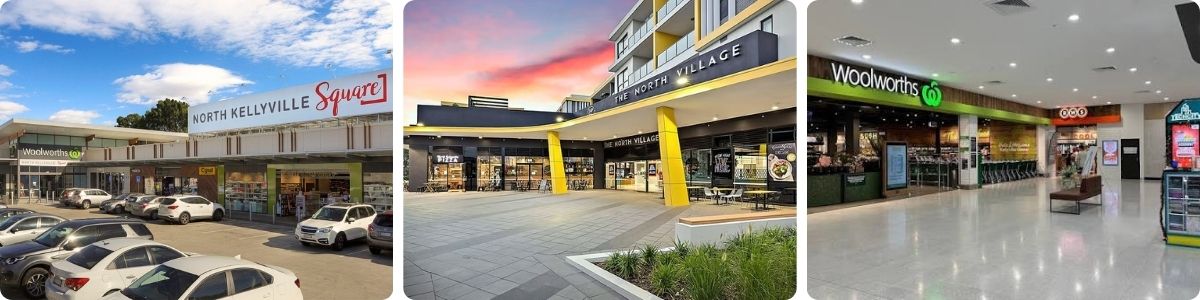
You rarely need to leave the area for everyday shopping, but for a proper retail day out, everyone heads to Rouse Hill. Covering everyday needs is one of Kellyville’s strengths. Unlike older suburbs with a single shopping strip, Kellyville has grown around several neighbourhood centres, each serving a different pocket of the suburb. Residents typically do their weekly grocery shop close to home at places like Kellyville Village, North Kellyville Square or The North Village, while bulky goods and home improvement are available at HomeCo. Kellyville Grove. For fashion, entertainment and major retailers, most locals simply drive 5-10 minutes to Rouse Hill Town Centre, which has effectively become the region’s main shopping destination.
Realty Market
Median house price figures vary meaningfully by data provider as of late 2025/early 2026, reported anywhere from around $1.65 million to $1.95 million, with most sources showing modest single-digit percentage growth over the preceding 12 months rather than a sharp run-up (PropertyValue, Your Investment Property, AusPropertyInsights). Units sit well below that, reported between roughly $700,000 and $900,000. Given the spread across sources, treat any single figure as indicative rather than exact, and get a current agent appraisal for a specific property. What’s consistent across every source is that Kellyville prices sit above the Sydney-wide median, a direct function of the metro station and the large block sizes in the older half of the suburb. The 2021 Census recorded a median weekly rent of $630 across all Kellyville dwellings; more recent listings-based estimates put house rents nearer $800-950 a week and units around $640-750 a week, reflecting both general Sydney rental growth since 2021 and the premium attached to metro proximity.
Future Growth
Kellyville sits inside an active state government rezoning push. A Transport Oriented Development (TOD) program covering 52 hectares around the Bella Vista and Kellyville Metro stations was finalised in late 2024 (effective 27 November 2024), enabling around 4,600 additional homes and 3,800 jobs in the immediate station catchments, backed by a stated $520 million in community infrastructure funding (NSW Department of Planning, Housing and Infrastructure). The broader North West Growth Area rezoning around North Kellyville and Box Hill, also finalised in late 2024, adds up to a further 20,700 homes across the combined precincts spanning The Hills Shire and Blacktown LGAs. On the ground, this means Kellyville and its immediate surrounds will keep densifying for at least the next decade, with medium-density infill increasingly common near the station rather than the large-block detached housing that defined the suburb’s first wave.
The Honest Verdict
Kellyville is a good choice if you want a family-sized home with a genuine metro connection into the city, and you can live with the traffic on the two roads that hold the whole suburb together. It suits growing families chasing land size, and anyone who values the certainty of turn-up-and-go rail over the promise of one that might arrive eventually elsewhere in the north west. It doesn’t suit those chasing lifestyle amenity, walkable dining strips or bushland outlook; Kellyville’s parks are sporting fields, not scenery, and its shopping is a village strip, not a destination. Weighed against its closest comparables, Castle Hill offers more retail and dining polish at a similar or higher price point, Beaumont Hills trades some of Kellyville’s metro convenience for larger, newer blocks further from the station, and Rouse Hill is generally the more affordable entry point in the corridor with its own town-centre retail hub but a younger, less-established feel. If land size and a proven rail link matter more to you than lifestyle polish, Kellyville is a defensible choice; if you’re chasing the latter, look elsewhere in the district first.
Frequently Asked Questions
What is the median house price in Kellyville?
Estimates vary by provider, from roughly $1.65 million to $1.95 million as of late 2025/early 2026. Get a current local appraisal rather than relying on a single online estimate, given how much the published figures diverge.
Does Kellyville have a train station?
Yes. Kellyville Station opened on the Sydney Metro Northwest line on 26 May 2019, with turn-up-and-go services connecting to Chatswood and, via the City & Southwest extension, into the Sydney CBD.
Is Kellyville safe?
Crime data in NSW is published at local government area level, not suburb level, so there’s no Kellyville-specific figure. The Hills Shire LGA (which includes Kellyville) recorded an overall crime rate of around 2,820 incidents per 100,000 people for the year to September 2025, below the NSW average, with theft, assault and intimidation/stalking/harassment the most common recorded offences (NSW Bureau of Crime Statistics and Research). The Hills Shire is consistently reported among Sydney’s lower-crime council areas, alongside the Upper North Shore and Northern Beaches.
What are the best schools near Kellyville?
Kellyville Public School (government, established 1873) and Kellyville High School (government secondary) are the long-standing local options, with North Kellyville Public School added more recently for the newer estates, and St Angela’s Primary as a Catholic option. Catchment boundaries have shifted with new school openings, so verify current zoning for any specific address via the NSW Department of Education.
Is Kellyville a good suburb for families?
The Census data says yes on paper: 7,590 families, an average household size of 3.3 people, and a median age of 38, all pointing to a suburb built around family life rather than singles or young professionals. Whether it suits your family specifically depends on how you weigh land size and school access against the traffic on Old Northern Road and Windsor Road.
Additional References
Australian Bureau of Statistics, 2021 Census QuickStats, Kellyville (SAL12096): abs.gov.au. NSW Bureau of Crime Statistics and Research, Local Area Rankings: bocsar.nsw.gov.au. Transport for NSW, bus network changes across the North West and Hills District: nsw.gov.au. NSW Department of Planning, Housing and Infrastructure, North West Growth Area and Sydney Metro Northwest Urban Renewal Corridor (Kellyville and Bella Vista TOD): planning.nsw.gov.au. The Hills Shire Council, Parks and Recreation Directory: thehills.nsw.gov.au. Property price estimates: PropertyValue, Your Investment Property Magazine, AusPropertyInsights, OpenAgent (accessed 2026). NSW Department of Education, Kellyville Public School: kellyville-p.schools.nsw.gov.au.
See all suburbs in the The Hills Shire Council. See the full Sydney Regions overview to explore more of greater Sydney.