
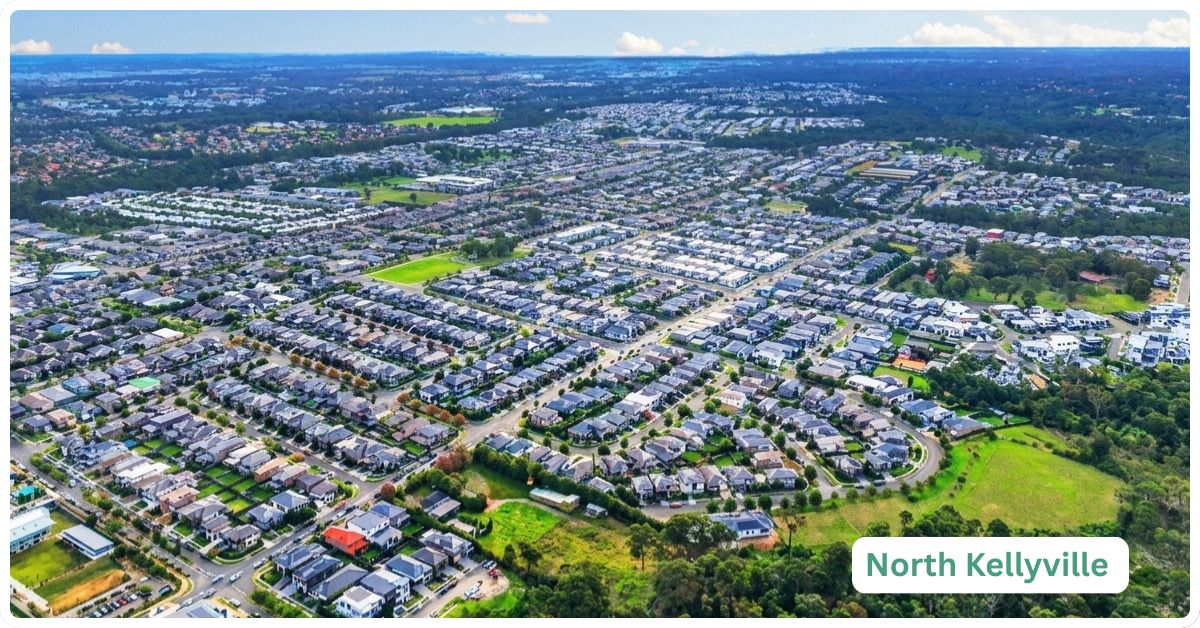
North Kellyville is what a growth corridor looks like mid-build. Drive its streets and you see the tell: near-identical double-storey facades on curving crescents, front yards still working out whether the turf has taken, and a shopping strip that opened only a few years after the first families moved in. This is a suburb that didn’t exist as an address until June 2018, when it was formally carved out of Kellyville as its own gazetted suburb after a decade of land release under the NSW North West Growth Area program.
What you get here is size and newness: bigger blocks and bigger houses than you’ll find in most of Sydney’s north west, a school built specifically for the estate, and parks that are genuinely new rather than merely renovated. What you don’t get, at least not yet and not within an easy walk, is a train station. North Kellyville sits between two Sydney Metro Northwest stops, Kellyville and Rouse Hill, close enough to see on a map and far enough that almost nobody in the suburb is walking to either one.
It’s a suburb built for families who’ve already decided they want space, a newly built school, and a masterplanned street grid, and who are prepared to drive or catch a feeder bus to the metro rather than walk to it. If that trade-off doesn’t work for you, say so early. It’s the single biggest thing about living here.
North Kellyville Suburb Map
North Kellyville sits in Sydney’s north west, roughly 38km from the CBD, bounded loosely by Hezlett Road and the Kellyville boundary to the south, Samantha Riley Drive and Beaumont Hills to the east, Rouse Hill to the north, and Old Northern Road running along its western edge. It was released for development as part of the NSW North West Growth Area from around 2010 and proclaimed a separate suburb, split out of Kellyville, in June 2018.
Quick Facts
North Kellyville: At a Glance
| LGA | The Hills Shire Council |
| Postcode | 2155 |
| Population | 17,401 (ABS 2021 Census, SAL13003), almost certainly higher now given ongoing land release |
| Median Age | 33 years (2021 Census) |
| Median House Price | $1,800,000, up 7.5% year-on-year (NSW Valuer General settlement data via htag.com.au, 2025) |
| Median Unit Price | $650,000, up 2% year-on-year (NSW Valuer General settlement data, 2025) |
| Nearest Metro Stations | Kellyville and Rouse Hill (Sydney Metro Northwest), both roughly 2.6-3km away, neither realistically walkable |
| Crime Rate (LGA) | The Hills Shire: 2,820 incidents per 100,000 people, year ending September 2025 (BOCSAR), below the NSW average |
| Local Public School | North Kellyville Public School, K-6, opened 2019 |
| Best For | Young families wanting a new house, a new school and a big block, who can live without a nearby train station |
What’s Nearby
| Shopping | North Kellyville Square shopping village |
| Parks & Recreation | Withers Road Reserve’s playground, Lansdowne Road Reserve |
| Nearby Centres | Wider Hills District and Rouse Hill Town Centre, a short drive away, for anything the local strip doesn’t cover |
Real Estate
| Market Character | House-and-land estate stock dominates, with larger blocks and near-new executive-style builds compared to older Hills suburbs |
| Median House Price | Around $1.8 million (2025), skewed up by larger blocks and near-new builds (NSW Valuer General settlement data) |
| Median Unit Price | Around $650,000, a smaller and cheaper slice of the market (NSW Valuer General settlement data) |
Transport
| Rail | No train station within the suburb; Kellyville and Rouse Hill Metro stations both sit 2.5-3km away |
| Bus | Local feeder buses (605, 633) reach Kellyville and Rouse Hill Metro stations |
| Road | Old Northern Road and Samantha Riley Drive carry most of the through-traffic on the suburb’s edges |
What Makes North Kellyville Special
A suburb built in one continuous push
Stockland, Mirvac and Dahua all ran estate releases through North Kellyville between 2010 and 2020, which is why the streetscape reads so consistently: similar block sizes, similar builder palettes, similar street-tree plantings still catching up to the rooflines. There’s very little pre-2010 housing stock here to break up the pattern, for better or worse.
Land size over density
Compared to newer apartment-heavy release areas further south west, North Kellyville has stuck largely to detached house-and-land product. That’s a deliberate trade: fewer walkable amenities right on your doorstep, but bigger backyards and more separation between neighbours than you’ll get in Box Hill or Marsden Park.
Named for the family that came before the suburb did
Kellyville, and by extension North Kellyville, is believed to take its name from Hugh Kelly, a former convict who arrived in NSW aboard The Rolla in 1803 and later held land here. The area was known first as “There and Nowhere,” then as “Irish Town” for the cluster of Kelly family holdings, before the subdivided Kellyville Estate gave the district its modern name.
What Is It Like Living Here?
This is a young suburb built almost entirely for young families, and the 2021 Census bears that out plainly: median age 33, average household size 3.3 people (against a Greater Sydney average of 2.7), and 88.9% of households classified as family households, with 60.7% being couples with children. Single-person households sit at just 9.5%. If you’re not raising kids or planning to, you’ll be in the minority here, and the local amenity mix (school, playgrounds, family-sized housing stock) reflects that skew rather than working against it.
Day to day, life here revolves around the estate itself and short drives out to Rouse Hill Town Centre or Castle Hill for anything bigger than a supermarket run. The local shopping village covers essentials. It doesn’t cover much else, and residents who want a proper night out or a wider retail spread are driving to get it, not walking.
Hospitals
Nepean and Blacktown hospitals are the nearest major public hospitals, both a drive away rather than a local walk-up option; there’s no hospital within North Kellyville itself. Norwest Private Hospital, in nearby Bella Vista, is the closer private option for those with cover.
Education
North Kellyville Public School, on Hezlett Road, opened in January 2019 specifically to serve the growing estate. It’s a K-6 school built in stages, with the completed project providing 40 learning spaces and capacity for around 1,000 students; as of recent reporting it enrols around 380 students, including a significant cohort in multicategorical support classes, and 69% of students come from language backgrounds other than English. Families needing high school options are zoned into the wider Hills District network rather than a dedicated North Kellyville secondary school, since none currently exists within the suburb.
Industry & Work Life
North Kellyville is a bedroom suburb, not an employment node. Most residents commute to Norwest Business Park, Castle Hill, Macquarie Park or the Sydney CBD for work, which puts the absence of a walkable train station squarely at the centre of daily life here rather than as a minor inconvenience.
Parks and Natural Spaces
Every park here is new, which means the equipment is current but the trees haven’t caught up yet.
Stringer Road Reserve offers sporting fields suitable for football and cricket, along with two full-sized basketball courts and a children’s playground.
Withers Road Reserve, on the corner of Hezlett Road and Withers Road, is the suburb’s best-known playground: a shade-sail-covered play area with a bird’s nest swing, a picnic shelter, and a half basketball court, sitting opposite the North Kellyville Square shops.
Lansdowne Road Reserve, off Foxall Road, offers a smaller playground, turf area and picnic shelter.
Tree Frog Park Reserve, at the corner of Oxlade Street and Bresnihan Avenue, and Twickenham Avenue Reserve, which includes a learn-to-ride track for kids on bikes, round out the local network. None of this is bushland; it’s suburban recreation infrastructure delivered alongside the housing, and it shows.
Samantha Riley Drive Reserve at the southern end of the suburb features two multi-purpose sports fields.
For a genuine bushland escape, the Rouse Hill Regional Park is only 2-3km away to the west.
Transport
There is no train station in North Kellyville and none planned for it. The nearest Sydney Metro Northwest stations are Kellyville, about 3km away (roughly a 38-minute walk from North Kellyville Square), and Rouse Hill, about 2.6km away (around a 34-minute walk). Both opened when the Metro Northwest line launched in May 2019. For almost every resident, getting to either station means a bus or a car, not a walk.
Route 605 runs as a local feeder between Rouse Hill Station and North Kellyville, with trips typically taking 10-15 minutes. Route 633 connects Rouse Hill Metro Station through Kellyville, Hills Showground, Castle Hill and Cherrybrook to Pennant Hills Station, a longer cross-district run. Routes 601 and 735 also service parts of the suburb. None of these replace the convenience of living within walking distance of a station; they’re the workaround.
Old Northern Road runs along the suburb’s western edge and is the main north-south route toward Castle Hill and Round Corner. Samantha Riley Drive forms much of the boundary with Beaumont Hills to the east and feeds traffic toward Windsor Road. Hezlett Road and Withers Road carry the bulk of internal estate traffic. Peak-hour queuing onto Old Northern Road and Windsor Road is a known local frustration, not unique to North Kellyville but not improved by it either.
Roughly 38km to the Sydney CBD, around 15-20 minutes’ drive to Castle Hill or Rouse Hill Town Centre, and about 25-30 minutes to Norwest Business Park, traffic depending.
Realty Market
The median house price sat at roughly $1,800,000 in 2025, up 7.5% on the year prior, based on NSW Valuer General settlement data. That’s a genuinely high figure for a north-west growth suburb, and it reflects the estate’s larger block sizes and newer, bigger builds rather than a broad cross-section of housing stock. Units are a much smaller part of the local market, with a median around $650,000, up a more modest 2% over the same period. Buyers should treat these as estate-driven figures: North Kellyville isn’t competing on affordability against the likes of Marsden Park or Box Hill, it’s competing on land size and newness. Rental stock mirrors the sales market: mostly detached houses rather than units, and priced accordingly for a family tenant rather than a share-house or single-occupant market. Anyone renting here without a car should factor in the bus-to-metro commute before signing.
Future Growth
North Kellyville’s major development wave, driven by Stockland, Mirvac and Dahua, has largely played out over 2010-2020, and the suburb is now closer to build-out than mid-construction. What’s still catching up is social infrastructure: parks are being delivered on a rolling basis (Withers Road Reserve and Lansdowne Road Reserve are both relatively recent completions), and there’s no indication of a second local public school being added within the suburb itself.
The Honest Verdict
North Kellyville makes sense for a specific buyer: a family that wants a bigger, newer house than they’d get in Kellyville or Rouse Hill proper, is comfortable driving or bussing to the metro rather than walking to it, and values a masterplanned street grid and a purpose-built local school over an established town centre. Weighed against Kellyville and Rouse Hill, both of which sit closer to or directly on the Metro Northwest line, North Kellyville trades transport convenience for land size and relative newness. Against Beaumont Hills, its immediate neighbour, the comparison is closer: similar era, similar demographic, similar reliance on Samantha Riley Drive and Old Northern Road to get anywhere. If proximity to rail matters more to you than square metres, buy closer to the line. If it doesn’t, North Kellyville is a reasonable, honestly-priced trade of one for the other, not a suburb with something to hide.
Frequently Asked Questions
Does North Kellyville have a train station?
No. The nearest Sydney Metro Northwest stations are Kellyville and Rouse Hill, both roughly 2.6-3km away and not a realistic walk for most residents.
What is the median house price in North Kellyville?
Around $1,800,000 as of 2025, up 7.5% year-on-year, based on NSW Valuer General settlement data. Units sit much lower, at a $650,000 median.
Is North Kellyville safe?
Suburb-specific crime data isn’t published in NSW; BOCSAR reports at the LGA level. The Hills Shire recorded 2,820 incidents per 100,000 people in the year to September 2025, below the NSW average, with theft, assault and intimidation/stalking/harassment the most common offence categories.
What primary school serves North Kellyville?
North Kellyville Public School on Hezlett Road, opened in 2019 and built specifically for the growing estate. There is no dedicated public high school within the suburb.
Is childcare easy to find in North Kellyville?
It’s tighter than in established suburbs. The official register lists a handful of long day care services within the suburb itself, against a resident base where 60.7% of households are couples with children. Families should expect to look across the wider 2155 postcode, not just North Kellyville proper, and to join waitlists rather than assume same-suburb vacancy.
References
Population and demographics: ABS 2021 Census QuickStats, North Kellyville (SAL13003). House and unit prices: HTAG North Kellyville property data, NSW Valuer General settlement figures, 2025. Crime statistics: NSW Bureau of Crime Statistics and Research, LGA crime tables. School information: School Infrastructure NSW, North Kellyville Public School. Parks: The Hills Shire Council, Parks and Recreation Directory. Suburb history and naming: Wikipedia, North Kellyville, New South Wales. Transport: Transport for NSW, route 605 and 633 details.
See all suburbs in the The Hills Shire Council. See the full Sydney Regions overview to explore more of greater Sydney.