
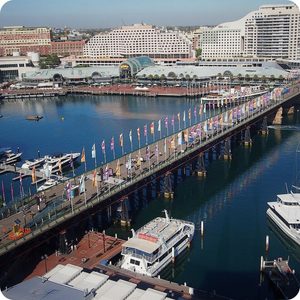
There is no other Sydney suburb where the transformation is this total. Forty years ago Pyrmont was wool stores, wharves and a coal-fired powerhouse, the kind of place where the conversation in the pub was about ships coming in.
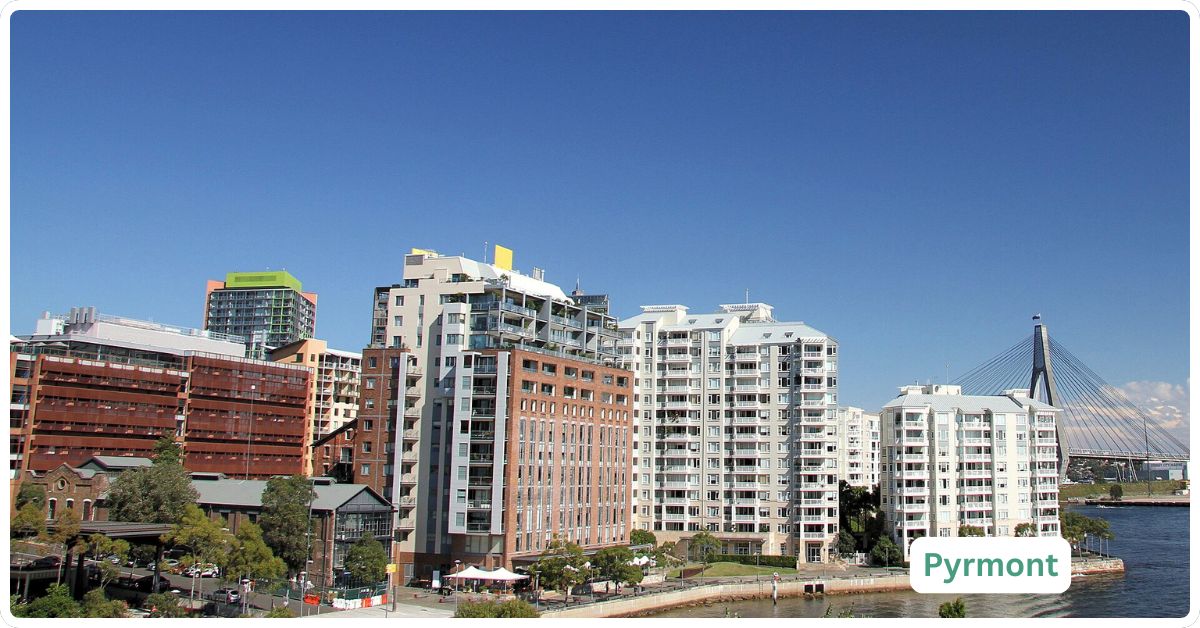
Today it is one of the most densely populated patches of land in the entire country: harbour-view towers stacked shoulder to shoulder on a peninsula you can walk end to end in twenty minutes, a casino and entertainment complex running at full volume next door to Google’s Australian headquarters, and barely a terrace house left standing to remind you what came before.
The trade-off is blunt. You get walk-to-everything density, water on three sides and a five-minute stroll to the CBD, in exchange for almost no backyard, thin heritage stock, and a suburb built around apartment living rather than the quarter-acre version of Sydney life. Pyrmont doesn’t pretend to be both. It picked a lane in about 1995 and has been accelerating down it ever since.
Pyrmont Boundary and Location Map
Pyrmont sits on a peninsula roughly 1.5 kilometres west of the Sydney CBD, across Darling Harbour, in the City of Sydney local government area. It borders Ultimo to the south across Wattle Street and the light rail corridor, the CBD and Darling Harbour to the east, and Glebe and Blackwattle Bay to the west, with Johnstons Bay wrapping the southern shoreline. The historic Pyrmont Bridge, now pedestrian and cycle only, links the peninsula directly into Darling Harbour and the city centre on foot.
Quick Facts
| LGA | City of Sydney |
| Postcode | 2009 |
| Population | 12,658 at the 2021 Census (ABS SAL13297); almost certainly higher now given ongoing apartment completions and no fresh count published since |
| Growth Rate | Precise recent-year population growth is not separately published post-2021; the underlying driver is a wall of apartment completions since the mid-1990s that took Pyrmont from an industrial precinct with a handful of residents to one of the densest suburbs in Australia |
| Distance from CBD | About 1.5km west of the CBD, across Darling Harbour |
| Character | High-rise, high-density apartment peninsula built almost entirely since the 1990s, anchored by The Star casino and entertainment precinct and a growing tech office cluster |
| Median House Price | $1,729,000, down 26.5% over the year to May 2026, on only 10 sales (Your Investment Property, August 2026). Thin sample: treat this figure with real caution, houses are a rare and shrinking stock type here |
| Median Unit Price | $1,110,000, down 5.93% over the year to May 2026, on 234 sales (Your Investment Property, August 2026) |
| Transport | Sydney Light Rail L1 runs through the suburb with multiple stops; Pyrmont Bridge gives a pedestrian/cycle link to the CBD; Sydney Metro West station under construction, targeting a 2032 opening |
| Crime Rate (LGA) | City of Sydney LGA recorded 19,852 incidents per 100,000 people for the year to March 2026 (BOCSAR via aucrimetracker, June 2026), above the NSW average. LGA-wide figures are heavily skewed by the CBD, casino and nightlife precincts, not suburb-specific |
| Childcare Availability | Adequate for a suburb this size: several long day care centres including SDN Pyrmont and Thrive Early Learning Pyrmont, but demand from a very high-density resident base means places fill early |
| School Zone Quality | Improving. Ultimo Public School (expanded new campus) is the local government primary zoning; no local government high school on the peninsula, families typically travel out of suburb for secondary |
| Parks & Recreation | Pirrama Park, Pyrmont Point Park, Jones Bay Wharf foreshore walk, plus the harbourside walking loop around the whole peninsula |
| Shopping | Sydney Fish Market (new $800m facility, opened January 2026), Harris Street retail strip, John Street Square, The Star’s dining precinct |
| Health | Local GP clinics including Star City Medical Centre and Pyrmont Medical Centre; nearest major public hospital is Royal Prince Alfred (RPA) in Camperdown, a short drive or bus ride away |
| Best For | Young professionals and downsizers who want to walk to the CBD and live above the ground floor, not families chasing a backyard |
What Makes Pyrmont Special
The Star, the Towers and Sydney’s Densest Postcode
The Star casino and entertainment complex is the loudest thing about Pyrmont, literally and figuratively. It anchors a precinct of restaurants, bars, a theatre and hotel towers that run late into the night, and it sits directly against a residential stack of high-rise apartment buildings that has made Pyrmont one of the most densely populated suburbs in the country on a per-hectare basis. That combination, casino next door to family apartments, is not something most Sydney suburbs have to reckon with, and it is worth being upfront about rather than glossing over. For a lot of residents it is a real drawcard: restaurants on the doorstep, a 24-hour buzz, water views from nearly every tower. For others it is the exact reason they’d rule Pyrmont out. There is no polite middle answer here, only which side of that trade-off you land on.
A Tech Address With Harbour Views
Away from the casino lights, Pyrmont has quietly become one of Sydney’s better-credentialed tech addresses. Google’s Australian headquarters sits on Pirrama Road, part of a broader cluster of media, tech and professional services tenants drawn by proximity to the CBD without CBD rents, and by the sheer visual pull of a working harbour on the doorstep. It means a meaningful share of the people who live in Pyrmont’s towers also work within a ten-minute walk of them, a live-work compression that few Sydney suburbs can offer. Harbour-view apartments here trade at a premium for exactly that reason: you’re paying for the address as much as the square metreage.
A Name From a German Spa and 120 Years of Bridges
The name itself comes from a bush picnic. In 1806, a party gathered at Captain John Macarthur’s estate at Cockle Bay (today’s Darling Harbour) found a spring of cold water bubbling out of the rock while scouting a spot for the festivities. One of the group, reminded of a mineral spring she’d seen near Hanover in Germany, suggested naming the place Pyrmont after that spa town, and it stuck (Francis Pollon, “The Book of Sydney Suburbs,” 1988). Macarthur had bought the land in 1799 from Obadiah Ikin, who’d bought it in 1796 from the original grantee, a soldier named Thomas Jones, granted 55 acres on the peninsula’s northern half in 1795. The suburb’s western and southern reaches were originally part of the neighbouring Ultimo estate (Pollon, 1988).
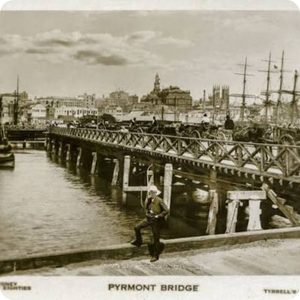
Pyrmont’s relationship with its own bridge is a story in two acts. The first Pyrmont Bridge opened in 1858 as a private toll bridge across Darling Harbour, at a time when Sydney had no motor cars: every crossing was horse-drawn, carts and wagons, gigs and sulkies, landaus and broughams, much of it carrying goods to the Queen Victoria Markets or ferrying the well-to-do of Glebe and Annandale into the city. It was, by all accounts, a very profitable toll to hold (Pollon, 1988). Traffic outgrew it, and in 1884 the state government took over the job of building something bigger. The second Pyrmont Bridge opened in 1902, cost £112,000, and featured a swinging span large enough to let ships pass up Darling Harbour, though as traffic kept growing that same swing became the thing everyone complained about, holding up cars and pedestrians every time it opened for a vessel (Pollon, 1988). That second bridge is the one still standing today: it survives as a pedestrian and cycle link into the CBD, its swing mechanism now largely retired, most famously crossed on foot rather than by horse or car.
The physical transformation around it was brutal and fast. A semi-freeway across Darling Harbour, completed in 1981, together with the 54-hectare Darling Harbour redevelopment from 1985 onward, wiped out much of what remained of old Pyrmont: terrace houses and freestanding homes dating to the original 1856 subdivision, along with most physical evidence of the suburb’s earliest industries, flour milling and shipbuilding among them (Pollon, 1988). What survived is a short list worth knowing: the First World War memorial in Pyrmont Square; the Ways Terrace houses on Pyrmont Street, designed by Professor Leslie Wilkinson and built in 1893; the Sam Hordern Fountain near Pyrmont Bridge, built in 1896; a fire station on Pyrmont Street designed by NSW Government Architect Walter Liberty Vernon in 1907; and the Catholic church of St Bede’s on Pyrmont Street, built in 1867. Not everything made it: Walter Burley Griffin’s 1935 incinerator building on Saunders Street, still standing as of Pollon’s 1988 writing, was ultimately demolished in 1992, four years after the book went to print, and the site is now occupied by apartment towers.
As of 1988, Pollon described Pyrmont as “an industrial suburb, centred on shipping activities, overlooked by a huge powerhouse that is now disused,” where “talk in the town pub is naturally about ships and shipping” (Pollon, 1988). None of that is true anymore, and it hasn’t been for close to three decades. From the mid-1990s, wool stores, wharves and industrial land across the peninsula were rezoned and redeveloped into residential towers at a pace few Australian suburbs have matched, turning Pyrmont into one of the country’s most densely populated suburbs and adding the casino, the office towers and the light rail that define it today.
What Is It Like Living Here?
Living in Pyrmont means living vertically and living close. Locals describe a suburb where you don’t need a car: the office, the supermarket, the gym and a decent restaurant are all within a ten-minute walk, and the CBD itself is closer on foot than most CBD-fringe suburbs manage. The flip side comes up just as often: apartment living means shared walls, lift queues at peak times, and a nightlife precinct around The Star that some residents love and others actively avoid on weekends. It is not a suburb for people who want space, silence or a garden. It is a suburb for people who’ve decided those things matter less than a five-minute walk to work.
Transport
Pyrmont is well served by the Sydney Light Rail L1, which runs through the suburb with several stops along its length, including a stop at the Sydney Fish Market precinct (recently renamed Bank Street to match the new market’s address) and further stops serving The Star and John Street Square, connecting straight through to Central and out to Dulwich Hill.
For pedestrians, the historic Pyrmont Bridge is the direct link into Darling Harbour and the CBD, a walk most residents can do in well under fifteen minutes.
Bus routes supplement the light rail along Harris Street and out toward Glebe.
The big structural change coming is Sydney Metro West, currently under construction, with a Pyrmont station planned near Pyrmont Bridge Road and Union Street; the project is targeting an opening around 2032, and it will be the first heavy-rail-equivalent connection the peninsula has ever had, cutting the trip to Parramatta and the western CBD dramatically for residents who currently rely on light rail and buses alone.
Healthcare
Local GP options include Star City Medical Centre and Pyrmont Medical Centre on Harris Street, along with several other clinics catering to the dense resident population, so day-to-day GP access is not a problem here. For anything beyond a GP visit, the nearest major public hospital is Royal Prince Alfred (RPA) in Camperdown, a short bus or car trip away; St Vincent’s in Darlinghurst is also within reasonable reach across the city. There’s no hospital on the peninsula itself, which is standard for a suburb this compact and this close to several major teaching hospitals.
Schools and Childcare
This is the honest soft spot in an otherwise convenience-heavy suburb. Pyrmont’s local government primary zoning runs through Ultimo Public School, which underwent a substantial expansion and new campus works (a state significant development approved in 2018) specifically to cope with the wave of families moving into the peninsula’s new apartment stock, having outgrown its old Harris Street footprint. There is no local government high school within Pyrmont itself; secondary-aged students typically travel to schools elsewhere in the City of Sydney or inner west.
Childcare fares better: providers including SDN Pyrmont Children’s Education and Care Centre and Thrive Early Learning Pyrmont operate long day care services in the suburb, listed on the ACECQA national register. It’s a nice historical echo, given that a Maybanke Nursery once operated on Harris Street, named for Maybanke Anderson, wife of University of Sydney philosophy professor Francis Anderson, in recognition of her strong advocacy for pre-school education (Pollon, 1988); the school reportedly thrived. Places in Pyrmont’s current centres do fill quickly given the sheer number of young professional households in the towers, so waitlisting early is standard advice, not a red flag.
Industry & Work Life
Pyrmont’s own employment base has shifted as dramatically as its housing stock. Where the suburb once ran on wharves, wool stores and shipping, it now runs on tech, media, tourism and hospitality. Google’s Australian headquarters sits on Pirrama Road, and The Star alone is one of the larger single-site employers in the inner city, running casino, hotel, entertainment and dining operations around the clock. A meaningful share of residents work locally or a short walk away in the CBD, which is part of why the light rail and the Pyrmont Bridge see such consistent foot traffic at commuter hours.
Shopping & Eating Out
The new Sydney Fish Market opened on 19 January 2026 in a purpose-built $800 million facility on the Blackwattle Bay foreshore, replacing the old market on the same general stretch and becoming an instant drawcard for the whole peninsula, not just Pyrmont residents.
Harris Street remains the suburb’s main retail and dining strip, with everyday shopping, cafes and casual dining clustered along it, while John Street Square adds a smaller local retail node closer to the light rail.
The Star runs its own substantial dining precinct, spanning celebrity chef restaurants through to casual options, open later than most of Sydney’s suburban dining strips. It is a suburb where eating out is easy and varied; it is not a suburb with a full-scale shopping centre, so bigger retail runs still mean a trip into the CBD or Broadway.
Attractions, Parks and Natural Spaces
Pirrama Park is the suburb’s headline green space, a harbourside park built over former wharf land with lawns, a large timber viewing platform and direct water access, one of the better harbourside parks in inner Sydney given how little open land the peninsula has left. The full loop around Pyrmont, wharf to park to bridge, is one of the more underrated short harbour walks in Sydney precisely because so few tourists know to do it. Darling Harbour’s broader attractions, the Sydney Aquarium, the Australian National Maritime Museum and Tumbalong Park, are all a short walk away across the bridge.
Crime and Safety
Crime data for Pyrmont is only available at the City of Sydney LGA level, not suburb by suburb, and that matters more here than almost anywhere else in Sydney. The LGA recorded 19,852 incidents per 100,000 people for the year to March 2026, above the NSW average, driven heavily by theft, drug offences and offences against justice procedures (BOCSAR data via aucrimetracker, June 2026). That LGA figure covers the entire City of Sydney footprint, including the CBD, Kings Cross and the nightlife strips, so it is not a clean read on residential Pyrmont specifically. What is worth being upfront about is that Pyrmont hosts The Star, a 24-hour casino and entertainment complex with its own late-night foot traffic, and any suburb with that kind of venue does carry a different night-time character to a purely residential suburb, even without a Pyrmont-specific crime figure to point to. Treat the LGA number as context, not as a verdict on any particular street or building.
Realty Market
Pyrmont is, in practical terms, a unit market. Census data shows 93.7% of occupied private dwellings are flats or apartments and effectively none are separate houses (ABS 2021 Census, SAL13297), so anyone shopping “houses” in Pyrmont is really shopping a handful of surviving terraces. That shows in the sales data: only 10 house sales were recorded over the year to May 2026, against a median of $1,729,000 and a striking 26.5% fall year-on-year, a number driven far more by which 10 properties happened to sell than by any market movement (Your Investment Property, August 2026). Treat that house figure as effectively unreliable given the sample size.
The unit market is a far more useful read on the suburb: 234 unit sales over the same twelve months, a median of $1,110,000, and a softer 5.93% fall year-on-year (Your Investment Property, August 2026). Rental yields sit at 3.62% for units against 2.50% for houses over the same period, and median weekly rent across the suburb was $580 at the 2021 Census, with more recent listings broadly consistent with that figure. Given renters make up 61.7% of Pyrmont households against just 35.7% owner-occupiers (owned outright or with a mortgage combined, ABS 2021 Census), this is fundamentally a rental-heavy, investor-and-tenant suburb, not an owner-occupier stronghold, and the market data reflects that.
Our Honest Verdict
Pyrmont is likely to appeal most to young professionals, couples and downsizers who want to walk to a CBD-adjacent job, who are comfortable in a tower rather than a house, and who see a casino and entertainment precinct on the doorstep as a feature rather than a nuisance. It is a convenient address: light rail through the suburb, a pedestrian bridge straight into the city, a new fish market on the water, and a tech-employer presence within walking distance of home. It is less compelling for families chasing a backyard, for anyone who wants a quiet residential streetscape, or for buyers specifically hunting heritage housing stock, of which there is very little left. It is also less compelling for investors primarily focused on rental yield, given a relatively high entry price against fairly modest yields on the current data.
The cross-shop suburb here is Ultimo, right next door and going through a similar tech-and-education-adjacent identity shift, but Ultimo trades some of Pyrmont’s harbour glamour for a slightly quieter, more university-and-creative-industry feel and, generally, a touch more affordability. If The Star’s late-night energy and the highest apartment density in the country sound like a selling point, Pyrmont is the pick. If you want the same inner-west convenience without the casino next door, look at Ultimo instead.
Frequently Asked Questions
Where does the name Pyrmont come from?
From a bush picnic in 1806 on Captain John Macarthur’s Cockle Bay estate, where a party member found a natural spring and likened it to the mineral spa town of Pyrmont near Hanover, Germany, and the name stuck (Pollon, 1988).
Is Pyrmont walkable to the CBD?
Yes, and it’s one of the suburb’s biggest draws. The historic Pyrmont Bridge, now pedestrian and cycle only, connects the peninsula directly into Darling Harbour and the CBD in well under fifteen minutes on foot, with no car needed.
Has the Sydney Fish Market actually moved?
Yes. The new $800 million Sydney Fish Market opened on the Blackwattle Bay foreshore on 19 January 2026, replacing the old site nearby. The light rail stop serving it has also been renamed to reflect the new address.
Is a train station coming to Pyrmont?
Yes, via Sydney Metro West, currently under construction with a Pyrmont station planned near Pyrmont Bridge Road and Union Street. It’s targeting an opening around 2032; until then, the light rail and the pedestrian bridge are the suburb’s main transport links.
Are there any original heritage buildings left in Pyrmont?
A handful, yes: the Ways Terrace houses (1893), the Sam Hordern Fountain (1896), a 1907 fire station by Walter Liberty Vernon, and St Bede’s Catholic church (1867) all survive on or near Pyrmont Street. Not everything made it though; Walter Burley Griffin’s 1935 incinerator on Saunders Street was demolished in 1992 and the site is now apartment towers.
References
- Francis Pollon, “The Book of Sydney Suburbs,” Angus & Robertson, 1988, entry on Pyrmont
- Australian Bureau of Statistics, 2021 Census QuickStats, Pyrmont (SAL13297), abs.gov.au
- Your Investment Property Magazine, Pyrmont NSW 2009 Suburb Profile and Property Report, accessed August 2026, data to May 2026
- NSW Bureau of Crime Statistics and Research (BOCSAR), City of Sydney LGA crime data, year to March 2026, published June 2026
- Sydney Fish Market, “The New Sydney Fish Market” project page, sydneyfishmarket.com.au, opening confirmed 19 January 2026
- Transport for NSW, “Fish Market light rail stop to be renamed as Bank Street” media release
- Sydney Metro, Pyrmont Station project page, sydneymetro.info, accessed August 2026
- NSW Planning Portal, Ultimo Pyrmont Public School (SSD-7503) major project record
- The Urban Developer, “Pyrmont Planning Overhaul to Reshape Sydney’s Inner-West,” Ultimo-Pyrmont strategy coverage, 2025-2026
- Pyrmont History Group, Burley Griffin Incinerator entry, pyrmonthistory.net.au
- ACECQA National Registers, childcare service listings for Pyrmont NSW 2009
- NSW Spatial Services, NSW Administrative Boundaries Theme, suburb boundary query for Pyrmont, postcode 2009
For more inner-city options to weigh against Pyrmont, browse the full list of Sydney suburbs, or step back and compare it against other parts of the city in the Sydney regions overview.