
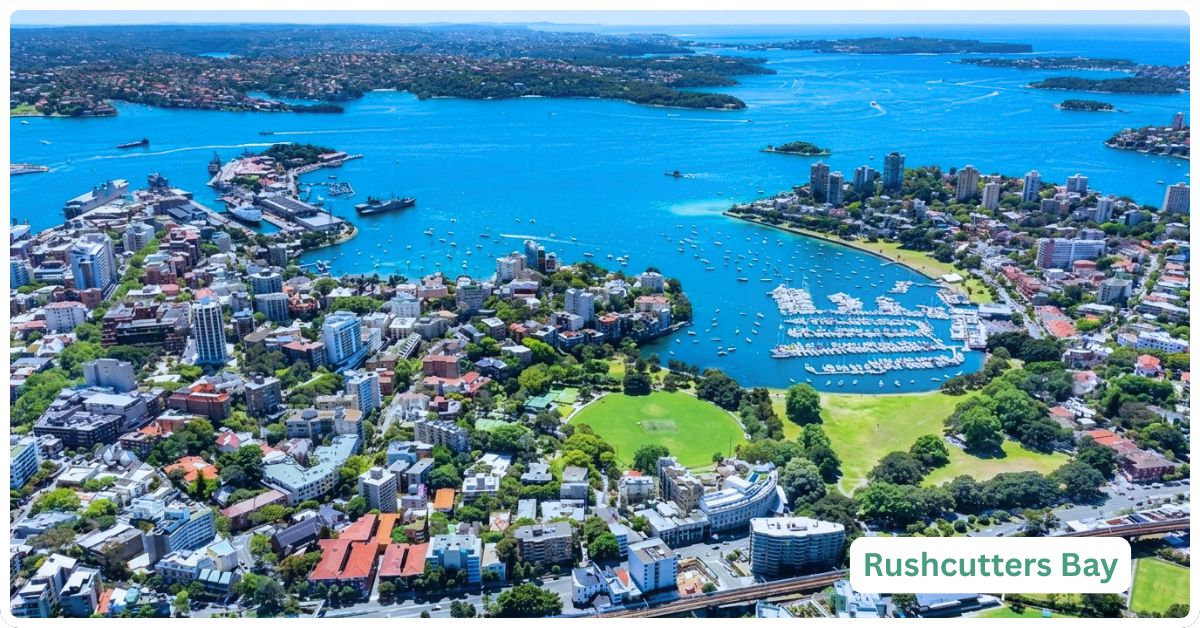
Rushcutters Bay is what happens when a harbour suburb runs out of land to build houses on and just keeps building apartments instead. There are almost no houses left here, the local shops fit on one short strip, and the suburb’s most famous asset, the park and marina fringing the bay, is jointly run by two different councils that split it down a stormwater channel. It suits someone who wants water, a boat, and a two-minute stroll to the harbour more than someone who wants a front garden or a supermarket at the end of the street. That is the real trade-off, and it has been the trade-off since the suburb was still swampland cut for thatching rushes.
Rushcutters Bay Boundary and Location Map
Rushcutters Bay sits about 3 kilometres east of the Sydney CBD, wrapped around the small harbour inlet of the same name. Elizabeth Bay and Potts Point sit to the west and southwest, Darlinghurst is just inland to the west, and Darling Point and Edgecliff border it to the east. Kings Cross, despite being the name everyone reaches for, is not a separately gazetted suburb today; it is the commercial strip that sits inside the Potts Point and Darlinghurst boundary immediately northwest of Rushcutters Bay. NSW Spatial Services’ own boundary layers show the Rushcutters Bay locality genuinely crossing into both the City of Sydney and Woollahra local government areas, which is confirmed on the ground too: Rushcutters Bay Park itself is physically divided between the two councils by a heritage-listed stormwater channel.
Quick Facts
| LGA | City of Sydney Council and Woollahra Municipal Council. The suburb genuinely straddles both: NSW Spatial Services boundary data confirms the Rushcutters Bay locality polygon crosses into each LGA, and Rushcutters Bay Park itself is split by a heritage stormwater channel, with City of Sydney managing the western half and Woollahra Council the eastern half. The great majority of the suburb’s housing stock sits within the City of Sydney LGA. |
| Postcode | 2011 |
| Population | 2,335 at the 2021 Census, down from 2,547 in 2016 (ABS QuickStats, 2021 and 2016). No newer official ABS estimate has been released for this locality as of August 2026. |
| Growth Rate | Population has actually fallen, not grown, over the most recent census period (-8.3% between 2016 and 2021), consistent with a suburb that has almost no vacant land left and where growth depends entirely on individual redevelopment sites rather than broad-acre supply. |
| Distance from CBD | Approximately 3 km east of the Sydney CBD |
| Character | Dense, near-total apartment suburb wrapped around a harbourside park and marina precinct, with almost no detached housing stock |
| Median House Price | Not reliably available. PropertyValue.com.au recorded only 1 house sale in the 12 months to its July 2026 data build, at $3 million, which is not a statistically meaningful median. Houses in Rushcutters Bay are effectively a rounding error in the market. |
| Median Unit Price | $1,104,000, as of November 2025 (AU Guide, citing Domain-sourced sales data), above the Sydney-wide unit median of roughly $840,000 at the same date |
| Transport | Buses along New South Head Road and Bayswater Road (routes including 311, 324, 325, 326, 327 and 328) run to Edgecliff Interchange and the CBD; Edgecliff and Kings Cross stations on the T4 Eastern Suburbs and Illawarra Line are both within realistic walking distance of most of the suburb |
| Crime Rate (LGA) | Split picture by council. City of Sydney LGA recorded roughly 19,852 incidents per 100,000 people in the year to March 2026, above the NSW average, driven heavily by the CBD and Kings Cross entertainment precinct. Woollahra LGA recorded roughly 4,062 per 100,000 in the same period, well below the NSW average (BOCSAR data via AU Crime Tracker). Neither figure is specific to Rushcutters Bay itself. |
| Childcare Availability | Tight. A small handful of long day care centres and preschools sit within the suburb itself; most families lean on Potts Point, Elizabeth Bay, Edgecliff and Paddington to fill the gap |
| School Zone Quality | Zoned to Darlinghurst Public School for government primary schooling, with a strong run of independent and selective options nearby rather than in-suburb |
| Parks & Recreation | Rushcutters Bay Park, White City (now Hakoah White City), the Cruising Yacht Club of Australia and Rushcutters Bay Marina |
| Shopping | Minimal. A short strip on New South Head Road and Bayswater Road covers cafes and convenience needs; anything beyond that means Kings Cross, Potts Point, Edgecliff or Double Bay |
| Health | GPs are limited within the suburb itself; St Vincent’s Hospital in Darlinghurst is the nearest major public and private hospital campus |
| Best For | Established professionals, couples and downsizers who want harbourside living and marina access and are comfortable with apartment-only stock and a short drive or walk for groceries |
What Makes Rushcutters Bay Special
Rush Cutting Bay: From Thatching Rushes to Prime Harbourside Living
Rushcutters Bay takes its name literally. English settlers first called it Rush Cutting Bay because the swampy foreshore between Macleay Point and Darling Point was thick with tall, strong rushes, useful for thatching hut roofs and for bedding down in horse stables (Francis Pollon, “The Book of Sydney Suburbs,” 1988). A freshwater stream once ran down from a nearby valley, crossing what is now New South Head Road on its way into the bay, and locals could cross it on stepping stones at low tide to reach a path towards Darling Point. None of that survives visibly today. The land was later worked as market gardens, and in 1878 an Act of Parliament reserved six acres of it for public recreation and reclamation, the direct ancestor of today’s Rushcutters Bay Park.
The suburb’s public infrastructure grew up around the same stretch of foreshore. A powerhouse with tram sheds was built in 1894 to run the cable trams out to Edgecliff, and later served as a garage for trolley buses; it has long since been demolished and redeveloped, and nothing of it is visible in the suburb today. A short distance away, the old Stadium on New South Head Road opened in 1908 and became one of Sydney’s great entertainment venues, hosting boxing bouts that drew crowds for heavyweights Jack Johnson and Tommy Burns, bantamweight Jimmy Carruthers and flyweight Joe Symons, before it was demolished to make way for the Eastern Suburbs Railway. It, too, is gone: there is no trace of the Stadium left in modern Rushcutters Bay, and the site now sits under rail infrastructure and later development rather than any surviving building.
The tennis story is the one most locals still half-know, and it is worth getting right, because the popular version of it is out of date. Land was resumed from Chinese market gardeners just before the First World War to create White City, which began life not as a tennis venue but as an open-air amusement park, complete with lakes, canals, fountains and pleasure palaces. The NSW Lawn Tennis Association bought the eleven acres in 1921 and converted it into what became, for most of the twentieth century, one of the best tennis grounds in the world, hosting Davis Cup ties, the Australian Open and generations of players making their competitive debut on its courts. That venue closed in 2011 and sat derelict for over a decade. It is now being rebuilt by the Hakoah Club as a mixed community and sports precinct, Hakoah White City, with nine tennis courts operated by Sydney Maccabi Tennis, expected to open through 2026: a genuine sporting facility again, but a fraction of the 28-court, world-class complex it once was, and formally addressed in neighbouring Paddington rather than Rushcutters Bay itself. Next door, Sydney Grammar School’s Weigall Sports Ground, named for former master A. B. Weigall, is still exactly where it always was. In the 1920s, day-trippers could hire a pulling boat from the bay at two shillings an hour to row out to Clark Island or Shark Island for a picnic, while steamers ran the same route on Saturdays and holidays under the marketing line “every convenience for visitors” (Pollon, 1988). That casual hire-boat culture is long gone, replaced by the private marinas and the Cruising Yacht Club that anchor the bay today.
A Harbour, Not a High Street
What actually sets Rushcutters Bay apart from its more famous neighbours is that its centre of gravity is the water, not a shopping strip. Rushcutters Bay Park runs the length of the foreshore with a sporting oval, tennis courts, open parkland and marina berths, and it is genuinely one of the better-used inner-city parks in Sydney rather than a token green patch between apartment blocks. The Cruising Yacht Club of Australia sits on the bay’s foreshore and remains the organising club and traditional start line for the Rolex Sydney to Hobart Yacht Race each Boxing Day, one of the very few Sydney suburbs that can claim to be the literal starting point of a globally watched sporting event. That combination, harbour frontage plus a working marina plus a national sailing institution, is a genuine point of difference over Elizabeth Bay or Potts Point next door, which get the views without the working waterfront culture.
What Is It Like Living Here?
Ask anyone who actually lives in Rushcutters Bay and the same three themes come up: the park is the reason they moved there, the parking is a genuine headache, and they do almost none of their actual shopping in the suburb itself. It reads on paper as an inner-eastern lifestyle suburb, and it delivers on that, but day to day it behaves more like a satellite of Potts Point, Edgecliff and Double Bay than a self-contained neighbourhood.
Transport
Rushcutters Bay has no train station of its own, but it does not really need one: both Edgecliff and Kings Cross stations on the T4 Eastern Suburbs and Illawarra Line sit within a realistic walk of most of the suburb, putting the CBD within about 10 to 15 minutes by rail.
On the surface, bus routes including 311, 324, 325, 326, 327 and 328 run along New South Head Road and Bayswater Road to Edgecliff Interchange and into the city, giving a genuinely useful frequency for a suburb this size.
New South Head Road itself is the main arterial in and out, and it is also one of the more congested stretches of eastern Sydney at peak times, so the train or bus is a faster bet into the CBD than driving for most of the working week. Off-street parking is scarce and street parking is heavily permitted, which matters more here than in most suburbs given how few dwellings come with a garage.
Healthcare
GP options within Rushcutters Bay itself are limited, a handful of small practices rather than a medical centre of any real scale. St Vincent’s Hospital in Darlinghurst, one of Sydney’s major public and private hospital campuses, is the nearest hospital and only a short drive or bus ride away, which covers the gap for anything beyond routine GP care. Anyone with a young family or an ongoing condition should factor in that day-to-day healthcare here means relying on neighbouring suburbs rather than anything walkable within Rushcutters Bay’s own boundary.
Schools and Childcare
The government primary catchment for the postcode is Darlinghurst Public School, with Sydney’s cluster of well-regarded selective and independent schools (Sydney Grammar School among them, with its Weigall playing fields right on the doorstep) accessible nearby rather than inside the suburb itself.
Childcare is tight: only a small number of long day care centres and preschools operate within Rushcutters Bay, and most families end up on waitlists spanning Potts Point, Elizabeth Bay, Edgecliff and Paddington as well. This is not a suburb where a family can assume everything they need is a pram-push away; it takes active planning, particularly for infant places.
Industry & Work Life
Rushcutters Bay is overwhelmingly a residential and lifestyle suburb rather than an employment hub in its own right. Most working residents commute into the Sydney CBD, a short train or bus trip away, with white-collar professional, finance and legal work the dominant pattern given the price point and renter profile of the housing stock. The marina and yacht club precinct supports a small amount of local marine services and hospitality employment, but it is not large enough to change the overall picture: this is a suburb people live in and commute out of, not one they work in.
Shopping & Eating Out
There is no shopping centre in Rushcutters Bay, and there is not much of a high street either. What exists sits on New South Head Road and Bayswater Road: a scattering of cafes, a handful of restaurants and the everyday convenience retail that a small apartment population supports. For anything more, residents head to Kings Cross and Potts Point for late-night dining and bars, Edgecliff’s small retail cluster for groceries and pharmacy needs, or Double Bay for the boutique end of shopping and a bigger restaurant strip. It is a suburb that borrows its retail life from its neighbours rather than generating its own, which is worth knowing before assuming a “five-minute walk to everything” lifestyle.
Attractions, Parks and Natural Spaces
Rushcutters Bay Park is the suburb in miniature: a sporting oval, tennis courts, open lawns, playgrounds and a foreshore promenade that locals actually use rather than just photograph. The Cruising Yacht Club of Australia anchors the bay’s marina precinct and remains the organising club for the Rolex Sydney to Hobart Yacht Race, giving the suburb a genuine annual moment on the national sporting calendar every Boxing Day.
Rushcutters Bay Marina adds hundreds of private berths to the working waterfront feel. Next to the park, the former White City tennis complex is being rebuilt as Hakoah White City, a mixed community and sports facility with nine tennis courts expected to open through 2026, a smaller and different proposition to the 28-court venue that once hosted the Australian Open, but a real sporting facility returning to the precinct rather than the derelict site it had been since 2011. Sydney Grammar School’s Weigall Sports Ground sits immediately alongside.
Crime and Safety
There is no suburb-specific crime figure for Rushcutters Bay; BOCSAR reports at the local government area level, and this suburb’s split status matters here too. In the year to March 2026, City of Sydney LGA recorded roughly 19,852 incidents per 100,000 people, above the NSW average, a figure heavily skewed by the CBD and the Kings Cross entertainment precinct rather than by residential streets around the bay. Woollahra LGA, which covers the eastern edge of the suburb including part of the park, recorded roughly 4,062 per 100,000 in the same period, well below the NSW average (BOCSAR data via AU Crime Tracker). Theft is the leading offence category in both LGAs. Anecdotally, residents and local agents describe Rushcutters Bay itself as feeling considerably calmer than the Kings Cross LGA-wide figure suggests, which lines up with it being an established residential and marina precinct rather than a late-night strip, but that is a read on lived experience, not a suburb-level statistic, and should be treated as such.
Realty Market
Rushcutters Bay’s sales market is, in practical terms, a unit market. The median unit price stood at $1,104,000 as of November 2025 (AU Guide, citing Domain-sourced sales data), comfortably above the broader Sydney unit median of around $840,000 at the same date. House sales are so rare that a reliable median cannot honestly be quoted: one recent data build recorded a single house sale at $3 million in the prior twelve months, which is not a statistically meaningful figure for a suburb-wide median, just a data point from one transaction. New supply is limited but not zero. A 13-residence boutique development at 55 Bayswater Road, by Third.i Group with NPACT and Woods Bagot, is under construction and scheduled for completion in late 2027, aimed squarely at established buyers and downsizers rather than first-home buyers.
Rushcutters Bay is also, decisively, a renter’s suburb: at the 2021 Census, 63.4% of occupied dwellings were rented, against 34.5% owned outright or with a mortgage, and 98.7% of dwellings were flats or apartments. Rental figures reported by AU Guide for late 2025 put a two-bedroom unit at around $1,100 a week and a three-bedroom unit at around $1,475 a week, well above the Sydney median, reflecting both the harbour position and the small stock of larger apartments. That combination, high rental share, thin owner-occupier turnover, and almost no detached housing, means this market moves on unit demand and marina lifestyle appeal far more than on the broader Sydney house cycle.
Our Honest Verdict
Rushcutters Bay is likely to appeal most to established professionals, couples and downsizers who want genuine harbour frontage and marina access, don’t need a house or a garden, and are comfortable outsourcing groceries, GP visits and most dining to neighbouring suburbs. The park and the Cruising Yacht Club give it a working waterfront identity that Elizabeth Bay and Potts Point next door simply don’t have, and that is a real point of difference for anyone who actually wants to use the harbour rather than just look at it. It is less compelling for families chasing walkable schools and childcare in the one suburb, given the reliance on Darlinghurst Public School and neighbouring childcare capacity, and it is not the pick for anyone who wants a detached house, since houses here are effectively unavailable rather than merely expensive.
The natural cross-shop is Double Bay: both are inner-eastern, harbour-adjacent, apartment-heavy suburbs that draw a similar established buyer, but Double Bay carries a bigger retail and dining strip of its own and a considerably higher price point, while Rushcutters Bay trades some polish and price for a more genuine, working-marina character and a real annual sporting moment in the Sydney to Hobart start. A buyer choosing between the two is really choosing between paying up for a self-contained village (Double Bay) or paying slightly less for water access with a borrowed high street (Rushcutters Bay).
Frequently Asked Questions
Is Rushcutters Bay in the City of Sydney or Woollahra council area?
Both, genuinely. NSW Spatial Services boundary data confirms the suburb crosses into both local government areas, and Rushcutters Bay Park itself is split down a heritage stormwater channel, with the City of Sydney managing the western half and Woollahra Council the eastern half. Most residential streets and dwellings sit within the City of Sydney LGA.
Can I buy a house in Rushcutters Bay?
Technically yes, but only just. Houses make up under 1% of dwellings, and sales are so rare that a reliable median house price cannot be quoted with any confidence. Assume you are buying an apartment here, because almost everyone else is.
Does the Sydney to Hobart Yacht Race still start from Rushcutters Bay?
The Cruising Yacht Club of Australia, on the Rushcutters Bay foreshore, remains the organising club and the traditional start line for the Rolex Sydney to Hobart Yacht Race, held every Boxing Day.
Is White City still a major tennis venue?
Not in the way it once was. The original 28-court complex, once one of the world’s best tennis grounds and a genuine Australian Open and Davis Cup venue, closed in 2011 and sat derelict for over a decade. It is being rebuilt by the Hakoah Club as Hakoah White City, a mixed community and sports precinct with nine tennis courts, expected to open through 2026, a real facility again but a smaller and different one, and formally addressed in neighbouring Paddington rather than Rushcutters Bay.
Is Rushcutters Bay walkable to Kings Cross station?
For most of the suburb, yes, and Edgecliff station is a realistic alternative walk depending on which part of Rushcutters Bay you are in. Both sit on the T4 Eastern Suburbs and Illawarra Line, putting the CBD within roughly 10 to 15 minutes by train.
References
- Francis Pollon, “The Book of Sydney Suburbs,” Angus & Robertson, 1988, entry on Rushcutters Bay
- NSW Spatial Services, NSW Administrative Boundaries Theme (suburb locality and LGA boundary layers), queried 24 August 2026
- City of Sydney Council, “Rushcutters Bay Park” and suburb listing pages, accessed August 2026
- Woollahra Municipal Council, “Rushcutters Bay Park,” List of Parks, Reserves and Playgrounds, accessed August 2026
- Australian Bureau of Statistics, 2021 Census QuickStats, Rushcutters Bay (SAL13459)
- Australian Bureau of Statistics, 2016 Census QuickStats, Rushcutters Bay (SSC13444)
- Domain, “Rushcutters Bay NSW 2011, Suburb Profile & Property Market Trends” and School Catchment page for Darlinghurst Public School, accessed August 2026
- AU Guide, Rushcutters Bay suburb data (median unit price, rents), dated November 2025
- PropertyValue.com.au, Rushcutters Bay suburb report, July 2026 data build
- NSW Bureau of Crime Statistics and Research (BOCSAR) LGA crime data, via AU Crime Tracker, Sydney LGA and Woollahra LGA, year ending March 2026
- Cruising Yacht Club of Australia, official website (cyca.com.au), accessed August 2026
- Hakoah Club, “Hakoah White City” official website and Australian Jewish News reporting on the redevelopment, accessed 2026
- Kanebridge News, “Landmark harbourside residences unveiled in Rushcutters Bay,” 2026
- Transport for NSW, transportnsw.info, bus route and rail network information, accessed August 2026
- Dictionary of Sydney, “Rushcutters Bay” entry, accessed August 2026
For more Sydney suburb profiles like this one, browse the full Sydney suburbs directory, or explore the broader Sydney regions overview for context on how Rushcutters Bay fits into the wider eastern suburbs and inner city.