
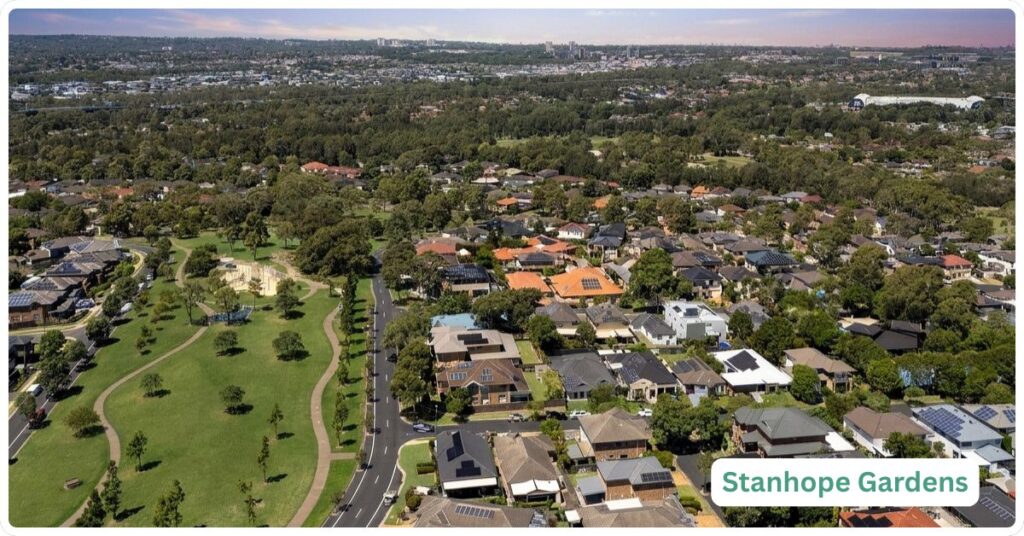
Stanhope Gardens is what a masterplanned estate looks like once the tradesmen have all gone home and the trees have had thirty years to grow. This is not a construction zone. The suburb was fully platted by Landcom and Mirvac through the 1990s, hit its population stride in the early 2000s, and by the 2021 Census had settled at 9,349 residents, a figure almost certainly a touch higher now but not one anyone is calling volatile (Australian Bureau of Statistics, 2021 Census QuickStats, SAL13664).
The name itself is a piece of actual colonial record-keeping rather than a developer’s marketing invention. John Hillas, a free settler who arrived in the colony in 1801, was granted 150 acres on Windsor Road in 1804 and named it Stanhope Farm, running an inn on the site called the Stanhope Arms. The land passed through the Pearce family and then Jack Peel’s Stanhope Park Dairy before the NSW Housing Commission compulsorily resumed it in 1973. When the estate was finally being developed in the 1990s, it was informally known as Irish Town, Kellyville and Parklea; a resident petition pushed to keep Stanhope in the name, and Stanhope Gardens was formally recognised as a suburb in 1996 (Wikipedia, Stanhope Gardens, New South Wales, citing Blacktown City Council history records).
What you get today is a suburb built almost entirely around family living: 65.5 per cent of local families are couples with children, median age sits at 37, and 85.6 per cent of dwellings are separate houses (ABS 2021 Census). It is not chasing a train line or a rezoning like its newer neighbours further north. It already has its shopping centre, its schools, its leisure centre and its street trees. The trade-off is that Stanhope Gardens will never again be the cheapest suburb in the corridor, and it was never going to get its own rail station either.
Stanhope Gardens Suburb Map
Stanhope Gardens sits in Sydney’s North West, wedged between Kellyville to the east, Glenwood and Parklea to the south, Acacia Gardens to the south-west and Kellyville Ridge and The Ponds to the north. It is bounded roughly by Sunnyholt Road and Windsor Road, two of the busiest arterial corridors in the district. Blacktown, the LGA’s commercial and rail hub, sits a short drive south-west via Sunnyholt Road.
Quick Facts
| LGA | Blacktown City Council |
| Postcode | 2768 |
| Population | 9,349 (2021 Census, ABS SAL13664) |
| Distance from CBD | approx. 42km north-west |
| Named After | Stanhope Farm, an 1804 land grant to settler John Hillas |
| Retail | Stanhope Village Shopping Centre, 76 stores |
| Recreation | Blacktown Leisure Centre Stanhope (wave pool, library) |
| Green space | Stanhope Gardens Reserve and five other local parks |
| Median house | approx. $1.53M-$1.59M, 2025 (sources vary) |
| Median unit | approx. $950,000, 2025 |
| No local station | nearest Metro is Kellyville, roughly 3.5-4km away |
| T-way | Stanhope T-way station on the North-West T-way busway |
What Makes Stanhope Gardens Special
A finished estate, not a growth front
Most of the suburb dates from the mid-to-late 1990s and 2000s, with a large chunk built out through the Newbury Estate, a masterplanned Landcom and Mirvac project from 1999 comprising 1,761 properties across seven community title subdivisions, each with its own clubhouse, tennis court, pool, spa and barbecue area (Wikipedia, citing Mirvac Group property compendium). This matters practically: unlike the still-forming suburbs further north (Marsden Park, Box Hill, Melonba), Stanhope Gardens already has mature street trees, a settled retail centre and none of the ongoing construction dust.
A genuinely mixed, high-income community
Stanhope Gardens has a strong Indian community (12.6 per cent of residents born in India, the largest overseas-born group), alongside residents from the Philippines, China, England and New Zealand. Hindi, Mandarin, Punjabi, Tagalog and Gujarati are all commonly spoken at home. Median household income sits around $149,000 a year, well above the Sydney average, which shows up in the presence of higher-spec retail and a well-resourced local leisure centre (ABS 2021 Census; localstats.com.au demographic summary).
What Is It Like Living Here?
Stanhope Gardens is a settled, house-and-garden suburb built for families who wanted space and a finished community rather than a fixer-upper closer to the city. Local resident commentary note a genuine appreciation for the parks, schools and shopping centre, and consistent grumbling about Sunnyholt Road and Windsor Road traffic at peak hour, plus the lack of a local train station. Both are fair. The suburb does the fundamentals well; it just asks you to drive or take the bus to get almost anywhere.
The local shopping centre, Stanhope Village, is well-loved and offers the convenience of easy access with a large enough array of stores to be interesting. It’s anchored by Coles and also features many eateries, cafes, and a gym, making it a bit of a hangout spot too.
Hospitals & Healthcare
The Stanhope Medical & Dental Centre and the Stanhope Park Medical Centre handle daily medical concerns in the local area. Blacktown Hospital, a major public hospital, is the primary tertiary facility for residents, a short drive south-west. Norwest Private Hospital, in the Bella Vista/Norwest precinct, is also within reasonable reach for residents with private cover wanting specialist or day-surgery care.
Education
Government schooling is split across catchments: John Palmer Public School (The Ponds), Kellyville Ridge Public School and Parklea Public School all draw from parts of Stanhope Gardens depending on street address, feeding into Glenwood High School, The Ponds High School or Rouse Hill High School. For Catholic schooling, John XXIII Catholic Primary School and St Mark’s Catholic College both sit inside the suburb itself on Perfection Avenue, giving local Catholic families a genuinely local option most nearby growth suburbs still lack.
Childcare supply is decent for an established suburb: roughly 22 centres serve the postcode, with the majority reporting vacancies, and average long day care costs sit around $169 a day, a marked contrast to newer growth fronts further north where childcare has visibly lagged rooftop delivery.
Industry & Work Life
Stanhope Gardens is a commuter suburb rather than an employment hub. Most residents work outside the suburb, commuting via the bus network to Norwest Business Park, Blacktown, Parramatta or the CBD, or driving via the M7. Local employment is largely retail and services tied to Stanhope Village and the leisure centre.
Parks and Natural Spaces
Stanhope Gardens Reserve on Stanhope Parkway is the suburb’s main public sporting ground, with four tennis courts, two netball courts and two separate playgrounds, one geared to younger children near the netball courts and another between the courts for older kids (Blacktown City Council, Stanhope Gardens Reserve listing). Parks make up roughly 13.1 per cent of the suburb’s total land area across six separate reserves, a genuinely high ratio for a suburb this built-out.
Beyond the public reserves, the Newbury Estate’s community title subdivisions add private pools, tennis courts and clubhouses that residents in those pockets can use, though these are not open to the general public. For council-run recreation, Blacktown Leisure Centre Stanhope, opposite the shopping centre, has an aquatic hall with a wave pool, a lap pool, spa, sauna and an attached library; it hosted the 2016 Women’s Oceania Handball Championship, one of the few pieces of minor sporting history the suburb can claim.
Transport
Stanhope Gardens does not have its own railway or Metro station and never has. The nearest Sydney Metro Northwest station is Kellyville, roughly 3.5km by road from the shopping centre precinct (about a 4-minute bus trip on route 632, or a 45-minute walk). Kellyville station opened in May 2019 as part of the Sydney Metro Northwest project and runs services toward Tallawong and Chatswood, with onward connections through the city via the Metro network.
Public transport within the suburb runs on private operator contracts to Transport for NSW: CDC NSW (6xx routes) and Busways (7xx routes). The suburb is served directly by Stanhope T-way station on the Blacktown-Parklea branch of the North-West T-way busway. Local routes connect to Kellyville station (603, 632), Blacktown (734, 735, 731), Parramatta (603, 663), Rouse Hill (616X, 663, 731, 735), Castle Hill and Pennant Hills (603), and St Marys via Quakers Hill and Plumpton (745). It is a genuinely well-served bus network for a suburb without rail, but it is still a bus network: no direct express service replaces the missing station.
Sunnyholt Road and Windsor Road are the two main arterials framing the suburb, both of which are consistently congested at peak hour, a common complaint in local Homely and Whirlpool threads about this pocket of the North West. Sunnyholt Road provides the most direct link south to the Westlink M7, giving residents motorway access toward Parramatta, the M4 and south-west Sydney without needing to fight through Blacktown town centre first.
Stanhope Gardens sits approximately 42 kilometres north-west of the Sydney CBD and around 19-20 kilometres from Parramatta. Driving to the CBD without tolls typically runs close to an hour; with the M7 and toll roads factored in, closer to 38-40 minutes outside peak.
Realty Market
Median house price estimates for 2025 vary by source and methodology: NSW Valuer General sales data puts it at $1,525,000, down 2.9 per cent on the previous year, while CoreLogic-based estimates put it closer to $1,590,000, with modest annual growth around 0.55 per cent. Either way, this is a suburb where prices have essentially plateaued after years of growth, not one still climbing. Median unit price sits around $950,000 (NSW Valuer General, 2025), though unit sales volume is low, with only a handful of apartment transactions in the past year against roughly 95 house sales, reflecting how overwhelmingly house-dominated this suburb is (85.6 per cent separate houses, ABS 2021 Census).
Median weekly rent recorded at the 2021 Census was $580, though current asking rents will sit higher given broader Sydney rental growth since then. Renters here are typically families wanting house-and-yard living without inner-Sydney prices, trading a longer commute and no train station for space and a finished neighbourhood.
The Honest Verdict
Stanhope Gardens suits a specific buyer: a family who wants a finished suburb with real trees, a proper shopping centre and a council leisure centre, and who is willing to drive or bus everywhere because there is no train station and never will be one. It does not suit anyone chasing capital growth momentum; prices here have flattened, not climbed, through 2025, and if train access is non-negotiable, Kellyville is the better buy despite the premium. Weighed against Glenwood, the two are close enough in price and character that the decision comes down to which street layout and school catchment you prefer. Weighed against Quakers Hill, Stanhope Gardens costs more but delivers a stronger local centre and a public swimming complex most cheaper suburbs in the corridor don’t have. The trade-off is honest and consistent: pay for amenity and maturity, not for a commute you don’t have to think about.
Frequently Asked Questions
Does Stanhope Gardens have a train station?
No. Stanhope Gardens has never had its own railway or Metro station. Residents rely on the Stanhope T-way busway station and bus connections to Kellyville Metro station, roughly 3.5km away.
What is Stanhope Gardens named after?
Stanhope Farm, a 150-acre land grant given to free settler John Hillas in 1804 on Windsor Road. The name survived a public petition process in the mid-1990s when locals voted to keep “Stanhope” over alternative names during development.
Is Stanhope Gardens safe?
Crime statistics in NSW are recorded at local government area level, not suburb level, so there is no Stanhope Gardens-specific figure. Blacktown LGA recorded an overall crime rate of approximately 10,176 offences per 100,000 people, above the NSW average, though the LGA’s rate has fallen roughly 15 per cent over the past five years (NSW Bureau of Crime Statistics and Research, Recorded Crime Report, 2025 data). Treat this as an LGA-wide figure, not a Stanhope Gardens-specific one.
What schools are zoned for Stanhope Gardens?
Government primary options include John Palmer Public School, Kellyville Ridge Public School and Parklea Public School depending on address, feeding into Glenwood High School, The Ponds High School or Rouse Hill High School. Catholic schooling is available locally at John XXIII Catholic Primary School and St Mark’s Catholic College on Perfection Avenue.
How does Stanhope Gardens compare to Kellyville or Glenwood?
Kellyville, immediately east, has direct Metro access and commands a premium for it, with median house prices around $1.9M-$2.05M in 2025, well above Stanhope Gardens. Glenwood, to the south, is closer in price (typical house price around $1.76M) and shares a similar built-out, family-suburb character. Quakers Hill, further south-west, is the value option of the group, with a median house price closer to $1.4M, but without Stanhope Gardens’ retail centre or leisure facility on the doorstep.
References
Australian Bureau of Statistics, 2021 Census QuickStats, Stanhope Gardens (SAL13664)
Blacktown City Council, Stanhope Gardens Reserve
Blacktown City Council, Stanhope Village
NSW Bureau of Crime Statistics and Research, Recorded Crime Report 2025
Your Investment Property Magazine, Stanhope Gardens Suburb Profile (NSW Valuer General data, 2025)
HTAG, Stanhope Gardens Property Market 2025-26 (CoreLogic-based data)
Toddle, Compare Child Care in Stanhope Gardens
LocalStats, Stanhope Gardens Demographics
See all suburbs in the Blacktown City Council. See the full Sydney Regions overview to explore more of greater Sydney.