
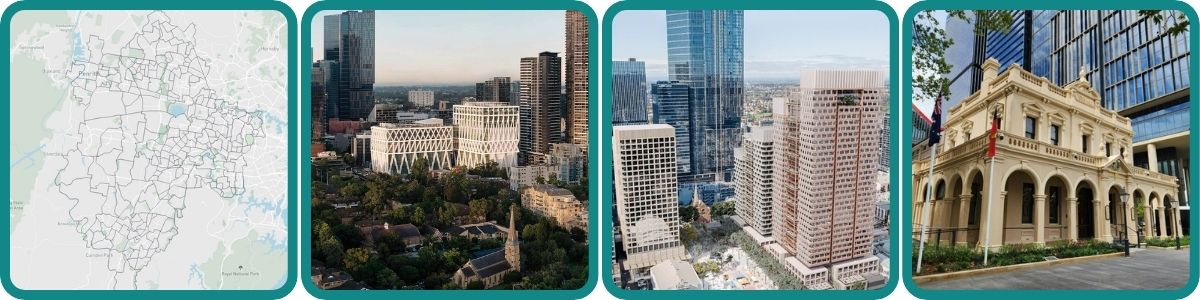
Western Sydney is not one place, rather, a collection of cities, communities and corridors that together make up the most diverse, fastest-growing and most misunderstood part of Sydney. More than 2.5 million people live here, making the region larger in population than most Australian cities.
From Parramatta’s corporate towers and the food precincts of Cabramatta and Auburn, to the greenfield communities of Box Hill and the airport rising at Badgerys Creek, this is where Sydney’s next chapter is being written. The region spans roughly 60 kilometres east to west and covers approximately 5,800 square kilometres.
Over 100 languages are spoken across the region. The food culture in Cabramatta, Auburn and Harris Park is genuinely exceptional. Parramatta functions as a real second CBD, not a satellite suburb. And the October 2026 opening of Western Sydney International Airport will transform the region’s relationship with the rest of the world.
If you have not paid attention to Western Sydney recently, now is the time to start.
Cultural diversity, affordability, Parramatta CBD, Western Sydney Airport, food precincts
2.5 million+ across 10-12 LGAs; Blacktown LGA alone has 410,000 residents
First-home buyers, families, multicultural food, authentic cultural neighbourhoods, commuters
Suburban space with genuine urban cores; strong community identity; fast growth
T1, T2, T3, T5 train lines; Sydney Metro Northwest; Parramatta Light Rail (opened Dec 2024)
Significantly below Sydney median; Penrith ~$880k median, roughly 45% below the city average
Multicultural, community-focused, entrepreneurial, rapidly evolving
Western Sydney is not one local government area. It spans roughly 10 to 12 LGAs from where the Inner West ends at Lidcombe and Auburn, to the Blue Mountains foothills in the west, a distance of around 60 kilometres. North to south it runs from the Hawkesbury River and Windsor down to Campbelltown and the Macarthur region.
There is no single agreed boundary. NSW Health, Transport for NSW, and planning agencies each use slightly different definitions. For most practical purposes, Western Sydney is everything west of Strathfield, Ashfield and Marrickville that isn’t the Inner West or the Hills District.
Key LGAs in the region include: Parramatta, Blacktown, Cumberland, Fairfield, Liverpool, Penrith, Canterbury-Bankstown, Hawkesbury, Camden and Campbelltown. Wollondilly and the Blue Mountains are sometimes included depending on the context.
Western Sydney speaks more than 100 languages. Blacktown LGA alone has around 410,000 residents, projected to add a further 154,700 by 2040. This is one of Australia’s most culturally diverse urban regions on earth, with major communities from Vietnam, Lebanon, China, the Philippines, India, Iraq, Korea, Samoa, and dozens of other nations. That diversity shows up in the food, in the street life, in the community organisations, and in the character of individual suburbs.
The NSW Government’s Decade of Decentralisation has moved major government departments including Education, Planning and Transport to Parramatta. NAB, Westpac, Deloitte and KPMG are all headquartered at Parramatta Square. The Westmead Health Precinct is one of Australia’s largest health and research hubs. The Parramatta Light Rail (L4) opened in December 2024 with 16 stops. Parramatta’s median house price reached $1,317,900 in March 2026, the strongest annual growth in Western Sydney at +14.4%.
Nancy-Bird Walton Airport opens 26 October 2026. Singapore Airlines is confirmed from 23 November 2026. Stage 1 capacity is 10 million passengers per year, with demand expected to reach 37 million by 2050. The surrounding Aerotropolis has attracted $21.6 billion in committed private investment. The M12 Motorway, already open and toll-free, provides direct road access. Between 120,000 and 200,000 jobs are projected for the precinct over coming decades.
Cabramatta is Australia’s Vietnamese food capital. The Moon Festival draws 90,000 or more visitors each year. Auburn is the centre of Turkish, Uyghur and Ethiopian food in Sydney. Merrylands has Lebanese and Afghan restaurants across its main streets. Harris Park, known as Little India, runs along Wigram Street in Parramatta. Fairfield’s Khmer and Pacific Islander communities add further layers. You’ll find genuinely exceptional food here, not a curated version of it.
Penrith’s median house price sits at around $880,000, roughly 45% below the Sydney-wide median. Two-bedroom rentals in outer Western Sydney run from $380 to $420 per week, compared to $850 to $1,500 per week in the eastern suburbs. Camden LGA is growing at 3.7% annually. Marsden Park-Shanes Park grew 101.6% since the 2021 Census. The affordability gap between Western Sydney and the rest of the city is driving the largest internal migration in Sydney’s history.
Parramatta is not a Western Sydney suburb in the traditional sense. It is a genuine city, formally recognised by the NSW Government as Sydney’s second CBD and the centrepiece of the Decade of Decentralisation policy.
Parramatta Square is one of Australia’s largest urban renewal projects. The mixed-use corporate precinct houses NAB, Westpac, Deloitte and KPMG alongside NSW Government offices that handle Education, Planning and Transport. Major legal, finance and consulting firms followed the government agencies west. The result is a working city, not a planned retail hub.
Westmead, immediately adjacent to the CBD, is one of Australia’s largest health and biomedical research precincts. Westmead Hospital, The Children’s Hospital at Westmead, and the Westmead Institute for Medical Research sit here. Locals and workers from across the region use Westmead as a destination in its own right.
Old Government House in Parramatta Park is UNESCO World Heritage listed as part of the Australian Convict Sites. It is the oldest surviving public building in Australia in its original form, set within 200 acres of riverside parkland with more than 100 Aboriginal archaeological sites. Entry to the park is free; the house requires a booking.
The Parramatta Light Rail (L4) opened in December 2024, connecting Westmead through the CBD to Carlingford across 16 stops, with around 130,000 people living within walking distance of the network. Stage 2 to Wentworth Point and eventually Sydney Olympic Park was announced in January 2026. Sydney Metro West, currently under construction, will cut travel time between Parramatta and the Sydney CBD significantly. You can already reach Parramatta from Central Station in around 25 minutes on the T1 Western Line.
Parramatta’s median house price reached $1,317,900 in March 2026, with 14.4% annual growth, the strongest figure in Western Sydney. That growth reflects genuine demand from workers, investors, and families who recognise what Parramatta has become.
Western Sydney International (Nancy-Bird Walton) Airport opens for passenger flights on 26 October 2026. Cargo operations begin from July 2026. This is the biggest infrastructure event in Western Sydney’s history.
The terminal was completed in June 2025, seven months ahead of schedule and within the $5.3 billion budget. Singapore Airlines is the first confirmed international carrier, with inaugural flights scheduled from 23 November 2026. Stage 1 capacity is 10 million passengers per year, with demand projected to reach 37 million by 2050. The airport will operate 24 hours a day, with no curfew, handling international, domestic and freight services.
The M12 Motorway, already open and toll-free, provides direct road access between the airport and the broader Sydney motorway network. Western Sydney residents will no longer need to drive across the city to reach Kingsford Smith Airport.
The surrounding Western Sydney Aerotropolis at Badgerys Creek has attracted $21.6 billion in committed private sector investment, up from $9.8 billion just 14 months earlier. The NSW and Commonwealth Governments have committed more than $28 billion in total infrastructure. Between 120,000 and 200,000 jobs are projected for the Aerotropolis precinct over coming decades. Bradfield City, the planned urban centre at the heart of the development, has one third of its area now development-ready.
For Liverpool, Campbelltown and the south-west corridor, the airport effect is already being felt in property demand and commercial investment. The Aerotropolis is not a distant promise: it is under active construction, with committed tenants and a confirmed opening date.
Parramatta is around 25 minutes from the Sydney CBD by train on the T1 Western Line or via the T5 Cumberland Line. Cabramatta is roughly 40 minutes from Central Station. The food precincts at Auburn, Cabramatta and Harris Park are best visited on weekends when they are at their busiest and most atmosphere-rich.
Old Government House in Parramatta Park requires advance booking for entry. Western Sydney Parklands, at 5,280 hectares, is Australia’s largest urban parkland and worth a separate visit if you are interested in cycling, walking or picnicking.
Western Sydney is large. Parramatta to Penrith is roughly 30 kilometres. Allow time between destinations and do not assume you can cover Cabramatta, Auburn and Parramatta in a single efficient trip without planning. A day focused on one area will always deliver more than a rushed tour of three.
Cross-suburban public transport within Western Sydney can require going via Parramatta or the CBD to transfer between lines. Check your journey on the Transport for NSW trip planner before you go.
Western Sydney draws different people for different reasons, but a few patterns are consistent.
Young families seeking space and a new home tend to gravitate toward Camden, Box Hill, Kellyville and Marsden Park, where master-planned estates offer house-and-land packages at prices that remain accessible by Sydney standards. These are communities being built from scratch, with schools, parks and retail infrastructure following the rooftops.
Established multicultural communities are the backbone of Auburn, Merrylands, Fairfield and Cabramatta. These are places where cultural life is not a feature of the suburb, it is the suburb: the food, the festivals, the community organisations, the languages on the shopfronts.
First-home buyers often look at Penrith, Campbelltown and Liverpool, where median prices are among the most accessible in Greater Sydney. Two-bedroom rentals in outer Western Sydney range from around $380 to $420 per week, a significant difference from the $850 to $1,500 per week typical of the eastern suburbs.
Professionals working in Parramatta or commuting to the Sydney CBD often choose suburbs along the T1 Western Line or near the Parramatta Light Rail, where they can access both city centres without a long commute. The region also receives a significant share of Sydney’s new arrivals: new migrants often settle first in Western Sydney, where community networks and affordable housing align.
The genuine urban quality of Parramatta catches most people off-guard. Glass towers, waterfront dining, a new light rail, and major arts and sports venues are not what visitors expect from “Western Sydney.” The food in Cabramatta, Auburn and Harris Park is not tokenistic multicultural dining: it is some of the most authentic cooking in Australia. And the difference between Parramatta and Penrith is as significant as the difference between the CBD and Manly. Western Sydney is not a place; it is a region.
Parramatta property is hitting record prices, up 14.4% in the 12 months to March 2026. The Aerotropolis effect is being felt in Liverpool and Campbelltown property markets, as buyers position ahead of the airport opening. Box Hill and Marsden Park continue to absorb thousands of new residents annually: Marsden Park grew 101.6% since the 2021 Census. These are the growth edges worth watching.
Affordability comes with commute. Getting from Penrith or Campbelltown to the eastern CBD can take 60 to 80 minutes each way on public transport. Space and a house come at the cost of urban walkability in outer areas. And Western Sydney still contends with an unfair reputation in some quarters: the perception gap between what the region actually offers and how it is sometimes portrayed in Sydney media is still significant, though it is narrowing as Parramatta’s profile rises.
Western Sydney encompasses hundreds of suburbs across LGAs including Parramatta, Blacktown, Cumberland, Fairfield, Liverpool, Penrith, Canterbury-Bankstown, Hawkesbury, Camden and Campbelltown. Key suburbs include Parramatta, Blacktown, Penrith, Liverpool, Fairfield, Cabramatta, Bankstown, Auburn, Merrylands, Campbelltown and Camden. Outer growth areas include Box Hill, Marsden Park, Oran Park and Leppington. See the full suburb directory by municipality for a complete list.
Yes. Parramatta is Western Sydney’s most prominent city, formally described as Sydney’s second CBD by the NSW Government. It sits roughly 24 kilometres west of the Sydney CBD and is the commercial and administrative heart of the region under the Decade of Decentralisation policy.
Western Sydney International (Nancy-Bird Walton) Airport opens for passenger flights on 26 October 2026. Cargo operations begin in July 2026. Singapore Airlines will operate the first confirmed international service from 23 November 2026. Stage 1 capacity is 10 million passengers per year. The airport is curfew-free and full-service.
Western Sydney is known for its cultural diversity, with more than 100 languages spoken across the region. It is recognised for its multicultural food precincts, particularly Cabramatta (Vietnamese), Auburn (Turkish and Middle Eastern), and Harris Park (Indian). Parramatta is known as Sydney’s second CBD. The region is also known for its affordability relative to the eastern suburbs, its rapid population growth, and the upcoming opening of Western Sydney International Airport in October 2026.
Relative to the rest of Sydney, yes. Penrith’s median house price sits at around $880,000, roughly 45% below the Sydney-wide median. Two-bedroom rentals in outer areas run from $380 to $420 per week. Liverpool (+6.8%), Fairfield (+7.0%) and St Marys (+7.4%) are all seeing growth, though prices remain well below the eastern suburbs. Even Parramatta, at $1,317,900 median, sits below suburbs like Mosman, Manly or Bondi.
It depends on your priorities. For affordability with good train access, you’ll find Blacktown, Penrith, and Liverpool all offer genuine value. For a CBD-adjacent feel with strong growth, Parramatta is the standout option. For families wanting space and new homes, Oran Park, Marsden Park and Box Hill offer master-planned estates with good community infrastructure. For cultural life and community, Auburn, Merrylands and Cabramatta are among Australia’s most distinctive multicultural neighbourhoods.
Western Sydney contains hundreds of suburbs across multiple LGAs. Below is a grouped reference. For a complete breakdown by municipality, see the Sydney suburbs by municipality directory.
Western Sydney is the part of Sydney most people think they know and most visitors have never properly explored. Explore all Sydney regions or use the links above to go deeper into specific areas and transport options.
Sydney suburb rankings: Most Expensive Suburbs in Sydney | Best Suburbs to Live in Sydney