
Sydney’s ferry network has been threading across the harbour since 1789. Ten routes. Thirty-nine vessels. Views of the Opera House and Harbour Bridge that no train window will ever match. This is truly one of the world’s most charismatic public transport services, rivalling that of Hong Kong’s Star Ferry.
10 (F1–F10)
39 vessels, 7 classes
Circular Quay
Opal card / contactless
Line Map
Sydney Ferry Map
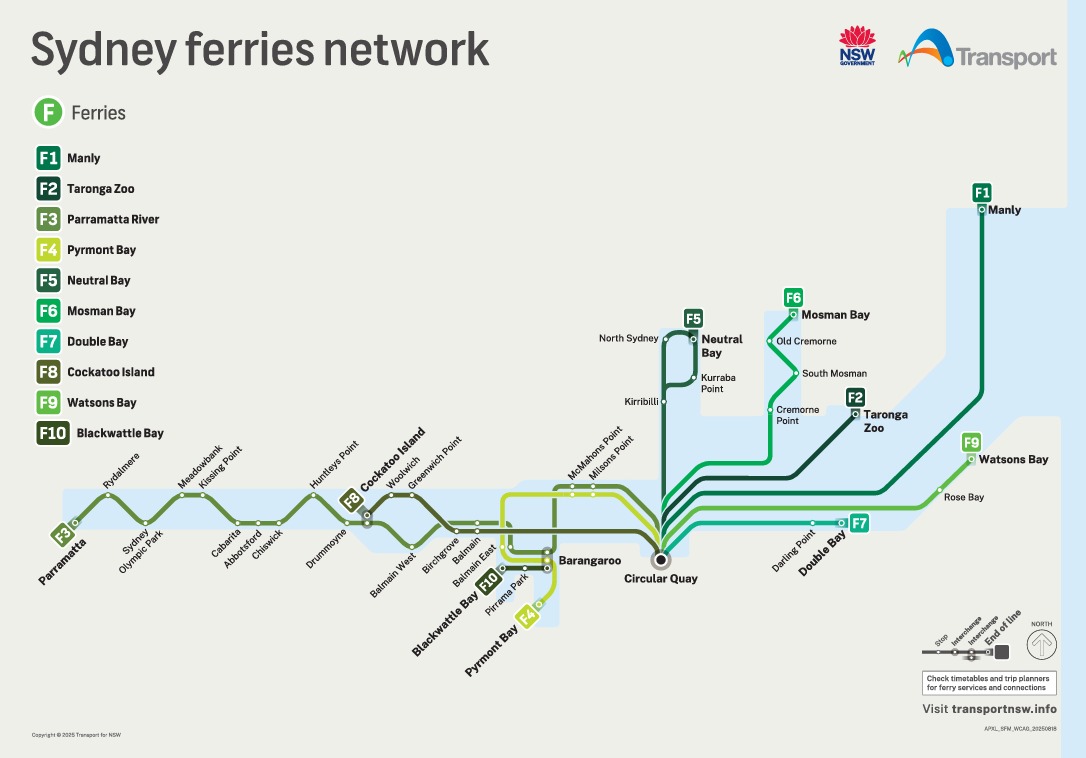
The Routes
Ten Lines, One Harbour, Infinite Outlooks
Every route but one departs from Circular Quay, Sydney’s original maritime hub and still the most atmospheric place in the city to stand and wait for a boat. The F10 is the exception, departing from Barangaroo Metro wharf and linking to Blackwattle Bay. Here’s the full picture.
F1 · Manly
Circular Quay → Manly · 30 min
The jewel of the network. A 11.3 km crossing of the open harbour, passing beneath the Harbour Bridge, through the Heads, and into Manly Cove. Operating since 1855. Runs daily on the iconic three-vessel Freshwater-class fleet. The single best thing you can do in Sydney for the price of an Opal tap.
F2 · Taronga Zoo
Circular Quay → Taronga Zoo · 12 min
A 3.3 km hop across to the Zoo Wharf on the lower North Shore. Brief enough to feel brisk, long enough for a clear view of the CBD skyline receding behind you. Connects directly to the Zoo’s Sky Safari cable car at the wharf. One of the harbour’s most compact and satisfying crossings.
F3 · Parramatta River
Circular Quay → Parramatta · approx 90 min
The river epic. A 27 km journey upstream through 18 wharves, winding from Circular Quay through Balmain, Drummoyne, Meadowbank, and Rydalmere all the way to Parramatta. Operated by the newer River-class and Parramatta River-class vessels. Budget time and settle in.
F4 · Pyrmont Bay
Circular Quay → Pyrmont Bay · 10 min
Six stops across Darling Harbour, serving the Fish Markets, The Star, Pyrmont, and Darling Harbour itself. A quick western Harbour crossing. Connects to the L1 light rail at Pyrmont Bay stop. A practical commuter route for Pyrmont and Darling Harbour residents that doubles as a harbour-view shortcut from the city.
F5 · Neutral Bay / F6 · Mosman
Circular Quay → Lower North Shore
Inner harbour routes serving five stops each on the lower North Shore. F5 runs to Neutral Bay; F6 serves Mosman Bay, Cremorne Point, and points between. Both offer front-row views of the CBD on the return trip, which are arguably at their best on a clear winter afternoon when the low light turns the sandstone
gold.
F7 · Double Bay
Circular Quay → Double Bay · 20 min
Three stops heading east through the Harbour’s upper reaches of Rose Bay and Double Bay. Undiscovered by most tourists, which means you’ll often have the upper deck to yourself on a weekday.
Double Bay Wharf is a short walk from the village’s cafe strip, making this one of the network’s quieter and more rewarding routes.
F8 · Cockatoo Island
Circular Quay → Cockatoo Island
Six stops including Balmain East, Darling Street, and the remarkable Cockatoo Island, a UNESCO World Heritage Site, former convict prison, and working shipyard. The island hosts camping, festivals, and the Sydney Biennale. A ferry route that delivers you somewhere genuinely extraordinary for the price of a regular Opal journey.
F9 · Watsons Bay
Circular Quay → Watsons Bay · 30 min
Three stops out to South Head, passing Garden Island and the eastern harbour mouth. Watsons Bay is home to Doyles fish and chips, a calm swimming beach, and easy walking access to the Gap and South Head Heritage Trail. One of the harbour’s great day-trip combinations: ferry out, coastal walk, ferry back.
F10 · Blackwattle Bay
Barangaroo → Blackwattle Bay
The network’s newest route, connecting Barangaroo ferry wharf (adjacent to the Metro station) to the Fish Markets at Blackwattle Bay via Pyrmont. Compact, practical, and the only route not to touch Circular Quay. Converted from an on-demand service to a timetabled route in 2021, proof that commuter demand on this western corridor was real.
How to Use It
From Wharf to Water in Five Steps
Ferries are the most forgiving mode on the Sydney network. There are no platform screen doors, no underground navigation, no guessing which exit to take. You find the water, you find the wharf, you get on the boat. A few things to know first.
Tap on at the wharf, tap off when you disembark
Opal readers are at the wharf entrance gates at major stops and on the gangway at smaller wharves. Use an Opal card or any contactless Visa, Mastercard, Amex, phone, or watch. Always tap off when you leave the vessel as forgetting defaults you to the maximum fare for the route.
Know your wharf number at Circular Quay
Circular Quay has six wharves numbered 2 through 6 (Wharf 1 is privately operated). Each ferry route departs from a specific wharf, so check the destination boards above the gangways or the Opal Travel app before you walk. It sounds obvious. You’ll still see confused tourists sprinting for the wrong gangway at 5:02pm on a Friday.
Check for low tide replacements
On the Parramatta River route, extremely low tides can make some wharves inaccessible. When this happens, replacement bus services operate between affected stops. Check transportnsw.info/alerts before travelling on F3, particularly to upper-river stops. This catches people out more often than it should.
One fare covers transfers
Transfer between a ferry and any bus, train, metro, or light rail within 60 minutes and Opal counts it as one continuous journey, one fare. This makes the ferry genuinely useful as a link in a longer trip, not just a standalone crossing. The Barangaroo Metro connection on F10 was built with exactly this in mind.
Arrive a few minutes early
Unlike trains, ferries have limited gangway capacity and they do leave on schedule. During peak hour, popular routes like F1 Manly can have queues that fill the next sailing. If you’re in a hurry, arrive at least five minutes before departure, or better yet, use the Opal Travel app to check live departures and adjust accordingly.
Features & Amenities
What’s On Board
The fleet ranges from the grand Freshwater-class vessels that are wide-decked, double-ended, with indoor saloons and outdoor bow seating, through to the sleek River-class catamarans built for the tighter Parramatta River passages. All of them are more comfortable than any bus in the network.
Fully Accessible Fleet
All vessels are wheelchair accessible, with gangways and onboard spaces designed for mobility aids. Priority seating is clearly marked. Assistance is available at staffed wharves, and you can call 131 500 in advance for planned assistance on specific services.
Prams and Strollers
Prams are welcome on all services. Fold where possible during peak sailings on busy routes. The Freshwater-class ferries have generous deck space that accommodates prams comfortably, even when the vessel is full.
Bikes on Board
Bikes are permitted on all ferry services, space permitting. During peak hours (7–9am and 4–7pm weekdays), bikes may be refused if the vessel is at capacity. Worth timing your ride outside those windows if you’re commuting with a bicycle to Manly or Balmain.
Pets Welcome
Leashed dogs and small animals in enclosed carriers are permitted on all services. Sydney’s “water dogs” are well accustomed to the Manly crossing, and your dog will be too, within about 90 seconds of watching the wake.
Refreshments On Board
The Freshwater-class ferries on the F1 Manly run have onboard kiosks serving coffee, snacks and drinks. Smaller vessels on inner harbour routes don’t carry food service, so grab a coffee at Circular Quay before you board, where the choice is predictably decent.
Safety and Security
All vessels are equipped with life jackets and meet maritime safety standards. CCTV operates throughout the fleet. Staff are present on all sailings. For emergencies, contact the crew directly, as there are crew points on all vessels and staffed positions at major wharves.
Best Ferry Trips
The Rides Worth Planning Around
Every route has its merits. These are the ones that earn their reputation, and the ones locals are quietly smug about paying Opal fares for.
F1 Manly · The Classic
30 min · Must-do
Stand on the bow as the Freshwater ferry clears the Heads and the Pacific opens up. In 30 minutes you get the Bridge, the Opera House, North Head, and the full panorama of one of the world’s great harbour approaches. Sydney residents who haven’t done this in years should correct that this weekend. It costs one Opal tap.
F9 Watsons Bay · The Day Trip
30 min · Weekend favourite
Take the F9 east, walk the South Head Heritage Trail to the Gap and the lighthouse, swim at Camp Cove, and end at Doyles on the waterfront. One of Sydney’s most satisfying half-days, entirely accessible by public transport. Return ferry at sunset if you can manage it.
F8 Cockatoo Island · The Discovery
25 min · Cultural stop
Disembark at Cockatoo Island and spend a few hours exploring the convict-era sandstone buildings, the massive dry dock, and the industrial archaeology of a place that built ships for two world wars. Free to enter. Stunning harbour views in every direction. Genuinely one of Sydney’s great undiscovered afternoons.
F3 Parramatta River · The Long Haul
90 min · River journey
Don’t treat this as a commute. Treat it as a river journey that happens to get you somewhere useful. The upper reaches of the Parramatta River are quiet, leafy, and genuinely beautiful, particularly on a midweek morning when the tourist crowd thins out, and the pelicans appear. Bring something to read for the return.
F6 Mosman · The Secret Commute
20 min · Local’s pick
Cremorne Point Wharf, where the F6 stops midway, is one of the harbour’s most quietly spectacular spots featuring a narrow headland with 180-degree water views and a walking track around to Mosman Bay. Locals use this route daily. Visitors almost never find it. That imbalance is part of its charm.
F2 Taronga Zoo · For Families
12 min · Best with kids
Twelve minutes across the harbour, then straight onto the Sky Safari gondola that climbs the zoo’s hill from the lower wharf entrance. The zoo visit is excellent; the ferry and gondola combination means children have had two major experiences before they’ve even seen a giraffe. This is efficient parenting.
Quick Verdict: When the Ferry Is Your Best Option
- Manly from the city — F1 is faster than any bus
- Taronga Zoo with kids — ferry + Sky Safari combo
- Watsons Bay for a coastal walk and seafood lunch
- Cockatoo Island for heritage and harbour views
- Balmain or Mosman for inner harbour day trips
- Parramatta via the river as a scenic alternative
- Darling Harbour and Fish Markets via F4 or F10
- Any sunset, any route, any direction
Connections
Where the Ferry Meets the Rest of the Network
Circular Quay is the most connected transport node in Sydney. Within 200 metres of the ferry wharves you can step onto a train, a bus, or the L2/L3 light rail. All transfers within 60 minutes count as one continuous Opal journey.
Key Interchange Points
Circular Quay — T1, T2, T4 and city circle trains from Circular Quay Station directly above the wharves. L2 and L3 light rail runs along Alfred Street. Dozens of bus routes from the adjacent Customs House bus stands. The network’s primary interchange, full stop.
Barangaroo Wharf (F10) — Direct connection to Barangaroo Metro Station (M1 line). Three minutes underground to Martin Place, eleven minutes to Central. The western harbour corridor has never connected this efficiently to the rest of the city.
Pyrmont Bay (F4, F10) — Connection to L1 Dulwich Hill light rail at the Pyrmont Bay stop which is a 90-second walk from the ferry wharf. One of the network’s most useful cross-modal connections for Darling Harbour and the Inner West.
Parramatta (F3) — T1 Western Line trains from Parramatta Station, a short walk from Parramatta Wharf. Also connects to the new L4 light rail at Parramatta interchange. Arrive by river, depart by rail, a combination that feels more European than it has any right to.
Manly Wharf (F1) — Local bus services to the Northern Beaches, including services to Dee Why, Brookvale, and Palm Beach. The wharf is the gateway to the Northern Beaches bus network, so chill and grab a coffee from the wharf kiosk and check the Opal app before deciding which bus you need.
Manly Fast Ferry — A Separate Service
Manly Fast Ferry is a privately operated service, not part of the Sydney Ferries network. It runs from King Street Wharf (Darling Harbour) to Manly in around 18 minutes which is faster than the F1 Freshwater ferry. Opal is not accepted; you buy a separate ticket. Worth knowing if you’re in a hurry. Not worth it if you want the real harbour experience.
A Brief History
Two Hundred Years on the Water
Sydney’s relationship with its ferries is not a recent convenience. It’s a 235-year-old love affair that predates the city’s roads, its bridges, and most of its suburbs. In many ways, it was the city’s original highway.
In 1789, just one year after the First Fleet dropped anchor at Sydney Cove, a convict-built vessel called the Rose Hill Packet, affectionately known as ‘The Lump’, began making laborious journeys between Sydney Cove and the farming settlement at Parramatta. It was powered by sails and oars, and a return trip could
take the better part of a week. Not quite the 30-minute F3 you catch today, but the instinct was identical: get across the water faster than walking around it.
By the 1830s, an ex-convict named Billy Blue, believed to be Jamaican-born, was running what historians consider Sydney’s first regular ferry service, rowing passengers across the harbour between Dawes Point and Blues Point (the headland that still bears his name). Steam arrived in the same decade, and with it, reliable schedules regardless of wind and tide.
The Manly service has its own origin story. In 1855, English businessman Henry Gilbert Smith had a pier built near Manly Wharf, constructed The Corso linking harbour to ocean beach, and encouraged ferry excursions from the city. The idea was simple: give Sydneysiders their own Brighton. By 1856 a daily service was running, and it has never stopped. The journey has carried passengers through two world wars, multiple recessions, and the opening of a bridge that everyone assumed would make the ferries obsolete.
When the Sydney Harbour Bridge opened in March 1932, it decimated the ferry service. Sydney Ferries Limited, which had grown into the world’s largest ferry operator by patronage, saw passenger numbers collapse from 44 million to 20 million almost overnight. The bridge took the commuters. The harbour kept the dreamers.
By 1951, the network was in financial difficulty, and the NSW Government stepped in, eventually taking full control in 1974. A 2007 government inquiry was scathing about aging vessels, poor management, and infrequent services. The result was a fleet renewal program and the outsourcing of day-to-day operations to private sector operators while the government retained ownership of the wharves and vessels. Today Transdev Sydney Ferries operates the network under contract, and the fleet, with its new River-class and Parramatta River-class vessels, is the youngest and most modern it has ever been.
The Freshwater Class
The three Freshwater-class ferries, the largest vessels on the harbour at 1,100-passenger capacity, have been running the Manly route since 1982. They are the direct descendants of the grand double-ended paddle steamers that first made the Manly crossing in the 1880s, and they remain the most beloved vessels in the fleet. Locals will argue endlessly about whether the upper deck or the bow is the superior spot. (It’s the bow. Front and centre, every time.)
Sydney Makes More Sense From the Water
Every city has a transport network. Not every city has one where the daily commute passes beneath a bridge that took 1,400 workers eight years to build, with an opera house on the left and the open Pacific ahead. Sydney’s ferries are the city’s oldest continuously operating public service, its most photogenic infrastructure, and still, after 235 years, its most civilised way to move. Get on the water. You’ll understand Sydney differently when you do.