
Everything you need to know about the Sydney Metro Western Sydney Airport line: where it goes, what riding it will feel like, and the honest truth about when it opens. Spoiler: not with the airport.
Quick Facts
- What it is: A 23 km driverless metro line linking St Marys to Bradfield via Western Sydney International Airport
- Stations: Six (St Marys, Orchard Hills, Luddenham, Airport Business Park, Airport Terminal, Bradfield)
- Trains: 12 fully automated, air-conditioned metro trains with platform screen doors Fares: Standard Opal, same as the rest of Sydney’s network
- Opens: Not at airport launch. Targeting mid-to-late 2027, with real risk of slipping further
- Best for: Future you. For October 2026, see the “what to do until then” section
Picture the platform. Screen doors slide open in perfect sync with a train that has no driver’s cab up front, just a panoramic window where the windscreen would be, the track unspooling ahead like something out of a transport nerd’s daydream. Ten metres wide at the Airport Terminal stop, the widest platform on the whole line, built for crowds dragging wheelie cases off a red-eye from Singapore. This is the Sydney Metro Western Sydney Airport line. It will be quietly brilliant. It is also, as of mid-2026, still very much a construction site.
Let’s be upfront, because pretending otherwise helps nobody. When Western Sydney International opens its doors on 26 October 2026, this train will not be running. The line and the airport were meant to launch together. They will not. So this is a guide to something that is coming rather than something you can ride today, and the back half tells you exactly how to get around in the meantime.
The 20-Second Verdict
You’ll love it when it opens if: you’re flying out of WSI and connecting to the wider Sydney rail network, you work anywhere along the Western Parkland City corridor, or you simply appreciate a driverless train that turns up every few minutes without a timetable to memorise.
It will frustrate you if: you’re expecting a one-seat ride to the CBD (it isn’t; you change at St Marys), or you need it for an October 2026 flight (you’ll be on a bus instead). See here for all the options.
Three reasons it matters:
- It’s the spine, not a spur. This line is the backbone of an entire planned city, not just an airport shuttle. Six stations, each anchoring a future precinct from revitalised St Marys to the brand-new Bradfield CBD.
- It’s properly modern. Driverless, platform screen doors, full accessibility with lifts and level boarding, real-time info on your phone and on board. The same generation of metro that’s already shifted tens of millions of riders on Sydney’s North West line since 2019.
- Standard Opal fares. No airport-premium gouge like the eye-watering station access fee at Kingsford Smith. You tap on with the same card you’d use to Bondi.
Where the Line Actually Goes
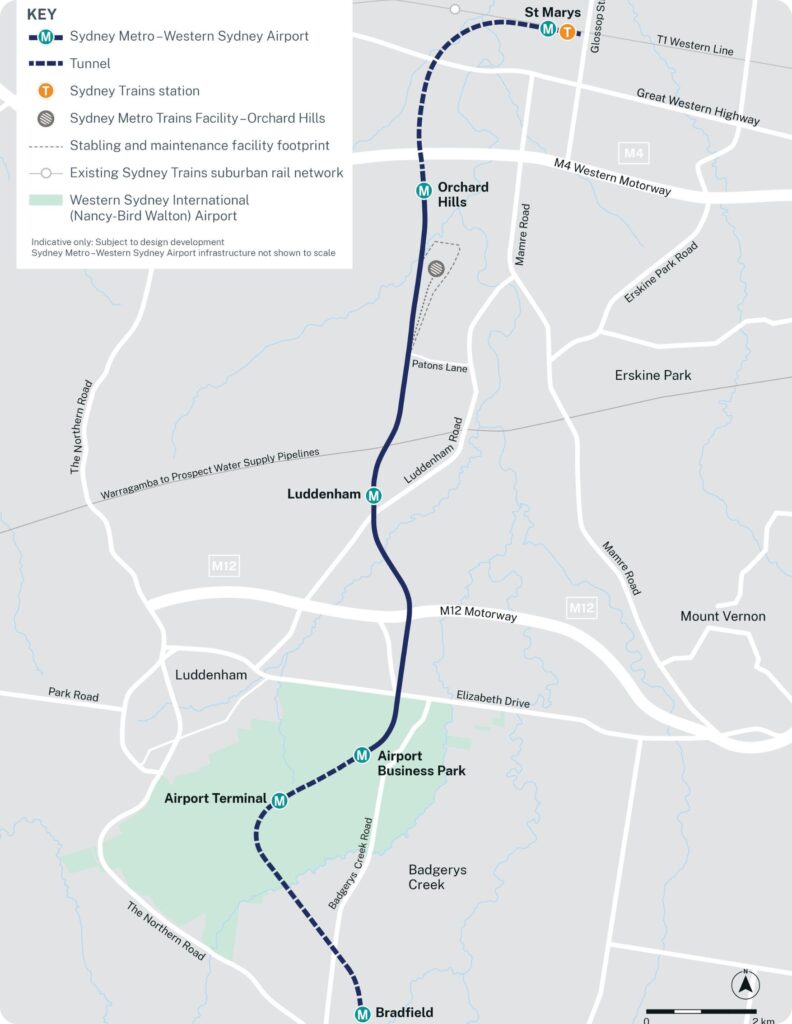
Run your finger along it from the east. The line starts at St Marys, burrowing in beneath the existing suburban station as a cut-and-cover box, joined to the platforms above by a new fully accessible footbridge (47 concrete beams, since you asked, all now in place). This is the pivot point. St Marys is where the metro meets the T1 Western Line, and from there it’s a direct heavy-rail run to Blacktown, Parramatta, Strathfield and Central. Get this station right and the whole line works.
West of St Marys the train dives into twin tunnels bored deep beneath Orchard Hills, surfacing to run on the open ground and elevated viaduct that makes up most of the alignment. Orchard Hills comes next, an open-cut station destined to seed a walkable new community, and notable for three striking diamond-shaped concrete beams craned into place overnight to hold up its canopy. Then Luddenham, an elevated station rising over a future research and innovation precinct, all timber-toned columns and glass in the renders.
The line then crosses the new M12 motorway on its own rail bridge and enters the airport site. Airport Business Park sits in the commercial heart of the precinct, an elevated station with road, rail and a new rapid-bus network knitting together beneath it. A few hundred metres on is Airport Terminal, the cut-and-cover showpiece with that ten-metre platform, delivering you almost to the check-in desks. Finally the track curves south to Bradfield (you may have heard it called Aerotropolis; same place, new name), the future central business district of the whole Western Parkland City.
What surprised me, digging into the plans, is how little of this is really about planes. The airport is the catalyst. The actual prize is 200,000 jobs and a new city growing up around six train stations.
What Riding It Will Be Like
If you’ve ridden the North West line out to Rouse Hill, you already know the feel. Trains that glide in without a driver, doors that line up exactly with the platform screen doors so nobody and nothing tumbles onto the tracks, and a frequency so high you stop checking departure times and just turn up. The system runs on a secure, sealed signalling network with hundreds of cameras, controlled from an operations centre at Orchard Hills where human controllers watch every lift, escalator and door across the line.
Every station is fully accessible. Lifts everywhere, level boarding between platform and carriage, the lot. Stations are designed to echo their local area rather than the bland metro template, with natural light, ventilation and, where they can manage it, solar panels. The trains are next-generation and air-conditioned, which in Western Sydney’s blistering summers is less a luxury than a survival feature.
The Awkward Truth About the Opening Date
Here’s where the curated insider earns their keep by telling you the unvarnished version. The line is late, and it’s late in a messy, contested way.
It was promised to open alongside the airport. Instead, a long-running commercial dispute between Sydney Metro and Parklife Metro, the private consortium building and operating the line, has dragged the schedule out and threatened to blow the cost out by as much as A$2.2 billion. Through 2026 the wrangling escalated: a builder hit the project with a go-slow, restricting work to critical track construction only, with night and weekend labour pulled back and everything “outside the railway track,” including car parks and landscaping, reportedly halted. One contractor was removed from the job entirely amid a labour and tax investigation. The Premier publicly pushed back, refusing, in his words, to be gouged.
Where does that leave an actual opening date? The official line is mid-to-late 2027. Internal Sydney Metro documents have pointed to around December 2027, a full year behind the original plan, and there are open fears it could slide into 2028 if the dispute isn’t resolved. Sydney Metro’s own chief executive has said the target date depends on the outcome of the negotiation. Translation: nobody is locking it in yet.
None of this makes the finished line any less good. It just means you shouldn’t plan an October 2026 trip around catching it.
What to Do Until It Opens
Don’t despair, and definitely don’t cancel your flight. From day one, Transport for NSW is running a free WSI Link shuttle bus between the Airport Terminal and St Marys station every 30 minutes, where you connect to the T1 Western Line into the city. It runs 4:30am to midnight Sunday to Thursday and until 1am Friday and Saturday, with the trip taking around 15 minutes in good traffic. There’s also a network of new permanent bus routes (electric, no less) linking the airport to Penrith, Liverpool, Campbelltown, Mount Druitt, Oran Park and Leppington from 5 July 2026.
For the full breakdown of every option, including drive times, parking, taxis and rideshare, see the companion guide on getting to and from WSI. The short version: at launch, the bus-plus-train combo is your public-transport workhorse, and the metro is the upgrade that arrives later.
Practical FAQs
Does the Sydney Metro go to Western Sydney Airport? It will, but not yet. The Sydney Metro Western Sydney Airport line is a 23 km driverless line with a station right at the airport terminal, but it is not expected to open until mid-to-late 2027 at the earliest, after the airport’s October 2026 launch. Until then, a free shuttle bus connects the airport to St Marys station.
Can I catch the metro straight to the city from the airport? No, and you won’t be able to even after it opens. The line runs to St Marys, where you change to the T1 Western Line heavy-rail service for Parramatta and the CBD. It’s designed as a connection into the wider network, not a single-seat airport-to-city express.
How many stations are on the line and where are they? Six: St Marys, Orchard Hills, Luddenham, Airport Business Park, Airport Terminal and Bradfield. St Marys is the interchange with the existing suburban rail network.
Why is the airport metro line delayed? A protracted commercial dispute between Sydney Metro and the Parklife Metro consortium building the line, including cost-blowout claims of up to A$2.2 billion and a contractor go-slow, has pushed completion well past the airport’s opening. Current targets sit in mid-to-late 2027, with some risk of further slippage.
How much will it cost to ride? Standard Opal fares, the same as the rest of Sydney’s public transport, set by the NSW Government. No special airport surcharge.
The Bottom Line
The Sydney Metro Western Sydney Airport line is going to be one of the most quietly transformative pieces of infrastructure Greater Sydney has built this generation. Driverless, frequent, fairly priced, and stitched into the fabric of a whole new city rising out of the Cumberland Plain. It deserves the hype.
It just doesn’t deserve your October 2026 travel plans yet. Treat it as the thing to look forward to: the upgrade that turns a bus-and-train shuffle into a glide. When it finally opens, ride the front carriage, press your nose to that driverless window, and watch Western Sydney roll past. Until then, grab the free shuttle and we’ll see you on the platform in 2027. Probably.