
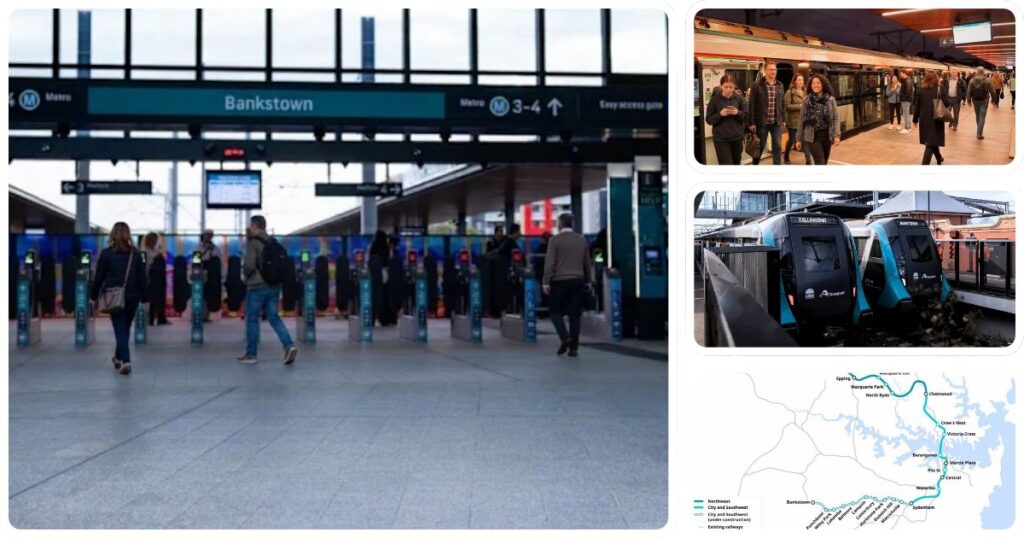
Some of them were on the platform at Bankstown by 3.30am. By the time the first train was due, there were hundreds of them, waiting for a train with no driver.
At 4.31am on Friday 30 October 2026, it pulled away. The first Sydney Metro service from Bankstown left for Tallawong, a 66-kilometre run through the heart of the city, according to the NSW Government.
“Most of us here are public transport enthusiasts,” a commuter named Abdullah told the ABC on the platform. “We’re all celebrating, we’re all happy.”
Jing Hean Yang was celebrating something else too. “I’ve got the same birthday as the Bankstown line, so this is an official birthday gift for me,” he said. “So many people were singing birthday on the train for me, this was a really unforgettable first day.”
It has been a long wait. The old T3 trains between Sydenham and Bankstown stopped running on 30 September 2024, for what was meant to be about 12 months. It took 25. In between, a fleet of pink buses carried the line’s passengers along Canterbury Road and through the suburbs, and the shops along the old line felt every month of it.
Here is everything you need to know about the Southwest Metro: how it works, how much faster it is, what changed for people west of Bankstown, and what locals are saying.
The Southwest Metro at a glance
| Opened | Friday 30 October 2026, first train 4.31am from Bankstown |
| Line | M1 North West & Bankstown Line, Tallawong to Bankstown |
| Length | 66km and 31 stations end to end |
| New metro stations | Marrickville, Dulwich Hill, Hurlstone Park, Canterbury, Campsie, Belmore, Lakemba, Wiley Park, Punchbowl, Bankstown |
| Frequency | Every 4 minutes in the weekday peak, 5 minutes during the day, 10 minutes in the evenings and on weekends |
| Bankstown to Central | 28 minutes |
| Fares | Standard Opal fares |
| Cost | $22 billion to $23 billion for the whole City & Southwest project (NSW Audit Office, December 2025) |
How much faster is it?
The biggest change is not just speed. It is where the line now goes. Instead of ending in the City Circle, trains run straight under the harbour, so you can sit on one train from Lakemba to North Sydney or from Canterbury to Chatswood.
| Trip | Metro time | Time saved |
|---|---|---|
| Bankstown to Central | 28 min | 6 min |
| Belmore to Gadigal | 22 min | 14 min |
| Punchbowl to Barangaroo | 32 min | 24 min |
| Lakemba to Victoria Cross (North Sydney) | 37 min | 24 min |
| Canterbury to Chatswood | 31 min | 23 min |
| Campsie to Macquarie University | 44 min | 17 min |
| Bankstown to Macquarie University | 54 min | 25 min |
For commuters, the numbers are personal. “It takes me one and a half hours,” Bankstown resident Progya Das, who works in Pyrmont, told the ABC. “I checked the schedule, and it’s probably going to cut me half an hour.”
Trains also come far more often. The old T3 ran eight trains an hour. The metro runs up to 15 an hour from Bankstown in the peak, every train stops at every station, and the government says it adds 50% more capacity.
What has changed at the stations
The line is about 130 years old, opened in stages from the 1890s and electrified in the 1920s. Rather than knock it down, Sydney Metro rebuilt around it. Canterbury’s heritage platform chimneys were kept and restored. Bankstown station had a major rebuild.
According to the NSW Government, the 10 stations now have 360 platform screen doors, more than 1,300 gap fillers on curved platforms, 790 CCTV cameras and 379 bike parking spaces.
For many people the most important change is the simplest. Wiley Park, Dulwich Hill, Hurlstone Park, Punchbowl and Canterbury have lifts for the first time, so every station on the line is now accessible to people in wheelchairs, parents with prams and anyone who struggles with stairs.
One thing to know: six of the 360 platform doors are closed for now, at Dulwich Hill, Canterbury, Campsie and Marrickville. The ABC reports the rail safety regulator required this because of the wide gaps on curved platforms. Extra staff are at every station and on trains while the line settles in.
If you live west of Bankstown
This is the part of the story that is easy to miss on a celebration day.
The old Bankstown Line did not stop at Bankstown. Trains carried on to Lidcombe and Liverpool, and many ran directly into the City Circle. The metro ends at Bankstown. West of it, the line is now served by the short T6 Lidcombe & Bankstown Line (via Yagoona, Birrong, Regents Park and Berala), and the T3 Liverpool & Inner West Line no longer goes through Bankstown at all.
Campaigners warned about this for years. In a 2023 submission to a NSW Parliament inquiry, the Restore Inner West Line and Save T3 Bankstown Line groups said about 19,000 daily commuters west of Bankstown would be affected. “Broken Hill has a direct train to Sydney CBD, but Birrong will have NONE!” they wrote. Transport group EcoTransit warned of a walk of up to 450 metres between the Sydney Trains and metro platforms at Bankstown.
Is the metro ever going further west, to Liverpool? We could find no current official plan or business case for it.
Two years on the pink buses
When the T3 shut in 2024, Transport for NSW replaced it with Southwest Link: about 100 free pink buses on three routes, running every two to four minutes at peak. Transport’s Howard Collins was honest from the start: “It will add several minutes, if not tens of minutes of time to your journey.”
Opinions on the buses were split. Inner West MP Jo Haylen’s verdict to the Guardian was that they were “not a train, but it’s been free and it’s been frequent.” Abdullah, on the platform this morning, was blunter: “the bus replacements for the past two years have been quite crappy.”
The pink buses are still running over the opening weekend. Transport for NSW says they will remain “until further notice”, so check before you rely on them.
The shops that waited it out
For some businesses along the line, the shutdown was brutal. The day before opening, the ABC spoke to Marrickville traders.
Talia Gill, who runs the vintage shop Casablanca, said she had to let go of almost 10 staff within a month of the 2024 closure. “This is the last hope,” she said, though she worried the metro might not turn her business around.
Nora Lee of Vanessa’s Hair Design said simply: “We lost 40 per cent of our customers this year.”
If you want to help, the easiest way is to ride the new line and get off somewhere you have never been. Campsie, Lakemba and Punchbowl are some of the best places in Sydney to eat, and they are now minutes from the CBD.
The cost, the delays and the critics
The Southwest Metro has never been uncontroversial.
In 2020, a NSW Upper House inquiry chaired by Greens MLC Abigail Boyd recommended that the conversion “should not proceed”. “Overall, the committee does not believe that the project has won community support,” Boyd said. Government members dissented, and the project went ahead.
In 2023, the incoming Labor government’s independent Sydney Metro Review found the conversion “should continue as it delivers significant benefits across the transport network”, but warned it needed up to about $1.1 billion more.
The bill kept growing. According to the NSW Audit Office, the business case put the whole City & Southwest project at $11.5 billion to $12.5 billion. By December 2025, it was $22 billion to $23 billion. It was originally due in 2024.
The government blamed much of the later delay on industrial action and the difficulty of fitting driverless trains to old, curved platforms. The Rail, Tram and Bus Union called it “another incompetent Transport blowout”. Transport Minister John Graham was frank about the cost to locals: “We know this has had an impact, though, on communities, on passengers, on businesses as well. There’s no easy way to upgrade the line in this way; it has taken time.”
There is also a bigger change coming that some residents fear more than any delay. The rezoning around the stations allows for thousands of new homes, including 14,000 around Bankstown alone. “We’ve always known that the metro was a Trojan horse for development,” Marrickville resident Heather Davie told the Guardian. Others see that same growth as the point of building it.
What the politicians said
- Premier Chris Minns: “This is a huge day for southwest Sydney, finally the wait for the Metro is over.”
- Transport Minister John Graham: “This was the moment patience turned to jubilation.”
- Jihad Dib, Member for Bankstown, who cut the ribbon: “For the first time ever, our community feels like we’re getting the best stuff in Sydney.”
- Sophie Cotsis, Member for Canterbury: “Lakemba to Macquarie University in 44 mins instead of over an hour will make their lives so much easier.”
Tips for riding it this week
- Opening weekend: trains run every 7 minutes on Saturday 31 October and Sunday 1 November.
- Celebrations: there is a community opening event on Sunday 1 November, 10am to 1pm, at Bankstown and Dulwich Hill stations, according to Sydney Metro.
- Expect crowds: Sydney Metro is expecting thousands of trips on day one, and says there may be “minor teething issues”.
- Heading to Lakemba Nights? Next year’s Ramadan food festival in Lakemba (from 11 February 2027) will be the first with a metro station on the doorstep.
- New to the metro? Our Sydney Metro guide explains how it works, and our Opal card guide covers fares and caps.
For 130 years, the Bankstown Line has carried southwest Sydney to work, to school and to the city. For the last 25 months, it carried nobody at all.
This morning it came back as something new: driverless, frequent, and running straight under the harbour. It cost far more than promised and took far longer than planned, and some people west of Bankstown have lost more than they gained.
But on a platform at 4.31am, with strangers singing happy birthday to a young man on the first train, none of that seemed to matter very much.