
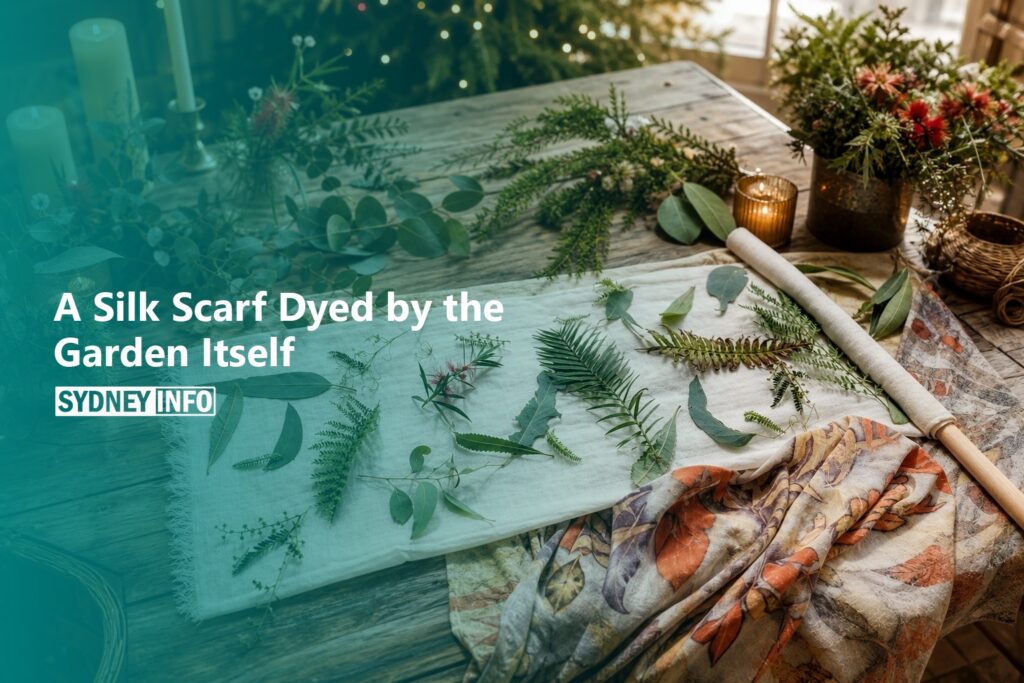
Alacoque Dash does not separate making art from walking among trees. On Saturday 18 July 2026, the educator, artist and herbalist will guide a small group through the Rathborne Lodge workshop, turning foliage gathered that morning from the Royal Botanic Garden Sydney into colour that can be worn.
The Natural Dyeing and Eco Printing Workshop is a two-hour session, running from 10am to midday, costs $75 for adults and $56 for concession holders. Every participant leaves with a naturally dyed and eco-printed silk scarf, made using leaves, bark and blossoms harvested directly from the 30-hectare living collection. All materials are provided, and no prior experience is needed. The workshop is recommended for people aged 16 and older.
Dash draws on qualifications in fine arts, education and herbalism, and a way of working she describes as a collaboration with the natural world. “Alacoque views nature as a collaborator in her work and daily life,” the Botanic Gardens of Sydney event notes explain, “utilising traditional cultural techniques to reconnect with the natural world through art and craft.”
Rathborne Lodge, the 1856 sandstone cottage where the workshop takes place, sits inside Australia’s oldest botanic garden. The venue pulls the session away from generic craft rooms and into the calm of a heritage building surrounded by the plants that supply the dye pots. Participants will learn which common plants produce lasting colour, how to prepare fibres, and techniques simple enough to repeat at a kitchen table long after the winter morning ends.
The session lands at a moment when many Sydneysiders are looking for hands-on escapes from fast fashion. Synthetic dyes, global supply chains and throwaway garments have nudged a quiet counter-movement toward slow craft. This workshop offers a direct alternative: a morning spent handling silk, steam and eucalyptus, with a wearable result shaped by the season’s actual colour palette rather than a Pantone trend forecast.
It is also a one-off. No repeat dates are currently listed for the natural dyeing session, and Rathborne Lodge can accommodate only a small group. Booking is through the Botanic Gardens of Sydney website or Humanitix, and organisers strongly recommend securing a spot early. People sometimes assume the gardens’ programs are free; this one is ticketed, and walk-ins are not possible.
The workshop combines dyeing and eco-printing in a single session, unlike shorter demonstrations that treat the two techniques separately. And because the plant material comes from the gardens’ own collection rather than a generic art supply bundle, each scarf carries the imprint of a specific winter day at a specific place. For anyone who has attended a craft class in a windowless studio, the difference matters.
People can book for the event via the official page at botanicgardens.org.au.
Public transport is the easiest way to arrive. St James, Martin Place and Circular Quay stations are all a 10-minute walk from the garden gates. Ferries pull into Circular Quay a short stroll away, and buses including the 441 from the Queen Victoria Building and route 200 stop nearby. Drivers can use The Domain car park, though city traffic on a July Saturday is its own project. Entry to the gardens themselves is free, so participants often arrive early to walk through the winter beds or duck into the Art Gallery of NSW before the workshop begins.
Related to This Story
Botanic Gardens of Sydney
Manages the Royal Botanic Garden Sydney, Australian Botanic Garden Mount Annan and Blue Mountains Botanic Garden Mount Tomah. Its work spans plant conservation, scientific research and public programs that include seasonal workshops like the natural dyeing session.
Dash has spent years teaching people to read plants not just as decoration but as a working material. On 18 July, her students will leave with a piece of silk that holds the memory of that lesson: a scarf whose colour came from leaves picked a few hundred metres from the lodge door, on a morning when the garden was quiet and the dye bath was warm.