
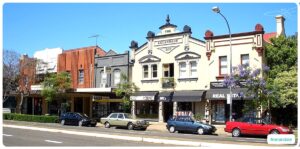
Annandale sells you a paradox and mostly gets away with it: a suburb of grand Victorian terraces and workers’ cottages, three kilometres from the CBD, with no train station and no shopping centre to speak of. What you get instead is Johnston Street’s strip of cafes and Italian delis, a creek-side park doing ecological work in the middle of the inner city, and streetscapes heritage-protected enough that almost nothing new gets built. That trade-off, character over convenience, is the whole story here, and anyone weighing up a move needs to be honest with themselves about which side of it they actually value.
Annandale Boundary and Location Map
Annandale sits roughly 3 kilometres west of the Sydney CBD in the Inner West Council area, wedged between Glebe and Forest Lodge to the east, Leichhardt to the west and south, and Lilyfield to the north. Johnstons Creek forms its western boundary, running through the suburb’s namesake environmental park before draining into Rozelle Bay. It is a small, tightly bounded suburb: you can walk it end to end in twenty minutes, which is either a selling point or a limitation depending on what you’re after.
Quick Facts
| LGA | Inner West Council/City of Sydney |
| Postcode | 2038 |
| Population | 9,487 (2021 Census, ABS QuickStats SAL10062); revised figures due once 2026 Census results are released, expected in 2027 |
| Growth Rate | Up from 8,669 at the 2011 Census (localstats.com.au) to 9,487 in 2021, roughly 9% over the decade. Heritage conservation controls cap most new dwelling supply, so growth here is incremental rather than a corridor-style surge |
| Distance from CBD | Approximately 3km |
| Character | Heritage terrace suburb: tightly held Victorian and Federation housing stock, low-rise, conservation-zoned streets |
| Median House Price | $2,412,500, up 3.99% year-on-year (Your Investment Property Magazine/CoreLogic data, 12 months to May 2026) |
| Median Unit Price | $1,037,500, up 1.97% year-on-year (same source, 12 months to May 2026) |
| Transport | No train station. Bus-reliant, with routes including 413, 440, 461, 480 and 483 running via Parramatta Road and Johnston Street to the City, Broadway and Leichhardt (Transport for NSW network, current as of the December 2024 Inner West timetable changes) |
| Crime Rate (LGA) | Inner West Council LGA, BOCSAR data for the year to December 2025: non-domestic assault 333.6 per 100,000, break and enter (dwelling) 163.4 per 100,000, motor vehicle theft 147.2 per 100,000. Suburb-specific figures for Annandale alone are not published; this is LGA-wide |
| Childcare Availability | Adequate to good: 26 long day care, family day care and preschool services listed within the 2038 postcode, 17 showing vacancies at time of search (Toddle listings, 2026) |
| School Zone Quality | Zoned for Annandale Public School and Annandale North Public School (both well regarded, both small), feeding into Leichhardt High School. St Brendan’s Catholic Primary offers a non-government alternative on Johnston Street |
| Parks & Recreation | Johnstons Creek Environmental Park, the Bay Run around Iron Cove, Annandale Oval, Whites Creek Valley Park |
| Shopping | Johnston Street strip (cafes, delis, boutiques); no shopping centre in the suburb itself, Broadway Shopping Centre and Norton Street Leichhardt both close by |
| Health | GPs along Johnston Street and Parramatta Road; Royal Prince Alfred Hospital, Camperdown, is the nearest major tertiary hospital; Concord Repatriation General Hospital also within reach |
| Best For | Heritage-home buyers, professionals and couples who prioritise inner-city character and walkability over on-site shopping and rail access |
What Makes Annandale Special
Annandale is one of the more intact heritage precincts in the Inner West, and that intactness is deliberate rather than accidental. Large sections of the suburb sit within conservation areas that restrict demolition and facade changes, which is why a walk down Johnston Street, Booth Street or Nelson Street still reads like a streetscape from the 1880s rather than a rendered-brick reinterpretation of one. That protection is also the honest trade-off: it keeps character high and supply low, which is a large part of why prices here sit where they do.
A Suburb Named After a Rebellion
According to local historical accounts, Annandale takes its name from Annandale in Dumfries and Galloway, Scotland, the home district of Lieutenant Colonel George Johnston (1764-1823), who received a land grant of roughly 40 hectares in the area. Johnston is a significant figure in early colonial history: he led the 1808 Rum Rebellion, the only successful armed takeover of an Australian government, deposing Governor William Bligh. Treat the specifics as background rather than settled fact, since dates and grant sizes vary slightly between local histories, but the broad outline (Scottish namesake, Johnston’s grant, the Rum Rebellion connection) is consistently reported.
The Father of Annandale and the Father of Federation
Johnston’s descendants held the estate for two generations before his son Robert sold it in 1877 to John Young, a businessman, architect and mayor of Sydney, who set about turning the property into the suburb that exists today (Francis Pollon, “The Book of Sydney Suburbs,” 1988). Young became known in his own right as “the Father of Annandale” for that work, and he built a small group of houses on the estate, including one called Kenilworth, distinguished by the picturesque “witch’s cap” roof style common to that period of local architecture. In his final years, with his fortune diminished by the 1890s Depression, former New South Wales premier Sir Henry Parkes (1815-96), the man credited as “the Father of Federation,” lived out his last days at Kenilworth on a low rent Young arranged for him. It’s an odd footnote for a suburb better known today for cafes and heritage terraces: two men, each nicknamed “father” of something significant to Sydney and Australia, sharing the same patch of Annandale a century apart from each other’s fame.
Terrace Housing at Scale
What sets Annandale apart from some neighbouring Inner West suburbs isn’t just that it has heritage terraces, plenty of Sydney suburbs do, it’s the scale and consistency of the stock. Whole streets of unbroken Victorian terraces survive here, several with grand proportions (wide frontages, high ceilings, decorative ironwork) that were originally built for the professional class rather than as worker’s cottages. That’s a real point of difference from, say, Newtown or Erskineville, where the housing stock skews smaller and more mixed.
What Is It Like Living in Annandale?
Day to day, Annandale runs at a slower, more local pace than its Inner West neighbours with metro or light rail access. Locals talk about it in terms of what it lacks as much as what it offers: no train, no big supermarket in the suburb itself, but a walkable core, a real sense of streetscape, and enough parkland along the creek that families with young kids and dog owners both rate it highly. It suits people who have already decided that character and quiet matter more than a five-minute train commute.
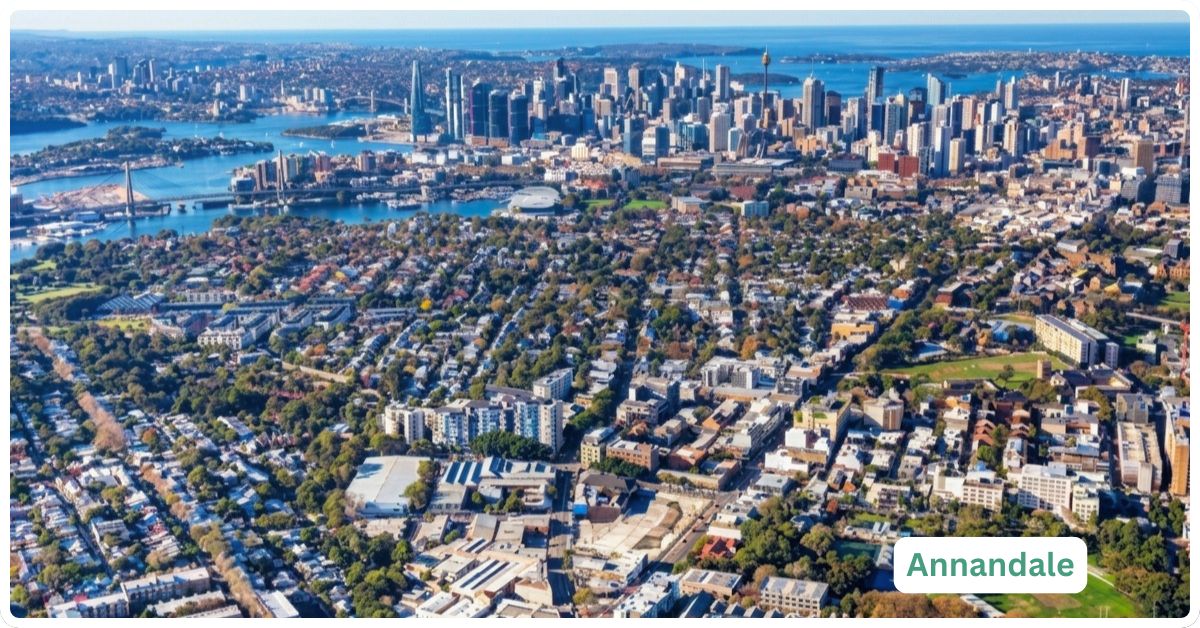
Johnston Street is the suburb’s actual centre of gravity: a strip of cafes, Italian-leaning delis and restaurants, a handful of boutiques, and enough foot traffic on a Saturday morning to feel like a local high street rather than a thoroughfare. There is no supermarket-anchored shopping centre inside Annandale, which is the practical downside of the heritage zoning; for a full grocery shop or bigger-format retail, residents head to Broadway Shopping Centre (Google Maps: broadwaysydney.com.au) toward Glebe, or Norton Street in neighbouring Leichhardt, both a short drive or bus trip away.
Annandale itself is almost entirely residential; there’s no significant local employment base beyond the Johnston Street retail and hospitality strip. Most residents commute out, heavily weighted towards professional, education, health and creative-industry roles in the CBD, Camperdown/Darlington’s university and hospital precinct, and Pyrmont/Ultimo’s media and tech cluster. It’s a suburb built around people who work elsewhere and come home to something quieter, rather than one with its own industrial or commercial identity.
For commuters, Annandale has no train station and none is planned. If a rail commute is non-negotiable for you, this isn’t your suburb, full stop. What it does have is a reasonably dense bus network, with routes including 413, 440, 461, 480 and 483 running along Parramatta Road and Johnston Street towards Broadway, Central and the City, and connections west towards Leichhardt and Balmain. Transport for NSW restructured much of the Inner West bus network in December 2024, lifting several nearby routes (433, 442 and 526) to a 10-minute frequent service and withdrawing a handful of underused ones, so check current timetables rather than assuming an older route number still runs the way it used to.
By car, Parramatta Road and Victoria Road are the main arterials, and the Rozelle Interchange (opened November 2023 as the final piece of WestConnex) has changed traffic patterns significantly on both, generally for the better on through-traffic though local streets still carry plenty of it during peak hours. Expect 15-25 minutes to the CBD by car outside peak, longer at peak, and 20-35 minutes by bus depending on the route and time of day.
On the healthcare front, GP coverage is solid rather than abundant: a handful of medical practices sit along Johnston Street and the Parramatta Road frontage, enough for routine care without a long wait in most cases. For anything more serious, Royal Prince Alfred Hospital at Camperdown is the nearest major tertiary hospital, a short drive or bus ride away, with Concord Repatriation General Hospital also within reasonable reach on the western side. Aged care is limited within Annandale’s small footprint itself; most residents needing residential aged care look to facilities in Leichhardt, Glebe or further into the Inner West.
For those with school-aged kids, the government primary zoning covers Annandale Public School and Annandale North Public School, both small, well-regarded local schools that feed into Leichhardt High School for secondary. St Brendan’s Catholic Primary on Johnston Street is the local non-government option at primary level, and families chasing selective or independent secondary schooling generally look beyond the suburb, since none sit within Annandale itself. Given the tight zoning catchments and the suburb’s small size, buying specifically for a school zone here is less of a price driver than it is in some larger Inner West suburbs, though proximity to Annandale Public in particular is sought after by local families. Childcare supply looks adequate on paper (26 services listed across long day care, family day care and preschool within the postcode, with 17 showing vacancies at time of writing) but demand for the smaller, more established centres closest to Johnston Street can still mean a waitlist, so it pays to enquire early rather than assume a spot is guaranteed.
As for parks and green space, this is where Annandale over-delivers. Johnstons Creek Environmental Park runs along the suburb’s western boundary, a rehabilitated urban waterway with mangroves, wetland planting and a shared pathway that’s a real piece of ecological restoration work rather than a token strip of grass. It connects onward to the Bay Run, the roughly 7-kilometre loop around Iron Cove that’s one of the most-used recreational circuits in the Inner West for walkers, runners and cyclists (Inner West Council: innerwest.nsw.gov.au). Annandale Oval provides local sporting fields, and Whites Creek Valley Park adds another pocket of green space toward Leichhardt. For a small suburb, the parkland-to-footprint ratio is strong.
Realty Market
Buying into Annandale means buying into a heritage market with limited stock. In the 12 months to May 2026, the median house price sat at $2,412,500, up 3.99% year-on-year, on 138 recorded house sales (Your Investment Property Magazine/CoreLogic). Units are a smaller and cheaper slice of the market: median $1,037,500, up 1.97% over the same period, from 70 sales. By bedroom count, Domain’s more granular breakdown puts two-bedroom houses around $1.855 million, three-bedroom houses around $2.433 million and four-bedroom houses around $3.2325 million, with one-bedroom units around $720,000 and two-bedroom units around $1.0625 million. The housing stock itself is overwhelmingly Victorian and Federation-era terraces and semis, with a smaller pocket of 1970s-onward unit blocks mostly along the Parramatta Road fringe; new-build stock is rare given the conservation area coverage.
The rental market reflects the same tight-stock dynamic. Median weekly rent across the suburb sat at $570 as of the 2021 Census, and asking rents have moved up materially since then in line with the broader Sydney rental market, though a precise, current median rent figure specific to Annandale was not available at time of writing; renters should treat any current listing site figure as the more reliable current guide rather than the 2021 Census number. With rental stock skewed toward whole-terrace and semi rentals rather than large unit blocks, competition for well-located rentals near Johnston Street tends to be sharp.
Our Honest Verdict
Annandale is likely to appeal most to buyers and long-term renters who have already made peace with commuting by bus or car, and who are prepared to pay a premium for streetscape and heritage character rather than for square metreage or a shorter trip to the station. It suits established professionals, couples and small families who work from home some of the week or don’t mind a 20-30 minute bus ride, and who value the Bay Run, Johnstons Creek and a local strip over having a Woolworths within walking distance.
It is less compelling for anyone who needs a train line as a daily non-negotiable, for buyers chasing new-build stock or a renovator’s blank canvas (heritage controls make substantial changes difficult), and for investors focused primarily on rental yield given the high entry price relative to rental return. For a cross-shop, look at Glebe: similarly heritage-heavy, similarly car-and-bus reliant in parts, but with light rail access at its eastern edge and a larger, more varied shopping strip along Glebe Point Road. If light rail or a slightly lower entry price matters more to you than Annandale’s particular quiet, Glebe is worth comparing directly before you commit.
Frequently Asked Questions
Does Annandale have a train station?
No. Annandale has never had its own train station and none is currently planned. Residents rely on the bus network or driving, with the nearest train stations sitting in neighbouring suburbs such as Lewisham, Stanmore and Petersham on the T2 Leppington & Inner West Line, or Central for direct city access.
Is Annandale a good suburb for families?
It works well for families who prioritise walkability and parkland over a large home footprint. Two solid local primary schools, a Catholic primary option, and good green space along Johnstons Creek and the Bay Run all support family life, though the lack of a big local shopping centre and the reliance on buses for school and work commutes are real factors to weigh up.
How does Annandale compare to Glebe or Leichhardt?
Annandale sits between the two both geographically and in feel. It’s quieter and more residential than Leichhardt’s Norton Street strip, and less connected than Glebe, which has light rail access at its eastern fringe. Prices across all three sit in a broadly similar heritage-suburb bracket, so the real decision usually comes down to transport access versus streetscape quiet.
Is Annandale safe?
Crime data is only published at the Inner West Council LGA level rather than suburb by suburb, and on that measure the LGA’s headline offence rates are broadly stable to declining over recent years. Local anecdotal sentiment describes Annandale itself as low-key and generally safe, but that’s resident feedback rather than a verified suburb-specific statistic.
References
- Australian Bureau of Statistics, 2021 Census QuickStats, Annandale (NSW) SAL10062, abs.gov.au
- Transport for NSW, Bus changes across the Inner West project page, transport.nsw.gov.au
- Bureau of Crime Statistics and Research (BOCSAR) data, compiled via inthesuburbs.com.au Inner West Council LGA profile, year to December 2025
- Toddle, Long Day Care and childcare centre listings for Annandale NSW 2038, toddle.com.au
- NSW Department of Education, School Infrastructure NSW, Annandale North Public School page, schoolinfrastructure.nsw.gov.au
- Inner West Council, State Government Projects page, innerwest.nsw.gov.au
- Transurban Group, “WestConnex is complete” Rozelle Interchange opening announcement, November 2023
- Sydney Metro, West project overview and Bays Station design announcement, sydneymetro.info
- Dictionary of Sydney and local Inner West historical accounts on George Johnston and the naming of Annandale
- Francis Pollon, “The Book of Sydney Suburbs,” 1988, Annandale historical entry, p.4
See the full list of Sydney suburbs or explore the broader Sydney Regions overview to understand where Annandale fits within Greater Sydney.