
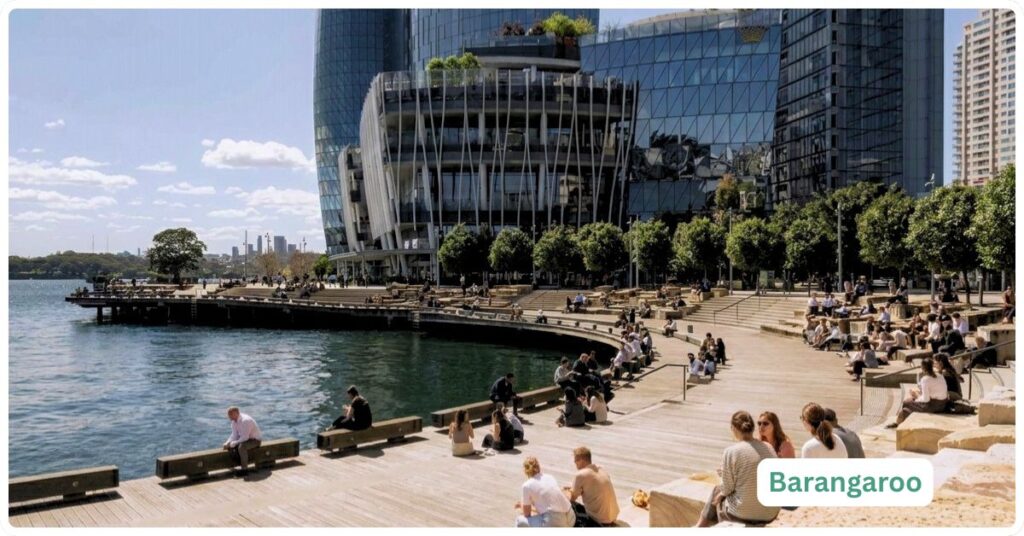
There is no “corner shop” in Barangaroo, no primary school run, no cul-de-sac full of kids on bikes. What there is: a reclaimed container wharf turned into the most expensive apartment stock in the country, a sandstone headland rebuilt blade by blade to look like it was never touched, and a resident population you could fit into a couple of suburban streets. Barangaroo isn’t really a suburb in the traditional sense at all.
It’s a purpose-built harbourside commercial and residential precinct, barely a decade into existence, where a one-bedroom apartment can cost more than a freestanding house in most of Sydney. That trade-off, extraordinary amenity and prestige against almost none of the social infrastructure that makes a “normal” suburb function, is the honest starting point for anyone weighing up a move here.
Barangaroo Boundary and Location Map
Barangaroo sits on the western edge of the Sydney CBD, on the harbour foreshore between Millers Point and Darling Harbour. It borders The Rocks and historic Millers Point/Dawes Point to the north and northeast, with the CBD proper and Wynyard immediately to the east, and Darling Harbour curving around to the south. To the west and north is the harbour itself, which is really the point: this is a suburb defined by its water frontage rather than by streets shared with any neighbour.
Quick Facts
| LGA | City of Sydney |
| Postcode | 2000 |
| Population | 220 residents (2021 Census, ABS, SAL10192). A small base given the precinct’s newness, and towers completed since 2021 (including One Sydney Harbour’s residential stages) mean the real figure is almost certainly higher now; the next official update arrives with the 2026 Census. |
| Growth Rate | No reliable population growth rate exists yet given the tiny 2021 base and ongoing construction. What is verifiable: dwelling stock is still expanding as Central Barangaroo and the remaining South Barangaroo towers complete, so the resident count is on a rising trajectory rather than a stable one. |
| Distance from CBD | Effectively none. Barangaroo adjoins the Sydney CBD directly at its western edge; it is arguably an extension of the CBD rather than a separate district. |
| Character | A purpose-built harbourside commercial and high-rise residential precinct on former container wharf and goods yard land, still partly under construction. |
| Median House Price | Not applicable. There is no detached house stock in Barangaroo; the entire residential offering is apartments and penthouses. |
| Median Unit Price | Roughly $2.0 million for a one-bedroom, $3.8 million for a two-bedroom, and $7.65 million for a three-bedroom, based on Domain’s trailing 12-month sales data (Domain suburb profile, accessed September 2026). Barangaroo also holds the record for Australia’s most expensive residential sale, a $141.55 million penthouse (Elite Agent, 2026), which sits well outside what a typical buyer will pay but says plenty about the ceiling on offer here. |
| Transport | Barangaroo Metro Station (Sydney Metro, opened 19 August 2024), Barangaroo ferry wharf, a short walk to Wynyard Station (T1 North Shore & Western Line), and bus routes into the city interchange network. Genuinely well served for a suburb with almost no cars parked in it. |
| Crime Rate (LGA) | City of Sydney LGA data (BOCSAR) consistently records some of the highest raw incident counts in NSW for offences like non-domestic assault and theft, a pattern driven overwhelmingly by CBD and Kings Cross nightlife density rather than by Barangaroo’s own streets. There is no suburb-specific crime figure for Barangaroo; treat the LGA number as a ceiling, not a description of the precinct itself. |
| Childcare Availability | Tight but present. A small number of long day care centres operate on-site (Guardian Childcare & Education Barangaroo among them), scaled to the resident and worker population rather than to a typical family suburb. |
| School Zone Quality | Minimal in-suburb schooling. Ultimo Public School is the nearest government primary option; most resident families look to CBD-fringe options rather than a dedicated local zone. |
| Parks & Recreation | Headland Park (Barangaroo Reserve), a rebuilt sandstone headland with native bushland, opened 2015, plus The Cutaway event space carved into the old wharf structure. |
| Shopping | Barangaroo House and the wharf dining strip, International Towers retail and dining, plus Darling Harbour and the CBD a short walk away for anything larger. |
| Health | Myhealth Medical Centre Barangaroo (on-site GP clinic); nearest hospitals are Sydney and Sydney Eye Hospital on Macquarie Street and St Vincent’s Hospital, Darlinghurst, both a short drive or taxi away rather than walkable. |
| Best For | High-income professionals and executives who want to walk to work in the CBD’s financial precinct, and investors chasing trophy-asset prestige rather than rental yield. |
What Makes Barangaroo Special
Most Sydney suburbs earn their character over a century or more. Barangaroo built its entire identity in about fifteen years, on land that was, within living memory, a working container wharf and rail goods yard. That compressed timeline is unusual enough on its own. What makes it distinctive is what the Barangaroo Delivery Authority and successive developers chose to do with the site once the wharves came out.
A rebuilt headland, not a leftover one
Headland Park, more commonly called Barangaroo Reserve, opened in 2015 on what was previously a flat, concrete container terminal. The sandstone cliff line that now looks like it has always been there was engineered from scratch: roughly 10,000 sandstone blocks, many salvaged from demolished Sydney buildings, were placed to recreate the natural headland that existed before industrial reclamation flattened it in the early twentieth century. Over 75,000 native trees and shrubs went in as part of the same project, chosen to reflect the pre-colonial harbour foreshore rather than a generic park planting scheme. It is one of the only places in inner Sydney where a “natural” harbourside headland is, in fact, a deliberate act of landscape reconstruction, and it is worth walking simply to notice how convincing the illusion is.
A name that carries real weight
The precinct is named after Barangaroo, a Cammeraygal woman and one of the most senior and outspoken Aboriginal figures recorded in early colonial Sydney, and the wife of Bennelong. She was known for refusing to adopt European dress or customs and for openly challenging colonial authority, a pointed contrast to the more accommodating public image often attached to Bennelong. Naming a multi-billion-dollar commercial precinct after her was a deliberate act of Aboriginal heritage recognition on a site with a much longer history than its recent industrial past, and the Aboriginal Cultural Recognition Project embedded in the Reserve (interpretive markers, plantings, and Cammeraygal-informed design elements) is an easy to miss layer beneath the towers and restaurants.
What Is It Like Living Here?
Living in Barangaroo means living in a tower with harbour views, walking to work in under fifteen minutes, and accepting that almost every errand outside your apartment, from a supermarket shop to a paediatrician’s appointment, happens somewhere else. It suits people whose lives are built around the CBD and who are happy to treat the rest of Sydney as somewhere you visit rather than somewhere you need daily.
Barangaroo is, first and foremost, a place of work. International Towers One, Two and Three house major banks, professional services firms and corporate headquarters, and the precinct was built explicitly to compete with the traditional CBD core for premium-grade office tenants. For residents, this cuts two ways: an unmatched number of people are commuting into the postcode you live in, which brings daytime buzz, cafes, and dining demand, but the suburb effectively empties out and quietens after office hours and on weekends outside of the dining precinct itself. If your own work is in finance, law, or a corporate head office based in the towers, the “commute” can be a lift ride.
Parks and Green Space
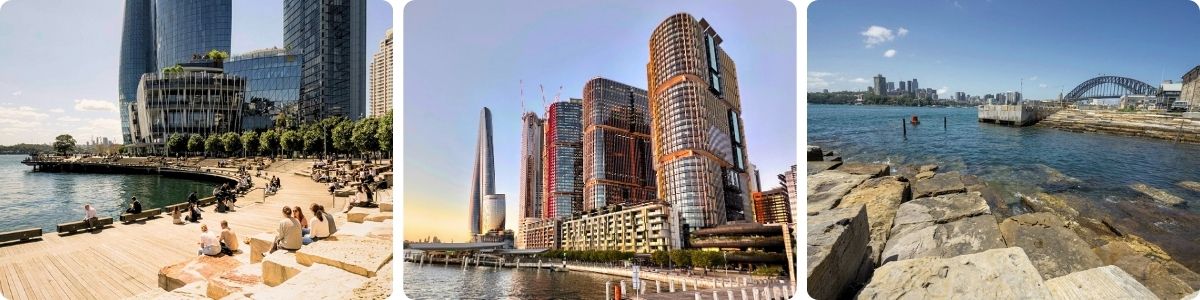
Headland Park (Barangaroo Reserve) is the standout, six hectares of reconstructed sandstone headland and native bushland with harbour walking paths, and it is free and open to the public year-round. Marrinawi Cove is a sheltered 700-square-metre swimming cove at the northern end of Barangaroo Reserve, where visitors can swim in Sydney Harbour within a netted enclosure surrounded by sandstone and native vegetation. It’s a rare chance to enjoy a harbour swim right beside Sydney’s CBD, with showers nearby and water quality regularly monitored. The Cutaway, a vast column-free event space carved into the old container wharf’s substructure, hosts exhibitions, concerts and festivals and is a point of difference for a residential precinct this size. Darling Harbour’s attractions, the Sydney Opera House, and the Royal Botanic Garden are all within easy walking or short ferry distance, making Barangaroo one of the better-positioned Sydney addresses for spontaneous weekend outings, so long as you’re happy walking rather than driving to them.
Shopping & Eating Out
There is no supermarket-anchored shopping centre here, which is worth saying plainly rather than dressing up. What Barangaroo does have is a deep dining and hospitality offering for its size: Barangaroo House, a three-level waterfront venue with rooftop bar, sits alongside the wider International Towers dining and retail precinct, which runs from casual grab-and-go through to high-end restaurants and bars along the wharf. It’s a destination dining strip that draws people in from across Sydney on a Friday night, not just a convenience for residents grabbing dinner. For day-to-day grocery and retail needs, most residents head into the CBD proper or Darling Harbour, both an easy walk away.
Transport
Barangaroo Metro Station opened on 19 August 2024 as part of the Sydney Metro City & Southwest extension, sitting on what is officially the Metro North West & Bankstown Line once through-running to Bankstown is completed in 2026. It puts the CBD’s core, North Sydney, and Sydney’s north-west within a single-seat ride, no line changes required. Wynyard Station, serving the T1 North Shore & Western Line among others, is a walkable ten minutes away for anyone who prefers heavy rail. The Barangaroo ferry wharf adds Parramatta River and inner-harbour services without needing to detour via Circular Quay. Bus routes running along Kent Street and through the CBD interchange network connect into the wider Sydney public bus system, though most residents simply walk. Car ownership is low here by Sydney standards; if you need a car for regular use, Barangaroo’s tight, largely underground parking supply and general urban-precinct traffic management make it more hassle than convenience.
Healthcare
Myhealth Medical Centre Barangaroo provides on-site general practice, bulk-billing options, and basic vaccination services, which covers the everyday need. For anything more serious, the nearest hospitals are Sydney and Sydney Eye Hospital on Macquarie Street (general and emergency care, a short taxi or brisk walk through the CBD) and St Vincent’s Hospital in Darlinghurst, a major tertiary and trauma centre a few kilometres east. Neither is walkable in an emergency the way it would be in a suburb built around a hospital precinct, so residents lean on rideshare or ambulance rather than a stroll.
Schools and Childcare
There is no dedicated government school inside Barangaroo, and given the resident population is barely a few hundred people, that isn’t likely to change soon. Ultimo Public School is the nearest government primary catchment option realistically available to families here, with the broader pool of inner-city independent and selective schools (accessible via the CBD’s transport links) doing the heavier lifting for secondary options. Childcare is workable rather than generous: a handful of long day care centres, including Guardian Childcare & Education Barangaroo, operate within or immediately adjacent to the precinct, sized more around the daytime worker population commuting into International Towers than a resident family base. A resident family should expect to book early and to widen their search radius into the CBD and Pyrmont rather than assume a Barangaroo-only solution exists.
Crime and Safety
Crime statistics are recorded at the City of Sydney LGA level by BOCSAR, and that LGA consistently posts some of the highest raw incident totals in NSW for offences such as non-domestic assault, theft, and alcohol-related incidents, a pattern driven heavily by the CBD’s nightlife and entertainment precincts rather than by any single residential pocket. There is no suburb-specific figure for Barangaroo itself, and given the small resident population, one wouldn’t be statistically meaningful even if it existed. Anecdotally, Barangaroo’s own streets feel considerably calmer than George Street or Kings Cross of an evening: it is a heavily managed private precinct with visible security around the towers and dining strip, more corporate campus after hours than nightlife strip. Treat the LGA number as context for the wider council area, not as a description of what it’s actually like to walk home in Barangaroo at night.
Realty Market
Barangaroo’s property market is unlike almost anywhere else in Sydney because there is, in effect, only one product on offer: apartments, from one-bedroom units through to full-floor penthouses. There are no houses, no townhouses, and no semis, so any comparison to a “median house price” is meaningless here and best stated as not applicable rather than forced.
On Domain’s trailing 12-month sales data (accessed September 2026), a one-bedroom apartment sits around $2.0 million, a two-bedroom around $3.8 million, and a three-bedroom around $7.65 million. These are extraordinary figures by any Sydney benchmark, and they sit at the very top of the national apartment market: Barangaroo also holds the record for Australia’s most expensive single residential sale, a $141.55 million penthouse (Elite Agent, 2026). Buyers here are overwhelmingly cash-rich owner-occupiers and offshore or domestic investors chasing trophy assets and harbour views, rather than first-home buyers or typical upgraders. A precise 12-month percentage change wasn’t published alongside Domain’s figures at the time of writing, and given the tiny number of annual sales in a precinct this size, any such percentage would swing heavily on one or two large transactions rather than reflecting a market trend.
The rental market tells a related but distinct story. ABS 2021 Census data shows 62.5 percent of Barangaroo households rent, nearly double the NSW average of 32.6 percent, reflecting a mix of corporate leases, executive relocations, and investor-owned stock. Median weekly rent sits around $1,246, against a median weekly household income of $4,591, both figures pointing to a market built almost entirely around high-income tenants rather than typical Sydney renters. Two and three-bedroom units currently list from roughly $2,000 to $4,500 per week (Domain, accessed September 2026). It is less compelling for investors primarily focused on rental yield, given how high the entry price sits relative to achievable rent; the appeal here is capital prestige and long-term harbour scarcity value rather than a strong yield case.
Our Honest Thoughts
Barangaroo suits senior professionals and executives working in the towers or elsewhere in the CBD who want to walk to work, who value harbour views and five-star dining more than a backyard, and who have the budget to treat a one-bedroom apartment as a multi-million-dollar purchase without blinking. It also suits investors chasing a trophy Sydney harbour asset for long-term capital growth, not rental yield.
It does not suit families with a local school run, anyone on a typical Sydney household income, or buyers who want the social texture of an established suburb, corner shops, a mixed-age street life, neighbours who’ve been there for decades. For that comparison, The Rocks next door is the natural cross-shop: similarly tiny, similarly harbourside, but with nineteenth-century texture, heritage pubs, and a settled, if equally thin, resident population, against Barangaroo’s glass-and-steel newness and much larger scale of commercial life around it. If instead your priority is maximum urban energy and a wider range of price points within the same CBD-adjacent radius, the Sydney CBD profile is the more useful read.
Frequently Asked Questions
Is Barangaroo a good place for families with children?
Not typically, and not by design. There is no dedicated in-suburb government school, childcare places are tight, and the resident population skews heavily towards professional couples and singles rather than families. Families who do live here generally rely on nearby CBD-fringe schooling and childcare rather than expecting a local option.
How do you get to Barangaroo without a car?
Very easily. Barangaroo Metro Station opened on 19 August 2024 on the Sydney Metro network, Wynyard Station is a short walk away for T1 North Shore & Western Line services, and the Barangaroo ferry wharf adds harbour services. Most residents and workers move around on foot, metro, or ferry rather than by car.
Is Central Barangaroo finished yet?
No. Central Barangaroo, the precinct’s final stage, received planning approval from the NSW Minister for Planning and Public Spaces in February 2025 under a concept plan modification, with Aqualand delivering it progressively. As of 2026 it remains under construction, with a mix of apartments, retail, restaurants, a hotel, and a waterfront park still being built out. No fixed overall completion date has been published.
Why is it called Barangaroo?
The precinct is named after Barangaroo, a Cammeraygal woman and senior figure in early colonial-era Sydney, and the wife of Bennelong. The naming was a deliberate act of Aboriginal heritage recognition on a site whose history long predates its recent use as a container wharf.
Can you buy a house in Barangaroo?
No. There is no detached house stock in Barangaroo at all. Every residential property is an apartment, ranging from one-bedroom units to multi-level penthouses.
References
- Australian Bureau of Statistics, 2021 Census QuickStats and Community Profile: Barangaroo (SAL10192), accessed September 2026
- Transport for NSW / Sydney Metro, Barangaroo Metro Station opening details, 19 August 2024
- NSW Department of Planning and Public Spaces / Barangaroo.com, Central Barangaroo Concept Plan Modification 9 approval, February 2025
- Bureau of Crime Statistics and Research (BOCSAR), NSW Recorded Crime Statistics quarterly updates, 2025-2026
- Barangaroo.com, Aboriginal Culture and “Barangaroo the Woman” history pages, accessed September 2026
- Barangaroo.com, “The creation of Barangaroo Reserve” and Headland Park landscaping details, accessed September 2026
- Guardian Childcare & Education, Barangaroo centre listing, ACECQA National Register, accessed September 2026
- Ultimo Public School, NSW Department of Education, accessed September 2026
- Myhealth Medical Centre Barangaroo, clinic listing, accessed September 2026
- International Towers, Dining & Shopping and Place pages, accessed September 2026
See the full list of Sydney suburbs or explore the broader Sydney Regions overview to understand where Barangaroo fits within Greater Sydney.