
Beaumont Hills was carved out of Kellyville in 2002 and formally named by the NSW Geographical Names Board in 2003, which makes it a suburb in its own right for barely over two decades. It is thought to be named after the birthplace of the wife of developer A.V. Jennings, whose company built much of the estate. Before the bulldozers arrived it was rural acreage on the edge of Kellyville and Kenthurst, and that history still shows: parts of the suburb, particularly toward the Kenthurst boundary, retain larger blocks and a semi-rural, equestrian-adjacent feel that most of the surrounding growth corridor has already lost.
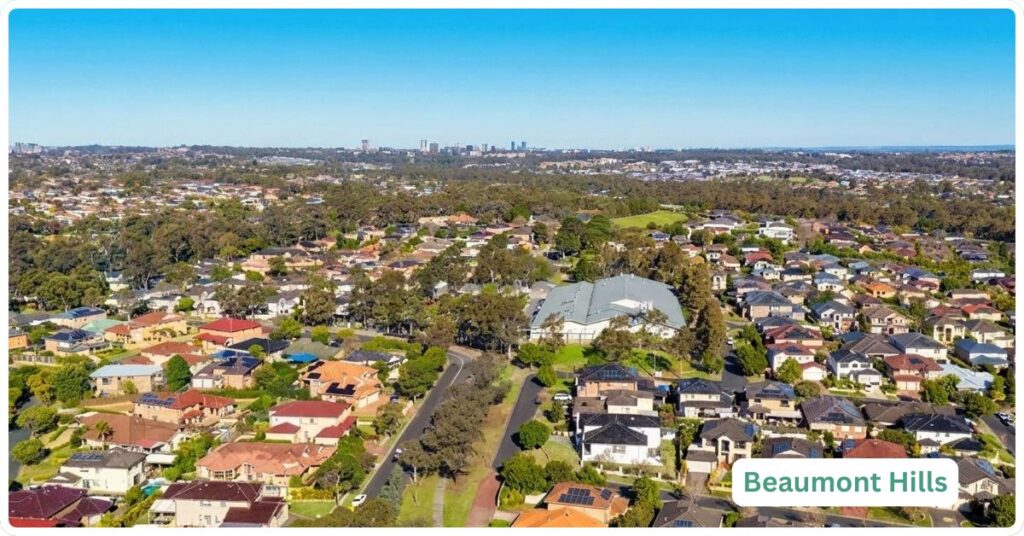
What Beaumont Hills is not, and this matters more than any other single fact about the place, is a metro suburb. Kellyville Station sits just over the boundary, but it is a drive or a bus trip away, not a walk. That single gap defines who Beaumont Hills suits: buyers chasing land size, a family-sized house and a quieter, more suburban feel who are willing to trade a train station for it. At the 2021 Census, Beaumont Hills had a population of 9,041, a median age of 38 and an average household size around 3.4 (dwellings 2,654), among the highest in Sydney and a clear marker of a suburb built for families with kids still at home, not singles or downsizers (Australian Bureau of Statistics, 2021 Census QuickStats, SAL10243).
It is also, on the numbers, one of the more expensive family suburbs in the north west. Median household income in the 2021 Census was $3,308 a week, well above the Sydney and NSW medians, and median mortgage repayments were $3,000 a month, nearly 40 per cent higher than the NSW median of $2,167. Beaumont Hills is a suburb of people paying a lot to live somewhere with big blocks and good schools and no rail line. Whether that trade makes sense for you is the honest question this page tries to answer.
Beaumont Hills Boundary and Location Map
Beaumont Hills sits in the south west of The Hills Shire, roughly 40 kilometres north west of the Sydney CBD. Rouse Hill borders it to the north, North Kellyville to the east, and Kellyville lies to the south across Samantha Riley Drive and Windsor Road. To the west, the suburb backs onto Kenthurst and Annangrove, both of which retain a more rural, larger-lot character than anywhere in the growth corridor proper. Because Beaumont Hills was only split out from Kellyville in 2002, the boundary with Kellyville in particular is more a line on a council map than something you’d notice driving through.
Quick Facts
| LGA | The Hills Shire Council |
| Postcode | 2155 |
| Population | 9,041 (2021 Census, ABS SAL10243) |
| Distance from CBD | Approximately 40km north west of the Sydney CBD |
| Named After | Thought to be the birthplace of developer A.V. Jennings’s wife; became a separate suburb in 2002, formally named in 2003 |
| Parks & Recreation | Turkey’s Nest Recreation Park, Beaumont Drive Reserve, Guardian Avenue Reserve |
| Shopping | No dedicated town centre; Kellyville Village and Rouse Hill Town Centre are the nearest retail hubs, a short drive away |
| Health | Norwest Private Hospital for private care; Blacktown Hospital for public emergency care, both a drive away |
| Median House Price | Reported between roughly $1.85m and $1.92m as of 2025, up around 2-3% on the previous year (OpenAgent, PropRadar, Domain) |
| Median Unit Price | No meaningful unit market; the suburb is almost entirely detached houses on larger blocks |
| Median Weekly Rent | $650 across all dwellings (2021 Census); listings-based estimates in 2025 put house rents higher, in the $850-950/week range |
| Rail | No station in the suburb; nearest is Kellyville Station on the Sydney Metro Northwest, a drive or bus ride away |
| Bus | Routes including 617 and 643 connect Beaumont Hills to Kellyville Station via Samantha Riley Drive |
| Road | Windsor Road and Samantha Riley Drive are the main arterials in and out of the suburb |
What Makes Beaumont Hills Special
Acreage Character on a Growth Corridor’s Doorstep
Most of the suburbs that make up Sydney’s north west growth corridor were paddocks a generation ago and are entirely new estate housing now. Beaumont Hills sits at an odd angle to that story: parts of it, especially the streets closest to the Kenthurst boundary, still carry larger blocks, some with room for a horse paddock or a shed, a holdover from the semi-rural acreage that defined this pocket before subdivision. It is not a horse suburb in the way Kenthurst or Annangrove still are, but it is closer to that character than Kellyville or Rouse Hill next door.
A Very Recent Name, A Very Established Feel
Beaumont Hills has only existed as a named suburb since 2002-03, split from Kellyville by the NSW Geographical Names Board. Despite that, much of the housing stock now reads as established rather than new: the initial A.V. Jennings-era estates are two decades old, with mature trees and settled gardens, even as newer infill continues around the edges. It is a suburb old enough to feel settled and young enough to still be finishing.
Is It Worth Visiting?
Beaumont Hills is not a destination. There’s no town centre, no headline attraction and no reason for anyone outside the district to plan a visit. Turkey’s Nest Recreation Park is a genuinely pleasant spot if you’re already in the area, with real bushland views rather than the flat sporting fields that pass for green space in a lot of the surrounding growth suburbs, but it’s not worth a special trip. This is a suburb that exists for the people who live in it.
What Is It Like Living Here?
Living in Beaumont Hills means living around families with money and a car, or two. The 2021 Census recorded 2,515 families, a median age of 38, and an average household size around 3.4, all pointing to a suburb built for kids still at home rather than singles or retirees. Median weekly household income of $3,308 sits well above the Sydney median, and 59.6 per cent of dwellings were owned with a mortgage, with median repayments of $3,000 a month, roughly 40 per cent higher than the NSW median. This is a suburb where residents are paying a real premium, in mortgage terms, for land size and school access rather than transport convenience: just 2.8 per cent of employed residents travelled to work by public transport at the last Census, against 38.4 per cent who drove, a clear signal of how car-dependent daily life here actually is.
Beaumont Hills is also more culturally mixed than its Hills District reputation might suggest. Only 56.5 per cent of residents were born in Australia, with India (6.0%), China (5.1%), the Philippines (3.7%) and South Africa (3.1%) the next most common countries of birth, and only 27.5 per cent of residents had both parents born in Australia, against a NSW average of 43.7 per cent. Almost half of all households (48.0%) use a language other than English at home, well above the NSW average of 29.5 per cent. This is a first-and-second-generation migrant family suburb as much as it is an old-money acreage one.
Hospitals
Beaumont Hills Family Practice handles day-to-day medical concerns, and surprisingly, there isn’t much else. If busy, nearby in adjacent suburbs there is Rouse Hill Family Medical Practice, Northwest Health Medical Centre and the Rouse Hill Medicare Urgent Care Clinic. There is no hospital in Beaumont Hills itself. Norwest Private Hospital in Bella Vista covers private surgical and maternity care for the district, and Blacktown Hospital is the public option for emergency care, both requiring a drive of 20 minutes or more depending on traffic.
Education
Beaumont Hills Public School, on Forest Crescent, is the suburb’s own government primary school, a K-6 school enrolling around 466 students in 2025, with half its students from language backgrounds other than English (NSW Department of Education, Beaumont Hills Public School 2024 Annual Report). There is no dedicated government high school within the suburb; Kellyville High School and Crestwood High School, both nearby, are the more commonly cited secondary options, though catchment boundaries shift and should be checked directly with the NSW Department of Education before assuming a specific address is zoned for either. St Angela’s Primary in neighbouring Castle Hill is a Catholic option some local families use. As with most of this corridor, school-zone certainty is worth confirming property by property rather than assuming from the suburb name alone.
Industry & Work Life
Beaumont Hills is almost entirely residential, with no significant local employment base of its own. Most residents commute to the Norwest Business Park, Castle Hill or further into Sydney for work, and the absence of a local metro station means that commute is disproportionately by car compared with neighbours like Kellyville or Rouse Hill that sit directly on the Metro Northwest line.
Parks and Natural Spaces
Turkey’s Nest Recreation Park is the standout: a heritage-listed site set in a bushland pocket with concrete walking paths, picnic areas, interpretive signage, a playground and public toilets, offering sweeping views that most of the pure suburban parks in this corridor don’t have (The Hills Shire Council).
Caddies Creek Reserve offers four mixed-use sports fields, a playground and walking trails. The nearby Caddies Creek Reserve offers a native bushland greenspace. Beaumont Drive Reserve and Guardian Avenue Reserve cover the more typical local playground and picnic needs, and Balmoral Road Reserve, just over the Kellyville boundary, adds sporting fields within easy reach for residents on that side of the suburb. It’s a smaller, less purpose-built parks network than you’ll find in newer, masterplanned estates nearby, which tracks with Beaumont Hills having grown up piecemeal rather than to a single estate plan.
Transport
Beaumont Hills has no railway station of its own, and it’s honest to say this is a genuinely car-dependent suburb by the standards of its metro-connected neighbours.
Kellyville Station, on the Sydney Metro Northwest line, sits just over the boundary and is the nearest station, but reaching it means a drive or a bus trip, not a walk from most addresses in the suburb. If you live on the southern end of the suburb, it’s a 5-min car ride, or a 15-min bus ride to the station.
If you live on the northwestern side of the suburb, then Rouse Hill Station becomes convenient (sort of). That area of Rouse Hill is separated by Caddies Creek, making it a dog-legged journey to reach the station, but a short one by car at 5 minutes or so, depending where you are based.
Bus route 617 connects Beaumont Hills and Rouse Hill to Kellyville Station via Mile End Road, Milford Drive, Withers Road, The Parkway, Brampton Drive and Samantha Riley Drive. Route 643 runs as a weekday peak-hour service between Samantha Riley Drive and Kellyville Station. Outside peak times and peak directions, services thin out noticeably, which is worth factoring in if you don’t drive.
Windsor Road and Samantha Riley Drive are the suburb’s two main arterials. Samantha Riley Drive provides the direct link to Kellyville Station’s entrance off Windsor Road and Newbury Avenue, and both roads carry heavy peak-hour traffic as they funnel Beaumont Hills, Kellyville and the wider corridor toward the metro and the M2/Old Northern Road network.
Beaumont Hills is roughly 40km north west of the Sydney CBD, with a typical drive of around 35-45 minutes outside peak traffic. Public transport into the city means driving or busing to Kellyville Station first, then around 40 minutes by metro from there.
Realty Market
Median house prices in Beaumont Hills are reported between roughly $1.85 million and $1.92 million as of 2025, up somewhere between 2 and 3.4 per cent over the preceding 12 months depending on the data provider (OpenAgent, PropRadar, Domain, accessed 2026). That puts it at or above Kellyville’s own median despite lacking a train station, a reflection of the larger, often more established blocks on offer here. There is effectively no unit market in the suburb; this is a house-only suburb, and buyers should expect to be competing for detached homes on larger-than-average lots rather than any apartment or townhouse stock.
The 2021 Census recorded a median weekly rent of $650 across all Beaumont Hills dwellings. More recent listings-based estimates for 2025 put typical house rents meaningfully higher, in the $850-950 a week range, tracking the broader run-up in Sydney rents since 2021 as well as the suburb’s own price premium. With owner-occupation running at around 60 per cent (owned with a mortgage) at the last Census, the rental pool here is smaller and tighter than in newer, more investor-heavy growth suburbs nearby.
The Honest Verdict
Buy in Beaumont Hills if land size and a quieter, more established feel matter more to you than a train line, and you’re comfortable driving or busing to Kellyville Station rather than walking to it. It suits families with the income to service a mortgage that, at $3,000 a month median, runs well above the NSW norm, in exchange for bigger blocks and a semi-rural edge that most of the surrounding growth corridor has already traded away. It doesn’t suit anyone who needs walk-up rail access as a daily non-negotiable; for that, Kellyville and Rouse Hill, both sitting directly on the Metro Northwest line, do the job Beaumont Hills can’t. Weighed against its closest comparables, Kellyville offers the same broad Hills District character with the metro station Beaumont Hills lacks, at a broadly similar price; Rouse Hill trades some land size for its own town-centre retail hub and station access; and Kenthurst, further west again, goes further into genuine acreage territory for buyers who want more land and fewer neighbours than even Beaumont Hills offers. If land size and a settled, family-heavy street beat a train station on your list, Beaumont Hills is a defensible pick. If the station is non-negotiable, look elsewhere in the corridor first.
Frequently Asked Questions
What is the median house price in Beaumont Hills?
Reported between roughly $1.85 million and $1.92 million as of 2025, depending on the data provider, up around 2-3.4% over the preceding 12 months. There is no meaningful unit market in the suburb.
Does Beaumont Hills have a train station?
No. The nearest is Kellyville Station on the Sydney Metro Northwest line, which sits just over the boundary but requires a drive or bus trip rather than a walk from most Beaumont Hills addresses.
Is Beaumont Hills safe?
Crime data in NSW is published at local government area level, not suburb level, so there’s no Beaumont Hills-specific figure. The Hills Shire LGA, which covers Beaumont Hills, recorded an overall crime rate of around 2,820 incidents per 100,000 people for the year to September 2025, below the NSW average, with theft, assault and intimidation/stalking/harassment the most commonly recorded offences (NSW Bureau of Crime Statistics and Research). The Hills Shire is consistently reported among Sydney’s lower-crime council areas.
What schools serve Beaumont Hills?
Beaumont Hills Public School (K-6, government) is the suburb’s own primary school, enrolling around 466 students in 2025. There’s no dedicated government high school within the suburb; Kellyville High School and Crestwood High School are the more commonly used secondary options nearby, though catchment zones should be confirmed directly with the NSW Department of Education for any specific address.
Is Beaumont Hills a good suburb for families?
On the Census numbers, yes: 2,515 families, a median age of 38 and an average household size around 3.4, among the highest in the district. It suits families who want land size and are willing to pay a premium for it, both in purchase price and in commute time, given there’s no train station in the suburb itself.
References
Australian Bureau of Statistics, 2021 Census QuickStats, Beaumont Hills (SAL10243): abs.gov.au. NSW Bureau of Crime Statistics and Research, Local Area Rankings: bocsar.nsw.gov.au. Sydney Metro, Kellyville Station: sydneymetro.info. Transport for NSW, bus operator changes across the North West and Hills District: nsw.gov.au. The Hills Shire Council, Parks and Recreation Directory (Turkey’s Nest Recreation Park, Beaumont Drive Reserve, Guardian Avenue Reserve): thehills.nsw.gov.au. NSW Department of Education, Beaumont Hills Public School 2024 Annual Report: schools.nsw.gov.au. Property price estimates: OpenAgent, PropRadar, Domain, Your Investment Property Magazine (accessed 2026). Dictionary of Sydney, Beaumont Hills: dictionaryofsydney.org.
See all suburbs in the The Hills Shire Council. See the full Sydney Regions overview to explore more of greater Sydney.