
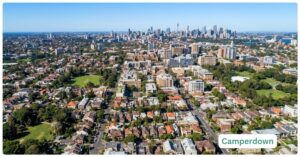
Camperdown is a hospital and university suburb before it is anything else. Royal Prince Alfred Hospital occupies a large slab of its land, the University of Sydney’s southern edge presses in from the north, and Chris O’Brien Lifehouse cancer centre sits a short walk from both.
The terrace houses that fill the remaining streets exist largely to shelter the people who staff, study at, or are treated in those three institutions. That’s the trade-off in one sentence: you get a walkable, architecturally intact inner-city pocket four kilometres from the CBD, but you also get ambulance sirens, hospital shift-change traffic, and a rental market skewed hard toward medical staff and students rather than families settling in for the long haul.
Camperdown Boundary and Location Map
Camperdown sits roughly 4 kilometres south-west of the Sydney CBD, sandwiched between Parramatta Road to the north and King Street/the Newtown rail corridor to the south. It shares postcode 2050 with Darlington and part of Newtown, and its edges blur into several LGAs at once: the University of Sydney and Darlington border it to the north-east (City of Sydney), Newtown and Enmore sit to the south and south-east, and Stanmore and Annandale lie just across the Inner West Council boundary to the west. Missenden Road, which runs the length of the suburb, is effectively the spine of the place, with Royal Prince Alfred Hospital dominating its eastern side.
Quick Facts
| LGA | City of Sydney |
| Postcode | 2050 (shared with Darlington and part of Newtown) |
| Population | 9,381 at the 2021 Census; no newer ABS estimate has been published for this small suburb as of August 2026 |
| Growth Rate | Population is effectively flat between Census counts; the housing stock is almost entirely built out, so growth shows up in prices, not new dwellings |
| Distance from CBD | Approximately 4km south-west of the Sydney CBD |
| Character | Dense inner-city terrace suburb built around a major teaching hospital and the University of Sydney’s southern campus edge; heavily rental, heavily transient |
| Median House Price | $2,199,999, up 17.96% year-on-year (Smart Property Investment, data as of August 2026). Treat with caution: house sales volumes here are low, so a handful of transactions can swing the median hard |
| Median Unit Price | $917,500, up 1.94% year-on-year (Smart Property Investment, data as of August 2026) |
| Transport | Macdonaldtown station (T2 Leppington & Inner West Line, occasional T3 Liverpool & Inner West Line services) is the nearest rail, on the suburb’s southern fringe; multiple bus routes along Parramatta Road and City Road; no light rail or metro station within the suburb itself |
| Crime Rate (LGA) | City of Sydney LGA; BOCSAR’s LGA dashboard shows theft and property offences running above the NSW average, typical of a dense inner-city LGA with heavy foot traffic, nightlife and visitor numbers, while violent crime against the person tracks closer to the state average. No Camperdown-specific figure is published; BOCSAR reports at LGA level only |
| Childcare Availability | Tight. A handful of long day care centres (Guardian Childcare & Education Camperdown, St Joseph’s Preschool and Long Day Care, Camperdown Child Care Centre among them) serve a suburb with an outsized share of working parents on hospital and university shift patterns |
| School Zone Quality | Camperdown Public School is the local government primary; secondary options are drawn from surrounding suburbs (Newtown, Petersham, Leichhardt) rather than a dedicated Camperdown high school, and Catholic/independent options (including St Joseph’s) sit within a short walk |
| Parks & Recreation | Camperdown Park and the heritage-listed Camperdown Cemetery are the two standouts, plus Victoria Park on the University of Sydney fringe |
| Shopping | Small local strip along Australia Street, Pyrmont Bridge Road and Missenden Road: cafes, a handful of restaurants and everyday retail; no full-line supermarket or shopping centre within the suburb itself, with Newtown’s King Street and Broadway Shopping Centre picking up the rest |
| Health | Royal Prince Alfred Hospital (major public teaching hospital) is physically inside the suburb, alongside Chris O’Brien Lifehouse (cancer treatment and research) and multiple GP and allied health clinics serving the hospital precinct |
| Best For | Hospital and university staff, postgraduate students and medical professionals wanting to walk to work; less suited to families chasing a quiet, child-first suburb |
What Makes Camperdown Special
History & Heritage
Camperdown takes its name from a 240-acre estate granted to Governor Bligh in August 1806 (Francis Pollon, “The Book of Sydney Suburbs,” 1988). Bligh named it in memory of the Battle of Camperdown, a naval engagement fought off the Dutch coast near the town of Camperduin, 50 kilometres north of Amsterdam, in which he had taken part in 1797. The grant ran from the junction of Orphan School Creek and Johnston’s Creek in the north, across Parramatta Road, down to Cook’s River Road. A model farm was established on the land but failed, and in 1841 the estate was subdivided into two hamlets: O’Connell Town, on Cook’s River Road, owned by Sir Maurice O’Connell (Bligh’s son-in-law), and Camperdown itself, fronting Parramatta Road.
In 1827 a racecourse opened on O’Connell’s land, with a grandstand, such as it was, standing roughly where Royal Prince Alfred Hospital’s Missenden Road site is today (Pollon, 1988). It stayed in regular use until 1833, when Randwick Racecourse, then popularly known as the Old Sandy Track, officially took over as Sydney’s main course. The Governor Bourke Hotel opened in Camperdown around the same period, with a Mrs Thompson as licensee.
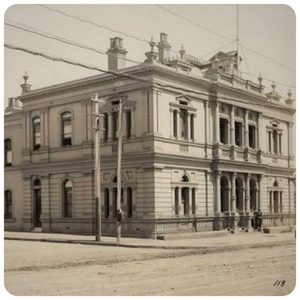
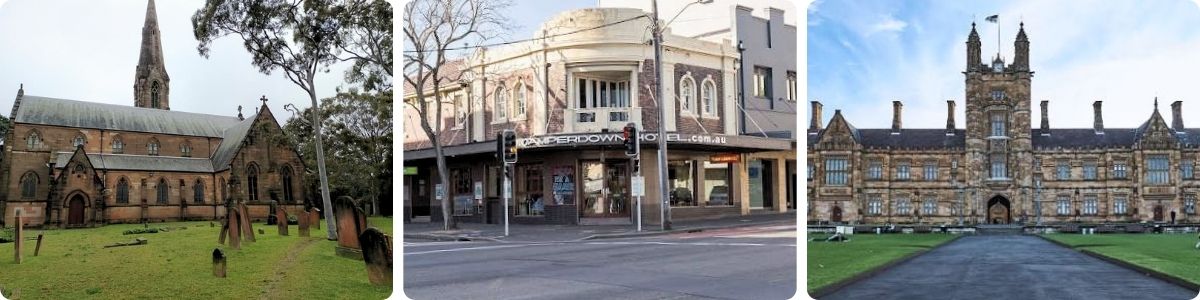
The suburb’s other defining institution arrived with the University of Sydney, incorporated in 1850, whose first buildings were designed through the 1850s by Edmund Blacket (1817-1883), including the Great Hall, opened in 1859 (Pollon, 1988). The university’s northern grounds began life as Grose Farm, 30 acres leased to Lieutenant-Governor Francis Grose in 1792 and converted by 1802 into a government experimental farm, a name that was then extended to cover the whole block between Parramatta, City and Newtown Roads.
Camperdown’s most consequential piece of civic history followed a near-tragedy rather than a triumph. In March 1868 Prince Alfred, Duke of Edinburgh, was shot and wounded by Henry O’Farrell during a picnic at Middle Harbour. The prince recovered and O’Farrell was hanged at Darlinghurst Gaol, and a public meeting in Camperdown resolved to build a permanent memorial to his “providential escape” (Pollon, 1988). Twelve acres of the university paddock, formerly part of the Wesleyan Institute, were set aside for a memorial hospital in 1873, which opened in 1882 as Royal Prince Alfred Hospital.
Two street names carry pieces of that history forward. Mallett Street recalls an early mayor, C. S. Mallett, known as a strong advocate for local ratepayers, while Carillon Avenue, on the Newtown side of the university, was originally named Bligh Street after the suburb’s founding grant-holder, renamed only when the university installed its war memorial carillon in 1928 (Pollon, 1988). Today many of Camperdown’s terrace houses have been renovated by professionals wanting to live close to the city, alongside a population of staff and students tied to the University of Sydney and Royal Prince Alfred Hospital.
A Medical and Research Precinct, Not Just a Suburb Near One
Most suburbs near a hospital are defined by proximity. Camperdown is defined by containment: Royal Prince Alfred Hospital, one of the busiest public teaching hospitals in NSW, sits inside its boundaries, and Chris O’Brien Lifehouse, the dedicated cancer treatment and research centre, is a short walk further along Missenden Road. That’s not incidental amenity, it’s the suburb’s actual economic base. Ambulance movements, shift-change foot traffic and a resident population weighted toward doctors, nurses, researchers and students are the direct, unavoidable consequence, and anyone weighing this suburb needs to price that in alongside the more obvious upside of a walk-to-work location.
Terrace Streets That Feel Like Newtown, Priced (Slightly) Differently
Away from Missenden Road and Parramatta Road, Camperdown’s back streets are almost indistinguishable from neighbouring Newtown: narrow Victorian and Edwardian terraces, iron lacework, the odd converted corner store now doing service as a house. The difference is scale rather than style. Camperdown is smaller, has far fewer transactions each year, and doesn’t carry Newtown’s King Street retail energy, so it tends to sit slightly under the radar of buyers who default straight to Newtown or Enmore without checking what’s two streets over.
What Is It Like Living in Camperdown?
Day to day, Camperdown reads as a working suburb in the literal sense: a large share of the people on its streets are on their way to or from a shift at RPA, a lecture at Sydney Uni, or a rental inspection. It’s compact enough to walk end to end in fifteen minutes, which is part of the appeal, and dense enough that parking, noise from Parramatta Road, and hospital-related traffic are constants rather than occasional annoyances.
Transport
The nearest station is Macdonaldtown, on the suburb’s southern edge, served by the T2 Leppington & Inner West Line with occasional T3 Liverpool & Inner West Line services, putting Central a few minutes away by train. It’s a smaller, quieter station than Newtown or Redfern, without the crowding, but also without the frequency of a major interchange. No Sydney Metro line or light rail service currently runs through Camperdown itself; the closest metro access is via the broader city network rather than a stop within the suburb. Bus services along Parramatta Road and City Road connect the suburb to the CBD, Broadway and Glebe, and are the more practical option for anyone living on the RPA or university side rather than near Macdonaldtown. Missenden Road and Parramatta Road are the two main arterials; both carry heavy traffic at peak times, and Parramatta Road in particular is one of Sydney’s more congested corridors, so driving into the CBD at peak hour rarely beats the train.
Healthcare
This is the section where Camperdown outperforms almost every other Sydney suburb, because the healthcare isn’t nearby, it’s on-site. Royal Prince Alfred Hospital, a major public teaching hospital attached to the University of Sydney, sits within the suburb and runs a full emergency department, alongside Chris O’Brien Lifehouse, a dedicated cancer treatment, research and support centre a short walk further down Missenden Road. GP clinics and allied health practices cluster around the hospital precinct to serve staff and outpatients. For residents, that means fast access to specialist and emergency care; for the character of the suburb, it means hospital infrastructure (ambulance bays, staff car parks, 24-hour lighting and noise) is simply part of the streetscape rather than something tucked away.
Schools and Childcare
Camperdown Public School is the local government primary option. There’s no dedicated Camperdown government high school; secondary-age families typically zone into schools in neighbouring suburbs, which is a real consideration for anyone planning to stay through the teenage years rather than a minor footnote. St Joseph’s runs a Catholic preschool and long day care presence locally, and independent options are a short commute away in Newtown, Stanmore and the inner west more broadly. Childcare supply is tight relative to demand: a small number of long day care centres, including Guardian Childcare & Education Camperdown, St Joseph’s Preschool and Long Day Care, and Camperdown Child Care Centre, serve a resident base that skews heavily toward working parents on hospital and university shift patterns rather than the standard 9-to-5, which makes flexible-hours care scarce and worth locking in well ahead of need.
Industry & Work Life
Health care and education are, quite literally, the industries here. Royal Prince Alfred Hospital and Chris O’Brien Lifehouse between them employ a large cross-section of the suburb’s working residents, and the University of Sydney’s southern campus edge adds academic and administrative staff plus a large postgraduate and research student population. Camperdown also falls partly within the City of Sydney’s Tech Central innovation precinct, the technology and innovation corridor running from Central Station down toward Camperdown; a 2023 council consultation on how the precinct should grow around the hospital and university has closed, with future planning changes still to be worked through as of August 2026. For residents who don’t work in health, education or the emerging tech precinct, the CBD is a short train or bus ride away via Macdonaldtown or the Parramatta Road bus corridor.
Shopping & Eating Out
Don’t expect a shopping centre. Camperdown’s retail is a small, local strip along Australia Street, Pyrmont Bridge Road and parts of Missenden Road: cafes serving the hospital and student crowd, a handful of restaurants, and everyday convenience retail rather than department stores or a full-line supermarket. For anything beyond that, Newtown’s King Street is a short walk south and does the heavy lifting for groceries, bars, live music and a much larger dining scene, while Broadway Shopping Centre near the University of Sydney covers a full-line supermarket, a Kmart and a cinema. What Camperdown has of its own is worth having for a coffee before a hospital shift or a quick meal near campus; it’s not a suburb you’d choose for its own retail strip alone.
Attractions, Parks and Natural Spaces
Camperdown Cemetery is the suburb’s point of difference: a heritage-listed, mostly-closed 19th century burial ground (one of Sydney’s oldest surviving cemeteries) that doubles as a shaded, atmospheric green space rather than a conventional park, complete with the adjoining St Stephen’s Anglican Church. Camperdown Park sits alongside it and is the suburb’s main everyday green space, used for casual sport and dog walking rather than organised facilities. Victoria Park, on the University of Sydney fringe, adds a larger open space with a running loop and pool nearby for residents willing to walk a little further. None of this replaces a Centennial Park or a harbour foreshore; Camperdown’s green space is small, historic and largely incidental to the suburb’s medical and academic function rather than a drawcard in its own right.
Crime and Safety
BOCSAR reports crime at the local government area level, not suburb by suburb, so there’s no Camperdown-specific figure to quote, and any suburb page that gives you one is making it up. At the City of Sydney LGA level, BOCSAR’s crime dashboard shows theft and property offences running above the NSW average, consistent with a dense, high-footfall inner-city LGA that includes nightlife, retail and tourist precincts well beyond Camperdown itself, while rates of violent crime against the person sit closer to the state average. Camperdown’s own character (hospital security presence, university foot traffic, relatively low nightlife activity compared with Newtown or the CBD) means the LGA-wide figure almost certainly overstates the suburb’s actual risk profile.
Realty Market
Camperdown’s housing stock is dominated by terrace houses and semis, with a smaller but apartment stock clustered nearer Parramatta Road and the university fringe. As of August 2026, Smart Property Investment has the median house price at $2,199,999, up 17.96% year-on-year, and the median unit price at $917,500, up 1.94% over the same period. Take the house figure with real caution: this is a small suburb with a low annual transaction count, so a run of a few expensive terrace sales can swing the median hard in a single quarter, and the 18% jump likely reflects that thin-sample volatility as much as market movement. Time on market runs to roughly 95.6 days for houses and 58.1 days for units on the same data, meaningfully slower than the frenetic pace of nearby Newtown, which points to a smaller, more considered buyer pool rather than heavy competition.
Rental demand is where Camperdown diverges from a typical inner-west suburb. With RPA, Lifehouse and the University of Sydney all within walking distance, the rental pool is dominated by hospital staff, postgraduate students and medical professionals on shorter-term leases rather than families settling in for the long haul, and average household size sits at a low 1.8-1.9 people per dwelling (Smart Property Investment / htag.com.au, 2021 Census-based, accessed August 2026), reflecting a suburb of share houses, couples and singles rather than family homes. Separate rental data from htag.com.au puts the median asking rent at $1,309 per week, up 11.71% year-on-year as of mid-2026, with stock reported extremely tight (sub-1% of stock on market, around one month of inventory). That combination, high rent growth against very thin supply, is a investor consideration; it also means anyone renting here should expect competition for a limited pool of listings, particularly around university semester starts.
Our Honest Verdict
Camperdown is a unusual proposition and it won’t suit most buyers looking at inner-west Sydney. It is likely to appeal most to hospital and university staff who want to walk to work, postgraduate students and academics tied to the University of Sydney, and buyers or investors comfortable with a small, thin, transient rental market in exchange for one of the shortest commutes to a major employment precinct anywhere in inner Sydney. It is less compelling for families chasing a settled, child-first suburb with a strong local high school and a quiet street, given the lack of a dedicated Camperdown government high school and the constant hum of hospital and Parramatta Road traffic. It’s also a weaker pick for investors chasing simple, high-turnover rental yield, given the thin annual sales volume and the price volatility that comes with it.
The natural comparison is Newtown, immediately south. Newtown offers the same terrace housing stock and inner-city walkability, but with a far larger retail and dining strip along King Street, better train frequency, and a broader buyer pool that isn’t as tightly tethered to one hospital and one university. If what you actually want is inner-west terrace living with more life on the street, Newtown does that better. If what you want is to walk to a hospital shift or a lecture in under ten minutes and you’re willing to trade suburb-wide amenity for that, Camperdown does something Newtown can’t.
Frequently Asked Questions
Is Camperdown a good suburb for families?
It’s workable for families with younger children who can use Camperdown Public School, but there’s no dedicated Camperdown government high school, meaning most families end up zoning or enrolling into a neighbouring suburb by high school age. Combined with heavy hospital and Parramatta Road traffic and a rental market weighted toward students and hospital staff, most established families looking for a settled, child-first environment will find Newtown, Stanmore or Petersham a more natural fit.
What train station serves Camperdown?
Macdonaldtown, on the suburb’s southern edge, served by the T2 Leppington & Inner West Line with occasional T3 Liverpool & Inner West Line services. There’s no light rail or Sydney Metro stop within Camperdown itself; buses along Parramatta Road and City Road cover the rest of the suburb.
Why is Royal Prince Alfred Hospital in Camperdown, not Newtown?
RPA and the University of Sydney’s southern campus buildings both sit within Camperdown’s boundaries, not Newtown’s, even though the two suburbs are often talked about together. It’s a common mix-up because the hospital’s Missenden Road address and the postcode overlap with Darlington and part of Newtown make the boundary easy to blur.
Is Camperdown expensive to buy into?
Houses are expensive by any Sydney measure (a median around $2.2 million as of August 2026), though the small number of annual sales means that figure moves around more than in a larger suburb. Units are considerably more accessible, with a median close to $917,500 over the same period, and are the more realistic entry point for most buyers.
Is Camperdown safe to live in?
There’s no suburb-specific crime figure published; BOCSAR reports at the City of Sydney LGA level only, and that LGA-wide figure covers far busier nightlife and tourist precincts than Camperdown itself. Property and theft offences run above the NSW average across the LGA, while violent crime tracks closer to the state average; Camperdown’s own hospital security presence and comparatively low nightlife activity likely put it below the LGA-wide average in practice, though that’s an inference rather than a measured statistic.
References
- Australian Bureau of Statistics, 2021 Census of Population and Housing, Camperdown (population, age, birthplace, language and religion figures)
- NSW Bureau of Crime Statistics and Research (BOCSAR), Crime and Policing statistics dashboard, City of Sydney LGA, accessed 23 August 2026
- NSW Government Health Infrastructure, Royal Prince Alfred Hospital Redevelopment project updates, accessed 23 August 2026
- Chris O’Brien Lifehouse, About Lifehouse (facility location and services), accessed 23 August 2026
- City of Sydney Council, “Help plan the emerging Tech Central precinct in Camperdown” consultation page, accessed 23 August 2026
- ACECQA National Registers, childcare service listings for Camperdown NSW (Guardian Childcare & Education Camperdown, St Joseph’s Preschool and Long Day Care, Camperdown Child Care Centre), accessed 23 August 2026
- NSW Department of Education, Camperdown Public School listing and NSW school intake zone data, accessed 23 August 2026
- Transport for NSW, Macdonaldtown railway station line information (T2 Leppington & Inner West Line, T3 Liverpool & Inner West Line services), accessed 23 August 2026
For more suburb profiles across the city, browse the full Sydney suburbs directory, or step back and explore the Sydney regions overview to see how Camperdown fits into the broader inner-west and City of Sydney picture.