
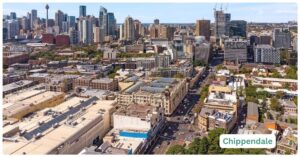
Chippendale is what happens when a brewery closes and nobody tears the whole thing down. For most of the twentieth century this was 0.5 square kilometres of workers’ terraces backing onto the Kent Brewery (later Carlton United Brewery), a gritty, industrial pocket wedged between Central Station and the University of Sydney. The brewery closed in 2004. What replaced it, Central Park, is one of the few Sydney redevelopments that actually changed how a suburb functions rather than just how it looks: a 350-tonne vertical garden on the side of a 34-storey tower, a basement food hall, and enough new apartment stock to more than double the suburb’s dwelling count. The trade-off is real and worth saying plainly. Chippendale now has almost no houses left to speak of and very little green space of its own; what it has instead is density, a short walk to two universities and the CBD, and a laneway culture around Kensington Street that most new-build precincts never manage to buy.
Chippendale Boundary and Location Map
Chippendale sits about 2 kilometres south of the Sydney CBD, in the City of Sydney LGA, running roughly from Broadway in the north down to Cleveland Street in the south, and from Regent Street and Central Station in the east across to City Road and the University of Sydney in the west. It borders Ultimo and Haymarket across Broadway to the north, Darlington and Camperdown (home to the University of Sydney and UTS) to the west, Redfern to the south and southwest, and Surry Hills to the east across the rail corridor. It is small enough to walk end to end in fifteen minutes, and everything in it is walkable to Central Station.
Quick Facts
| LGA | City of Sydney |
| Postcode | 2008 |
| Population | Approx. 9,506 (SA2 estimate, May 2026), up from 7,803 at the 2021 Census and 8,617 in 2016 (AreaSearch, ABS QuickStats) |
| Growth Rate | Down 9.4% between 2016 and 2021 (construction disruption during the Central Park build), then up 21.8% from the 2021 Census to the May 2026 estimate as new towers filled up |
| Distance from CBD | Approx. 2km south of the Sydney CBD; 10-12 minute walk to Central Station |
| Character | Dense, apartment-heavy inner-city suburb built around a former brewery site, terrace streets, laneway dining and student/young-professional renters |
| Median House Price | Around $2,000,000 on a thin sample of 17 sales in the 12 months to mid-2026 (YIP); Domain’s April 2026 market report notes 2025 house transactions were too few to produce a reliable median at all. Treat any house figure here as indicative, not a market |
| Median Unit Price | $767,500, up 0.3% over the 12 months to April 2026 (Domain); a separate YIP snapshot from the same period puts it closer to $800,000, up 9.59% annually. Take the range, not either single number, as the read |
| Transport | 10-12 minute walk to Central Station (Sydney Trains, Sydney Metro, light rail); frequent buses along Broadway and Cleveland Street |
| Crime Rate (LGA) | No suburb-specific data exists; City of Sydney LGA context from BOCSAR’s December 2025 quarterly update shows Greater Sydney retail theft up 13.5% over two years while non-domestic assault fell 4.0% and robbery fell 8.9% over the same period |
| Childcare Availability | Tight but workable: a handful of long day care centres (SDN Chippendale, Blackfriars Children’s Centre, Care-A-Lot, SAGE Early Education, plus UTS Child Care nearby) serving a suburb with a high concentration of young renters and relatively few young families |
| School Zone Quality | No government primary or high school sits inside Chippendale itself; nearest zoned options are just outside the suburb (Bourke Street Public School, Cleveland Street area schools), which matters if you’re planning to stay through school age |
| Parks & Recreation | Very little standalone green space (ABS puts park coverage at roughly 2.9% of the suburb); Central Park’s own landscaped grounds and vertical garden are the suburb’s main outdoor amenity, with Prince Alfred Park a short walk away via Central |
| Shopping | Kensington Street laneway precinct, Spice Alley hawker-style food court, and the retail base of Central Park (Broadway Shopping Centre adjoins directly) |
| Health | Royal Prince Alfred Hospital in adjoining Camperdown is the nearest major public hospital; GPs cluster around Broadway and City Road |
| Best For | Young professionals, students and downsizers who want CBD-adjacent apartment living and are comfortable trading a backyard and a car space for a short walk to two universities and the city |
What Makes Chippendale Special
History
William Chippendale was a free settler who arrived in the colony of New South Wales carrying a letter from Earl Bathurst, requesting that Governor Macquarie arrange a land grant for the new immigrant (Francis Pollon, “The Book of Sydney Suburbs,” 1988). In 1819 Chippendale was granted 95 acres, a parcel that included the present site of Redfern Station. He later sold the land to Solomon Levey (1794-1833), a prominent figure in the colony’s commercial world, and the Chippendale name stuck to the area regardless of the sale.
In 1838 part of the land was sold off and subdivided, and Chippendale developed into a suburb that was part residential and part industrial, a mixed character it held for well over a century (Pollon, 1988). That history is legible today in its nineteenth-century terraces and cottages, many of which have since been carefully renovated rather than replaced, giving the suburb its present appeal to people wanting inner-city living within walking distance of Victoria Park, its bowling club and popular swimming pool, the University of Sydney, the Broadway shops, and Central Railway Station.
Chippendale, who gave the suburb its name, is remembered locally by two streets: Chippen Street and Dale Avenue (Pollon, 1988). Solomon Levey, the man he sold the land to, has his own memorial in Levey Street, a small but neat piece of symmetry: the original grant-holder and the buyer who built on it both still have their names written into the suburb’s map.
A Brewery Site That Became a Landmark
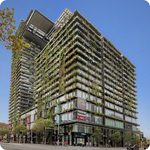
Central Park, built on the old Kent Brewery site through the 2010s, is the reason Chippendale gets talked about at all outside Sydney. One Central Park’s vertical garden, designed by Patrick Blanc and covering the tower in roughly 250 plant species across 21 vertical gardens, is an architectural landmark, and it’s visible from well beyond the suburb’s own boundaries.
Underneath it sits a basement-level food and retail precinct that plugs directly into Broadway Shopping Centre next door, which is what makes daily life here workable without a car: a full-line Woolworths, a chemist, and a run of casual dining within the same building as several thousand apartments. It’s a rare case of a “vertical village” development actually delivering the ground-floor amenity it promised on the way up.
Kensington Street and a Laneway Culture That Predates the Redevelopment
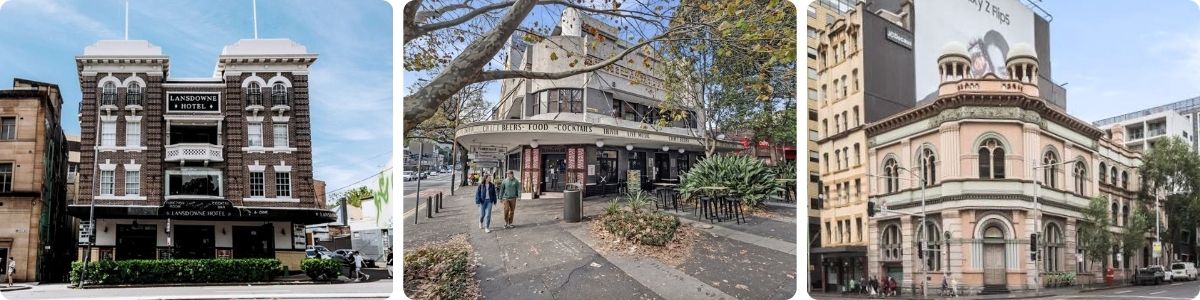
What separates Chippendale from a generic Sydney apartment precinct is that the redevelopment didn’t erase the old terrace-and-warehouse fabric next door, it built alongside it. Kensington Street runs through a row of restored 19th-century terraces and former brewery workers’ cottages, now home to Spice Alley, a cash-only, communal-seating hawker-style food court modelled on Southeast Asian street food markets, and to the White Rabbit Gallery, a free contemporary Chinese art museum housed in a converted Rolls-Royce warehouse at 30 Balfour Street. That combination, brewery-scale redevelopment on one side of the street and a preserved laneway on the other, is the actual point of difference here, not a marketing line about “vibrant lifestyle precincts.”
What Is It Like Living Here?
Day to day, Chippendale reads less like a residential suburb and more like a very well-located, very dense apartment estate with a couple of streets of old terraces stitched onto it. You’ll rarely drive anywhere. You’ll walk to Central for the train, walk to Broadway for groceries, and walk to Sydney University or UTS if that’s where you study or work. What you won’t get is a backyard, a driveway, or much silence: construction around the wider Central precinct (Tech Central, the Central Station Metro upgrade) is still an active part of the soundscape as of 2026, and the population density means footpaths and the local Woolworths get busy at peak times.
Chippendale’s working population skews heavily toward professional occupations, and the reason isn’t hard to find: it sits between two universities and Sydney’s fastest-growing tech and health precinct. The University of Sydney and UTS employ and educate large numbers of residents directly, Royal Prince Alfred Hospital next door is a major employer in health and medical research, and South Eveleigh (Australian Technology Park) a short walk south hosts Atlassian’s headquarters, Commonwealth Bank, and a growing tenant base under the state government’s Tech Central initiative, which is actively planning more housing and commercial floor space across the Central-to-Eveleigh corridor as of 2026. Median household income of around $1,606 a week (FY2023 data indexed to March 2026, AreaSearch) sits above the Sydney metro median, consistent with a suburb full of professionals and postgraduate students rather than families on a single wage.
For commuters, Central Station is the whole point of living in Chippendale, and it’s a 10-12 minute walk from most of the suburb’s streets, closer from the Central Park end near Broadway. Central carries almost every Sydney Trains suburban line except the T5 Cumberland Line, including direct services on the T8 Airport & South Line and the T4 Eastern Suburbs & Illawarra Line. Since 19 August 2024, Central also has two Sydney Metro platforms (26 and 27) on the Metro North West & Bankstown Line, reached via the new Central Walk concourse, plus light rail: the L1 Dulwich Hill line terminates at Central Grand Concourse, and the L2 Randwick and L3 Kingsford lines run through Central Chalmers Street en route to Circular Quay. Frequent bus services run along Broadway and Cleveland Street toward the CBD and the inner west, useful for the (fairly common) days you don’t feel like the walk. What you won’t find is any need for a car; on-street parking is scarce and mostly permit-restricted, and most residents don’t own one.
Royal Prince Alfred Hospital, one of Sydney’s largest public teaching hospitals, sits in adjoining Camperdown, close enough to walk from most of Chippendale. St Vincent’s Hospital in Darlinghurst is a further option, reachable by bus or a short train-and-walk combination, and is the closer major emergency department for anyone living on the eastern side of the suburb near Central. GPs are accessible rather than abundant: clinics cluster around Broadway, City Road and Central Station rather than within Chippendale’s own residential streets, reflecting the suburb’s apartment-and-student character rather than a shortage of care in the broader area.
On the education front, Chippendale has no government primary or high school within its own boundaries, and honestly, the demographics explain why: the 2021 Census shows only around 5% of households are couples with children, against 46% single-person households, so a school inside the suburb has never been the priority for developers or the department. Families here are zoned to nearby options, with Bourke Street Public School (just over the border in Surry Hills) among the closer choices, and Cleveland Street’s schools in reach for older students. If staying through the school years matters to you, treat this as a constraint rather than a detail to work around later; most families who want a Chippendale postcode long-term end up moving a suburb or two out once children reach school age.
Childcare is tighter than the suburb’s population would suggest, precisely because so few residents have young children yet. A small cluster of long day care options exists within or right on the border of Chippendale, including SDN Chippendale Children’s Education and Care Centre, Blackfriars Children’s Centre, Care-A-Lot Childcare Centre, SAGE Early Education Centre, and UTS Child Care Incorporated servicing the university community next door. That’s a workable but not deep supply for a suburb this dense; anyone planning ahead should get on a waitlist earlier than they would in a more established family suburb.
Broadway Shopping Centre sits directly against Central Park and functions as Chippendale’s supermarket and everyday retail, anchored by a full-line Woolworths and the usual food court and pharmacy tenants. For dining with actual character, Kensington Street is the drawcard: Spice Alley (communal, cash-friendly, hawker-style Southeast Asian food stalls) and a run of independent restaurants and small bars along the same strip. Central Park’s own retail base at street level adds cafes and casual dining that serve the tower residents directly. It’s not a suburb built around a traditional high street, it’s a suburb built around one very good laneway and one very large shopping centre, and that combination covers most day-to-day needs without a car.
The vertical garden on One Central Park is the suburb’s single most photographed feature and is worth seeing in person; it’s a functioning piece of architecture, not just a render that got built smaller. The White Rabbit Gallery at 30 Balfour Street is a drawcard beyond the suburb’s own residents, a free contemporary Chinese art museum open Wednesday to Sunday, 10am to 5pm. Green space of Chippendale’s own is thin (roughly 2.9% park coverage across the suburb), largely limited to Central Park’s own landscaped grounds and a scattering of pocket parks among the terrace streets. For anything larger, Prince Alfred Park, with its public pool, athletics track and open lawns, sits just across Central Station and is realistically the local park for most Chippendale residents, even though it technically falls in Surry Hills.
Crime and Safety
BOCSAR does not publish suburb-level crime statistics, and no Chippendale-specific figure exists, so anything claiming otherwise should be treated with suspicion. What can be said honestly is the City of Sydney LGA context: BOCSAR’s December 2025 quarterly update (published 18 March 2026) shows non-domestic violence assault down 4.0% and robbery down 8.9% over the preceding two years, against a backdrop of retail theft rising 13.5% across Greater Sydney over the same period, driven largely by shoplifting. For a dense, transient, high-foot-traffic suburb wedged between Central Station and two universities, the realistic day-to-day risk profile is opportunistic (bike and phone theft, and the general low-level property crime that comes with a suburb full of short-term renters and constant pedestrian traffic) rather than anything more serious. Treat this as LGA-wide context, not a suburb guarantee.
Realty Market
Chippendale is not really a house market at all. YIP’s most recent snapshot puts the median house price around $2,000,000, but on just 17 sales in the preceding 12 months, and Domain’s April 2026 market report goes further, stating there were too few 2025 house transactions in Chippendale to produce a reliable median price at all. Any house figure quoted for this suburb should be read as a signal of scarcity value for the handful of surviving terraces and warehouse conversions, not as a market with any depth.
Units are where the real market sits. Domain’s April 2026 figures put the median unit price at $767,500, up a modest 0.3% over the year, a pace Domain attributes directly to the sheer volume of apartment stock Central Park added to the suburb, which has kept unit price growth flat compared with tighter inner-city markets. A separate YIP snapshot from around the same period shows a higher figure, close to $800,000 and up 9.59% annually on 171 sales, with units spending an average of 64 days on market. The gap between those two figures is a reasonable illustration of how much the median moves depending on exactly which building mix sold in a given quarter; take it as a $760,000 to $800,000 range rather than a single number. Domain also flags a mixed buyer pool: downsizers relocating from elsewhere in Sydney, tech workers from Google’s Pyrmont office and the South Eveleigh precinct, and long-time renters (including hospital and university staff) finally buying into the area they already live in.
The rental market is the more useful number for most people actually considering Chippendale, because 77.8% of dwellings here are rented (AreaSearch, 2021 Census-based, indexed 2026), against just 9.1% owned outright and 13.1% owned with a mortgage. Median unit rents sit around $900 a week against a gross rental yield of roughly 5.85%, a strong yield by inner Sydney standards, driven by the same apartment density that caps capital growth. House rents, on the thin surviving stock, sit around $1,100 a week for a comparatively lower yield of about 3.11%. For an investor, the unit market is the honest read: solid yield, modest capital growth, and a tenant pool (students, university and hospital staff, young professionals) that isn’t going anywhere given the suburb’s location.
Our Honest Thoughts on Chippendale
Chippendale suits renters and owner-occupiers who want CBD-adjacent apartment living, who work or study at the University of Sydney, UTS, RPA or the South Eveleigh tech cluster, and who don’t need a car, a backyard, or much quiet. It is likely to appeal most to young professionals, postgraduate students and downsizers prioritising walkability and lock-up-and-leave convenience over space or a garden. It doesn’t suit families planning to stay through school age (there’s no school inside the suburb and childcare supply is thin), and it’s less compelling for investors chasing strong capital growth specifically, given the sheer volume of Central Park apartment stock has kept unit prices largely flat since 2025.
The cross-shop suburb here is Redfern, immediately south across Cleveland Street. Redfern offers its own train station (cutting the walk to a city-bound platform to virtually zero for parts of the suburb), a deeper mix of surviving terrace housing, and a comparable laneway and small-bar culture, generally at a lower unit entry price than Chippendale’s Central Park stock. What Chippendale offers that Redfern doesn’t is the vertical garden itself, Broadway Shopping Centre’s scale, and a shorter walk to Sydney University’s main campus. If terrace character and your own train station matter more than a single landmark tower, look at Redfern first.
Frequently Asked Questions
Is Chippendale a good suburb to live in?
It’s a good fit for anyone who wants a short, walkable commute to the CBD, Sydney University, UTS or RPA and is comfortable in apartment living. It’s a poor fit for anyone who wants a backyard, on-street parking, or a school inside the suburb.
How far is Chippendale from Central Station?
Around 10-12 minutes on foot from most of the suburb, closer from the Central Park end near Broadway. Central Station carries almost every Sydney Trains suburban line, two Sydney Metro platforms opened in August 2024, and three light rail lines.
Does Chippendale have any houses, or is it all apartments?
A small number of terrace houses and warehouse conversions survive, mostly around the older streets away from Central Park, but sales volume is thin (around 17 sales in the 12 months to mid-2026) and Domain’s own reporting notes 2025 didn’t produce enough transactions for a reliable median house price. Units are the real market here.
What is Spice Alley and is it worth visiting?
Spice Alley is a cash-friendly, hawker-style food court on Kensington Street with communal seating and Southeast Asian street food stalls, set among restored 19th-century terraces. It’s one of the better casual dining experiences in inner Sydney, not just a novelty for tourists.
Is Chippendale family-friendly?
Not particularly, and the census data backs that up directly: only around 5% of Chippendale households are couples with children, against 46% living alone. There’s no school inside the suburb and childcare supply is limited. Families tend to move on once children reach school age.
References
- Australian Bureau of Statistics, 2021 Census QuickStats, Chippendale (SAL10906), accessed 23 August 2026
- NSW Bureau of Crime Statistics and Research (BOCSAR), NSW Recorded Crime Statistics Quarterly Update, December 2025 quarter, published 18 March 2026
- Transport for NSW, Central Station platform and service information (Sydney Trains, Sydney Metro, light rail), accessed 23 August 2026
- ACECQA National Registers, Chippendale-area children’s education and care service listings, accessed 23 August 2026
- White Rabbit Gallery, official Visit page (address, hours, current exhibition), accessed 23 August 2026
- City of Sydney Council, Prince Alfred Park Pool official page, accessed 23 August 2026
- NSW Government, Tech Central precinct information, accessed 23 August 2026
- Dictionary of Sydney, “Chippendale” entry (boundary and historical context), accessed 23 August 2026
For more inner-city options to compare against Chippendale, browse the full directory of Sydney suburbs, or step back for the wider context in our guide to Sydney’s regions.