
Redfern asks something most inner-city Sydney suburbs don’t: can you hold two true things about a place at once? It is, simultaneously, the birthplace of the modern Aboriginal rights movement in Australia and one of the fastest-gentrifying postcodes the city has produced this century.
Terrace houses that sold for beer money in the 1990s now clear well past $2 million. The Aboriginal Housing Company still runs The Block a few hundred metres from a boutique sourdough bakery. If you want a suburb with a coherent, single-note identity, Redfern isn’t it. What you get instead is genuine depth, a real sense of place, and a level of social and cultural complexity that a display-home estate 40 kilometres out will never have to reckon with.
Redfern Boundary and Location Map
Redfern sits roughly 3 kilometres south of the Sydney CBD, within the City of Sydney local government area. It borders Chippendale and Darlington to the west (with the University of Sydney’s main campus footprint pressing right up against the Darlington boundary), Surry Hills to the east, Waterloo to the south, and Eveleigh to the southwest, where the old railway workshops precinct has been redeveloped into the South Eveleigh commercial campus. Redfern’s northern edge runs close to Central Station, which is walkable from most of the suburb in 10 to 15 minutes.
Quick Facts
| LGA | City of Sydney |
| Postcode | 2016 |
| Population | 13,072 at the 2021 Census (ABS QuickStats). A more recent third-party estimate puts it at 13,231, though that figure isn’t independently dated to a specific ABS release, so treat the 2021 Census figure as the reliable baseline pending the next Census count due in 2026-27. |
| Growth Rate | No verified suburb-level annual growth figure is publicly available between Census years; population is understood to be broadly stable to slightly rising given continued apartment completions in and around the Redfern and Waterloo renewal precincts. |
| Distance from CBD | Approximately 3 km south of the Sydney CBD; one stop from Central Station. |
| Character | Dense, inner-city, terrace-and-apartment mix. Historic working-class and Aboriginal community centre now heavily gentrified, with a significant remaining social housing stock alongside new-build apartments and a large University of Sydney-adjacent renter population. |
| Median House Price | $2,470,000 as of July 2022 (Htag.com.au, citing 12-month growth of +4.56% at that time). No more recent verified median has been located; treat this as dated and directionally indicative only, not current. |
| Median Unit Price | No single current median unit figure is verified. Domain’s most recent bedroom-count breakdown shows 1-bedroom units around $770,000, 2-bedroom around $1.2 million and 3-bedroom around $2.0 million, based on sales over the trailing 12 months (Domain suburb profile, accessed August 2026). |
| Transport | Redfern Station (T2, T3, T4 and T8 lines) plus NSW TrainLink and intercity services; Central Station walkable in 10-15 minutes; multiple bus routes along Cleveland Street, Regent Street and Botany Road. |
| Crime Rate (LGA) | City of Sydney LGA recorded 42,013 incidents in the year to March 2026, a rate of 19,852 per 100,000 people, above the NSW average (BOCSAR data, year ending March 2026). LGA-level only; no suburb-specific Redfern figure exists. |
| Childcare Availability | Tight to adequate. A handful of long day care centres and one occasional-care centre operate within the suburb (SDN Redfern, Redfern Cottage Early Learning Centre, Only About Children Redfern, Redfern Occasional Child Care Centre), with more options a short walk away in Chippendale, Waterloo and Surry Hills. |
| School Zone Quality | Mixed. Redfern’s public primary zoning covers a well-regarded, historic local school; secondary options rely on nearby comprehensive high schools rather than a dedicated selective drawcard within the suburb itself. |
| Parks & Recreation | Redfern Park (with Redfern Oval attached), Redfern Community Centre, plus proximity to Prince Alfred Park and Sydney Park in nearby Alexandria. |
| Shopping | Redfern Street strip (cafes, independent retail, grocers); no full-line shopping centre within the suburb; Broadway Shopping Centre and Central Park (Chippendale) a short walk away. |
| Health | Aboriginal Medical Service Redfern (AMS, one of Australia’s oldest Aboriginal community-controlled health services); several GP clinics; Royal Prince Alfred Hospital and St Vincent’s Hospital both within a few kilometres. |
| Best For | Renters and buyers who want walkable inner-city living with real cultural depth, plus investors targeting a University of Sydney-adjacent tenant pool. |
What Makes Redfern Special
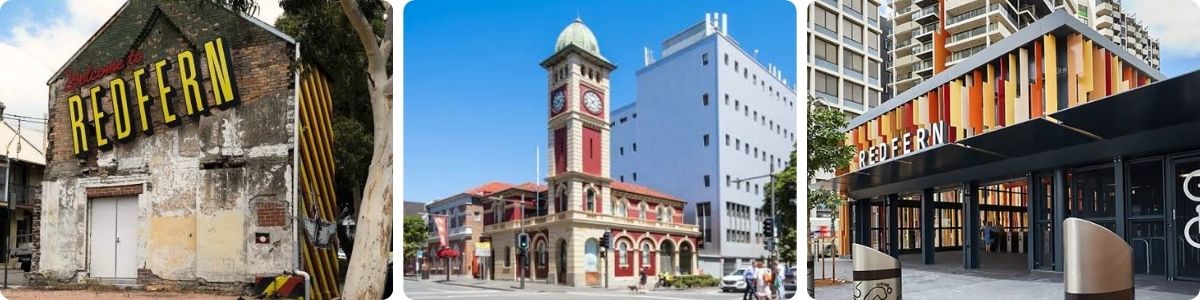
The Birthplace of Aboriginal Rights Activism in Australia
No other Sydney suburb carries this weight in terms of its documented history. The Aboriginal Housing Company was established on Eveleigh Street in 1973, creating what became known as The Block, one of the first pieces of urban land in Australia formally handed back for Aboriginal community housing and self-determination. The site has been through decades of upheaval, including demolition and the long-running Pemulwuy Project redevelopment, but it remains under Aboriginal Housing Company control and continues to anchor the suburb’s Aboriginal community.
A short walk away, Redfern Park is where Prime Minister Paul Keating delivered the 1992 Redfern Address, the first formal acknowledgement by an Australian Prime Minister of dispossession, killings and the removal of children. The Aboriginal Medical Service Redfern, founded in 1971 and one of the first Aboriginal community-controlled health services in the country, still operates from the suburb today. This history isn’t a footnote to Redfern’s identity, it is Redfern’s identity, and any buyer or renter who treats it as incidental hasn’t understood what they’re moving into.
A Genuinely Fast Gentrification Story
Redfern’s transformation since the 2000s is one of the more dramatic in inner Sydney. A historically working-class, industrial suburb built around the railway workshops has become a suburb of restored heritage terraces, specialty coffee and boutique retail on Redfern Street, and a median house price north of $2 million.
The old Eveleigh railway yards are now South Eveleigh, a commercial campus that houses thousands of corporate and technology workers. What hasn’t changed is the housing mix underneath it: Redfern still carries a substantial social and public housing stock managed by the Aboriginal Housing Company and NSW Land and Housing Corporation, sitting directly alongside new-build apartments and million-dollar terrace renovations. That combination, rare this close to a CBD, is part of what gives Redfern a genuinely mixed street life rather than the flattened, single-income-bracket feel of a lot of gentrified inner suburbs.
The transformation isn’t finished either: the Redfern-North Eveleigh Precinct Renewal is progressing under Transport for NSW and the NSW Government as a broader renewal of the old rail lands adjoining the suburb, and immediately to the south, the Waterloo Estate renewal (including the Waterloo South planning proposal) is set to deliver Australia’s largest social housing renewal project, thousands of new homes across a mix of social, affordable and private housing. Neither project sits inside Redfern’s own boundary, but both will materially change the streets and services immediately around it over the next decade.
The Convict Surgeon, the Railway and a Century of Migration
Redfern takes its name from a convict surgeon, not a grand estate. William Redfern (circa 1774 to 1833) arrived in the colony in 1801 after being court-martialled for his part in the 1797 Nore mutiny while serving as a surgeon’s mate aboard HMS Standard; sentenced to death, he was reprieved on account of his youth (Francis Pollon, “The Book of Sydney Suburbs,” 1988). He served as assistant surgeon on Norfolk Island, was pardoned in 1803, and returned to Sydney in 1808 to resume medical practice, eventually taking charge of Sydney Hospital in 1816 and succeeding D’Arcy Wentworth as principal surgeon in 1819. His 1814 report on conditions aboard convict transport ships led directly to the requirement that every transport carry a surgeon responsible for prisoners’ health, a reform with a real body count behind it. Despite that record, and his friendship with Governor Macquarie, Redfern faced open contempt from parts of colonial society simply for having arrived as a convict. In 1817 he was granted 100 acres roughly bounded by today’s Regent, Redfern and Elizabeth Streets, where he built a country house surrounded by flower and kitchen gardens; his neighbours included Captain Cleveland of the 73rd Regiment, whose home gives Cleveland Street its name. Redfern later added a further 1,300 acres near what is now Campbelltown and died in Edinburgh in 1833 owning more than 23,000 acres across the colony, a striking rise for a man who arrived in chains.
The railway did as much as the man to fix the name in place, and did it in a roundabout way. Sydney’s first railway terminus was built in the Redfern Paddocks, the open land stretching from Devonshire and Cleveland Streets toward Chippendale, and the station took Redfern’s name in his honour; it was originally an iron structure with a Mr Fielding as the first stationmaster, replaced in 1874 by a brick and stone building spanning two platforms. Confusingly, what is now Redfern Station was for a time known as Eveleigh, after an old house that stood on the line’s western side; when Central Station was built on the old Devonshire Street cemetery site, the Eveleigh name was transferred to the new station and the original Redfern-area station was renamed Redfern, while Eveleigh survived as the name for the adjoining railway workshops. The last surviving fragment of the old Redfern Paddocks is Prince Alfred Park, built for an 1870 inter-colonial exhibition and opened by Governor Belmore, who also lends his name to Belmore Park in the city (Pollon, 1988). Redfern has one more transport first to its name: in 1879 the colony’s first double-decker tram made its maiden run from the old Redfern tram terminus to the corner of Hunter and Elizabeth Streets, using steam engines and trams imported from the United States.
Redfern’s migrant character isn’t a recent development either. By the turn of the twentieth century, industry was displacing the suburb’s earlier gardens, and a wave of Syrian-run businesses set up along its streets, among them George Dan (trading from 1890), Stanton and Aziz Melick (from 1888), and Anthony and Simon Coorey (from 1896) (Pollon, 1988). Rachel Forster Hospital, founded in Surry Hills in 1922 and named for the philanthropist wife of Lord Forster, relocated to George Street, Redfern, and reopened at its present 150 Pitt Street site in 1941 as a teaching hospital now specialising in arthritis and orthopaedic care. The Redfern Mail Exchange, built in 1965 after evicting around 300 residents from its 2.15-hectare site, became notorious for the opposite of efficiency: its automated sorting machinery shredded so much mail that locals nicknamed it the Redfern Mangler, and it was decentralised in 1984 once the technology proved more trouble than it was worth. Redfern’s status as a magnet for successive waves of migration, Syrian traders in the 1890s, Lebanese and other communities today, alongside its longstanding Aboriginal population is what makes Redfern one of the most storied places in Sydney.
What Is It Like Living Here?
Day to day, Redfern reads as compact, walkable and noisy in the way inner-city rail suburbs are noisy: trains, traffic on Cleveland Street and Regent Street, and a lot of foot traffic around the station at peak hour. It suits people who want a car-optional lifestyle and don’t mind sharing footpaths with a large University of Sydney student and staff population spilling over from neighbouring Darlington and Camperdown.
Transport
Redfern Station is one of the busiest and oldest stations in the Sydney network, and it earns that reputation as a genuine multi-line interchange: the T2 Leppington & Inner West Line, T3 Liverpool & Inner West Line, T4 Eastern Suburbs & Illawarra Line and T8 Airport & South Line all call at Redfern, alongside NSW TrainLink regional and intercity services. Central Station, with its full suite of lines and the Sydney Metro connection, is an easy 10 to 15 minute walk if you’d rather not wait for a Redfern-bound service.
Transport for NSW completed a major accessibility upgrade at Redfern in recent years, delivering a new southern concourse with six new stairs and lifts giving step-free access to Platforms 1 to 10; accessibility work on Platforms 11 and 12 remains under investigation with no confirmed timeline.
Bus routes along Cleveland Street, Regent Street and Botany Road connect Redfern to Surry Hills, the CBD and points south; see the public bus network overview and the dedicated T2 Leppington & Inner West Line, T3 Liverpool & Inner West Line, T4 Eastern Suburbs & Illawarra Line and T8 Airport & South Line pages for timetables and route detail.
Healthcare
Redfern’s standout healthcare asset is the Aboriginal Medical Service Redfern (AMS), founded in 1971 as one of the country’s first Aboriginal community-controlled health services and still delivering GP, dental, and specialist care from the suburb today (AMS Redfern; RACGP). Beyond AMS, there’s a reasonable spread of GP clinics along Redfern Street and Regent Street. For hospital care, Royal Prince Alfred Hospital in Camperdown and St Vincent’s Hospital in Darlinghurst are both within a few kilometres and reachable by bus or a short drive, giving Redfern residents access to two major tertiary hospitals without needing to leave the inner city.
Schools and Childcare
Redfern Public School, on George Street, is the suburb’s local government primary and one of the oldest public schools in NSW, with a history tied closely to the suburb’s Aboriginal community (Dictionary of Sydney). Secondary options rely on nearby comprehensive high schools rather than a selective school inside the suburb itself; families chasing a specific selective-entry outcome typically look further afield or into the private system.
Childcare is workable but not abundant within Redfern’s own borders: SDN Redfern Children’s Education and Care Centre, Redfern Cottage Early Learning Centre, Only About Children Redfern and Redfern Occasional Child Care Centre are all registered on the national register (ACECQA; StartingBlocks.gov.au), which gives a working family a small handful of realistic options inside the suburb, with meaningfully more choice a short walk into Chippendale, Waterloo or Surry Hills. Don’t assume you’ll walk straight into a place; inner-city long day care waitlists are a known pressure point across this pocket of Sydney.
Industry & Work Life
Redfern’s employment base has shifted hard from rail workshops to knowledge work. South Eveleigh, built on the old Eveleigh railway yards immediately southwest of the suburb, now houses Commonwealth Bank’s technology and operations campus (around 10,000 staff at capacity) along with other corporate tenants, giving Redfern a genuine white-collar commuter base that didn’t exist a generation ago. Layer that over the University of Sydney’s proximity, and a large share of renters here are either students, university staff, or workers commuting a single stop into the CBD. It’s a suburb built for people who want to minimise commute time, not maximise backyard space.
Shopping & Eating Out
Redfern Street is the suburb’s main strip: independent cafes, a scattering of well-regarded restaurants, grocers and boutique retail rather than chain-heavy shopping. There’s no full-line shopping centre inside Redfern itself; for a bigger grocery run or a wider retail spread, residents head into Broadway Shopping Centre or Central Park in neighbouring Chippendale, both an easy walk. Redfern’s cafe and restaurant scene has genuine critical standing (Broadsheet runs dedicated Redfern cafe and restaurant guides), which is a reasonable proxy for how far the dining strip has come from its industrial-era reputation.
Attractions, Parks and Natural Spaces
Redfern Park is the suburb’s main green space and its most historically significant, both as a genuine recreational park and as the site of the 1992 Redfern Address. Redfern Oval, attached to the park, hosts community sport and the Redfern Community Centre runs indoor hireable spaces including a dedicated performance space (City of Sydney). Beyond the suburb’s own borders, Prince Alfred Park (Surry Hills) and Sydney Park (Alexandria) are both a short walk or bus ride away for larger open space, and Redfern’s proximity to Central and the CBD puts the Royal Botanic Garden and Domain within easy reach for a weekend outing.
Crime and Safety
There is no suburb-specific crime figure for Redfern; BOCSAR only publishes reliable numbers at the LGA level, so what follows is City of Sydney-wide, not Redfern-specific. In the year to March 2026, the City of Sydney LGA recorded 42,013 incidents, a rate of 19,852 per 100,000 people, which sits above the NSW average (BOCSAR data, year ending March 2026). Theft was the single largest offence category, followed by offences against justice procedures and drug offences, with assault and malicious damage also featuring. Crime across the LGA has trended down modestly over the past five years. Anecdotally, longtime residents and local media occasionally flag street-level incidents around The Block and the station precinct at night, but that’s neighbourhood chatter, not a data-backed suburb-level statistic, and should be weighed as such.
Realty Market
Redfern’s house market is thin (terraces dominate the limited house stock) and expensive: the most recent verified median sits at $2,470,000 (Htag.com.au, July 2022, +4.56% over the prior 12 months), with more recent bedroom-level data from Domain showing 2-bedroom houses trading around $1.765 million, 3-bedroom around $2.2 million and 4-bedroom around $3.18 million based on the trailing 12 months of sales (Domain suburb profile, accessed August 2026). No verified single current median house figure more recent than the 2022 Htag data has been located; treat the newer bedroom-level breakdown as the more current signal and the headline median as dated. Housing stock is dominated by heritage terraces and semi-detached dwellings (28.6% of dwellings at the 2021 Census) alongside apartments, which make up the clear majority of the suburb’s housing (68.1% of dwellings, ABS 2021 Census).
The rental and unit market is where most of Redfern’s activity actually happens: 61.9% of Redfern households rent (ABS 2021 Census), reflecting the suburb’s large student and young-professional tenant base. Domain’s most recent unit breakdown shows 1-bedroom units trading around $770,000, 2-bedroom around $1.2 million and 3-bedroom around $2.0 million (Domain suburb profile, accessed August 2026). Median weekly rent for houses was reported at $1,231 (up 4.92% year-on-year) with a gross rental yield around 2.59% as of the mid-2022 Htag data; a market described at that time as “tight supply, rising rental pressure,” a description that is broadly consistent with the University of Sydney-driven rental demand that hasn’t gone anywhere since.
Our Honest Verdict
Redfern is likely to appeal most to renters and buyers who want genuine inner-city walkability, a short commute into the CBD or South Eveleigh, and a suburb with real cultural depth rather than a manicured, single-note gentrification story. It’s a strong fit for investors targeting University of Sydney-adjacent tenants, given the sustained rental demand the Census tenure data confirms.
It is less compelling for anyone chasing a quiet, low-density, backyard-and-driveway lifestyle: house stock is dominated by terraces on small blocks, apartments make up the bulk of dwellings, and street noise from trains and Cleveland Street traffic is a constant. It’s also not the suburb for a buyer who wants to pretend gentrification and the suburb’s Aboriginal history and remaining social housing don’t coexist here; they do, visibly, and that’s central to what living in Redfern is actually like.
For a genuine cross-shop comparison, look at Surry Hills: similarly inner-city, similarly terrace-heavy, similarly gentrified from a working-class base, but without Redfern’s Aboriginal cultural significance or its comparatively larger social housing stock, and generally commanding a price premium over Redfern for equivalent stock.
Frequently Asked Questions
Is Redfern a good suburb to live in?
It depends entirely on what you’re after. For inner-city walkability, transport access and cultural depth, yes. For quiet, low-density living with a backyard, no. Redfern rewards people who value proximity and history over space and hush.
What train lines service Redfern Station?
Redfern Station is served by the T2 Leppington & Inner West Line, T3 Liverpool & Inner West Line, T4 Eastern Suburbs & Illawarra Line and T8 Airport & South Line, plus NSW TrainLink regional and intercity services. Central Station, with a wider range of lines and Sydney Metro, is a 10 to 15 minute walk away.
Is Redfern safe?
There’s no Redfern-specific crime statistic; BOCSAR reports at the City of Sydney LGA level, where the crime rate (19,852 incidents per 100,000 people, year to March 2026) sits above the NSW average, driven mostly by theft. That’s an LGA-wide figure covering a much larger area than Redfern alone, so treat it as context rather than a suburb-specific verdict.
What is The Block in Redfern?
The Block is the section of Eveleigh Street handed to the Aboriginal Housing Company in 1973, one of the first pieces of Australian urban land formally returned for Aboriginal community housing and self-determination. It remains under Aboriginal Housing Company control today and continues to anchor Redfern’s Aboriginal community, even as redevelopment (the Pemulwuy Project) has changed the site physically over the decades.
Is Redfern good for investors?
It’s likely to appeal to investors targeting a stable, University of Sydney-adjacent rental market, given 61.9% of Redfern households rent (ABS 2021 Census) and the suburb’s tight supply has historically supported rising rents. Gross rental yields have run relatively low (around 2.59% on the most recent verified house data), which makes it more of a capital-growth and tenant-demand play than a yield play.
References
- Francis Pollon, “The Book of Sydney Suburbs,” Angus & Robertson, 1988, entry on Redfern
- Australian Bureau of Statistics, 2021 Census QuickStats, Redfern (SAL13352), accessed August 2026
- NSW Spatial Services, NSW Administrative Boundaries Theme FeatureServer, Redfern suburb boundary query, accessed August 2026
- Htag.com.au, Redfern NSW 2016 Property Market and House Prices, data dated July 2022
- Domain, Redfern NSW 2016 Suburb Profile, accessed August 2026
- NSW Bureau of Crime Statistics and Research (BOCSAR), NSW Recorded Crime Statistics, year ending March 2026, City of Sydney LGA
- Transport for NSW, Redfern Station Upgrade (New Southern Concourse) project page, status reviewed August 2024
- Aboriginal Medical Service Redfern (amsredfern.org.au), organisational history
- Sydney Barani, Aboriginal Housing Company site history
- Dictionary of Sydney, Redfern Park entry and Aboriginal Housing Company entry
- City of Sydney Archives, Paul Keating Redfern Address, 1992
- ACECQA National Registers and StartingBlocks.gov.au, Redfern-area childcare service listings, accessed August 2026
- South Eveleigh (southeveleigh.com), South Eveleigh commercial precinct overview
- City of Sydney, Redfern Community Centre and Redfern Oval Community Room hireable space listings
- Transport for NSW, Redfern-North Eveleigh Precinct Renewal project page, accessed August 2026
- NSW Government, Waterloo renewal project page (nsw.gov.au), accessed August 2026
For more inner-city Sydney options to compare against Redfern, browse the full Sydney suburbs directory, or step back and explore the Sydney regions overview to see how Redfern fits into the broader inner-city picture.