
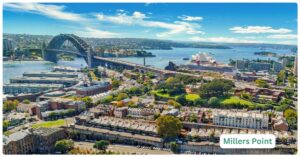
Millers Point is the rare Sydney suburb where the real estate section and the front page have been fighting over the same streets for a decade. On one side: sandstone terraces on Lower Fort Street selling at auction for figures that would embarrass a Vaucluse agent. On the other: an elderly public housing community, some of it dating back to the Sydney Harbour Trust era, being progressively moved out to make that selling possible. Both things are true at once, and neither cancels the other out. That tension, not the harbour views, is what actually defines the place today.
Millers Point Boundary and Location Map
Millers Point occupies the western side of the Dawes Point peninsula, immediately beneath the southern approach to the Sydney Harbour Bridge. It borders The Rocks to the east along Argyle Street and Kent Street, Barangaroo to the west and south along the Hickson Road foreshore, and Sydney Harbour itself to the north, with Walsh Bay’s finger wharves marking the transition to the harbour proper.
Quick Facts
| LGA | City of Sydney |
| Postcode | 2000 |
| Population | 1,735 at the 2021 Census (ABS QuickStats, SAL12630). No official update since; local advocates argue the ongoing social housing sell-off has continued to thin the resident count ahead of 2026 Census figures |
| Growth Rate | Not a growth suburb in the conventional sense. Population has been shaped almost entirely by tenant turnover from the government housing sale program rather than new supply, since virtually no new dwellings have been built |
| Distance from CBD | Around 1km from the Sydney CBD core, technically inside the northern edge of the city centre itself |
| Character | Heritage maritime and working-class streetscape, harbourside sandstone terraces, and a shrinking but historically significant public housing community |
| Median House Price | Freestanding house sales are rare given the tiny stock and heritage listing on most terraces; individual Millers Point terrace sales have run from roughly $1.4 million to over $8 million depending on size and heritage grading (Domain sold-listings data, 2026) |
| Median Unit Price | Two-bedroom units around $2.475 million and one-bedroom units around $1.005 million (Domain suburb profile, 2026) |
| Transport | No train station in the suburb. Wynyard and Circular Quay stations are both a walkable 10-15 minutes away; Barangaroo ferry wharf is close by for harbour services; several CBD bus routes pass along Kent Street and George Street |
| Crime Rate (LGA) | City of Sydney LGA (BOCSAR, quarterly update to December 2025) records some of the highest raw incident counts of any NSW council area, driven overwhelmingly by CBD nightlife and retail precincts rather than residential streets; suburb-specific figures for Millers Point are not published separately |
| Childcare Availability | Tight. A small number of long day care services sit in and around Millers Point, The Rocks and Dawes Point, and most families end up on a CBD-wide waitlist rather than a local one |
| School Zone Quality | Millers Point falls in the Fort Street Public School catchment, a well-regarded inner-city public primary with its own heritage building on Observatory Hill; secondary options are mostly selective or out-of-area |
| Parks & Recreation | Observatory Hill Park and Sydney Observatory on the doorstep, Barangaroo Reserve a short walk west, plus the small pocket parks around Windmill Street and Argyle Place |
| Shopping | No local shopping strip. Residents lean on The Rocks and Barangaroo for groceries, cafes and retail, or a short trip into the CBD |
| Health | Observatory Tower Medical Centre provides local GP services; Sydney Hospital and Eye Hospital on Macquarie Street is the nearest major public hospital, roughly 2km away |
| Best For | Heritage-home buyers with deep pockets and an interest in maritime history, plus anyone who wants to live inside the CBD’s postcode without living in a CBD tower |
The Millers Point Backstory – History & Heritage
Every harbourside suburb in Sydney claims heritage. Millers Point is one of the few that can actually back it up street by street, and it does so with two stories that don’t get told anywhere else in the city: a catastrophic wharf fire that shaped how the precinct was built, and a public housing saga that is still, as of 2026, working its way through the courts, the council chamber and the lives of the people it displaced.
The Night the Wharves Burned
By December 1890, Millers Point’s bond stores were holding one of the most dangerous cargoes on the harbour. Gibbs, Bright and Company’s bond store had roughly 35,000 cases of tinned kerosene sitting in storage while customs duty was paid, and moored nearby, a ship called the Australia was mid-way through unloading another 18,000 cases fresh from New York. Unloading stopped at 5.30pm, the store was locked up, and the night watchman, a man named Proctor, came on duty. Everything seemed ordinary until 8.40pm, when a seaman aboard a ship tied up at the wharf spotted sparks coming off the warehouse roof.
Telephones were still a novelty in 1890, but they earned their keep that night: the alarm reached fire stations as far away as Marrickville within minutes, and every one of them raced for Millers Point. It made no difference. Firefighting foam for oil fires hadn’t been invented yet, and 35,000 cases of burning kerosene were well beyond anything a bucket brigade with sand could touch. The bond store and the wharf were lost, and the blazing kerosene poured straight into the harbour, where the tide carried it across to the northern shore. The fire burned through the night and into the next day, drawing crowds of spectators along the foreshore, and the exhausted fire stations were left in disarray for days afterwards (Francis Pollon, “The Book of Sydney Suburbs,” 1988). By contemporary accounts it was Sydney’s first large-scale oil fire, and it taught the colony’s fire services a hard lesson about a hazard that water alone couldn’t fight.
The bond stores were rebuilt, and several of the surviving Walsh Bay and Millers Point warehouses still carry evidence of that reconstruction. It’s the kind of story that never made it into the postcard version of Sydney’s history, because there was nothing scenic about it at the time: industrial infrastructure burning, insured cargo going up in smoke, and a precinct built almost entirely of sandstone, timber and stored fuel discovering exactly how badly that combination could go wrong. Millers Point’s heritage streetscape wasn’t preserved by accident. It survived a fire that, on the night itself, looked like it might take the whole working waterfront with it.
From Company Town to Contested Sell-Off
Millers Point’s social history runs on a different track from The Rocks next door. Where The Rocks’ story is convict-era colonial settlement, Millers Point’s is maritime labour: a 19th century population of wharf workers, wool handlers and their families, overwhelmingly working-class and tightly bound to the trade cycles of the port. The 1890 maritime strike hit the community hard, and the reputation for being a “rough” waterside quarter dates from that decade. Then came the 1900 bubonic plague outbreak, which the NSW Government used as justification to resume the entire peninsula, evict private landlords and hand control to the newly formed Sydney Harbour Trust (later folded into the Maritime Services Board). The Trust became landlord to its own workforce, housing wharf labourers in its own terraces on the condition they kept working the docks, effectively running Millers Point as a company town until the housing stock transferred to the state Department of Housing in the 1980s.
That transfer is what made Millers Point famous for the reason most people now recognise it: one of inner Sydney’s most historically intact public housing communities, generations deep, living in heritage terraces the government itself had built and maintained for over a century. In March 2014 the NSW Government announced it would sell that stock. By the time the program wound up in November 2018, 189 properties had sold for a combined $609.6 million, at a median price of roughly $2.5 million and a top sale over $26 million, plus the Sirius apartment building for an estimated $120-180 million on top. Most long-term tenants were relocated elsewhere; a small number, around 28 households, secured deferred-sale arrangements letting them stay for life. Advocacy groups including the Tenants’ Union of NSW have documented the human cost in blunt terms: broken social networks, isolation, and multiple deaths among displaced elderly residents in the years that followed. Whatever view you take of the policy, the numbers and the human account both belong in any honest description of this suburb, and neither should be softened to make Millers Point sound more comfortable than it is.
What Is It Like Living Here?
Day to day, Millers Point feels less like a suburb and more like a village that happens to sit inside the Sydney CBD’s postcode. It’s quiet at street level (steep lanes, sandstone kerbs, almost no through-traffic) while the financial district hums a few hundred metres away. Long-term residents, private owners and the last of the public housing tenants share the same handful of streets, which makes for an unusual social mix by inner-Sydney standards.
The working wharves that built Millers Point are long gone, replaced by finance, professional services and hospitality jobs a short walk away in the CBD and Barangaroo’s commercial towers. Most residents who work locally are employed in the offices, hotels and restaurants of Barangaroo, The Rocks and the city centre, meaning the classic Millers Point commute is a walk, not a drive. It’s a stark contrast to the suburb’s own history as a working port, and one of the more interesting quiet ironies of living here: a suburb built by wharf labour now houses people who mostly work in glass towers built where the wharves used to be.
Shopping & Eating Out
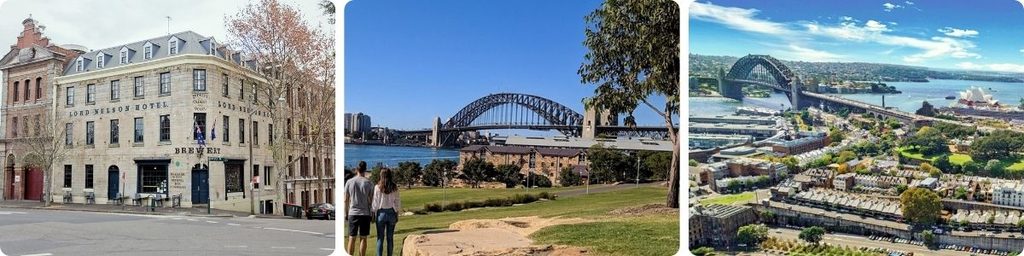
There is no supermarket or shopping strip in Millers Point, and that’s not going to change given the heritage controls over almost every building in the suburb. What it does have is two of Sydney’s most historic pubs: the Lord Nelson Brewery Hotel on the corner of Kent Street and Argyle Place (trading since 1834, one of the oldest hotels in Sydney), and the Hero of Waterloo on Lower Fort Street (built 1843-44), both worth the walk even if you don’t live here. For groceries and everyday retail, residents head into The Rocks or Barangaroo, where the Barangaroo precinct’s dining strip and Walsh Bay’s restaurants are both a five to ten minute walk. It’s a suburb where you eat and drink extremely well within a few hundred metres, and buy your milk somewhere else entirely.
Recreation, Parks and Green Space
Observatory Hill Park, home to the Sydney Observatory, sits at the suburb’s high point with sweeping harbour views, an off-leash dog area and a underrated spot to watch the sunset over the bridge without the Circular Quay crowds. The Garrison Church (Holy Trinity, built 1840) on Lower Fort Street, Argyle Place (Sydney’s oldest surviving village green) and Windmill Street round out a National Trust-classified heritage streetscape that’s rare this close to a CBD. Barangaroo Reserve, a short walk west, adds six hectares of harbourside headland parkland, walking trails and native bushland regeneration on what used to be a container terminal, an amenity advantage for a suburb this small.
Transport
There is no train station in Millers Point, and there never has been. Don’t buy or rent here expecting one. Wynyard station (T1, T2, T3 and T7 services) is a 10-15 minute walk depending on which end of the suburb you’re at, and Circular Quay is a similar distance in the other direction. Both mean climbing or descending the peninsula’s steep streets, which is fine for most people but worth factoring in if stairs are an issue. Barangaroo ferry wharf, a short walk along Hickson Road, adds harbourside ferry connections without needing the train at all. CBD bus routes run along Kent Street and George Street on the suburb’s eastern edge; see the public bus network overview for routes and timetables. For a car, the Western Distributor and Sydney Harbour Bridge approach sit right on the suburb’s boundary, which is a convenience for driving north but also means traffic noise on the streets closest to the approach ramps.
Healthcare
Observatory Tower Medical Centre provides GP services within the suburb itself, and there are further options a short walk away in The Rocks and the CBD. Sydney Hospital and Eye Hospital on Macquarie Street, roughly 2km away, is the nearest major public hospital, with Royal North Shore Hospital across the bridge and St Vincent’s Hospital in Darlinghurst both accessible within 15-20 minutes by car or bus for more specialised care. There is no dedicated aged care facility in Millers Point itself, which is a gap given the age profile of the remaining long-term community.
Schools and Childcare
Fort Street Public School, on Observatory Hill within Millers Point itself, is the local government primary and a well-regarded one, occupying one of the oldest continuously used school sites in NSW and currently the subject of a heritage redevelopment project. Its catchment quality is a real drawcard for families willing to live in a suburb with almost no other family-oriented infrastructure. Secondary options mostly mean selective schools (Fort Street High School itself relocated to Petersham generations ago and now draws city-wide) or a move out of the area. Childcare is tight: a handful of long day care centres serve Millers Point, The Rocks and Dawes Point combined, and most inner-city families report treating it as a CBD-wide waitlist problem rather than a suburb-specific one. Anyone planning around childcare here should assume competition, not availability, as the default.
Crime and Safety
Millers Point sits within the City of Sydney LGA, which BOCSAR’s quarterly crime statistics (updated to December 2025) consistently place among the highest-volume council areas in the state for recorded theft and alcohol-related assault. That figure is almost entirely a CBD and nightlife-precinct effect: George Street, the entertainment strips and the retail core drive the bulk of incidents, not the quiet residential lanes of Millers Point itself. Suburb-level crime data isn’t published separately by BOCSAR, so residents and prospective buyers should read the LGA number as context, not as a description of what happens on Lower Fort Street. Anecdotally, the suburb’s low foot traffic and tight-knit, long-term community give it a reputation as one of the quieter corners of the LGA, though that’s a local perception rather than a measured statistic.
Realty Market
Buying in Millers Point means buying into an unusually thin, unusually specific market. Genuine freestanding heritage terraces come up rarely, most are heritage-listed with real restrictions on what a buyer can change, and prices have tracked well above the inner-city average since the government sell-off put dozens of them on the open market for the first time in generations. Individual terrace sales through that program ranged from around $1.4 million up to over $26 million, and post-sell-off resales have generally held those values given the scarcity of stock and the precinct’s heritage status. Unit stock, mostly conversions and a small number of purpose-built apartments, sits at a median of roughly $2.475 million for two bedrooms and $1.005 million for one bedroom (Domain, 2026), figures that reflect the harbour views and CBD-fringe location as much as the buildings themselves.
The rental market is a mixed picture. Alongside private leases (a one-bedroom unit typically around $875-$1,250 a week and larger apartments well beyond that), a meaningful slice of the suburb’s dwellings remain public or social housing, home to the community that predates the 2014 sell-off. That dual market, private rents at CBD-fringe premiums sitting a few doors down from subsidised public tenancies, is not something you’ll find described this plainly on a standard portal listing, and it’s central to understanding what you’re actually buying or renting into here. Anyone weighing an investment purchase should treat the small number of annual sales and the heritage overlay as constraints on liquidity, not just charm, and should do their own due diligence on any heritage listing conditions attached to a specific property rather than relying on this guide as a planning reference.
Our Thoughts on Millers Point
Millers Point suits a specific buyer: someone with the budget for a heritage terrace or harbour-view apartment, an interest in living inside a historically significant precinct rather than a generic CBD tower, and no particular need for a train station, a supermarket or a school run beyond Fort Street Public. It does not suit anyone chasing rental yield, anyone who needs a car-free commute from a train line, or anyone uncomfortable with a suburb still visibly working through the aftermath of a contentious public housing sell-off. If proximity to the harbour and heritage streetscape matter more to you than the social housing angle, The Rocks next door offers a similar location and character with a longer track record as a settled, tourism-oriented precinct rather than one still absorbing the fallout of a decade-long sale program. Millers Point is smaller, quieter and arguably more authentic, but it comes with a social history that a buyer should understand before signing anything, not discover afterwards.
Frequently Asked Questions
Is Millers Point still public housing?
Partly. The NSW Government’s sale program ran from 2014 to 2018 and sold 189 properties for $609.6 million, but a small number of long-term tenants (around 28 households) secured deferred-sale arrangements allowing them to remain for life, and some social housing stock remains in the broader precinct. The overall trajectory since 2014 has been a steady shift from public to private ownership, and that shift is effectively complete for the properties sold, though not for every remaining tenancy.
Does Millers Point have a train station?
No. Wynyard and Circular Quay are both walkable in 10-15 minutes, and Barangaroo ferry wharf is close by, but there’s no station within the suburb itself.
What’s the difference between Millers Point and The Rocks?
Both sit on the same peninsula and share early colonial and 1900 plague-era history, but Millers Point’s distinct story is maritime and working-class (wharf labour, the Sydney Harbour Trust as landlord, and the 2014-2018 social housing sell-off), while The Rocks is more associated with convict-era settlement and its later transformation into a tourism and heritage precinct.
References
- Australian Bureau of Statistics, 2021 Census QuickStats, Millers Point (SAL12630), accessed 2026
- NSW Bureau of Crime Statistics and Research (BOCSAR), NSW Recorded Crime Statistics Quarterly Update, December 2025
- Tenants’ Union of NSW, “The sale of Millers Point properties has ended: it has made inequality worse”, accessed 2026
- Dictionary of Sydney, entry: Millers Point, accessed 2026
- City of Sydney Council, Observatory Park (Observatory Hill), accessed 2026
- Barangaroo Delivery Authority / Barangaroo.com, Barangaroo Reserve and precinct information, accessed 2026
- Toddle and CareforKids.com.au, childcare centre listings for Millers Point, The Rocks and Dawes Point, accessed 2026
- NSW Department of Education, Fort Street Public School, accessed 2026
- Francis Pollon, “The Book of Sydney Suburbs,” 1988, joint Millers Point and The Rocks historical entry, pp.171-172
- The Conversation, “Why moving out public housing tenants is a tragedy for Millers Point and for Sydney”, accessed 2026
- Healthdirect Australia, GP and health service listings for Millers Point 2000, accessed 2026
For more inner-city options, browse the full list of Sydney suburbs or explore the Sydney Regions overview for a broader view of the harbourside precincts around the CBD.