
Quick Facts: Parramatta
Where Is Parramatta?
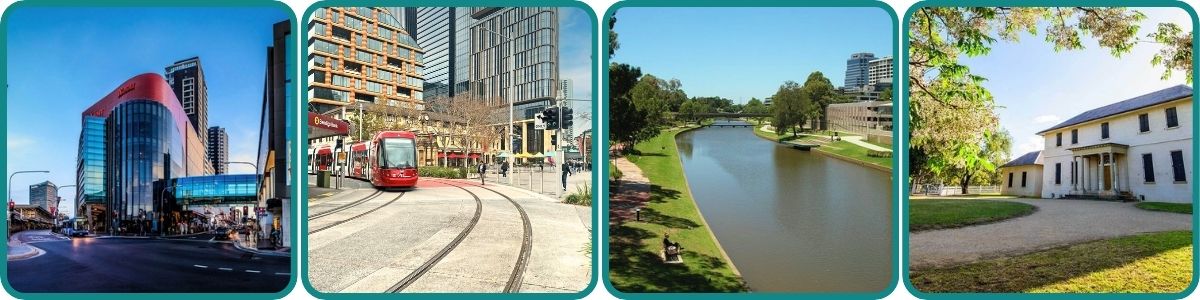
Parramatta sits at the geographic heart of the Greater Sydney basin, approximately 24 kilometres west of the Sydney CBD along the Parramatta River corridor. It is the centre of the City of Parramatta local government area and functions, in both official policy and lived reality, as Western Sydney’s second CBD. The name comes from the Burramattagal people’s word for the place, variously interpreted as “the place where eels lie down” or “the head of the waters”, a reference to the tidal reach of the Parramatta River that shaped the landscape long before European arrival.
Today, Parramatta is a genuine city within a city. Its skyline of commercial towers, government offices, and residential high-rises distinguishes it clearly from surrounding suburbs. The scale of investment flowing into the area over the next decade, coming from Metro West to riverside redevelopments to expanded cultural institutions, signals that this is not a suburb in transition but a city ascending.
A Deep History: Australia’s Oldest City
Parramatta carries historical weight unlike almost anywhere else in Australia. The Burramattagal clan of the Darug nation lived along the Parramatta River and its tributaries for tens of thousands of years, and their relationship with this Country remains central to Parramatta’s contemporary identity.
European settlement began almost immediately after the First Fleet’s arrival in 1788. The thin soils of Sydney Cove proved inadequate for farming, and Governor Arthur Phillip led an expedition westward in late 1788, finding the fertile alluvial soils of the Parramatta basin. By 1789, settlement was underway, and Parramatta rapidly became the food-producing engine of the new colony. It was, for a time, more important to the survival of New South Wales than Sydney itself. If you want to dive deeper into that history, check out the City of Parramatta Heritage Collections Services as a good starting point.
Old Government House: UNESCO World Heritage
The most tangible expression of this history is Old Government House in Parramatta Park, which holds the distinction of being Australia’s oldest public building and a UNESCO World Heritage Site as part of the Australian Convict Sites listing. The house, begun in the 1790s and substantially completed under Governor John Hunter, served as the country retreat and working headquarters of multiple early governors. Standing inside its Georgian rooms, you are in the oldest government building in the southern hemisphere. The surrounding Parramatta Park, itself a heritage landscape of great significance, provides the setting for the house and offers one of Sydney’s finest heritage walking experiences.
The colonial heritage extends across the suburb: Elizabeth Farm, the oldest surviving homestead in Australia, sits in nearby Rosehill; the Female Factory precinct tells the story of the convict women who shaped the colony; and Hambledon Cottage survives as another extraordinary Georgian remnant.
Getting Around: Transport Links
Parramatta is one of the best-connected transport hubs in metropolitan Sydney outside the CBD, and it is about to get significantly better.
Train Services
Parramatta Station is served by the T1 Western Line, connecting east to the City Circle via Strathfield or via Homebush, and west to Penrith and the Blue Mountains. The T5 Cumberland Line links Parramatta to Bankstown, Campbelltown, and Macarthur. The T1 also connects north through Epping to Chatswood. Journey time to Central Station is approximately 35 to 40 minutes by express service.
Metro West: The Game Changer
The Sydney Metro West project, currently under construction, will fundamentally alter Parramatta’s connectivity. When complete, the Metro will run between Parramatta and the Sydney CBD with a journey time of approximately 20 minutes, cutting the effective travel time nearly in half compared to the current express train. Parramatta Station on the Metro West will be one of the largest new transport infrastructure investments in Western Sydney’s history, and property analysts widely expect it to accelerate the already substantial development activity in the area.
Bus and Ferry
Parramatta is a major bus interchange with routes penetrating deep into the surrounding LGA and connecting to areas not on the train network. The Parramatta River ferry service connects downstream to Rydalmere, Meadowbank, Rhodes, and ultimately Circular Quay, a scenic alternative to the train on fine days. Personally, I pick this almost every time for casual journeys, with the cost ($9.20), almost double that of the train, being the only sticking point. The journey to Circular Quay by ferry takes approximately 75 to 90 minutes and rewards you with views of the river and of life along its banks.
Parramatta Light Rail
The Parramatta Light Rail network has expanded connectivity across the inner western Sydney suburbs, linking Westmead, Paramatta, Camellia, Rydalmere, and Carlingford on Stage 1, with future stages planned to connect to the Olympic site at Homebush and Strathfield.
Sports: A Major Venue City
Parramatta has emerged as one of Sydney’s premier sporting venue locations, anchored by CommBank Stadium (formerly Western Sydney Stadium and Bankwest Stadium), which opened in 2019. The 30,000-capacity venue is the home ground of the Parramatta Eels NRL club and hosts A-League matches, international football, and major events. Its design, tucked into the heritage landscape near Parramatta Park, is widely regarded as one of the better stadium builds in recent Australian history.
The Parramatta Eels have one of the largest and most passionate supporter bases in rugby league, and match days at CommBank Stadium generate an electric atmosphere that has reinvigorated the local hospitality economy. The Eels’ history in this suburb goes back decades, and their identity is deeply woven into Western Sydney’s cultural fabric.
Beyond league, Parramatta supports the Western Sydney Wanderers football club, whose home ground has historically been nearby, and is close to the Western Sydney International Airport precinct at Badgerys Creek, which opens in October 2026. That airport’s activation will significantly expand the sporting, concert, and event economy across the western Sydney catchment.
Food, Culture and Dining
Parramatta’s dining scene reflects its status as the commercial and cultural capital of Western Sydney’s extraordinarily diverse population. Church Street and the surrounding laneways offer one of the most genuinely multicultural restaurant strips in metropolitan Sydney.
Church Street: The Food Spine
Church Street running north from the station is lined with Lebanese, Indian, Bangladeshi, Sri Lankan, Afghan, Turkish, and Southeast Asian restaurants, alongside modern Australian venues, cocktail bars, and wine rooms. The concentration and quality of subcontinental cuisine in particular, is exceptional. Parramatta has long been recognised as one of the best destinations in Sydney for Indian, Pakistani, and Sri Lankan food. Late-night trading is common, and the strip has a genuine urban energy particularly on weekends.
Riverside Dining
The redevelopment of the Parramatta riverfront has added a new dimension to the city’s dining and leisure offer. Cafes, restaurants, and bars along the river walk have opened the waterfront to a wider audience, and the combination of water outlook and heritage surrounds makes for an attractive setting that was underutilised until relatively recently.
Westfield Parramatta
Westfield Parramatta is one of the largest shopping centres in New South Wales, with a comprehensive food court, restaurant precinct, and the full range of major retail brands. It connects directly to the station and is central to the CBD commercial core.
Parks and the River
Parramatta Park is one of Sydney’s great underappreciated open spaces. The 85-hectare heritage-listed park, wrapping around Old Government House and the Domain, offers walking tracks, historic cattle grazing paddocks, a velodrome, and direct access to the Parramatta River. The park’s dual status as a UNESCO World Heritage precinct and a living recreation space used by tens of thousands of residents weekly gives it a character quite unlike any other park in Sydney.
The Parramatta River Foreshore extends downstream from the park, with walking and cycling paths, kayak launch points, and the kind of languid waterside atmosphere that belies the density of the CBD immediately inland. On weekends, the foreshore fills with families, joggers, and people using the barbecue facilities in a scene that speaks to the community life of Western Sydney at its most straightforward and convivial.
The Future City: Development and Investment
No suburb in Sydney is changing faster than Parramatta. The CBD skyline has been transformed by commercial towers housing the NSW Government, major law firms, accounting practices, and corporate tenants who have relocated west as rents and talent have shifted. The Department of Education, Service NSW, and multiple other government agencies now base significant operations here.
Residential development has kept pace, with high-density apartment towers rising throughout the CBD core and mid-density development spreading through adjacent suburbs. The population of the City of Parramatta LGA is projected to grow substantially over the next twenty years, driven by housing construction, economic activity, and continued migration into Western Sydney.
The arrival of Western Sydney International Airport at Badgerys Creek in October 2026 will introduce a new international gateway approximately 35 kilometres to the south-west, further reinforcing Parramatta’s position as the logical centre of gravity for a metropolitan area that is becoming genuinely polycentric.
Key Features
Is It Worth Visiting?
In my view, Parramatta is essential viewing for anyone who wants to understand where Sydney is heading. The combination of deep colonial history at Old Government House, the energy of one of Australia’s most multicultural dining precincts, the scale of CommBank Stadium on match day, and the quiet beauty of the river foreshore makes Parramatta a genuinely compelling destination in its own right.
For those considering living in Western Sydney, Parramatta is the benchmark: excellent transport now and transformative connectivity coming with Metro West, a CBD-quality employment market, and a cultural richness that inner-city commentators consistently underestimate. The city is in the middle of a generational transformation, and visiting now means witnessing that change firsthand.
See all suburbs in the City of Parramatta. Parramatta anchors Western Sydney’s most dynamic corridor. Explore the full Western Sydney region guide to discover neighbouring suburbs, or return to the Sydney regions overview to explore further afield.