
Rooty Hill doesn’t try to be Parramatta or Penrith, and it shouldn’t. It’s a modest, multicultural, owner-occupier suburb wedged between Mount Druitt and Eastern Creek that most Sydneysiders know for two things: an unusual name that traces back to a Norfolk Island hillside, and a train station that’s been running since 1861, one of the oldest stops on the Main Western line.
The Sydney Zoo and Sydney Motorsport Park sit on its southeastern doorstep. It’s also home to West HQ, formerly Rooty Hill RSL, the largest licensed club in New South Wales, which does more to define the suburb’s social life than any park or shopping strip. If you want a train station, a big club, and houses still under $1 million, it’s a genuine contender. If you want leafy or upmarket, keep driving.
Rooty Hill Boundary and Location Map
Rooty Hill sits within the City of Blacktown local government area in Western Sydney, roughly 42 kilometres west of the Sydney CBD. It borders Mount Druitt and Whalan to the west, Minchinbury and Eastern Creek to the south, Doonside to the north and Woodcroft nearby, with the M7 (Westlink) motorway running through its southern edge near Eastern Creek (Transport for NSW, 2026).
Quick Facts
| LGA | City of Blacktown (Blacktown City Council) |
| Postcode | 2766 |
| Population | 16,176 (ABS 2021 Census, SAL13410) |
| Growth Rate | No verified year-on-year population growth figure was found for Rooty Hill specifically; treat the 2021 Census figure as the reliable baseline and expect it to be somewhat higher by 2026 given Western Sydney’s general growth trend |
| Distance from CBD | Approximately 42km west of Sydney CBD |
| Character | Established, multicultural, owner-occupier suburb of mostly separate houses; not a growth-corridor greenfield estate |
| Median House Price | 3-bed houses $940,000; 4-bed houses $967,500; 5-bed houses $1,311,250 (Domain, accessed August 2026, based on sales in the prior 12 months) |
| Median Unit Price | 3-bed units $835,000 (Domain, accessed August 2026; low sales volume, 13 sales in 12 months, treat as indicative only) |
| Transport | Rooty Hill railway station on the T1 Western Line (Sydney Trains), buses 728, 738 and 756, M7 motorway access nearby, M4 within a short drive |
| Crime Rate (LGA) | Blacktown LGA, year to March 2026 (BOCSAR Local Area Rankings, official spreadsheet): violent crime 1,294.8 per 100,000 (5,682 incidents, ranked 57th-lowest of 118 NSW LGAs), above the NSW average of 1,166.0; property crime 1,401.6 per 100,000 (6,151 incidents, ranked 71st-lowest of 118), below the NSW average of 1,606.3 |
| Childcare Availability | 19 childcare services listed for postcode 2766, 14 with vacancies at time of search (CareForKids.com.au, accessed August 2026) |
| School Zone Quality | Mixed; local government primary and high schools plus a well-regarded Catholic high school, but no independent/private high school within the suburb itself |
| Parks & Recreation | Blacktown International Sportspark, Rooty Hill Skatepark, West HQ recreational precinct, Rooty Hill historic site/lookout |
| Shopping | Rooty Hill town centre (Railway Street precinct) plus easy access to Mount Druitt Westfield and Eastern Creek bulky goods/retail strip |
| Health | Mount Druitt Hospital nearby; Blacktown Hospital (major referral hospital) a short drive away |
| Best For | First home buyers and families wanting a train-line suburb under $1 million, close to the M7/M4, who don’t need a premium school zone |
What Makes Rooty Hill Special
The Name Nobody Forgets
Rooty Hill’s name isn’t a joke someone made up about the local landscape, it actually comes from Norfolk Island. Governor Philip Gidley King reportedly saw a hillside thick with exposed tree roots there, and when he later established his government post at the base of a similar-looking hill in this part of New South Wales, he gave it the same name. The name appears on maps as early as 1803 (Wikipedia, 2026). It’s a genuinely old piece of Sydney’s colonial map, older than most of the suburbs around it, and the suburb still carries early heritage buildings like the Imperial Hotel (1890) and Pioneer Memorial Church (1891) as a reminder of that.
West HQ and the Club Culture
West HQ, previously known as Rooty Hill RSL, is described as the largest licensed club in New South Wales. It’s not a small pub with poker machines, it’s accommodation, entertainment venues, function spaces and recreational facilities rolled into one site, and it functions as the de facto community hub for a huge stretch of Western Sydney. If you’re weighing up lifestyle here, factor this in properly: a lot of what locals do socially happens at or near this club, not in a cafe strip.
Transport
Rooty Hill’s biggest infrastructure asset already exists and has existed for over 160 years: its own railway station, opened in 1861 as the original terminus when the Main Western line was extended from Blacktown, electrified in 1955 and rebuilt with a new footbridge and lifts in a 2020 accessibility upgrade.
It’s on the T1 Western Line, with services running to Penrith and Emu Plains in one direction and through Central and Chatswood to North Sydney, Gordon, Hornsby and Berowra in the other, plus a commuter car park for 375 vehicles. Buses 728, 738 and 756 connect at the station. By train, it’s about a 77-92 minute journey.
Road access is genuinely strong for a suburb this far west: the M7 (Westlink) runs along Rooty Hill’s southern edge near Eastern Creek, with Transport for NSW media releases specifically referencing traffic changes on the M7 through Rooty Hill and Eastern Creek (Transport for NSW, 2026), and the M4 is a short drive south via the Great Western Highway corridor.
There’s no light rail, metro or Sydney Metro extension planned for Rooty Hill itself as far as this research could establish; unlike some Western Sydney growth suburbs waiting on unfunded rail promises, Rooty Hill’s core transport asset (the train station) is delivered and operating today, not a future promise. The trade-off is that there’s no evidence of any major new transport project coming to lift the suburb further; what you see now is largely what you get.
Crime and Safety, Honestly
BOCSAR’s official Local Area Rankings dataset (year to March 2026) puts Blacktown LGA’s violent crime rate at 1,294.8 per 100,000 (5,682 incidents), ranked 57th-lowest of 118 NSW LGAs, above the state average of 1,166.0 per 100,000. Property crime sits at 1,401.6 per 100,000 (6,151 incidents), ranked 71st-lowest of 118, actually below the state average of 1,606.3 per 100,000. That’s a genuinely mixed picture: Blacktown’s violent crime rate is elevated relative to the state, but its property crime rate is not, a distinction worth keeping in mind against the LGA’s broader reputation for high crime volumes.
Schools and Childcare
Rooty Hill has its own government primary and high school: Rooty Hill Public School, established in 1957, and Rooty Hill High School, a comprehensive NSW Department of Education secondary school (NSW Department of Education). For Catholic education there’s St Aidan’s Primary and St Agnes Catholic High School, a well-known local secondary option (Catholic Schools Guide, 2026). There is no independent (non-Catholic private) high school located within Rooty Hill itself, so families wanting that option will be driving or bussing to a neighbouring suburb, which is a genuine limitation compared to suburbs closer to Sydney’s private-school belt.
Childcare supply looks reasonably healthy on paper: CareForKids.com.au lists 19 childcare services for postcode 2766 (which covers Rooty Hill), of which 14 showed vacancies at the time of this research (CareForKids.com.au, accessed August 2026). That’s a postcode-level figure, not a Rooty Hill-only figure, so actual local capacity may be tighter or looser than the headline number suggests depending on exactly where a family lives within the postcode. Still, an availability rate around 74% at search time is a reasonably positive signal compared with the tighter markets seen in some newer growth-corridor suburbs further out.
What Is It Like Living Here?
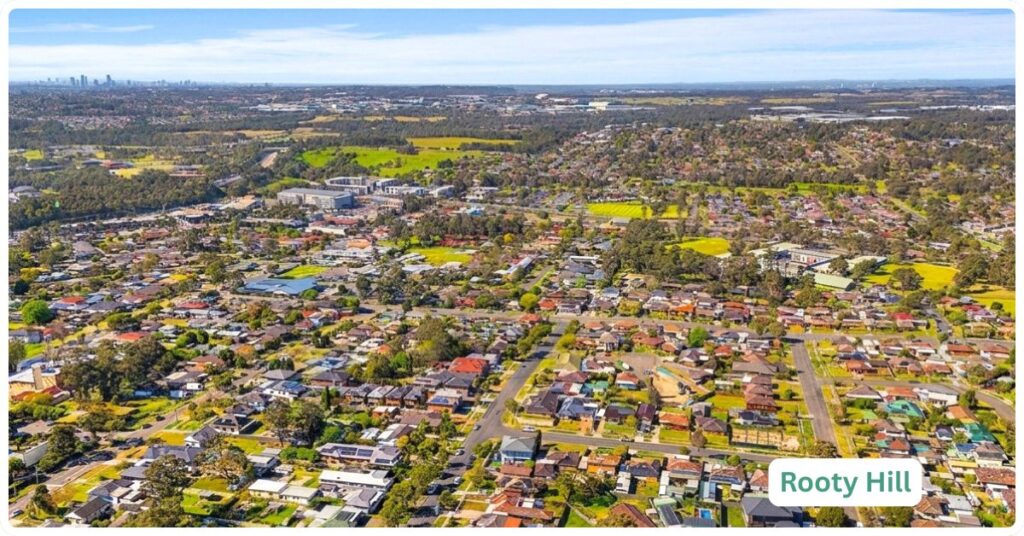
Diverse, established, practical, family-oriented, with plenty of everyday convenience. It has a strong local community with life for many people revolving around West HQ. It has relatively affordable housing compared with many parts of Sydney, and good access to shops, schools, parks and public transport, with Rooty Hill Station providing a direct rail connection to Parramatta and the Sydney CBD. Housing is a mix of older detached homes, newer townhouses and apartments, giving different parts of Rooty Hill quite different streetscapes. Mostly, it is a busy, densely settled suburban environment rather than a leafy or prestige area.
Hospitals
For GP services, there is a string of them to choose from along Rooty Hill Road North. Mount Druitt Hospital sits just next door in neighbouring Mount Druitt, offering emergency and general services closer to home, while Blacktown Hospital, the major referral hospital for the district (run jointly as Blacktown and Mount Druitt Hospitals under Western Sydney Local Health District), is a short drive away for more complex care. Neither is a tertiary teaching hospital on the scale of Westmead, so residents needing highly specialised care will still need to travel further into Sydney.
Industry & Work Life
Rooty Hill’s own economy is modest, mostly local retail, services and the West HQ hospitality/entertainment complex, but its real economic advantage is proximity. It sits right next to Eastern Creek, one of Western Sydney’s biggest industrial, logistics and bulky-goods employment zones, and the M7/M4 interchange puts the Western Sydney Employment Area, the M4 corridor toward Parramatta, and the Blacktown CBD all within a realistic daily commute. This is a suburb built around commuting out for work, whether that’s rail into the city via the T1 Western Line or road into nearby industrial and logistics precincts, not one with a strong local jobs base of its own.
Parks and Natural Spaces
The standout is Blacktown International Sportspark, a large multi-sport facility drawing visitors well beyond the immediate suburb. The Rooty Hill historic site preserves the hill itself, the original namesake landform, as a heritage and lookout area. There’s a skatepark (opened 2003) for younger residents, and West HQ contributes significant recreational infrastructure of its own on top of its club functions.
On the eastern side of the suburb is the Western Sydney Parklands, offering a massing long stretching native bushland space and parks. Just outside the suburb’s southeastern corner is the wonderful and popular Sydney Zoo.
Realty Market
On Domain’s most recent sales-based figures (accessed August 2026, reflecting sales over the prior 12 months), a 3-bedroom house in Rooty Hill has a median price of $940,000 on 87 recorded sales, a 4-bedroom house $967,500 on 57 sales, and a 5-bedroom house $1,311,250 on a thinner 14 sales, which means that top figure should be treated as less statistically reliable than the 3 and 4-bedroom medians.
Units are a genuinely small market here: the only reported segment, 3-bedroom units, sold at a median of $835,000 across just 13 sales in the year, far too few transactions to treat as a stable benchmark.
The Honest Verdict
Rooty Hill suits a fairly specific buyer: someone who wants an existing house on an existing train line, under roughly $1 million for a 3 or 4-bedroom home, with genuinely useful road access via the M7 and M4, and who doesn’t need a premium school zone to feel comfortable. It’s not a growth-corridor suburb chasing new infrastructure that may or may not arrive; the infrastructure it has (the station, the motorway access) is already delivered and has been for decades. First home buyers and value-focused families are the clearest fit. Buyers chasing capital growth on the promise of a coming rail or metro upgrade, or families set on an independent private high school within the suburb, should look elsewhere.
Weighed against its closest neighbours, Rooty Hill sits in an interesting middle position. Mount Druitt, immediately to the west, has had its own recent moment, with Domain reporting a sustained price surge there after years of being dismissed as Sydney’s punching bag; it shares the same LGA and broad crime profile, and arguably a stronger retail centre via its Westfield, but a rougher public reputation historically. Minchinbury, to the south, is smaller, quieter and more purely residential, without its own train station, leaning more heavily on the M4/M7 for access rather than rail. If train access matters most to you, Rooty Hill beats Minchinbury outright. If you’re chasing the sharpest recent capital growth story in the immediate area, Mount Druitt’s numbers are worth comparing directly before you commit to Rooty Hill instead.
Frequently Asked Questions
Does Rooty Hill have its own train station?
Yes. Rooty Hill railway station has been operating since 1861 and sits on the T1 Western Line, with direct services toward Penrith/Emu Plains and toward the city via Central and Chatswood (Wikipedia, 2026).
Is Rooty Hill safe?
Blacktown LGA’s violent crime rate (1,294.8 per 100,000, year to March 2026, BOCSAR) sits above the NSW average of 1,166.0, but its property crime rate (1,401.6 per 100,000) sits below the NSW average of 1,606.3. There is no official suburb-specific BOCSAR crime rate for Rooty Hill; third-party suburb-level estimates for Rooty Hill itself are mixed and use different timeframes, and none should be treated as an authoritative substitute for BOCSAR’s own LGA data.
What is the median house price in Rooty Hill?
Based on Domain’s most recent sales data (accessed August 2026), a 3-bedroom house had a median of $940,000, a 4-bedroom house $967,500, and a 5-bedroom house $1,311,250, though the 5-bedroom figure is based on only 14 sales and should be treated with caution.
Where did the name Rooty Hill come from?
The name originates from Norfolk Island, where Governor Philip Gidley King observed a hill covered with exposed tree roots. He later applied the same name to a similar hill in this part of New South Wales, with the name recorded on maps from as early as 1803 (Wikipedia, 2026).
References
Australian Bureau of Statistics, 2021 Census QuickStats, Rooty Hill (SAL13410), accessed August 2026.
Domain, Rooty Hill NSW 2766 Suburb Profile and Mount Druitt NSW 2770 Suburb Profile, accessed August 2026.
Domain Insight, “Sydney property market’s ‘underdog’ has the last laugh as Mount Druitt prices surge by $330k,” accessed August 2026.
NSW Bureau of Crime Statistics and Research (BOCSAR), Local Area Rankings dataset (LGA ranking for violent and property offences), year to March 2026 (bocsar.nsw.gov.au).
CareForKids.com.au, childcare services listing for Rooty Hill 2766, accessed August 2026.
NSW Department of Education, Rooty Hill High School, accessed August 2026.
Catholic Schools Guide, St Agnes Catholic High School, Rooty Hill, accessed August 2026.
Healthdirect Australia, hospital listings for Mount Druitt and Blacktown, accessed August 2026.
Transport for NSW, media releases regarding M7 Motorway traffic changes in Rooty Hill and Eastern Creek, accessed August 2026.
For more Western Sydney suburbs, browse the full list of Sydney suburbs or read the Western Sydney regional guide.