
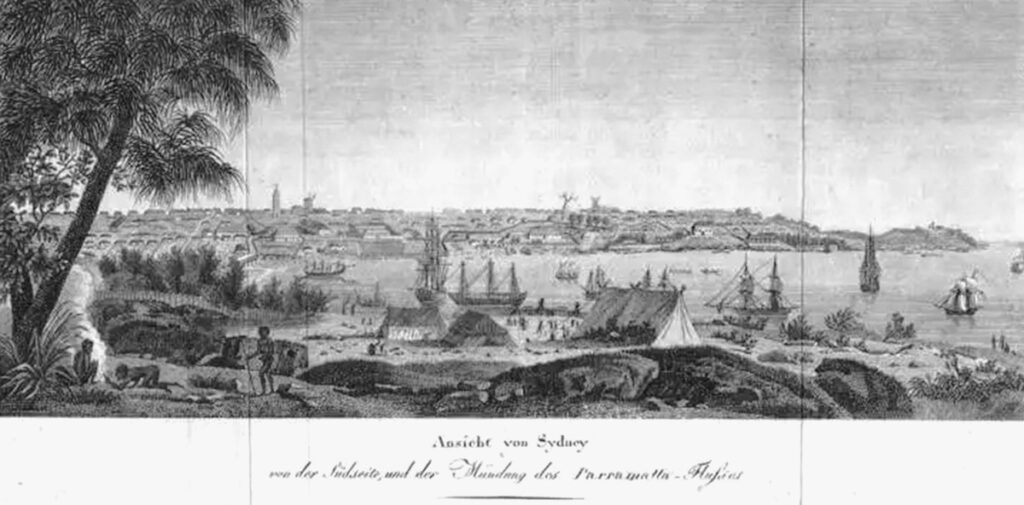
Let’s go back to 1788, 18 years after James Cook charted the east coast of Australia and landed at Botany Bay. That year, Captain Arthur Phillip led the First Fleet into Port Jackson, establishing the first permanent British settlement in Australia and setting in motion the events that would soon bring Europeans into the heart of Darug Country at Parramatta.
Sydney Cove had the harbour, but its sandy soil grew almost nothing. Twenty-five kilometres inland, where the water ran fresh and the ground was actually good for farming, the British planted a second settlement in 1788, and within two years it had a name that stuck. Long before it was a second CBD, Parramatta would be the difference between the colony eating and the colony starving.
What follows is the story of its first century, told through the people who actually lived it: a French doctor riding out from Sydney on a day trip, a settler pouring rum over his wife’s grave, an orange grower who bred a single tree that produced ten thousand fruit in a season, and a local GP in 1875 who was furious enough about vaccination to print his own pamphlet about it.
1788 – Choosing the Spot
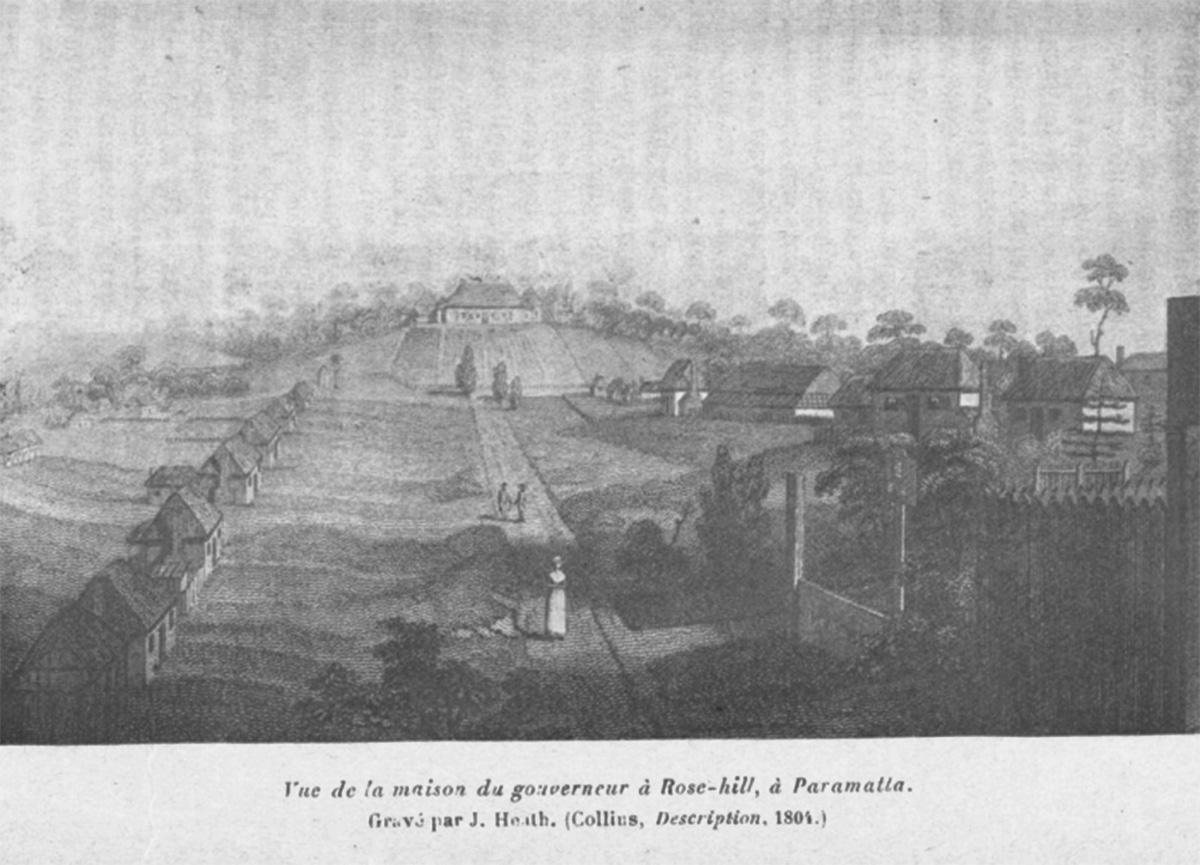
After landing at Sydney Cove, Governor Arthur Phillip went looking for better ground. He found it at a rise the fleet had been calling “the Crescent,” on the banks of a river that ran fresh well upstream of the harbour’s saltwater reaches. On 2 November 1788 he sent ten convicts out to start clearing it, and named the rise Rose Hill. It was chosen for one reason: the soil could actually grow wheat, and Sydney’s couldn’t.
It worked. Grain came up. By June 1790, Phillip was confident enough in the place to give it a permanent name, taking the local Darug word for the area: Parramatta. A year later he laid the whole thing out as a proper town, not a camp, with his own hand on the plan. The main street ran a mile west from the river landing, an enormous 205 feet wide, lined with huts spaced 60 feet apart, each meant to house ten people. For a settlement still short of nails and short of food, that was a serious commitment to the idea that this place was permanent.
The 1790s – Fires, Floods, and a Grave by the Front Door
Almost nothing built in Parramatta’s first decade survived intact. The early huts rotted and had to be rebuilt. A log gaol burned down overnight in 1798 with prisoners still locked inside; they were pulled out in time, but one later died of his burns. A separate fire took out a public granary, an estimated three thousand bushels of wheat gone along with it, cause never established. A bridge across the river was simply swept away by floodwater. A nearly finished Government House was badly damaged in the same violent storm season that tore the roof off Sydney’s church, and the record from the time says plainly that the whole settlement was set back at least a year by that one run of bad weather.
People suffered along with the buildings. In January 1793, the wife of a settler named Williams, along with her child and a second woman, were rowing back from Sydney to Parramatta with a bag of rice when the boat overturned; all three drowned. Williams and his wife had been fighting bitterly just before she got in the boat, and she’d apparently said she hoped never to make it home to him. He buried her and the child within a few yards of his own front door, and a few days later was seen sitting at the graveside with a bottle of rum, drinking one glass and pouring the next onto the ground, telling anyone nearby how much she’d loved it while she was alive.
A year later, an elderly convict named Lewis, sent out to watch the government’s cattle, was murdered and left in a hollow under logs and branches; wild dogs had already got to the body by the time it was found. He’d made the mistake of boasting he’d saved money and sewn it into his clothes. Whoever killed him was never caught.
Not everything was grim. Once the town filled out enough to matter, licensed passage boats began running the river route between Sydney and Parramatta, a shilling a head, another shilling per hundredweight of luggage, all of it run by ex-convicts who’d served their time and gone into business for themselves. It was, in its small way, the first proper public transport New South Wales ever had.
Rebuilding in Brick
Everything that burned or washed away in the 1790s got rebuilt bigger and less flammable the second time. A hundred-foot brick granary went up, then had sixty feet added because the colony still had nowhere proper to store wheat. A second granary, 140 feet long, went up for maize. A proper church was finally built too, a hundred feet long, with its own stone-pillared vestry room and a purpose-built tower just to house a town clock, a genuine extravagance for a settlement that had been rationing food a few years earlier. When it opened, the record notes with obvious relief that Sunday worship was finally being properly attended by everyone in the district, a small line that says a lot about how ragged those first years actually were.
Along the way, the darker side of colonial order kept pace with the ordinary convict population too. A man named Mitton, twice previously pardoned from death sentences, once in Ireland and once in the colony, was finally hanged at Parramatta for robbery, confessing on the scaffold to a string of other planned crimes and naming a blacksmith’s wife as the person fencing the stolen goods. A convict named Kenny, who had murdered a woman and tried to burn her body afterward, was hanged in chains at Parramatta as a public warning of its own.
The Dispossessed Darug People and the Underlying War
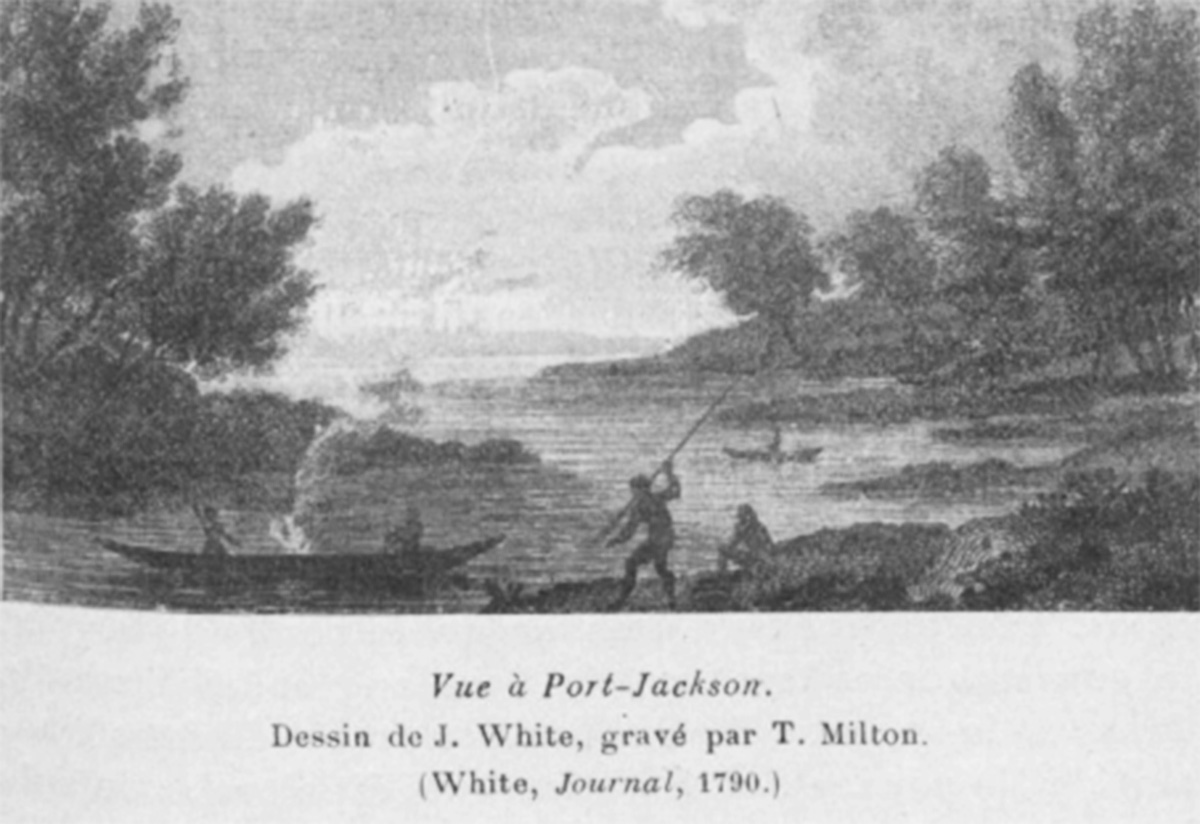
None of the granaries, the church, or the mile-long street described above went up on empty land, and none of it went up without cost to the people who already lived there. While convicts hauled brick and settlers rebuilt what fire and flood had taken, the Cumberland Plain underneath it all was Darug country, and the people who lived on it did not simply step aside. This wasn’t a single episode that happened and finished. It ran the whole time, underneath everything else in this story, for years.
The pattern was set early and repeated often. Convicts at Parramatta destroyed a canoe belonging to a Darug man named Ballooderry. He speared one of the men responsible in return, a response entirely consistent with his own law, and for it the Governor banned him from the settlement outright. When he later tried to walk back in with a group of companions, soldiers opened fire on them without warning; one man was wounded before the group escaped.
As land under crop kept expanding, so did the raids on it, and it’s worth reading those raids for what they plainly were: attempts to reclaim food and country that had been fenced off and planted over without consent. Farms around Parramatta, at Kissing Point and Lane Cove, were burned, livestock killed, and settlers wounded, in what the settlers themselves admitted were clearly deliberate acts rather than random violence. Colonial authorities answered with a proclamation, read aloud and posted by name, ordering specific Darug men to surrender within fourteen days or be formally declared outlaws, hunted down by anyone willing to do it, with the Governor promising to hang the next man caught raiding a farm in chains at the scene, as a public warning to the rest.
The pressure of dispossession cut in cruel directions inside Darug society too. A young woman named Yerranibe, who along with her husband had grown up partly within the settlement, was murdered by him and another man, Colebee, in the brickfields at Parramatta. And Bennelong, the Darug man most famous for having crossed between both worlds, travelling to England and back at the Governor’s side, was for a time accused by his own community of killing a woman whose dying words named him, though he denied ever having met her. None of this reads as a simple story of noble resistance against straightforward villainy. It reads as what dispossession actually does to a society under pressure from every direction at once, which is arguably more honest, and harder to look away from.
So while Parramatta was busy becoming a proper town, brick by brick, the ground it stood on was still contested, unevenly and often violently, by the people it had been taken from. Both things were happening at once, in the same streets, in the same years.
1802 – A Frenchman’s Day Out
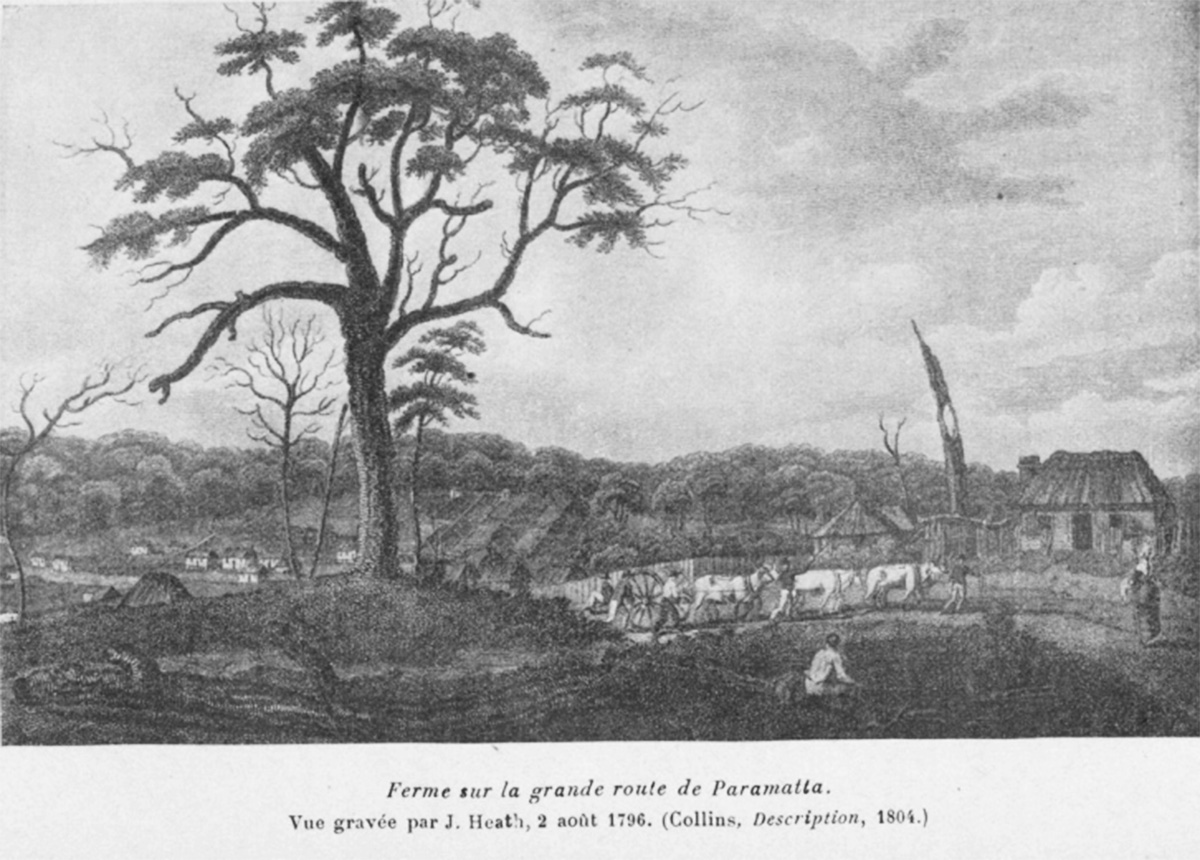
One of the single richest descriptions of early Parramatta comes from an outsider entirely by accident. In 1802, a French physician named Bellefin, travelling with a scientific expedition Napoleon had sent to the Pacific, rode the 25 miles from Sydney to Parramatta out of curiosity, with a colonial soldier as his guide. He found the road better kept than he expected, wide enough for three carriages abreast, cut clean through forest so dense it felt like riding through a tunnel of green, with nothing but birdsong for company the whole way.
What struck him most wasn’t the road, though. It was the farmhouses along it, and the people living in them. A decade or so earlier, many of these families had been exactly the kind of people Georgian England locked up and shipped to the other side of the planet: pickpockets, forgers, women who’d been arrested for prostitution. Bellefin describes riding up to these farms and being welcomed in warmly by mothers fussing over children the way any settled family would, watching English cattle “frisk about with a vigour” he thought matched anything back home.
He was writing partly to reassure European readers that transportation could genuinely reform people, so it’s worth reading with a raised eyebrow. But strip the moralising out and what’s left is a real outsider’s snapshot of a fourteen-year-old penal town that had, against fairly long odds, started to look and run like an ordinary farming district.
1832 – A School, and a Fruit Economy Taking Root
By the 1830s Parramatta was building institutions meant to outlast any of the people running them. King’s School opened in 1832 and would go on to become the oldest grammar school in Australia. Around the same period, the district’s real long-term identity was quietly taking shape in its orchards. Parramatta sits on a belt of deep red loam, the kind that holds moisture well without turning to clay-bound mud in a dry spell, exactly the soil orange trees need. Local growers worked out how good it was early, and one of them, a man named James Pye, spent much of his life breeding better varieties on his own estate. By the time anyone was keeping proper records, a single tree on Pye’s property was reportedly producing upward of ten thousand oranges in a season. Parramatta oranges weren’t a local curiosity by then; they had an export reputation that reached well beyond the colony.
1846-1847 – An Explorer’s Send-off, and a Governor’s Tragedy
Parramatta wasn’t only a farming town by the 1840s; it was also a genuine departure point for the colony’s exploration effort. In November 1846, the explorer Sir Thomas Mitchell set out from Parramatta on an Imperial-funded expedition to find a port suitable for shipping horses to India, a journey that opened up huge tracts of what’s now central Queensland and put several rivers on the map for the first time.
The following year brought tragedy instead. In 1847, Lady Fitzroy, wife of the sitting Governor, was killed in an accident at Parramatta, significant enough an event that almanacs were still recording the date decades later, alongside milestones like the opening of the colony’s first railway.
1850-1883 – Getting There Gets Easier
The very first vessel ever built in the colony, launched in 1789, was a small, ungainly craft the convicts nicknamed The Lump; its actual name was the Rose Hill Packet, because its whole job was ferrying people and cargo between Sydney and Rose Hill. That river run set the pattern for the next century.
By 1850, the colony did it properly. The first sod of the first railway ever built in New South Wales, and in Australia, was turned that July, on a line built specifically to connect Sydney and Parramatta. It opened on 26 September 1855, meaning Parramatta was the destination of the country’s first ever railway journey. By 1883 the town had added a privately built tramway too, three miles of track connecting the river landing to the town centre, built at a cost of £20,000. River steamers kept running the water route in parallel, so that by the century’s end you could get to Parramatta from Sydney by river steamer, by suburban train, or by tram from the wharf, a level of transport choice most colonial towns never came close to.
1875 – The Doctor Who Fought the Needle
Not every voice from Parramatta’s past belongs to a governor or an explorer. In 1875, a local general practitioner named John Morton printed a pamphlet on Parramatta’s own George Street arguing, at real length and with real medical training behind it, that compulsory smallpox vaccination was doing more harm than good.
He’d watched patients in his own practice develop swollen glands and skin eruptions after vaccination and became convinced the vaccine itself was a kind of poison. He was wrong, medically; vaccination against smallpox remains one of the genuine triumphs of public health.
But his pamphlet is a small, sincere, argumentative window into a very different Parramatta from the one Phillip founded: a town with settled families, a functioning medical profession, its own printing press, and enough civic confidence for a country doctor to publish a direct challenge to government policy and dedicate it, in his own words, to “the Mothers of England, and Parents and Guardians throughout the World.”
1890 – A Town in Full
By 1890, the descriptions of Parramatta read like a completely different place from the one Phillip marked out with ten convicts and an axe. It was a borough with its own seat in the colonial parliament and eight named hotels: the Commercial, Tattersall’s, the White Horse, the Star, the Park, the Emu, the Royal Oak, and the Royal Exchange. There was a Town Hall, a district hospital, an asylum for the infirm, and a second asylum on Macquarie Street that had started life as a military hospital under Governor Macquarie and by then held over three hundred people. The old Catholic orphanage had become an industrial school; the old Protestant orphan school had become a convalescent home. There was a proper gaol, two lunatic asylums, and a Mechanics’ Institute with 1,440 books on its shelves.
Government House itself, the grand replacement building Parramatta’s founders never lived to see finished, had by then been leased out as an ordinary boarding house under the plain name Park House, a detail that says as much about the town’s confidence as anything else: the old seat of colonial power had simply been absorbed into everyday commerce. The park nearby had oaks along its walking paths that were, by then, the largest in Australia, and the nearby Rose Hill racecourse had a reputation as one of the prettiest in the colonies.
What’s Still There Today
Read this way, Parramatta’s first century looks less like a series of clean breaks and more like one long argument the town kept having with itself about how much of its convict-era bones to keep.
Old Government House, once rented out as a boarding house, is now restored and open to the public as Australia’s oldest surviving public building. The church with the stone-pillared vestry and the clock tower is still St John’s, still standing on the same site.
The river that carried The Lump between Rose Hill and Sydney Cove in 1789 is the same river the steam packets worked a century later, and the corridor the country’s first railway followed in 1855 is, broadly, still the route the modern rail line takes. The soil James Pye’s giant orange tree grew in is the same red Cumberland loam local gardeners still work with today.
Very little of what made Parramatta in its first hundred years actually disappeared. Most of it just got built over, once, on top of itself, the way the town always had.
For our full profile on contemporary Parramatta, see: https://sydneyinfo.net.au/sydney-regions/suburbs/parramatta/
Sources: George Barrington’s 1811 History of New South Wales; an anonymous 1790s sequel to Barrington’s account; David Collins’s 1798 Account of the English Colony in New South Wales and a contemporary 1803 review of it; John Morton’s 1875 Parramatta pamphlet on vaccination; a nineteenth-century Sydney gardening handbook; and the 1890 Australian Handbook and Shippers’ and Importers’ Directory.