
The single most useful thing to know about rideshare in Sydney has nothing to do with cars. It is that a taxi from the airport rank to the CBD is now a fixed $60, tolls and levies included, while an Uber on a Friday evening can quietly ask you for more than that and call it a quote. For years the assumption was that rideshare always undercut the cab. In 2026 that is no longer reliably true, and knowing when it flips is worth real money.
The rest of it is straightforward once you understand the fee stack. Sydney has two apps that matter, one that is quietly cheaper, a set of airport pickup rules that change depending on which terminal you land at and which Uber product you booked, and a regulator most passengers have never heard of who will take your complaint seriously. Here is all of it.
Snapshot
| Apps that operate here | Uber (roughly 70% of the market) and DiDi are the two that matter. Bolt and inDrive have a smaller presence, Rydo launched in January 2026 for airport and premium work |
| Typical UberX fare structure | About $2.55 base, $1.65 per km, $0.40 per minute, plus an $0.85 booking fee, with roughly a $9 minimum |
| 10km city trip, off peak | Around $27 |
| Airport to CBD | $35-$55 typically, more with surge. A taxi from the rank is a fixed $60 |
| Passenger service levy | $1.20 per trip, $1.32 once GST is added if the operator passes it on. Runs until at least 31 December 2030 |
| Regulator | NSW Point to Point Transport Commissioner. Operators must be authorised, drivers must pass checks |
| Best for | Point-to-point trips under about 30 minutes, late nights, and anywhere public transport is awkward |
| Biggest gotcha | Surge. The same trip can double in price inside ten minutes, and the app will not tell you it is about to drop |
Fares and fees checked July 2026. Rideshare pricing is dynamic by design, so treat every figure here as indicative and check the in-app quote.
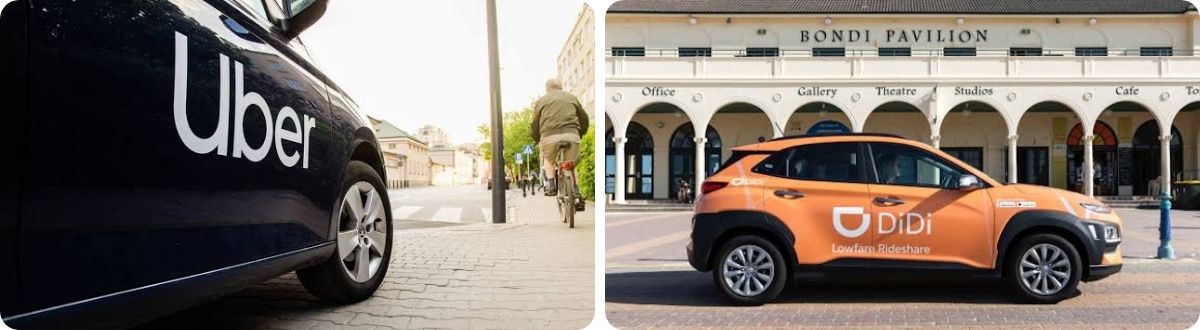
Which Apps Actually Operate in Sydney
The Australian rideshare market has thinned out considerably, so ignore older guides listing seven operators.
- Uber is dominant, with roughly 70% of the market. Widest coverage, shortest waits, most vehicle options, and the only operator with dedicated kerbside pickup at Sydney Airport’s international terminal.
- DiDi is the genuine number two and usually the cheaper of the pair. Coverage is strong across the inner and middle suburbs and weaker on the fringes.
- Bolt and inDrive operate but with limited fleets. Worth having installed as a surge backup rather than a primary.
- Rydo launched in Australia in January 2026, focused specifically on airport transfers and premium vehicle categories rather than general point-to-point work.
The graveyard, so you do not waste time downloading them: Ola exited Australia in April 2024, giving riders and drivers about two days’ notice. Shebah, the women-only service, and GoCatch have both effectively left the field.
What a Ride Actually Costs
Rideshare pricing is built from a stack of components, which is why the quote never looks like a simple per-kilometre calculation.
| Component | Indicative UberX amount | What it is |
|---|---|---|
| Base fare | about $2.55 | Charged the moment the trip starts |
| Per kilometre | about $1.65 | The bulk of a long trip |
| Per minute | about $0.40 | The bulk of a trip stuck in traffic |
| Booking fee | about $0.85 | Platform fee, applied to every trip |
| Passenger service levy | $1.32 | NSW government levy, if the operator passes it on |
| Tolls | at cost | Added automatically if the route uses a toll road |
| Airport pickup fee | varies | Built into the quoted fare on trips from the airport |
| Minimum fare | about $9 | The floor, however short the trip |
| Surge multiplier | 1.0x to 4.0x+ | Applied to the whole fare, not just part of it |
Real-world benchmarks: a 10km, 20-minute trip across the inner city runs around $27 off peak. Airport to CBD is typically $35-$55, and surge on a Friday evening or during a major event can push it past $60. A short hop of a few kilometres will usually hit the minimum fare, which is why a two-kilometre trip and a four-kilometre trip can cost the same.
Uber or DiDi
DiDi is usually cheaper on base fares, and the gap widens on inner-suburb trips. DiDi also tends to surge less aggressively, which matters more than the headline rate: on an airport run at peak, Uber might quote past $60 while DiDi holds closer to $40.
Uber wins on coverage, wait times, airport convenience and vehicle choice. It also has the only PIN-verified kerbside pickup at T1, which genuinely saves ten minutes of confusion.
The move is to have both installed and check both. It takes fifteen seconds and on a surging night it regularly saves $20. Apps like Placie and Best Ride compare Uber, DiDi and taxi prices side by side if you would rather not toggle.
Uber’s product tiers, briefly
- UberX: the standard option, and what most people should book.
- Uber Comfort: newer cars, more legroom, modest premium.
- UberXL: six or seven seats. Worth it for groups and luggage, and often cheaper per head than two UberX.
- Uber Green: hybrid or electric.
- Uber Premier / Premium: executive cars, meaningfully more expensive.
- Uber Pet: allows a pet, with a surcharge to the driver.
- Uber Assist and Uber WAV: covered under accessibility below.
Sydney Airport, Terminal by Terminal
This is the part worth reading before you land, because Sydney Airport treats Uber differently from every other rideshare service and differently again at each terminal.
T1 International
- UberX picks up at Rank C, about 20 metres outside Arrivals Hall B. These trips use Uber PIN technology: after requesting, you get a six-digit PIN, which you give to the first available driver at the zone before getting in. You are not matched to a specific car, you take the next one. This is faster than the old system and closer to the terminal than the taxi rank.
- Uber Premium, UberXL and Uber Green pick up from Rank B, where Uber has four dedicated bays. These allocate you a specific vehicle and do not use PIN.
- DiDi and all other rideshare use the Priority Pick-up Zone, which is a longer walk.
T2 Domestic
All rideshare, including Uber, picks up from the Priority Pick-up Zone.
T3 Domestic
Uber picks up kerbside, directly outside the T3 Arrivals level. Other rideshare services use the Priority Pick-up Zone.
The taxi comparison you should actually run
Since 3 November 2025, a one-way taxi trip from a Sydney Airport rank to a designated Sydney CBD area has been a fixed fare:
- $60 for a standard taxi, including wheelchair accessible services
- $80 for a maxi-taxi with five or more passengers, or where a maxi is specifically requested
Those fixed fares are inclusive of all taxes, fees, levies and road tolls, though a card payment surcharge or cleaning fee can still apply. Critically, the fixed fare does not apply to rideshare. Book an Uber and you pay whatever was quoted and agreed at booking, surge included. More on Sydney Taxis.
So the rule is simple: if you are going airport to CBD and the rideshare quote is above about $55, walk to the taxi rank. If you are going anywhere else, or the quote is well under, rideshare usually wins. Sydney Airport has also introduced WeKnow, an in-terminal booking desk and kiosk system at T1 International Arrivals (near Carousel 7) that books a premium taxi with transparent pricing and priority-lane access before you leave the building.
Also see the T8 Airport Line, which is a popular option and cheaper for a solo traveller. For the new Western Sydney Airport options, see this guide.
The Fees That Surprise People
Surge. Applied as a multiplier to the entire fare. It responds to demand in a small geographic zone, which means walking two or three blocks away from a venue, a station exit or a beach car park often drops the price noticeably. Waiting five to ten minutes usually does too.
Cancellation fees. Charged if you cancel after a grace window, typically a couple of minutes, or if you are not there when the driver arrives. Reasonable in principle, and a common source of disputes when a driver marks an arrival they have not made.
Wait time. Some products start charging per minute once the driver has waited beyond a short free period. Be at the kerb.
Cleaning fees. The most disputed charge in rideshare. Drivers submit a claim with photos, and the platform charges your card, sometimes for amounts up to $150 or more. Passengers do get these reversed, but you have to push. Photograph the back seat when you get out if you have any concern at all, particularly late at night.
Tolls. Added at cost and usually unavoidable, since the fastest route across the harbour or out west is almost always tolled. If you care, you can ask the driver to avoid tolls, but it will cost you time.
The levy. $1.20 per trip, becoming $1.32 with GST if passed on. It funds the taxi licence compensation scheme and is legislated to run until 31 December 2030, or until the compensation fund is filled.
Safety and Regulation
Rideshare in NSW is regulated more tightly than most passengers realise, by the Point to Point Transport Commissioner.
- Booking service providers must be authorised. Uber, DiDi and the rest hold authorisations and carry legal safety duties, not just terms of service.
- Drivers must pass background checks, including criminal history, and there is a published list of disqualifying offences. Both Uber and DiDi run police checks in Australia.
- Vehicles must meet safety standards for booked services, and providers must maintain a Safety Management System.
- Notifiable occurrences must be reported to the Commissioner, and the Commissioner prosecutes breaches.
What to actually do before you get in: check the number plate against the app, check the driver’s face against the photo, and if the app gave you a PIN, use it. At T1 the PIN system means you are not looking for a specific car, so the plate check matters less and the PIN matters more. Sit in the back, share your trip through the app if you are alone at night, and use the in-app emergency button rather than calling if something goes wrong mid-trip.
Incidents do happen. There have been NSW cases of alleged assaults by rideshare drivers, and the background check regime is not a guarantee. None of that makes rideshare unsafe as a category, but the basic precautions are worth taking rather than skipping because the app looks official.
Accessibility, Children and Pets
Wheelchair access. Uber Assist drivers complete a disability awareness course and their vehicles must accommodate folding wheelchairs, walkers and collapsible scooters, but they are not ramp or lift equipped. Uber WAV vehicles are properly wheelchair accessible but availability in Sydney is limited and waits can be long. For reliable wheelchair accessible travel, the Wheelchair Book & Ride service for wheelchair accessible taxis across metropolitan Sydney is the better bet, and pre-booking is strongly advised.
Children and car seats. This is genuinely confusing and worth getting right. Taxis in NSW have limited exemptions from standard child restraint rules, and all wheelchair accessible taxis must carry an approved child car seat. Rideshare vehicles are generally expected to follow the same child restraint rules as private cars, which means an infant or toddler needs a proper restraint and most rideshare drivers do not carry one. In practice: children under six months need a rear-facing restraint, and from six months to four years a rear or forward-facing restraint with an inbuilt harness. If you are travelling with a baby, either bring your own capsule, book a maxi-taxi or specialist baby-capsule service in advance, or request a taxi with a capsule through the airport kerbside supervisors. Do not assume the car that turns up will have one.
Pets. Uber Pet allows a pet with a surcharge. Assistance animals must be carried by law regardless of product, and refusing one is a breach.
The 2026 Driver Pay Reforms, and Why Your Fares May Rise
Something significant changed this year. Under the Commonwealth’s Closing Loopholes reforms, the Fair Work Commission now has power to set enforceable minimum standards for “employee-like” gig workers, including rideshare drivers and delivery riders.
Following an agreement involving Uber, DoorDash and the Transport Workers Union, a minimum safety-net rate of $31.30 an hour takes effect from 1 July 2026, with a further increase from 1 January 2027, and new minimum standards commencing from 10 August 2026. The package also includes injury insurance and protection from unfair algorithmic deactivation, which is the practical name for being kicked off a platform by software with no explanation.
For passengers, the honest implication is that fares are more likely to rise than fall over the next year or two. It also means the drivers taking you home have a floor under their earnings and a route to challenge a deactivation, which is a reasonable thing to be paying a little more for.
What Locals Know
Walk away from the surge zone. Surge is geographically tight. Two blocks from the stadium, the festival gate or the pub strip is frequently a different price. This is the single most effective trick in Sydney rideshare.
Never book from directly outside a major venue after an event. Between the surge and the driver’s inability to reach you through the crowd, you will wait twenty minutes for a fare at three times the normal rate. Walk ten minutes in the direction of home first.
Compare against the train for airport trips. The airport station access fee makes the train expensive for one person and terrible value for four, but for a solo traveller heading to the CBD in peak traffic, the train is both cheaper and faster.
Order an UberXL for three or more with bags. It is not much more than UberX and you avoid the pantomime of trying to fit four suitcases into a Corolla, which is also a legitimate reason for a driver to cancel on you.
New Year’s Eve, Vivid and Mardi Gras are the exceptions to everything. On those nights, expect road closures, extended surge and long waits, and plan on public transport, which runs extra services, instead.
Screenshot the quote. If the final charge does not match, you want the evidence. This takes two seconds and resolves most billing disputes immediately.
Rain changes everything. Sydney rain triggers surge faster than almost any other condition, because demand spikes and traffic slows simultaneously, which drives both the multiplier and the per-minute charge.
Complaints, and How to Get Money Back
Work through this in order.
- Dispute it in the app first. Both Uber and DiDi have a trip-level help flow for fare disputes, cleaning fees and cancellation charges. Attach your screenshots. Cleaning fee reversals are common when passengers actually contest them, and platforms often refund immediately rather than investigate.
- Escalate in writing, not live chat. A recurring complaint across review sites is chat sessions ending abruptly with no record. Email creates a paper trail.
- For safety issues, report to the Point to Point Transport Commissioner. The Commissioner takes safety complaints about booking service providers and drivers, and has genuine enforcement powers including prosecution. This is the step almost nobody uses and it is the one platforms actually respond to.
- For taxi trips specifically, the NSW Taxi Fare Hotline is 1800 500 410. You will need the plate number or driver number, the network, and the time and date.
- Request a chargeback through your card issuer if money was taken and the platform will not engage. Uber has previously paid a $19 million penalty in Australia over misleading fee and cancellation warnings, so regulators do take this conduct seriously.
- For persistent consumer issues, NSW Fair Trading and the ACCC accept complaints about misleading pricing and unfair contract terms.
Trade-offs
What works: a fixed price shown before you commit, no cash and no fare negotiation, coverage across the whole metro area, all-night availability, vehicle choice from budget to premium, cashless splitting between friends, and a regulator with real teeth if something goes wrong.
What does not: surge pricing that can double a fare with no warning and no ceiling, a minimum fare that makes short trips poor value, cleaning and cancellation charges that are easy to apply and tedious to reverse, patchy wheelchair accessible availability, no child restraints, and the awkward fact that the airport fixed-fare taxi now undercuts it on the single most common tourist trip in the city.
Is It Worth It?
For most Sydney trips, yes. For cross-suburban journeys, late nights and anywhere the train does not go, rideshare is the obvious answer and DiDi in particular is well priced.
But stop treating it as automatically the cheapest option, because in 2026 it often is not. Airport to CBD, check the $60 fixed taxi fare first. For anything with multiple stops over a few hours, car share will beat it comfortably. In heavy surge with a station nearby, the train wins on both time and money.
The version that works is unglamorous and reliable: have Uber and DiDi both installed, check both, walk two blocks before you book, and screenshot the quote. That is the whole skill, and it saves a few hundred dollars over a Sydney holiday.
Frequently Asked Questions
Is Uber or DiDi cheaper in Sydney?
DiDi is usually cheaper on base fares and tends to surge less aggressively, particularly on inner-suburb trips. Uber has better coverage, shorter waits and better airport access. The practical answer is to install both and compare each time, which regularly saves $10 to $20 on a surging night.
How much is an Uber from Sydney Airport to the city?
Typically $35 to $55, rising past $60 with surge at peak times or during major events. Since 3 November 2025 a taxi from the airport rank to the designated CBD area has been a fixed $60 including all taxes, fees, levies and tolls, so if your rideshare quote is above about $55 the taxi rank is the better deal. The fixed fare does not apply to rideshare.
Where do I meet my Uber at Sydney Airport?
At T1 International, UberX picks up at Rank C about 20 metres outside Arrivals Hall B using a six-digit PIN you give to the first available driver. Uber Premium, XL and Green use Rank B with allocated vehicles and no PIN. At T3 Domestic, Uber picks up kerbside outside Arrivals. At T2 Domestic, and for DiDi and all other rideshare at every terminal, pickup is from the Priority Pick-up Zone.
What rideshare apps work in Sydney in 2026?
Uber and DiDi are the two that matter, with Uber holding roughly 70% of the market. Bolt and inDrive operate with smaller fleets, and Rydo launched in January 2026 focusing on airport transfers and premium vehicles. Ola exited Australia in April 2024, and Shebah and GoCatch are no longer meaningful options.
Why is my Uber so expensive right now?
Almost always surge, which multiplies the entire fare in response to demand in a small area. Surge zones are geographically tight, so walking two or three blocks away from a venue, station exit or beach often drops the price. Waiting five to ten minutes usually helps too. Rain in Sydney triggers surge faster than almost anything else.
What is the passenger service levy on my rideshare receipt?
A NSW government levy of $1.20 per trip, which becomes $1.32 with GST when the operator passes it on to passengers. It funds the taxi licence compensation scheme and applies to taxis, hire cars and rideshare alike. It is legislated to continue until 31 December 2030 unless the compensation fund is filled earlier.
Can I dispute an Uber or DiDi cleaning fee?
Yes, and it is frequently reversed when contested. Dispute it through the trip in the app, attach photos, and escalate by email rather than live chat so there is a record. Photographing the back seat as you get out, especially late at night, gives you the evidence you need. If the platform will not engage, request a chargeback through your card issuer.
Do I need a car seat for a baby in an Uber in Sydney?
Rideshare vehicles are generally expected to follow the same child restraint rules as private cars, and drivers do not carry car seats. Children under six months need a rear-facing restraint, and from six months to four years a rear or forward-facing restraint with an inbuilt harness. Bring your own capsule, or pre-book a taxi or specialist service that supplies one. Taxis have limited exemptions and all wheelchair accessible taxis must carry an approved child seat.
Is rideshare wheelchair accessible in Sydney?
Partly. Uber Assist drivers are trained in disability awareness and can carry folding wheelchairs, walkers and collapsible scooters, but the vehicles have no ramp or lift. Uber WAV vehicles are genuinely accessible but availability across Sydney is limited. For reliable travel, use the Wheelchair Book & Ride service for wheelchair accessible taxis and pre-book where possible.
Who regulates rideshare in NSW and how do I complain?
The Point to Point Transport Commissioner. Booking service providers must be authorised, drivers must pass background checks against a list of disqualifying offences, and providers carry legal safety duties. Safety complaints go directly to the Commissioner, who can prosecute. Fare and billing disputes start with the platform, then your card issuer, then NSW Fair Trading.
Are rideshare fares going up in Sydney?
Probably. Under the Closing Loopholes reforms, the Fair Work Commission can now set minimum standards for “employee-like” gig workers. A minimum safety-net rate of $31.30 an hour takes effect from 1 July 2026, with new standards from 10 August 2026 and a further increase from 1 January 2027, plus injury insurance and protection from unfair algorithmic deactivation. Higher driver costs generally flow through to fares.
Is rideshare safe in Sydney?
Broadly yes, within a regulated system that requires driver background checks and imposes legal safety duties on operators, but it is not risk-free and there have been NSW assault cases involving drivers. Check the plate and the driver photo against the app, use the PIN where one is issued, sit in the back, share your trip when travelling alone at night, and use the in-app emergency function rather than phoning if something happens mid-trip.
Useful Links
- Sydney Airport taxi and rideshare information, with current pickup zones by terminal
- Point to Point Transport Commissioner, information for passengers
- Make a safety complaint about a rideshare or taxi service
- NSW airport taxi fixed fare trial
- Revenue NSW passenger service levy
- Transport for NSW point to point transport
- Book a wheelchair accessible taxi
- NSW Taxi Fare Hotline: 1800 500 410
Fares, fees and rules verified July 2026. Rideshare pricing is dynamic and platform fee structures change regularly, so always check the in-app quote before booking.