
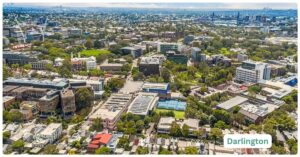
Darlington doesn’t have a high street, a supermarket, or in any meaningful sense its own centre of gravity any more. What it has is nine short streets of surviving terrace housing wedged against the eastern edge of the University of Sydney’s main campus, a population you could fit inside a single large apartment tower elsewhere in the city, and a working-class and Aboriginal history that the university’s expansion never fully erased, even as it swallowed most of the suburb’s land.
The honest trade-off: you get a walkable, tightly-knit pocket 3 kilometres from the CBD with real 19th-century bones, in exchange for a suburb so small it has no shops of its own, no train station within its boundary, and a housing market so thin that “median price” barely means what it usually means.
Darlington Boundary and Location Map
Darlington sits about 3 kilometres south of the Sydney CBD, wedged between the University of Sydney’s Camperdown/Darlington campus and the old Eveleigh rail corridor. It’s bounded roughly by City Road and Cleveland Street to the north, Abercrombie Street to the east (where it meets Chippendale, with which it shares the 2008 postcode), the former Eveleigh railway yards to the south, and Golden Grove Street to the west, where it borders Camperdown. Redfern lies immediately to the south-east across the rail corridor, and Newtown is a short walk further south-west. A large share of the historical suburb’s footprint, including former residential blocks, sporting grounds and streets, is now University of Sydney land, which is why the residential remnant you can actually visit today is so much smaller than the suburb’s boundary on a map.
Quick Facts
| LGA | City of Sydney |
| Postcode | 2008 (shared with Chippendale) |
| Population | 2,597 people (2021 Census, ABS). No mid-cycle figure exists; the next ABS Census count is due in 2026/2027. |
| Growth Rate | No reliable recent trend figure. Darlington’s population fell for decades as the University of Sydney acquired residential land from the 1950s to the 1970s; it has been broadly stable at a low base since, per the 2021 Census. |
| Distance from CBD | Approximately 3 km south of the Sydney CBD |
| Character | Tiny, dense, mostly-university inner suburb; surviving terrace streets ring a campus that now occupies most of the old suburb’s land |
| Median House Price | Reported between roughly $1.89 million and $2.0 million depending on data provider, on an extremely small annual sales count (2025 figures). Treat any single figure with caution given the volume. |
| Median Unit Price | Approximately $1.07 million on just 11 sales in 2025, down close to 5% on the prior year. A sample this small can swing on a handful of settlements. |
| Transport | No station within Darlington itself. Redfern station (multiple Sydney Trains lines plus NSW TrainLink intercity services) is a short walk from the suburb’s eastern edge; buses run along City Road and Cleveland Street. |
| Crime Rate (LGA) | City of Sydney LGA-level BOCSAR data; no suburb-specific figure exists for a suburb this small. See Crime and Safety section below. |
| Childcare Availability | Tight to adequate. No large-format centre sits inside Darlington’s own boundary; several long day care options in adjoining Chippendale and Redfern, plus University of Sydney-run centres, serve the area. |
| School Zone Quality | One government primary school (Darlington Public School) sits within the old suburb; no secondary school within Darlington’s boundary. |
| Parks & Recreation | Very little dedicated public open space inside Darlington itself; residents rely on nearby Prince Alfred Park and Victoria Park, plus university grounds with informal public access. |
| Shopping | Essentially none within Darlington. Cafes, bars and everyday retail are a short walk into Newtown, Redfern or Chippendale. |
| Health | No hospital within Darlington. Royal Prince Alfred Hospital, a major public teaching hospital, is immediately adjacent in Camperdown. |
| Best For | University staff, postgraduate students and academics who want walk-to-campus terrace living, and buyers drawn to heritage housing stock in a tiny, tightly held market |
Darlington’s Backstory – History & Heritage
From Darling Nursery to Darlington
Darlington’s first settler was William Shepherd, a botanist. In 1827 he was offered 30 acres of Grose’s Farm, land that later became the University Paddock and today’s Camperdown, but he turned it down, saying he would rather have a block “closer to the Town.” He was given land to the north-east instead, and by 1835 had cultivated 20 and a half acres into a thriving nursery garden he called the Darling Nursery, in honour of Governor Darling (Francis Pollon, “The Book of Sydney Suburbs,” 1988). The borough later took the name and added “town,” which was gradually corrupted into Darlington. Shepherd’s venture is still legible in the suburb’s street names: Rose, Myrtle, Ivy, Vine and Pine all recall the nursery, alongside Shepherd Street itself.
In 1835 James Chisholm was granted a further 62 acres in the area and built Calder House on it, though he had little time to enjoy the property before his death in 1837 (Pollon, 1988). The land was resumed by the government in 1878 and folded into what became the Eveleigh Railway Workshops, the same complex that opened in 1882 and went on to define Darlington’s working-class character for the next century.
Working-Class and Aboriginal History on the University’s Doorstep
Before the university’s expansion, Darlington was a dense working-class suburb built around the Eveleigh railway workshops and nearby factories. Gadigal people occupied and used this land before European settlement, and Darlington’s proximity to Redfern places it inside one of the most historically significant areas for Sydney’s urban Aboriginal community, a significance that predates and outlasts the campus boundary. The 2021 Census counted 42 Aboriginal and Torres Strait Islander residents in Darlington (1.6% of the population), a modest number in absolute terms but one that sits within a much larger and historically important Aboriginal community footprint centred on nearby Redfern and The Block.
A Suburb the University Ate
Darlington’s defining fact isn’t a landmark, it’s an absence. From 1958 the University of Sydney used special zoning powers under the County of Cumberland Planning Scheme to acquire and progressively demolish around 650 houses across the suburb, along with its Town Hall and much of its civic infrastructure, to expand the Camperdown/Darlington campus. Local opposition eventually stopped the acquisitions by federal directive in 1975, which is the only reason any residential Darlington survives today (Dictionary of Sydney, accessed 2026). What’s left is a fragment: a handful of streets, most prominently Darlington Road and Golden Grove Street, holding onto 19th-century terraces while the rest of the old suburb’s footprint, sporting fields included, now functions as literal university grounds. Few Sydney suburbs have had this much of their physical fabric converted to another institution’s property and kept the name regardless.
What Is It Like Living Here?
Living in Darlington means living inside a university’s shadow in the most literal sense. Neighbours are as likely to be visiting academics or postgraduate students in university-managed housing as long-term terrace owners, and the rhythm of the place follows the semester more than it follows a typical suburban calendar (quiet in January, packed with foot traffic in March). It’s a suburb you experience mostly on foot, because there’s nowhere to drive to that isn’t faster to walk.
Transport
Darlington has no train station of its own. Redfern station sits just outside the suburb’s eastern edge (roughly 600 metres from Darlington Road, an 8-10 minute walk) and is one of inner Sydney’s busiest interchanges, served by multiple Sydney Trains lines including the T2 Leppington & Inner West Line, T3 Liverpool & Inner West Line, T4 Eastern Suburbs & Illawarra Line and T8 Airport & South Line, plus NSW TrainLink intercity services heading south and south-west. From Redfern it’s typically one stop and a few minutes to Central.
Redfern’s southern concourse upgrade, delivering new stairs, lifts and step-free access to platforms 1 to 10, was completed in October 2023, which improved the walk-up experience from Darlington’s side of the tracks.
Beyond that, buses run along City Road and Cleveland Street on Darlington’s northern boundary, connecting to Central and the CBD, and City Road doubles as the main arterial route into town for anyone driving, though most residents don’t bother running a car for CBD trips this short.
Healthcare
There’s no hospital and no significant standalone medical centre inside Darlington itself, but you’re about as close to major tertiary healthcare as an inner-Sydney address gets. Royal Prince Alfred Hospital, one of the state’s largest public teaching hospitals with a full emergency department, sits immediately over the Golden Grove Street boundary in Camperdown, close enough that some Darlington streets are effectively RPA’s back fence. GP clinics are thin within Darlington’s own boundary; residents typically use practices in Newtown, Redfern or the university’s own health service on campus rather than anything local.
Schools and Childcare
Darlington Public School, a NSW Department of Education kindergarten-to-Year-6 comprehensive co-educational primary school, is the one government school inside the old suburb’s boundary (the school’s own site describes its location as Chippendale, reflecting just how blurred that shared-postcode line is on the ground). There’s no secondary school within Darlington; secondary-aged children are zoned into comprehensive high schools in neighbouring suburbs depending on the exact street, so families planning to stay through high school need to check the current NSW Department of Education zoning map for their specific address rather than assume.
Childcare supply follows the same pattern as everything else here: nothing large-format sits inside Darlington’s own boundary, but SDN Chippendale and several long day care centres in Redfern are a short walk away, and the University of Sydney runs its own child care centres for staff and students on campus. Given the area’s density and its double role as both a residential pocket and a working campus, demand for the nearest centres runs tight rather than adequate, and prospective residents with young children should expect to be on more than one waitlist.
Industry & Work Life
The University of Sydney is Darlington’s industry, in a way that’s true of very few suburbs anywhere in the country. The 2021 Census shows professionals making up 47.7% of employed residents and managers a further 13.0%, both figures well above a typical Sydney suburb, and a median age of just 27, skewed heavily by the 20-24 and 25-29 age brackets (ABS Census 2021). This isn’t a suburb people commute out of to a CBD office each day so much as one where a large share of residents work, study or teach within a few hundred metres of home, on the campus that surrounds them.
Shopping & Eating Out
Be honest with yourself about this one: Darlington has essentially no retail of its own, no supermarket, and no shopping strip. What passes for local amenity is university cafes and the food precincts of neighbouring suburbs. Abercrombie Street and King Street in Newtown are a short walk south-west for cafes, bars and restaurants; Redfern Street and the newer Chippendale/Central Park precinct cover everything from casual dining to bars a few minutes’ walk north-east and east. Anyone weighing up Darlington against a suburb with its own high street needs to accept upfront that “shopping in Darlington” really means “shopping a five-to-ten-minute walk from Darlington.”
Attractions, Parks and Natural Spaces
Formal public open space inside Darlington’s own boundary is minimal, a direct consequence of how much of the old suburb’s land became university property rather than council parkland. Residents lean on two significant City of Sydney parks nearby: Prince Alfred Park, with its pool and sports facilities on the CBD side of Central station, and Victoria Park, which sits right against the University of Sydney’s eastern edge and functions as the de facto green space for the whole precinct. Within the campus itself, university ovals and open lawns (including areas that were once part of Darlington’s residential streets) see informal public use for walking, running and picnicking outside teaching hours, even though they remain university-managed land rather than public parkland in the formal sense. The restored Old Darlington School building on Maze Crescent, now part of the university, is the clearest surviving physical link to the pre-university suburb and worth a look if you’re interested in the area’s history.
Crime and Safety
Darlington is too small to have its own reliable suburb-level crime statistics, and no legitimate source publishes one, so the honest reference point is City of Sydney LGA-level data from BOCSAR. Recent LGA-wide figures compiled from BOCSAR data show non-domestic-violence assault holding broadly stable, alongside a two-year rise in break and enter (up around 14%) and a sharper two-year rise in motor vehicle theft (up around 38%), figures reported for the Sydney LGA as of 2025 (inthesuburbs.com.au, citing BOCSAR, accessed 2026). None of that is specific to Darlington’s own streets, which are low-traffic, terrace-lined and largely residential-or-institutional rather than commercial, and anecdotal local sentiment (forums, real estate agent commentary) treats the immediate precinct as low-key rather than high-risk. That said, City of Sydney LGA covers everything from the CBD entertainment strip to Kings Cross-adjacent areas, so an LGA-wide figure will always overstate risk for a quiet residential pocket like this one. Treat it as context, not a verdict on Darlington’s own streets specifically.
Realty Market
The single most important thing to understand about Darlington’s realty market is its size, or lack of it. This is not a suburb where a median price is a robust statistical measure; it’s a suburb where a handful of settlements in either direction can move the number materially. Two independent property-data providers put the 2025 median house price at different points: one records $1.89 million across 45 sales (up 6.6% on 2024), the other $2.0 million across just 34 sales (up 9.94% year-on-year, with properties spending an average of 28 days on market and a modest 2.4% vendor discount, both signs of a market where sellers currently hold the advantage). Both figures sit in a broadly similar band, and the gap between them is itself the honest headline: on this few transactions a year, “the median” moves around depending on which specific terraces happened to sell.
Units are an even thinner market. 2025 data puts the median unit price at approximately $1.07 million on just 11 sales, down close to 5% on the prior year, a decline that on this sample size could reflect the mix of what sold rather than a market shift. Housing stock is overwhelmingly heritage terrace, semi-detached and townhouse (76.1% of occupied dwellings per the 2021 Census), with flats and apartments a minority (19.1%) and freestanding houses being rare (3.8%). The rental market leans heavily toward tenants: 59.0% of occupied dwellings are rented rather than owned, unsurprising given the university-adjacent, student-and-academic-heavy population, with a median weekly rent of $650 at the 2021 Census and more recent third-party data putting median rent closer to $975 a week with a gross yield around 2.5% (2025 figures). Anyone buying here as an investor should go in understanding they’re buying into one of the shallowest, least liquid pockets of the Sydney market, where comparable sales evidence is hard to find.
Our Honest Verdict
Darlington suits a narrow but real buyer: someone who works or studies at the University of Sydney, values a walk-to-campus terrace over almost anything else, and is comfortable accepting that this suburb has effectively no retail, no train station and no significant parkland of its own. It is likely to appeal most to academics, postgraduate researchers and heritage-terrace buyers who see the tiny stock and thin transaction volume as scarcity rather than a warning sign. It is less compelling for young families chasing a school and park network on their own doorstep, given there’s no local secondary school and next to no dedicated public open space within the boundary, and it’s a difficult proposition for investors focused primarily on rental yield or liquidity, given the roughly 2.5% gross yield and the handful of comparable sales available in any given year.
The cross-shop here is Chippendale, which shares Darlington’s 2008 postcode and its eastern boundary, and offers a similar terrace-and-university character but with substantially more retail, dining and apartment stock (thanks to the Central Park redevelopment) and a slightly less campus-dominated feel. If what draws you to Darlington is the terrace housing and the walk to the university, Chippendale is worth inspecting side by side before you commit, because it gives you more of a suburb around the same core appeal. If what draws you to Darlington specifically is its unusual, almost-erased history and its tight, low-turnover market, Chippendale won’t replicate that, and Darlington remains the only place that does.
Frequently Asked Questions
Is this Darlington the same as Darlington, NSW 2330 near Muswellbrook?
No, and this is a common mix-up. This profile covers the tiny inner-Sydney Darlington, postcode 2008, in the City of Sydney LGA, adjoining the University of Sydney’s main campus. There is a separate, entirely unrelated Darlington in the Hunter region, postcode 2330, near Muswellbrook, which is a rural locality with no connection to this suburb beyond sharing a name. If you’ve landed here searching for Hunter Valley property or the Muswellbrook area, this is not that Darlington.
Why doesn’t Darlington have a train station?
Darlington predates most of Sydney’s rail expansion into a small, dense residential grid, and its practical transport needs have always been served by the adjoining Redfern station rather than a station of its own. Given the suburb’s small remaining footprint, a dedicated Darlington station has never been a live proposal.
Why is so much of Darlington now University of Sydney property?
From 1958 the University of Sydney used special planning powers to progressively acquire and demolish residential land across Darlington for campus expansion, a process that removed around 650 houses and the suburb’s Town Hall before local opposition halted further acquisition by federal directive in 1975 (Dictionary of Sydney, accessed 2026). The result is a suburb where most of the historical footprint is now university land, and only a handful of streets retain residential housing.
Can the public use the University of Sydney’s grounds and ovals in Darlington?
Informally, yes, in the sense that university lawns and ovals see public foot traffic for walking and running outside teaching hours. Formally, this land remains university-managed rather than public parkland, so access, hours and permitted use can change at the university’s discretion rather than under council park rules.
Is Darlington a good suburb for a young family?
It’s a mixed picture. There’s one solid government primary school within the old suburb’s boundary, but no secondary school, minimal dedicated parkland, and no supermarket or everyday shopping within Darlington itself. Families who are comfortable relying on neighbouring suburbs for high school, groceries and playgrounds can make it work; those who want all of that within walking distance of their own front door are usually better served by a larger neighbouring suburb.
References
- Australian Bureau of Statistics, 2021 Census QuickStats, Darlington (Sydney – NSW), SAL11215, accessed 2026
- Transport for NSW, “Redfern Station Upgrade – New Southern Concourse” project page, accessed 2026
- NSW Bureau of Crime Statistics and Research (BOCSAR), LGA crime data tables, City of Sydney, last updated 16 June 2026
- propertyvalue.com.au, “Darlington House Prices & Property Trends”, accessed 2026
- Honi Soit, “University abandons plans to sell Darlington Terraces”, August 2024
- NSW Department of Education, Darlington Public School official website, accessed 2026
- City of Sydney Council, Prince Alfred Park and Victoria Park official park pages, accessed 2026
For more inner-city options, browse the full list of Sydney suburbs, or step back to the Sydney regions overview to see how Darlington fits into the wider CBD and inner south picture.