
Drive along Cowpasture Road today and you will pass warehouses, a bus depot and a hardware store, and there is nothing to tell you that light aircraft once took off and landed on this exact patch of ground. Hoxton Park Airport ran here from 1942 until December 2008, when the runway was dug up and the taxiways bulldozed within weeks of the last flight. That closure is the single most defining fact about the suburb: Hoxton Park is not a paddock-to-rooftops growth corridor story like its western neighbours, it is an established suburb that absorbed an entire airfield’s worth of industrial land into its identity within the last two decades.
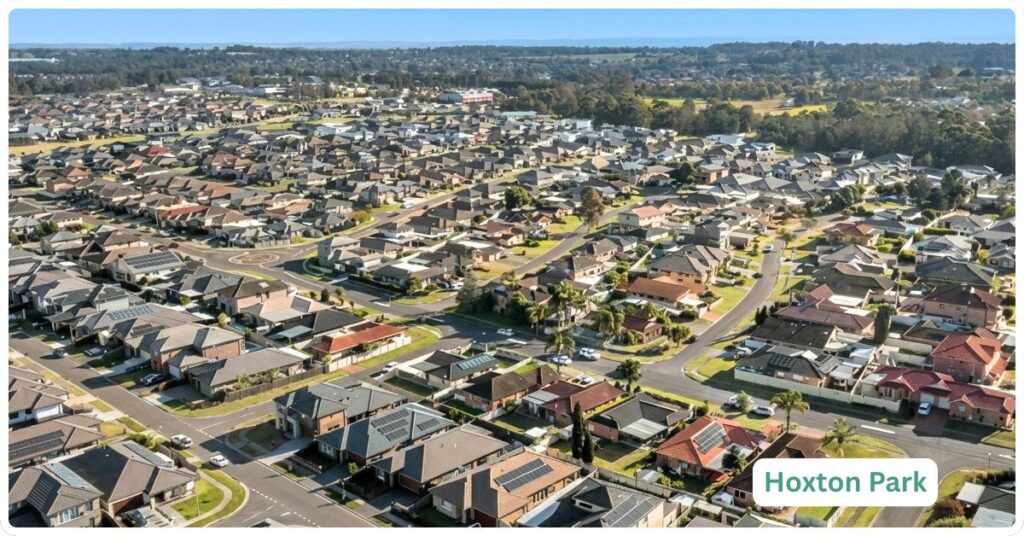
What is left is a suburb of around 4,500 people (2021 Census) squeezed between Liverpool and the newer estates further west, built mostly through the 1970s to 1990s with a wave of newer infill since. It sits at the junction of Hoxton Park Road and Cowpasture Road, both of which feed straight onto the Westlink M7, which makes it a genuinely useful base for anyone who drives for work across south-west Sydney. It is not a suburb chasing a train line that might arrive in a decade. It is a suburb that already has its roads, its shops, its churches and its sporting grounds, and its trade-off is the one that comes with maturity: modest, older housing stock rather than architect-brochure new estates, and rail access that still means a bus first.
Middleton Grange, Carnes Hill and West Hoxton sit immediately around it and get more of the new-estate attention; Hoxton Park is the older, cheaper, more settled sibling in the middle of that cluster.
Hoxton Park Boundary and Location Map
Hoxton Park sits within the Liverpool City Council area, roughly 7km south-west of Liverpool itself (about a 12-minute drive) and bordered by Cartwright, Green Valley, Prestons, Carnes Hill, West Hoxton and Middleton Grange. Its two defining roads, Hoxton Park Road and Cowpasture Road, cross at the suburb’s centre and both connect directly to the Westlink M7.
Quick Facts
Hoxton Park: At a Glance
| LGA | Liverpool City Council |
| Postcode | 2171 |
| Population | 4,572 (ABS 2021 Census, SAL11958) |
| Median Age | 35 years (ABS 2021 Census) |
| Distance to CBD | 38km west of Sydney CBD |
| Median House Price | Approx. $1.16m-$1.18m, up around 17-20% in 12 months (CoreLogic-sourced data via Your Investment Property and HtAG, early 2026) |
| Median Weekly Rent | $680-$700 for houses, yield around 3.45% (HtAG, early 2026) |
| Crime (LGA) | Liverpool LGA rate around 10,991 per 100,000 people, year to March 2026, above the NSW average (BOCSAR-sourced data) |
What Makes Hoxton Park Special
The Airport That Isn’t There Anymore
Hoxton Park Airport was built in 1942 as a WWII dispersal and emergency landing field, one of a ring of airstrips around Sydney intended to scatter aircraft in case of Japanese air attack, complete with revetment hideouts cut into the surrounding scrub. It served as a training and satellite field for Schofields, Bankstown and Camden during the war under the RAAF. After the war it was briefly leased to the Hardy Rubber Company as a tyre test track before aviation lobbying got it reinstated as an airfield, and by the late 1960s it had been redeveloped into a light aircraft strip that ran four flying schools and a steady stream of general aviation traffic.
It closed for good on 15 December 2008, and the runway was physically destroyed the very next day, with taxiways and buildings gone by early 2009. Today the site carries industrial warehouses, a bus depot and a hardware store, and there is a small commemorative plaque marking what used to be there. It is a genuinely unusual thing for a Sydney suburb to have absorbed an entire working airfield within living memory, and it explains why parts of the suburb still feel oddly industrial next to streets of 1980s brick veneer housing.
An Established, Multicultural Suburb
Unlike the growth corridor suburbs further west, Hoxton Park was largely built out decades ago and its population reflects it: a broad mix of ancestries (Australian 12.2%, English 10.0%, Indian 7.5%, Italian 5.9%, Chinese 5.7% per the 2021 Census) and a genuinely wide spread of countries of birth beyond Australia (Iraq 8.6%, Fiji 6.2%, Vietnam 3.3%, Philippines 2.8%, New Zealand 2.0%). Just over a third of residents speak only English at home. The suburb also carries an unusually dense cluster of churches for its size, including Inspire Church (more than 5,000 members and over 25 years in the suburb), Hoxton Park Anglican Church, Bible Baptist Church, Good Shepherd Catholic Church, a Seventh-day Adventist church and Hoxton Park Union Church, reflecting a Catholic-plurality (30.4%) but genuinely multi-faith community (Islam 12.4%, no religion 11.4%, Buddhism 7.9%, Hinduism 6.6%, 2021 Census).
What Is It Like Living Here?
Hoxton Park is a suburb that has settled into itself. It is not chasing new infrastructure, it is not marketing itself as a growth corridor, and the housing stock (predominantly older brick homes from the 1970s through 1990s, with pockets of newer infill) reflects that. Median age of 35 and 22.1% of the population under 15 (2021 Census) point to a family-heavy demographic, but this is not the young-family-in-a-display-home suburb you find further west; it is families who have often been here for years, alongside newer arrivals drawn by relative affordability against West Hoxton and Middleton Grange next door.
The trade-off is straightforward: you get a genuinely established community, existing infrastructure, and direct M7 access, in exchange for older housing stock and a rail commute that always involves a bus first. If you need a train station on your doorstep, this is not the suburb; if you drive for work and want value against its newer, pricier neighbours, it is worth serious consideration.
Hospitals
Liverpool Hospital, the region’s major public hospital, is around 7km away, roughly a 12-minute drive.
Education
Hoxton Park Public School, on Pacific Palms Circuit, serves the local intake area, and Hoxton Park High School serves the suburb for secondary schooling. As with any NSW public school, exact zoning boundaries should be confirmed directly with the NSW Department of Education’s School Finder tool rather than assumed from the suburb name alone. Additional government, Catholic and independent options are available in neighbouring Liverpool and Cecil Hills for families who want to compare beyond the local intake school.
Industry & Work Life
The former airport land now carries industrial warehousing and logistics uses, alongside a bus depot and a large hardware store, which provide some local employment. Most residents commute out of the suburb for work, aided by the direct Westlink M7 access at the suburb’s centre.
Parks and Natural Spaces
Hoxton Park Recreation Reserve is the suburb’s main sporting ground, with floodlit fields, a sheltered BBQ area, playground equipment and an amenities building, used for local football and cricket through the seasons. Brownes Farm Reserve adds a cricket pitch, basketball court and rugby league facilities.
The Liverpool Catholic Club, with its attached ice skating complex, is the suburb’s odd-one-out amenity and genuinely well known across south-west Sydney beyond the suburb’s own residents.
Nearby to the south is the Michael Clarke Recreation Centre with an indoor fitness and basketball facility, tennis courts, a skate park, a cafe and a public plaza.
Transport
There is no train station in Hoxton Park. Leppington station, on the T2 line, sits around 4.4km from the suburb’s centre. Liverpool station, further away again but better served by bus, is the practical rail option for most residents. Buses 853 and 854 run along both Hoxton Park Road and Cowpasture Road, connecting the suburb to Liverpool station and areas further west; if you live off either of those roads you are within a reasonable walk of a stop, if you live elsewhere in the suburb you are not.
The Hoxton Park Road/Cowpasture Road intersection connects directly to the Westlink M7, which is the suburb’s biggest practical transport asset for anyone who drives regularly across south-west Sydney rather than commuting into the CBD, this location is genuinely convenient. Liverpool is around 7km away (about 12 minutes by car); Sydney CBD is roughly 38km away, a drive that varies heavily with traffic and is not a realistic daily commute without a car-to-rail combination.
Realty Market
Median house prices sit in the region of $1.16m to $1.18m as of early 2026, according to CoreLogic-sourced figures reported by Your Investment Property Magazine and HtAG, with annual growth reported in the high-teens to low-20% range over the prior 12 months. That is a genuinely large jump and worth treating with some caution given the relatively low volume of sales in a suburb this size (around 33-36 house sales in the past 12 months per the same sources); a handful of higher-value transactions can move a small-sample median more than they would in a bigger suburb.
Against neighbouring West Hoxton (median around $1.3m, growth reported closer to 4% over the same period) and Green Valley (median around $1.21m, up roughly 11.5%), Hoxton Park still reads as the more affordable, more volatile option in the immediate cluster. Median weekly rent for houses sits around $680 to $700, with a rental yield around 3.45% reported by HtAG in early 2026.
Unit stock is minimal; this is overwhelmingly a house-and-land suburb rather than an apartment market.
The Honest Verdict
Hoxton Park is the affordable, established middle ground in a cluster of suburbs (West Hoxton, Middleton Grange, Carnes Hill) that have mostly gone upmarket and new-build around it. Buy here for the M7 access, the lower entry price relative to its neighbours, and the fact that the infrastructure, schools and shops already exist rather than being promised for later. Don’t buy here expecting a train station, architect-estate housing stock, or stunning scenic green space; none of that is what this suburb offers. The former airport is a genuinely interesting piece of history and a useful reminder that this suburb has been through more change already than its quiet streets suggest.
Frequently Asked Questions
Does Hoxton Park have a train station?
No. The nearest station is Leppington, on the T2 line, around 4.4km away. Most residents rely on buses 853 and 854 to reach Liverpool station, or drive.
Was there really an airport in Hoxton Park?
Yes. Hoxton Park Airport operated from 1942 until it closed on 15 December 2008, with the runway destroyed the following day. The site is now industrial land, including warehouses and a bus depot.
Is Hoxton Park safe?
Crime is reported at LGA level, not suburb level. Liverpool City Council’s recorded crime rate was around 10,991 incidents per 100,000 people for the year to March 2026 (BOCSAR-sourced data), above the NSW average, with theft and transport-related offences the most common categories. There is no suburb-specific figure available for Hoxton Park alone.
What is the median house price in Hoxton Park?
Around $1.16m to $1.18m as of early 2026 (CoreLogic-sourced data via Your Investment Property Magazine and HtAG), up sharply over the previous 12 months, though based on a relatively small number of annual sales.
What schools serve Hoxton Park?
Hoxton Park Public School and Hoxton Park High School are the local options; families should confirm exact zoning through the NSW Department of Education rather than assuming based on suburb boundaries.
References
Australian Bureau of Statistics, 2021 Census QuickStats, Hoxton Park (SAL11958), released 28 June 2022.
Your Investment Property Magazine, Hoxton Park NSW 2171 Suburb Profile, accessed 2026.
HtAG, Hoxton Park NSW 2171 Property Market, accessed 2026.
NSW Bureau of Crime Statistics and Research (BOCSAR), crime and policing data for Liverpool City Council, year ending March 2026.
Liverpool City Council Library, Hoxton Park suburb history.
NSW Department of Education, Hoxton Park Public School.
See all suburbs in the Liverpool City Council. See the full Sydney Regions overview to explore more of greater Sydney.