
“I am just so angry about the disintegration of the little village where I was born.” James Nobbs said that to the Sydney Morning Herald in 2001. He and his wife Lorraine had been paid $425,000 for their two-hectare block at Badgerys Creek and moved to Wallacia. They were among hundreds of people moved off their land after 1986, when the federal government announced that Sydney’s second airport would be built there.
Then nothing happened. For years.
The post office closed in 1989. The public school was decommissioned in 2014. The churches’ graves were moved to a new memorial cemetery at Leppington. By the 2021 census, Badgerys Creek had just 168 residents.
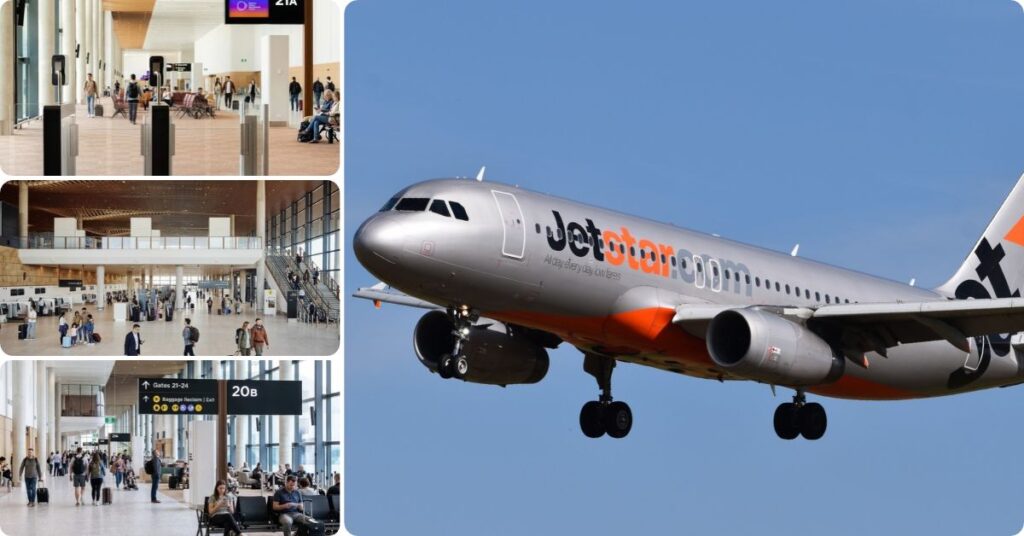
And on Sunday 25 October 2026, a little after its scheduled 11am departure, a sold-out Jetstar A320 rolled down a runway laid across that land and lifted off for the Gold Coast. It was the first passenger flight from Western Sydney International (Nancy-Bird Walton) Airport.
Forty years after the site was chosen, Sydney finally has its second airport. Here’s how opening day went, where you can fly, what people are saying, and what comes next.
The airport at a glance
| Full name | Western Sydney International (Nancy-Bird Walton) Airport, with the Nancy-Bird Walton Terminal |
| Opened to passengers | Sunday 25 October 2026 (freight from 26 July 2026) |
| Location | Badgerys Creek, in the Liverpool City Council area, about 44km west of the Sydney CBD |
| Runway | One runway, 3.7km long |
| Curfew | None; it operates 24 hours a day |
| Capacity | Up to 10 million passengers a year in its first stage |
| Cost | Up to $5.3 billion in Commonwealth equity, not counting the metro line or roads |
| Air traffic control | A digital tower instead of a traditional control tower, a first for a major Australian airport |
Opening day
Check-in opened at 8am. The first flight, Jetstar JQ362 to the Gold Coast, was sold out, the ABC reported. Among the passengers was Jetstar chief executive Stephanie Tully. At the controls was Blacktown-raised pilot Aglaya Papadokokolakis, who told the ABC: “Today still feels very surreal.”
The flight was scheduled for 11am. The ABC said it took off just before 11.30am, and SBS put it just before midday. None of the reports called it a delay.
Prime Minister Anthony Albanese, Premier Chris Minns and federal Infrastructure Minister Catherine King were there, along with WSI chief executive Simon Hickey and Qantas Group chief executive Vanessa Hudson.
“For the first time in more than 50 years, Australia is opening a major new airport,” Albanese said, as reported by the Moodie Davitt Report. He went further, calling it “Australia’s best airport, without question.”
Hickey reached for the biggest comparison he could find: “WSI is the most transformational piece of infrastructure our nation has seen since the Sydney Harbour Bridge.” He also spoke to the people who live nearby, telling SBS: “Young people growing up in the west can now look to the sky and see their future is bright and right here.”
King put it more plainly: “It requires perseverance to build really big things.”
The first arriving passenger flight, JQ363 from the Gold Coast, was due to land at 3pm, and the first Melbourne service was scheduled for 6pm. Air New Zealand’s first flight from Auckland is due on Monday 26 October at 7.50am, making it the airport’s first international service. We found no reports of delays, cancellations, or baggage or traffic problems on opening day.
In the forecourt, passengers walk past Barayabinyang (Songbirds), an artwork by Dharug and Darkinjung artist Adam Laws.
The airport opened to freight on 26 July 2026, with Qantas Freight and Texel Air flying from the following day. From 1 November, the government intends WSI to become Sydney’s overnight freight airport, ending the freight flights currently allowed during Kingsford Smith’s 11pm to 6am curfew. Airservices Australia still described 1 November as the “intended” date in the week of opening.
The airport says more than 12,800 people have worked on the project, about half of them locals, and more than $500 million has been spent with more than 360 western Sydney businesses.
Where you can fly
Flying now, or from the first weeks
| Airline | Destination | Frequency | Starts |
|---|---|---|---|
| Jetstar | Gold Coast | Daily (increased from four a week) | 25 October 2026 |
| Jetstar | Melbourne | Up to 14 a week | 25 October 2026 |
| Jetstar | Brisbane | 3 a week | 25 October 2026 |
| Air New Zealand | Auckland | 3 a week (Mon, Wed, Fri) | 26 October 2026 |
| Singapore Airlines | Singapore | Daily, A350 overnight service | 23 November 2026 |
Announced for 2027
- Vietjet to Ho Chi Minh City: twice a week on an A330 from January 2027, rising to three a week from March. Executive Traveller gives the first flight as 10 January; earlier reports said 9 January.
- Fiji Airways to Nadi: three a week from 19 March 2027, according to the federal infrastructure minister.
- QantasLink to Melbourne and Brisbane: four flights a week on each route, on Embraer E190s, from 28 March 2027.
- Qatar Airways to Doha: three a week on a Boeing 777 from 15 December 2027, with tickets due on sale from 19 December 2026. This was announced the week before opening.
Proposed, but not confirmed
- Jetstar to Bali: proposed as a daily service from 15 March 2027, subject to regulatory approval.
- Vietjet Thailand to Bangkok: four a week from November 2027, subject to approval.
- Emirates and Etihad: the government granted Emirates, Qatar Airways and Etihad rights to fly seven extra flights a week each through WSI in May 2026. Qatar has now announced its schedule. Emirates and Etihad have not.
- Virgin Australia: no flights planned. The airline says it is still evaluating the airport.
- Zinc: a proposed low-cost airline led by former Qantas executive Peter Kelly, which wants to be based at WSI. It’s still raising money and has no launch date.
It’s a slow start. In the week before opening, Bloomberg reported that aviation data firm Cirium counted six or fewer scheduled passenger flights a day over the airport’s first 12 months. Mascot handles hundreds. Hickey told the ABC the airport would get closer to its 10 million passenger capacity in the early to mid 2030s.
Inside the terminal
The terminal was designed by Zaha Hadid Architects and COX Architecture, and built by Multiplex. Domestic and international flights share one building, with common check-in and bag-drop kiosks for every airline.
The design leans into its setting. You arrive under what the airport calls a “great Australian veranda”. Inside there are sandstone walls, terrazzo floors set with pebbles from the Nepean River, and what’s described as Australia’s largest suspended aluminium ceiling, inspired by the Blue Mountains and the Cumberland Plain. Floor-to-ceiling windows look west to the mountains.
Lagardère runs 11 duty free and travel essentials stores, and Global Exchange the currency exchange. A dnata-run lounge, the Rayleigh Lounge, is due to open in November.
First impressions: what people are saying
The pretend passengers
Since August, thousands of volunteers have spent Tuesdays and Thursdays acting as passengers, checking in fake bags with fake boarding passes so the airport could test its systems. The first trial passenger jet, a Jetstar A320 from Melbourne, landed on 1 September.
“The interest from volunteers within the community for the trials was overwhelming,” said chief operating officer Matt Duffy.
Most of what the volunteers said was positive. One, Kylie, called it “a really beautifully built airport,” and two locals from Mulgoa described check-in as seamless, according to YourLifeChoices. But volunteers also pointed out problems: limited seating in arrivals and at the baggage carousels, unclear signage, no travelators on the international arrivals side, and hot afternoon sun through the west-facing glass.
On the day: the locals
Not everyone was celebrating. The day before opening, Luddenham resident Carolyn Wong told the ABC: “It’s such a kick in the guts that they are opening it without addressing any of the community’s concerns.”
Since flight paths took effect in July, residents of Luddenham, Greendale and Wallacia have complained about night freight noise, the ABC reported in August. They invited the Prime Minister and the infrastructure minister to stay the night. At that point, of 236 buildings eligible for noise insulation, 74 had been approved and none had been completed. Not every neighbour agrees: one resident told South West Voice the noise was “no dramas”.
Penrith Mayor Todd Carney welcomed the airport but not the wait for rail: “There’s so much more potential in it if we actually just deliver on the underlying infrastructure that’s actually required.”
Will Sydney use it?
A YouGov poll published on 13 October 2026 found that 54% of Greater Sydney residents say they’re likely to use WSI, and 79% think it will ease congestion at Mascot. But given similar fares and times, 53% would still choose Mascot, against 29% for WSI, according to YouGov.
The critics
- No train on day one. The metro line to the airport won’t open until late 2027 at the earliest. Dean Long of the Australian Travel Industry Association called it a “missed opportunity,” adding: “Is it as convenient to get into the main CBD? No.”
- Too few flights. University of Sydney transport professor David Levinson has compared WSI with Montréal’s Mirabel and Melbourne’s Avalon, airports that struggled to attract airlines.
- Noise in the Blue Mountains. “This plan proudly promotes being a 24/7, seven days a week airport with no curfew or hourly aircraft cap,” Blue Mountains Mayor Mark Greenhill said in 2025. “We won’t stop fighting to address the issue of potential and severe noise impacts.”
- Air traffic control. In August 2026, a confidential report published by the Australian Transport Safety Bureau said Sydney’s air traffic controllers had “minimal confidence” in handling the new airspace introduced for WSI under normal traffic. CASA said it was “satisfied that these matters were considered through the approval process”.
Getting there
Our full guide to getting to and from Western Sydney International Airport covers every option. In short:
- WSI Link: a free bus between the terminal and St Marys station (on the T1 line), every 30 minutes, from 4.30am to midnight (1am on Fridays and Saturdays). It takes about 30 minutes.
- Local buses: five electric bus routes have run since July, every 30 minutes from 5am to 10pm, linking the airport with Penrith (790), Mount Druitt (772), Liverpool (825 and 860) and Campbelltown (845).
- Super Shuttle: $25 one way to Parramatta, $55 to the Sydney CBD (about an hour) and $65 to Sydney Airport.
- By car: the toll-free M12 Motorway opened in March 2026. There are more than 6,000 parking spaces, with long-stay parking from $15 a day, Saver from $29 and Premium from $49 until April 2027. The first 15 minutes at the pick-up and drop-off zone are free.
- Uber and taxis have dedicated areas, and five car hire companies operate from the P1 car park.
If you just want to look around, the airport is offering three hours of free parking from 26 October to April 2027 for people who book online.
The metro: not yet
The 23km Sydney Metro Western Sydney Airport line will run from St Marys through Orchard Hills, Luddenham, Airport Business Park and the airport terminal to Bradfield. The final track was laid in June 2026 and the first driverless trains have arrived. The target is December 2027, but in June Premier Chris Minns said it could be delayed until 2028. No new date was announced in opening week.
How we got here: 80 years of arguing
Sydney has been talking about a second airport since the 1940s. Towra Point in Botany Bay was considered in 1946. In the decades that followed, sites at Wilton, Holsworthy and elsewhere came and went.
On 17 February 1986, the Hawke government announced Badgerys Creek. Over the next few years it bought about 1,700 hectares, more than half of it compulsorily. A sod was turned in 1992, with opening then expected in 1995. It didn’t happen. The Howard government looked at Holsworthy instead, and in 2000 decided not to build at all. In 2012, Badgerys Creek was ruled out again.
Through all of it, the people who’d lost their land waited. Dairy farmer Tony Perich, who had part of his farm compulsorily acquired in 1991, told the Herald: “I lost 20 years of my life because of them bloody fools.” Years later he told a local paper: “We’ve come to accept the airport now and I actually think it will be very good for the southwest.”
The decision finally stuck on 15 April 2014, when the Abbott government confirmed Badgerys Creek. Prime Minister Scott Morrison turned the first sod of the current project on 24 September 2018.
The land before the airport
Long before any of it, this was Dharug Country. The airport names the Cabrogal people of the Dharug Nation as Traditional Custodians of the site, and more than 70 Aboriginal heritage sites have been recorded on it. A grinding groove and a scarred tree are preserved in a 117-hectare conservation zone in the south-east of the site. Where sites couldn’t be kept, artefacts were recorded and salvaged, according to the Western Sydney Airport project.
A Keeping Place to hold those artefacts has been discussed with Darug Traditional Owners, the Gandangara Local Aboriginal Land Council and Muru Mittigar. A 2021 consultation summary said everyone agreed on its cultural importance, but they “were not able to agree on ultimate ownership and control”. In 2025, the airport proposed “Cabrogal” as the name of a new suburb for the airport precinct.
Why Nancy-Bird Walton?
The airport was named in March 2019 after Nancy-Bird Walton, who learned to fly at Charles Kingsford Smith’s flying school at Mascot in her teens. At 19 she became the youngest woman in the British Empire to earn a commercial pilot’s licence. In 1935 she flew a Gipsy Moth for an outback medical service in western NSW, which earned her the nickname “The Angel of the Outback”. She died in 2009, aged 93.
Sydney’s first airport carries Kingsford Smith’s name. Now the young woman who enrolled at his flying school has an airport of her own.
The suburbs around the airport
The airport is officially in Badgerys Creek, in the Liverpool local government area, with part of the site extending into Luddenham. The semi-rural suburbs around it are changing fast:
- Bradfield, gazetted as a new suburb in 2023, is planned as Sydney’s third CBD, next to the airport.
- Bringelly and Rossmore, acreage country to the south and south-east, inside the planned Aerotropolis.
- Kemps Creek, to the north-east, along the M12.
- Orchard Hills, to the north, which will have its own metro station.
- The nearest big centres are Liverpool and Penrith.
For the bigger picture, see our Western Sydney guide.
What comes next
- Growth: the long-term plan is for the airport to handle about 82 million passengers a year by the 2060s, more than Mascot today.
- A second runway: planned parallel to the first, but not expected until after 2050, when demand reaches about 37 million passengers a year.
- Bradfield City Centre: the first building, an advanced manufacturing facility, opened in 2025, 400 metres from the future metro station.
- More rail: metro extensions north to Tallawong and south to Campbelltown and Macarthur have been proposed but not committed. Western Sydney councils want them sped up.
- Roads: upgrades to Elizabeth Drive, Mamre Road and Fifteenth Avenue are funded. Read about the Fifteenth Avenue plan.
- Noise insulation: eligible homeowners can apply for free, voluntary noise insulation until April 2028, through the federal Noise Insulation Program.
For the people of Badgerys Creek, the airport has been coming for most of their lives. Some lost their homes and farms. They watched their post office and school close, and their churches’ graves moved to Leppington, for a project that, for decades, never seemed to arrive.
On Sunday 25 October 2026, it finally did. Whether it becomes Sydney’s gateway to the world or an expensive quiet runway in the paddocks will depend on the airlines, the metro and the millions of people in western Sydney who now have an airport on their doorstep.
The paddock where the village used to be has started to find out.