Your no-nonsense insider’s guide to Western Sydney International (Nancy-Bird Walton) Airport: who it’s for, how to get there, and whether you should hold off booking that overseas trip until it opens.
Quick Facts
Opens: 26 October 2026 (passenger flights); cargo from July 2026
The headline: Australia’s first curfew-free, 24/7 international airport
Best for: Western Sydney locals, late-night flyers, and anyone tired of the cross-city trek to Mascot
Getting there at launch: Toll-free M12 motorway, free shuttle bus to St Marys, 6,000+ parking spaces (metro arrives 2027)
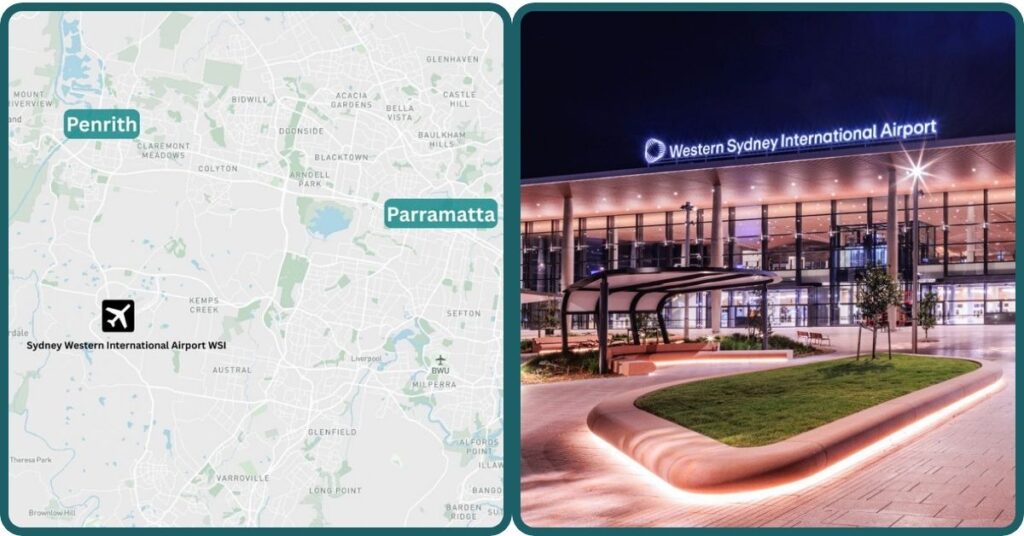
The plane lands at 3am and nobody flinches. No curfew. No apologetic circling over Botany Bay waiting for the clock to tick past six. Just a quiet taxi under a wave-shaped timber ceiling that ripples overhead like dappled light through eucalyptus bark, and a terminal that, for once in Australian aviation, does not look like every other terminal you have ever shuffled through. This is the whole point of Western Sydney International. It never sleeps, and it was built from a blank paddock to do exactly that.
For over a century, Sydney has run on one airport. Kingsford Smith has served since 1919, hemmed in on three sides by suburbs and on the fourth by water, shackled by an 11pm-to-6am curfew that turns the place into a pumpkin every night. WSI is the answer to that bottleneck. And if your next big trip is pencilled in for late 2026 or beyond, this guide will tell you whether it is worth waiting for.
The 20-Second Verdict: Is WSI Right for You?
Here is the honest read before you commit.
You will love it if: you live anywhere from Penrith to Liverpool to Campbelltown, you fly red-eye or late-night long-haul, or you have ever lost an afternoon to the M5 trying to reach Mascot. WSI puts an international gateway on the doorstep of 2.5 million Western Sydney residents who used to drive an hour-plus just to check in.
You might hesitate if: you live on the eastern side of the harbour, you need rail access from day one, or you want a lie-flat business seat to New Zealand (more on that below). The metro is not ready at launch, and the route network starts small before it grows.
Three reasons to be genuinely excited:
No curfew, ever. Airlines can finally fly the schedules that make sense, including those lucrative just-before-midnight departures that connect you into Asia by breakfast.
One roof, no shuttle buses. Domestic and international sit under a single terminal. Connecting passengers skip the inter-terminal scramble entirely.
It is, quietly, beautiful. This is not a soulless metal shed. The design draws on the Cumberland Plain and the geology of the Blue Mountains, and you feel it the moment you walk in.
Getting There: The Anxiety-Killer Section
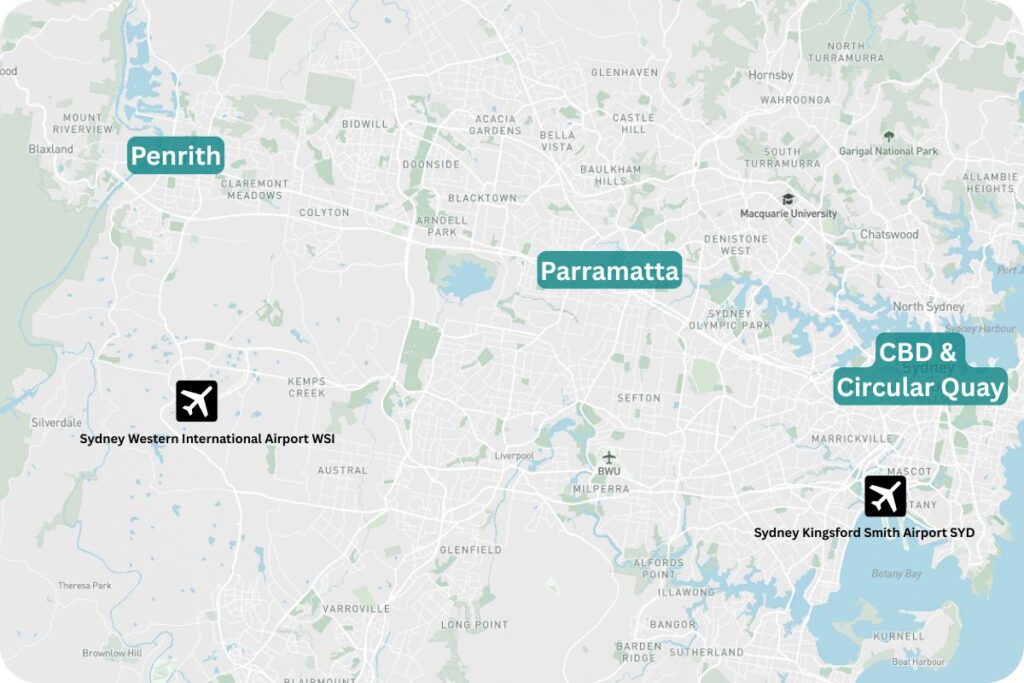
Let’s deal with the question everyone actually has. WSI sits at Badgerys Creek, roughly 50 km and a world away from the CBD, so your arrival plan matters more here than it does at Mascot.
By car (the easy option at launch). The brand-new toll-free M12 Motorway has opened ahead of flights, linking the airport straight into Sydney’s orbital network via the M7 and Elizabeth Drive. From the CBD you are looking at 45 to 90 minutes depending on traffic, trending toward a smoother run as the M12 beds in. From the western centres it is genuinely close: Liverpool (15-20 min), Penrith (20-25 min), Parramatta and Campbelltown (25-30 min), and the Blue Mountains resort district (35-45 min). Parking is accessed from Nancy Drive, with more than 6,000 spaces across several car parks and EV charging on site. One catch worth flagging: as of mid-2026, per-day parking rates had not been published, and online booking only opens in the second half of the year. Check wsiairport.com.au close to your travel date rather than guessing.
By public transport (the work-in-progress). Here is where you need to read the fine print. The shiny Sydney Metro Western Sydney Airport line, a 23 km driverless rapid-transit spine running through St Marys, Orchard Hills, Luddenham, the Airport Business Park, the terminal, and Bradfield, will not open with the airport. Track-laying delays and power-switching issues at St Marys pushed it back to 2027. So from opening day, the connection is a free interim shuttle bus between the terminal and St Marys station, where you join the T1 Western Line straight through to Parramatta, Strathfield and Central. The free buses run every 30 minutes, 4:30am to midnight Sunday to Thursday and until 1am on Friday and Saturday, with the St Marys leg taking about 15 minutes (allow 30 in real traffic). On top of that, five new permanent bus routes launched on 5 July 2026, linking the airport to Penrith, Oran Park, Campbelltown, Liverpool, Mount Druitt and Leppington. Useful. Not yet seamless. If you are landing on a 7am curfew-busting long-haul, double-check that your onward service is actually running at that hour.
By chauffeur or rideshare (the time-saver). For corporate travellers, a direct transfer sidesteps the whole bus-changes calculus. Reckon on Parramatta in 25-30 minutes and Penrith in around 20. Worth the spend if a CBD meeting is waiting at the other end.
The launch network is deliberately lean, then scales fast. Don’t expect fifty destinations on day one. Do expect the schedule to fill out through 2027 as more carriers grab those curfew-free slots.
Air New Zealand is the launch-day act, flying WSI to Auckland three times a week (Monday, Wednesday, Friday) on the A320/A321 family, with the inaugural service on opening day, 26 October 2026. One thing to know before you book on points: it is economy-only at launch. If you want Premium Economy or a Business seat across the Tasman, that is still a Kingsford Smith service for now.
Singapore Airlines brings the long-haul glamour from 23 November 2026, a daily A350-900 to Changi. The return leg, SQ202, departs WSI at 23:55, that golden near-midnight slot Mascot simply cannot offer. Land in Singapore at dawn, connect onward before most of Sydney has had coffee.
Qantas and Jetstar anchor the domestic side from late 2026, with the trunk routes to Melbourne, Brisbane and the Gold Coast. Jetstar is basing a fleet of narrowbodies on-site and leaning into leisure and low fares; Qantas covers the high-volume business runs. Watch this space too for ultra-low-cost newcomers chasing the Melbourne-Brisbane-Gold Coast “Golden Triangle.”
Behind the scenes, Australia has been busy signing bilateral air agreements with Vietnam, Türkiye, Sri Lanka, Tonga, Samoa, the Gulf carriers and others, adding dozens of weekly services and laying the groundwork for the international map to expand quickly once the doors are open.
The Terminal Itself: Worth Arriving Early For
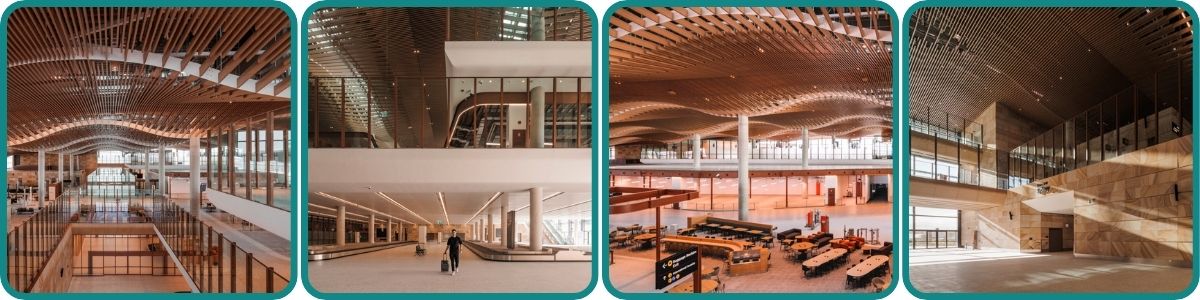
Most airports want you in and out. This one rewards a wander. The terminal was conceived by Zaha Hadid Architects with COX, delivered by Woods Bagot, and it refuses the generic. The low, horizontal profile echoes the Cumberland Plain savannah rolling out around it. A vast glazed facade pulls in what the architects call the “Great Australian Light,” which doubles as intuitive wayfinding: follow the daylight and you find check-in.
The showpiece is overhead. An undulating timber-toned ceiling, built from roughly 188 km of wave-shaped battens, filters the light into patterns that mimic sun through eucalyptus bark. Local sandstone runs through the arrivals and departures halls, a deliberate physical handshake with the Blue Mountains next door. And crucially, the public spaces were shaped through deep consultation with Dharug Custodians, so the layout carries a genuine local narrative rather than tacked-on decoration. If you didn’t know those things, your first unguided thought may be “was this built by IKEA”. Seating is locally made (over half the seats have USB-A, USB-C and AC power), so your phone survives the wait.
A nerd’s footnote that is actually quite cool: WSI is Australia’s first major airport with no physical control tower. Controllers work from a Digital Aerodrome Service centre 20 km away in Eastern Creek, watching the runway through a 25-camera high-definition array with infrared night vision and augmented-reality overlays. Security uses 3D CT scanners too, which means you keep your laptop and liquids in your bag. Small mercy. Big difference.
Where to Stay Nearby
No on-airport hotel at launch (the WSI Business Precinct hotel arrives in phases from Q2 2027), so base yourself in the surrounding centres. A few picks by traveller type:
Special occasion / corporate: The Pullman Sydney Penrith (about 30 min away) is the five-star anchor, 153 rooms wired into the 1,000-seat Western Sydney Convention Centre, with Sleep Therapy menus and in-room Nespresso for the early starts.
Mid-range with personality:QT Parramatta (about 40 min) delivers 250 design-led rooms across an 18-floor tower with the brand’s signature cheeky styling, or the apartment-style SKYE Suites Parramatta if you want a kitchen and a 26th-floor rooftop bar.
Family-friendly value:Meriton Suites Liverpool (about 30 min) offers self-contained suites with full kitchens, internal laundry, a 23-metre heated indoor pool and a sauna. Spread-out-and-relax territory.
One important heads-up: hotels with “Sydney Airport” in the name (Rydges Sydney Airport, Crowne Plaza Sydney Airport, Travelodge Mascot) serve the old Mascot terminal near Botany Bay. They are nowhere near WSI. Book by suburb, not by the word “airport.”
Killing Time Around WSI
Long layover or a delayed flight? The western location is secretly well-placed for a half-day detour.
Ten minutes away: the free WSI Experience Centre (open Tuesday to Friday) with AR displays and architectural models, or Luddenham Raceway if you would rather floor a go-kart around a 600 m track.
Thirty minutes away:Featherdale Sydney Wildlife Park in Doonside, seven acres and 1,700-plus native animals, koalas and wombats included. Or point the car west to the Blue Mountains, where the UNESCO-listed escarpment, the Three Sisters and the heritage towns of Katoomba and Leura sit barely half an hour from the runway.
Forty-five minutes away: the Windsor Historic Precinct, one of Australia’s oldest European settlements, home to the Macquarie Arms Hotel (1815), the country’s oldest surviving inn. Sit back and order a pint where people have been doing so for two centuries.
Practical FAQs
When does Western Sydney Airport open? Passenger flights begin on 26 October 2026, with cargo operations starting earlier in July 2026. The terminal is complete and the airport spent most of 2026 in trial mode, testing systems and training staff.
Is there a train to WSI? Not at launch. The Sydney Metro Western Sydney Airport line is expected to open in 2027. Until then, a free shuttle bus connects the terminal to St Marys station every 30 minutes, where you can join the T1 Western heavy-rail line to Parramatta and the city.
Does WSI have a curfew? No. It is Australia’s first major curfew-free international airport, operating 24 hours a day, seven days a week. This is its defining feature and the reason carriers can schedule late-night and early-morning flights that are impossible at Kingsford Smith.
How far is WSI from the Sydney CBD? About 50 km west, at Badgerys Creek near Luddenham. By the toll-free M12 motorway, expect 45 to 90 minutes depending on traffic. It is far closer for Western Sydney residents: Liverpool, Penrith, Parramatta and Campbelltown are all roughly 15 to 30 minutes away.
Which airlines fly from WSI? At launch: Air New Zealand (to Auckland from opening day), Singapore Airlines (daily to Changi from 23 November 2026), plus Qantas and Jetstar on domestic trunk routes to Melbourne, Brisbane and the Gold Coast, with low-cost newcomers and more international carriers expected to follow through 2027.
How much is parking at WSI? More than 6,000 spaces are available with EV charging, accessed via Nancy Drive. Per-day rates had not been publicly confirmed as of mid-2026, and online booking opens in the second half of the year. Check the official airport website close to your travel date.
The Bottom Line
Western Sydney International is not an overflow car park for Mascot’s spillover. It is the engine room of a whole new “Western Parkland City,” and it announces that ambition the moment you step under that rippling timber sky. For the millions who live out west, it ends the cross-city pilgrimage for good. For everyone else, it offers something Sydney has never had: a gateway that runs around the clock, connects you into Asia on a near-midnight departure, and looks like it actually belongs to the landscape it was built on.
My advice? If your overseas trip falls in the back half of 2026, hold off booking for a beat. Flying out of a brand-new terminal, on opening week, through a building this striking, with no curfew to clip your schedule, is the kind of small thrill that does not come around often.
Just sort your transport home before you go. The buses are free and the metro is coming. Patience, like the best long-haul connections, pays off.